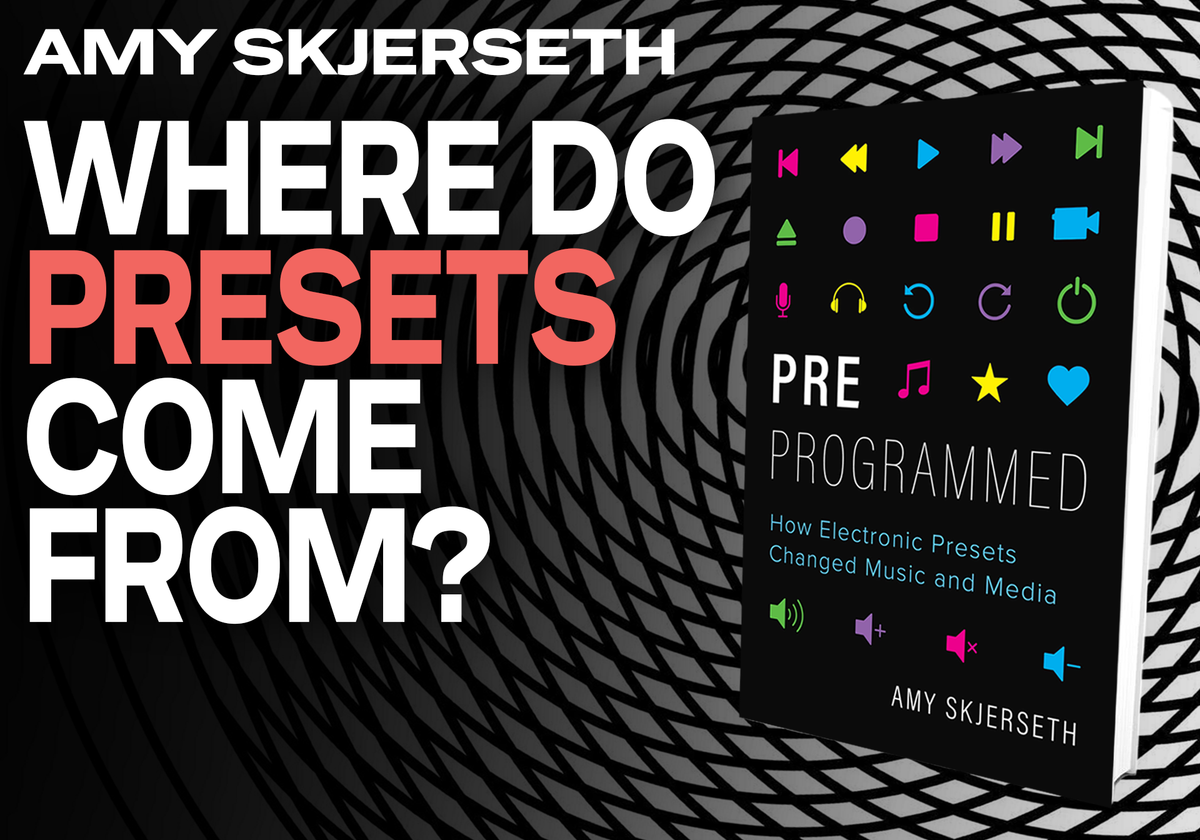
Audio Presets: Creative Friend or Foe? (Amy Skjerseth)
How much of your life is preprogrammed? Presets, or default settings on technology, can be found everywhere, from radios to apps to appliances. A preset is meant to enable the user, but it constrains the user at the same time. According to author Amy Skjerseth, they also reinforce—but sometimes challenge—economic, political, and social norms.
Skjerseth's new book examines the fascinating histories of common presets, with a special focus on audio technologies. Using capitalist, queer, and feminist critique, she shows how, from the popularization of the push-button car radio in the 1930s to the Auto-Tune era and the advent of AI, artists have co-opted preset technologies to reconfigure ways of seeing and hearing and develop new forms of artistic and cultural expression.
Amy Skjerseth is Assistant Professor of Popular Music at the University of California, Riverside, and coeditor of The Routledge Companion to Voice and Identity.
Cited Media:
Books:
Amy Skjerseth - Preprogrammed: How Electronic Presets Changed Music and Media (2026)
Rick Altman - Silent Film Sound (2004)
Paula Harper - Viral Musicking and the Rise of Noisy Platforms (forthcoming)
Ada Lovelace - Notes on the Analytical Engine (1843)
Articles:
Lisa Nakamura - Indigenous Circuits: Navajo Women and the Racialization of Early Electronic Manufacture (2014)
Podcasts:
Hyperfixed - A Button is a Promise (2026)
Phantom Power - Ep. 24: Voice of Yoko (2021)
Phantom Power - Analog Revolutionaries with Theodore Gordon (2026)
Video:
Suzanne Ciani - David Letterman Show appearance (1980)
Clara Rockmore - The Swan (1976)
Performance:
Anna Friz & Jeff Kolar - The Other Spectrum (2025)
Transcript
Intro: SpectreVision Radio.
Amy: Preset is something that creates power. It's something that generates all kinds of creativity, new combinations of these sounds have an enormous amount of cultural power because they have been circulated over time and in different exciting uses, and because they enable people with less capital to create something.
Intro: This Is phantom power.
Mack Hagood: Hey, it's Phantom Power. I'm Mack Hagood. How much of your life is preprogrammed? The technologies all around us feature presets, default settings that are supposed to make life more convenient and efficient. Presets enable us to do things easily, but they constrain us at the same time, raising the question: how much freedom do we give up in the name of convenience?
The question becomes especially relevant when it comes to the technologies that we use to make music and art. Default settings and sample packs help us work quickly, but they also make us sound more like everyone else. And according to my guest, author and UC Riverside professor Amy Skjerseth, presets even reinforce economic, political, and social norms.
This week, we're talking to Amy about her book, Preprogrammed: How Electronic Presets Changed Music and Media. Using capitalist, queer, and feminist critique, Amy studies the rise of the push-button car radio in the 1930s, the era of Auto-Tune, and even the advent of AI, and a whole lot more. She's especially interested in how artists have co-opted presets to change how we listen and develop new forms of artistic expression.
We talk about human agency and identity, enabling constraints, the loneliness of algorithmic microtargeting, and self-optimization culture versus creative friction. Amy's super smart. She's a past producer on this very show. Check out her killer episode on the voice of Yoko Ono. I think you're gonna enjoy this conversation with Amy Skjerseth.
Mack: All right, Amy, welcome back to Phantom Power, and congrats on the new book.
Amy: I feel like your work has influenced me in so many ways, and of course, we've had many conversations over the years, whether it's about the subjects we work on, but also really how to deliver them. So it's really exciting to be back.
Mack: Yeah, it's great to have you back. So I thought maybe we could start off with a very basic question. What is a preset? maybe you can give us an example.
Amy: It is one of those things that is actually everywhere around us in all kinds of different technologies. But the word itself, well, it's not something that's quite in common language. And so a preset is a setting that is installed in advance, hence the pre. And it is installed usually by manufacturers in an attempt to make the operation that it does easier for consumers to use.
So the most popular example, well, at least back when we were watching maybe more movies and TV shows at home and having family popcorn and movie nights, was using the microwave popcorn button. And this of course is a preset that has a specific amount of time that's encoded into it. Depending on how fancy a microwave you have, it might try to sense the weight of the popcorn bag that you have and also sense how many kernels have have popped inside of it. But sometimes back, back in the day, it was just a set time, right? A set time that the manufacturers thought that all of the kernels would be popped in the bag. Well, as we know, if you've ever used that button, you have probably burned your bag of popcorn. Because the the technology is just set up beforehand. it can't adapt to maybe the age of the popcorn bag, if it's been sitting on the shelf for a while or sitting on your shelf for a while. And so that example just unlocks how interesting presets are for thinking about consumers and capitalism and technology.
These manufacturers are trying to guess at what might be the most common use for one of these settings. and usually that use is for the most average user.
Mack: Did you happen to hear the Hyperfixed podcast in early October? They did an entire episode on the popcorn button. a popcorn button when is there all of the popcorn bags say, "Don't use the popcorn button"?
Amy: Yeah. I'm so excited to check that out.
It's one of those things where it is this mystery that, again, it only becomes annoying once we actually are, are using it, and then you forget about it, right? And that's what I think the magic of studying presets is.
Once we kind of stop and think about our uses of them and, you know, try to do some research into how they might have been set up in advance for, you know, the most widespread consumption, then we start to realize, oh, these companies, these manufacturers are making a whole set of assumptions about who the users of these technologies are, even of the popcorn button.
They're trying to guess at their consumer market base. They're doing market testing. but try as they might, they can't solve for all of the variables, that come up in a use of a microwave even, or a dishwasher, or music technologies and media technologies, which is what my book focuses in on.
But I start with this wide view of the preset, and it continues all the way through the book, because I feel very strongly about trying to expand our uses of music and media technologies to our kind of everyday technologies as well.
But even using the radio, right? Using our phones, all of these have presets that have things in common with that kind of assumption that's baked into the microwave popcorn preset as well.
Mack: It's interesting because I suppose anytime anyone creates anything, there's always an imagined use case and an imagined user. So even to take the phenomenologist's favorite thing in the world, the hammer, like the hammer has a handle, so like in a sense that's almost like a preset or even just an old-fashioned radio before presets.
I mean, I remember, you know, as a kid being fascinated that there was a range of frequencies that I could access, and then there was an end to the dial. But of course, that end wasn't where the radio spectrum ended. It was just where my radio stopped allowing me to keep exploring. And so I was always just going to the edges, which it, it's a good thing I did because I discovered college radio out there at a very young age and got turned on to a lot of really cool music. But it is interesting to think that in a sense, I don't know if you would agree with this, but it's almost presets all the way down.
Amy: I definitely agree with that. I mean, once you start following this line of, well, if it's something that's determined in advance by someone else or something else, then is DNA a preset? Right? Is a sunset a preset? It happens every day. And so you can really widen the scope if you wish, but I love your example of radio frequencies because something else I was trying to do with this playful, expansive framing of the preset is to really think about infrastructures and how things end.
So if our radios in our cars or on our sets you know, they have bounds, why do they have those particular bounds, and why are those created? And then of course, we have amazing artists like Anna Friz and Jeff Kolar, who are actually coming to UC Riverside in a few weeks, playing with the other frequencies, right? The other spectrum, as they call it in their work.
And so, I became fascinated with this idea of how we could play with those out of bounds things that the manufacturers, the governmental bureaucracies, the infrastructure builders may not want us to tune into, but that is precisely a site for political subversion.
Mack: A lack of presets has been a real problem for AI use because people stare at that empty box and they're not sure what to do with it. And we've seen with Meta's new AI agent, Muse, it's very, very aggressive. I haven't downloaded it, but I've heard a lot of accounts and read a lot of things about it. But it's very aggressive in constantly kind of tapping you on the shoulder and saying, "Hey, would you like me to do this? Would you like me to do that? What about this? What about this? What about this?"
So, you give it access to your email, and it's suddenly coming up with all of these use cases for you so that you don't get that sort of blank page, I have no idea what to do with this technology effect.
Amy: Yes, exactly. It's one of those things where I think so often in AI agents and in other AI use cases, they're being designed so that they remind you of the human functions that we might desire the most. And again, gender and class come back here because so many AI voice agents, right, from, you know, Alexa to Siri and so on, have that feminized wanting to please design in them.
And so I see this so much in AI agents because they're replicating kind of human ideals of the ideal agent, right? Someone who will help you, but then they also want this additive economy where you're constantly just feeding the machine, right? And so of course they're going to have an AI agent that's tapping you on the shoulder and trying to prompt you and goad you into feeding the beast, right?
Mack: Yeah, there's also something happening there with trying to give us these very human use cases, and get us to feel that this interaction with a non-human agent is actually going to further our human relationships and human desires. So they're always coming up with these examples of like, oh, you write a poem for your kid on her birthday or like, you know, Mark Zuckerberg talking about coming up with baking recipes because his daughter likes to bake or something, and it's just like not really clear why can't you go look at a cookbook or something?
Like how is this actually helping? it reminds me a little bit of an example that you gave where they try to add this sense of the human touch to something, and that's the example of the, pre-made bake mix. Can you talk a little bit about that?
Amy: Well, I have to thank Neil Verma for this incredible example, which actually starts my book. We were talking at a conference and he said, " You've heard this kind of mythology about cake mix, right?" The story goes, in the Great Depression, there was a company called P. Duff & Sons. They're a molasses company.
And so there, of course, were shortages of many other ingredients during the Great Depression, and this company had so much molasses. They had a surplus of molasses, and they didn't know how to entice people to buy it. And so what they did was they came up with the idea of canned cake mix, which of course later became boxed cake mix that lines our supermarket shelves now.
And so they created a use and a demand for all of their supply. And what they did was they enabled customers to make a cake very easily, even given the economic conditions they were dealing with. But also, so anyone could do it. Anyone could pull this off the shelf if they had that money at the time and could make a cake with it.
And so it's really trying to meet the human need of still making something for the family, right? It's very much in our line of conversation where we're thinking about supply and demand. This is a tale as old as time, of course.
Mack: Just like with AI, there was something that kind of turned people off about this automation of something for your family, right?
Amy: Exactly. And so there would be images, you know, of happy housewives using this, and that was their whole marketing campaign. And they would try to sell recipes and cookbooks with it, but you can't really sell a recipe if you only have two ingredients. And so what they did was they had some market testing back when they were trying to first release this canned cake mix, and yes pretty much all of their market testers were housewives.
They reported back that just using the canned molasses and water, was not a satisfying home baking experience for them. And so they actually then tweaked their recipe so that housewives will also have to add eggs and feel as if they were contributing more to the recipe itself.
And so with AI, of course, there is this kind of obsequious nature of chatbots and agents to try and help us with everything. But that is making a lot of people recoil from those systems because it is just too much intrusion. It's too much help, and it's too much predetermination where they feel their agency is constrained.
I mean, we're seeing a lot of Gen Z, right? A lot of my students are saying, "We don't want this. It's taking over too much of our agency." And so with the baking example, we again get the kind of gender, class, all of this is very much entangled in consumer capitalism, but also in ideas of how something that is predetermined really constrains our agency, doesn't let us feel fully human.
Mack: Okay, well, let's turn from edible examples to get into some sonic examples as befitting our sound podcast. So I was interested in one of the examples from the introduction, I believe. When you were about the long musical and media history that led into a setting on the organ called the mood stop.
So could you maybe tell us the story about that? Because I think it really brings a lot of these different social and technological strains to bear that you've been discussing.
Amy: Yes. So if you've ever been to an older picture palace, an older movie house, the Music Box in Chicago has, for example, a theater organ from the 1900s where you can actually go to certain screenings, especially of silent films, and hear this theater organ being played. Theater organs were created for silent film screenings because, as the name suggests, film did not have an accompanying soundtrack.
It didn't have music that went with it as it was being projected, and so musicians came into the movie house, and they actually played music along to the film screening. So there's a misnomer, of course, that silent films were never really silent that Rick Altman talks about in his book, Silent Film Sound and Others.
Mack: And we have an episode with Rick on that book, so if you're interested, check that one out.
Amy: It's absolutely brilliant, and I love studying this history, and I love teaching it to my students too, because as you mentioned, there are direct connections to how people use mood music today in apps, especially TikTok, Instagram, any suggested music that you'll see at the top. If you're playing a silly video of, you know, pets frolicking around, then you're probably going to be using a very kind of silly track, and Paula Harper talks about this in her upcoming book as well.
And so going back to theater organs, they built these for silent film screenings because often when a musician, you know, showed up for work to play for their silent film screening, they may have never seen that film before. And so they would need to quickly react to whatever was being shown on screen.
And gradually, you know, films have action. They have particular genres, right? They have particular moods. If it's going to be a romance or a love story, you can almost guarantee there will be a love theme that will be played at some point. And so this is an amazing material history because it started with print culture.
There were these encyclopedias that had lists of all of the possible themes that you might encounter in a film, and then you can quickly flip to the page where these themes were notated out and play them for the corresponding scene.
Mack: These are like motifs that are meant to represent a particular emotion or a particular situation, or sometimes a particular culture or place.
Amy: Yes, exactly. Everything from lullabies to chase scene music to, you know, mystery, or my favorite is clown or grotesque music. I mean, the ways the ways that these are labelled are just, they kind of are an amazing look back into history in terms of how people were categorizing film and how music could go along with film to help spectators watching the movie feel these emotions.
But yes, as you say, they also come in to represent a particular place, and they often really reduce that place to the stereotypes that we might have in our minds because of decades of media circulating these stereotypes. So for example, also in one of these encyclopedias is the line Mexican or Spanish music which of course is just completely forgetting about all of the different folk musics that can come from multiple countries that belong to this.
And so stereotypes really get circulated because if you imagine you're going to all of these films, and musicians might be playing from the same themes over and over again. And I'm actually doing a project right now on the desert lady voice, which we hear in the Dune soundtracks, which we hear in James Bond.
You hear it across decades, and in part because of these materials that were being circulated to musicians. And then once sound became technologically possible to accompany films, you get that music because people are still looking back to the earlier traditions of how people made and watched films.
Those stereotypes get baked in, and they even get baked into the organ, the theater organ, on the actual stops, the buttons that organists will push to get the right sound so that they can quickly play the theme with the right kind of sound or timbre. And so it's not just print culture, it's also in these organs.
And then the result is we get these sonic stereotypes that are bundled up with visual stereotypes anytime we see a certain scene, right?
Mack: There was a line that you had in the book where you said, "The history of presets in artistic signification is also a history of mood regulation." I thought that was, particularly from my work, the kinds of sound technologies that I think about where people try to use sound to contain or control their, effective state, that was really fascinating to think about the long musical history that also pertains to that kind of work.
Amy: Yes, exactly. Because even when I'm teaching people who have not played an instrument before or have, you know, encountered music, and we encounter music mainly through media and through our friends and through these traditions that get passed down. And so we, really come to think of music as something that tells a story or helps us connect to certain emotions, to help us share emotions.
And so media really relies on a whole kind of encyclopedic knowledge of trying to share these emotions. But it begins to do so in shorthanded ways. Basically, if you're watching the scene, and remember the economic conditions and the technological conditions of early silent film musicians, they had to do this extremely quickly.
They didn't have access to the films. They had to come up with something that was going to help tell the story in as quick a way as possible. And so of course, you know, people will reach for something that can quickly convey that mood or that location. And so you have to think as well, I mean, again, this is the whole concept of the preset, is thinking about the conditions that also go into something to make it so, to make it perpetuate in culture.
They get added, as I mentioned, into Instagram and TikTok. They actually nudge users to add this music. I can't make an Instagram story or post without being nudged to add music. And the next time that you do this, take a look, because it's likely that that music doesn't quite go with what you are trying to post, especially if you like to post a lot of different kinds of things, right?
The algorithm can't keep up with you. It might suggest something that could have worked for an older post that you made, but regulation, I think, is a really important word in this conversation, because the algorithms are trying to look at a past you and a past set of users, right? And this is just AI in general.
It is working from a data bank. it's not really able to aggregate to make something new, to keep up with human creativity. And so I'm still getting nudges to add music that may have been relevant for a past project or a past vacation or something, but it doesn't fit what I'm doing now.
Mack: Well speaking of sound in the future, Let's talk about synthesizers because as we've recently discussed at length, not only with Ted Gordon, but also with Suzanne Ciani, you know, the early days of synthesis, it was a very up in the air thing of, like, what a synthesizer was and how it was supposed to function.
And Suzanne, you know, said to me that Robert Moog ruined the synthesizer by putting a keyboard on it, which is kind of a preset, you know? And so if the synth was such an open system at one point that people weren't even sure what it was or what it was for, or how it was supposed to work, or how you were supposed to operate it. How did it eventually become so defined by presets?
Because I feel like, these days, especially, like, a software synth, it tends to be just, like, a whole bunch of presets, like, in your face, kind of already constraining what you can do with the thing, and that's a feature and not a bug for a lot of musicians.
Amy: Yes, presets are being really pushed towards consumers, and this is any digital audio workstation you use, but especially subscription-based packages like Splice which is a really interesting company, I think, for both sound and image scholars, and is something I'm studying because it has so many prepackaged presets, sample packs.
It's based on a system of subscription but also accruing credits and then spending those credits on the most desired sounds. It's almost like an equivalent to baseball cards, where you get sold this pack, and you're promised that it's the most exciting thing right now, and you might get something really valuable, and your music might be really valuable as a result.
There's a whole bunch of promise contained in all of these sample packs and presets that are really being brought towards consumers right now and highlighted and foregrounded.
Mack: Interesting too, how much of it is visual. That the visual presentation of these software libraries, these software synths, these different packs of sounds or loops, A lot of the most innovative work particularly on some of the software instruments, it seems to me is in the visual interface, and then that the way that they're sold online and, you know, fill up my YouTube and Instagram feed with all this eye candy that, oh yeah, also happens to make sound, but it's almost like that's not the lead, you know?
Amy: It's become something that people need to see in order to acquire for their own and to make their music. "Oh, if I only had that piece of gear, then I could make this sound." It's, the transaction has become incredibly visual. But I think this also leads back to the project of legitimizing synthesizers, which of course, if we go back to the early electronic music, that history that you traced with Ted, so I don't want to retread that ground, but you start with the theremin, you know, an ethereal instrument that you, you play with your hands, and that you have to be able to sense exactly where in the air, in these signals, those sounds and the volume of those sounds are.
And then that concept becomes packaged in consoles that look like organs, to go back to the theater organ, which of course, people who came to see a movie became familiar with. Or an organ, of course, is in a lot of churches and places of worship. And so the organ is this less threatening symbol, just like the piano keyboard on the synthesizer, because people recognize it and they say, "Oh, because it has a keyboard, it must be a musical instrument."
I love Suzanne Ciani's response to David Letterman in this 1980 demonstration where she was invited on and David Letterman doesn't really know what to do with her music, and her demonstration of all of these incredible technologies. He just wants to kind of play around with the voice distortion technology, and then also to have her make the noise that sounds like in his words, "The whole building is going to come down around us." Which is basically like the THX sound.
Suzanne Ciani: Ready? Yeah. Oh, yeah.
Wonderful.
Amy: But the way that, that episode is framed and the way that so many demonstrations are framed is visually, right? So she's going over to the microphone she's switching off the distortion technology, and then she's going and encoding the THX-like sound, right? But it's made less threatening to viewers because it's being controlled by these button.
It's being called up, right, within the black box of technology. But people see the interface and they go, "Okay, so this sound has a visual source."
Mack: You have an interesting feminist reading of the role that these demos play. And also just in a wider sense, the role that women played in building from the ground up the kinds of sounds that would eventually become familiar to us as presets. Can you maybe talk a little bit about that dimension, and maybe also the sort of dimension of your book, the sort of feminist and queer theory reading of the preset that you have?
Amy: I'm deeply inspired by work on early computing, especially Lisa Nakamura's work on women Navajo weavers who were brought in by tech companies to hand wire, hand create circuit boards. She has this incredible article and a couple different versions of it online that show deeply how those skills of blanket weaving were called upon in order to do the intricate work of wiring and placing circuit boards.
So I'm really inspired by this feminist reading because in the history books, we always get told that, you know, it's the men who are the brainchild behind this technology, and you never actually see the people who are laboring to make the components of this technology work.
And very often, it is women with incredible skill base. It actually even goes back to weaving even before these 20th century women. It goes back to Ada Lovelace and the analytical engine that Charles Babbage was designing, which becomes early computer. Her suggestion of the similarity between weaving patterns, which was essentially binary code, zeros and ones, that idea came from the skills practice of weaving.
And so this incredible observational power and being able to translate the labor behind something that is considered domestic, but actually translating that up and getting the computer out of it, or the weaving practices that gave us computing power. All of these infrastructures, but not only the literal infrastructures, but the thinking behind, the conceptualization of these infrastructures came from women and from people who were devalued in society, who have been exiled or pushed out from society, are actually the ones who have built our modern society, right?
So then translating that to electronic music and musical instruments, it was Clara Rockmore, the violinist, who demonstrated the theremin. Because her skills as a violinist, which when you've seen a violinist play, their fingers are moving incredibly agilely and nimbly across that instrument.
Amy: But they had to learn exactly where the notes are on the strings. There's not a visual guide unless you're first starting out, and when I first started on violin, you actually put tape underneath the strings so that you know where the notes are, almost making it like a guitar or like a piano keyboard.
So Rockmore was able to visualize sound through this invisible instrument, the theremin, in part because of that training as well. And then in turn, translated that ethereal instrument into something that could be used for all kinds of things, for horror films especially. It's kind of spooky sounds. You'll hear them all over the soundtrack of Loki, for example.
And women are doing a lot of this translation work and using instruments that might not be familiar, but suddenly do become familiar to general audiences because of the uses that they dream up for them. Translation work is, of course, something that requires an incredible amount of skill, and It's a risk, right?
To be the first person to bring something new into musical vocabulary or even into any of the arts. And this is something that a lot of the queer artists I write about in the book are doing as well. They are dreaming up new uses of technology to come up with a way to express something that is non-normative, that is something that is exiled from society.
They're coming up with ways to express that and to introduce it back into art forms so that they can find ways to not only express themselves, but also to create a political gesture of presence and of importance and of things that have become the cornerstone of many artistic movements, but also tracing back from the history of early computing society itself.
I think the book gives us, like, a very compelling and convincing history of how sometimes these presets are made with a particular use case or particular type of person in mind, that may not comport with the needs of other types of people or, you know, that sort of thing. I wonder if don't have almost an opposite problem in today's society, which is that now there are... And in many ways, this is a really good thing, right? There's been a democratization of presets, I would say. But that it's become so widespread, so predominant that we're kind of encouraged to think of ourselves as a subculture of one, that there's just, like, a perfect preset for every snowflake individual, and that we're encouraged to identify with what makes us a unique individual and maybe not think of ourselves as part of a group or something larger.
And I think that's sort of the logic of our algorithmic feeds. It's really good for capitalism because the more you can break a market into little segments and you can target it and really sell more to it. But I wonder, you know, and just to sort of expand on this, like, I just feel like in my classes, I'm increasingly seeing students who are buying into the idea of difference so deeply that they're afraid to even attempt to speak across it.
And that they find the whole landscape of identity so treacherous, and I wonder if it's because they've been so micro-targeted and so encouraged to think of themselves as being part of some little subcategory that has its all these presets made for it that they just almost feel like, "Well, how can I relate to everybody who's not in my preset?" So, I don't know. I just conflated a whole lot of things, and maybe that question is, like, a little too crazy and expansive. I was ... It's a little bit off the cuff. But I wonder if, any of that speaks to you.
Amy: I love the potential conversation fodder that this concept might start because it can get deeply philosophical. I mean, is time a preset? Is a calendar a preset? Actually, these things are prefigured by technology, the sundial, right? Different versions of the calendar that actually do try to set things up, and then now become these huge, expansive concepts that we think about.
And while one subscribes to in a culture, there are, as we know, so many ancient ways of telling time or affixing time to a calendar. And so I think there is this constant tension between an individual and a society. How do you expand something so that it fits one point of view to a whole bunch of different people?
And that's what we get with algorithmic culture. But I think also we are absolutely flooded and saturated with this market. The cake mix mythology has gone from that version of supply and demand to just endless supply and trying to manufacture a demand, which theoretically, again to go to our conversation with AI companies wanting us to, you know, get in tune with our family more by these uses that encourage us to make a recipe or a video.
But, but now there are so many options so many different buttons to press and different streams to surf, and there's so many options that we are completely flooded with and losing senses of intentionality and agency and humanity even. And I think that it's created an echo chamber, of course, politically, as we have seen, where difference is something that is deeply politicized and prevents people from being able to speak across the aisle.
But we see it just in our individual lives because this echo chamber that we have politically is, is also here. This is an echo chamber as well, and it's something that even the language of TikTok's for you, even the idea of a personalized algorithm makes us think that, oh, we have been so circumscribed as individuals that this is who I am.
We've also been sold this idea of uniqueness, and this is something that voice studies has actually looked into deeply, the idea of our voice as our individual signature of our person. So I get into this a little bit in my book too, thinking about Auto-Tune and examples of purposefully manipulating your voice with technology to sound like something else, right? It's additive. It's not trying to drill down into the one perfect idea of what one person's unique voice sounds like. But that's what people are so threatened by with Auto-Tune is kind of destroying that idea that one person's voice is fixed and stable.
So to go back to algorithmic culture and our classes and society in general right now, to speak very generally, I see this idea of we're being sold so many technological tools and solutions to make us drill down and spend more time on that screen, spend more time on those feeds. And again, the language is so purposeful here, the feed.
Just keep feeding that idea of extreme individualism, so that we can be completely controlled, that we can be alienated, that we have no choice but to follow along with a more general feed that's happening around us. So it's a little dystopian, but we do have so many options and choices and presets that we're being completely flooded with.
It's deeply economical. It's deeply capitalistic, as you say. To go back to the example of Splice even, you have to have money to have a credit, right? And you have to have a credit to buy a sample pack or a preset. And so that then encourages you to spend as much money as possible so that you can obtain the perfect preset for your use.
But the flip side of that is this subscription-based model and royalty-free sample company means that people who create these samples often are alienated from their labor in the song that you might use their preset from. and they're alienated from those proceeds too. So, there's a whole bunch of, kind of catastrophic alienation that is happening in these economic structures and models of presets that are deeply connected. The CEO of Splice was in Photoshop and Adobe and GitHub as well. And so in music technology, we need to pay attention to what's, happening there, but not for the reasons that they tell us.
You know, they tell us, "Oh, the most exciting developments are in music technology," but it's being connected as well to algorithmic culture in a way that, "Oh, it's just music. It's just vibes. It's just exciting to listen to. It's just someone's emotion." But no, it's deeply alienated labor that is, taught to us through a system of massive accrual and capitalistic spending, but is actually taking us away from the people and the places who created those sounds in the first place.
Mack: Yeah. I have mixed feelings about it because my younger son and his friends love to make music, and they're always rapping, and for a while there he was making his own beats, but lately you know, he's been more into the FL Studio and like, all these, you know, what I would call store-bought beats or whatever.
And, and the, the sound quality is way better, you know, and the beats are pretty great, right? But then I'm like "Oh man, shouldn't you be making your own beats?" But then again, I'm like, "Well, isn't that just some kind of like conservative notion of authenticity that I have that like," you know there's been all kinds of great music, like the examples of the drum machine in your book that where like really great music has just been made with just the off-the-shelf preset beat, you know? And so I'm always like debating this little thing in my mind.
Amy: I will join you on that debate because it's something that I think we need to think really carefully about as cultural critics. Of course, there are all kinds of uses for presets, and I really do advocate in the book that preset is something that creates power. It's something that generates all kinds of creativity, new combinations of these sounds, no matter how lo-fi or recycled they are, have an enormous amount of cultural power because they have been circulated over time and in different exciting uses, and because they enable people with less capital, be it economic or cultural, to create something.
And so it is a very good thing that we have presets, and I wish there was more acknowledgement, especially on the hand of companies like Splice and especially AI, right? AI companies that are just buying all of our cultural texts and then destroying them. We need to come up with a citational culture as we see in hip hop, as we see in other art forms that do try to hang onto the long tail of citational practice to give people credit, to name them.
Mack: The other piece that I don't like about the presets and off-the-shelf beats and loops and so forth the way that they get tied into this culture of self-optimization, and it all becomes this discourse of efficiency. And I see this in, like, YouTube videos and reviews and all over the internet where it's this discourse of, like, "How can we get this music-making over with as quickly as possible?" I'm like, "Wait a minute, what was the fucking point." Like, it's fun to make music. What are you doing? Most of us are not making our living off of this, right? Like, aren't we here to have fun and have a good time? And, like, why on earth would you wanna get this over with as quickly as possible?
And I just think a lot of times people have kind of, you know, lost the script there. On the other hand, again, like, if my kid can just slap a beat down really fast, you know, he and his friends can start rapping about what's going on at school, and get to that fun part fast. So again, I don't really wanna have one preconceived notion about this one way or the other, but to the degree that people treat music as something to be optimized away, I'm not down with that.
And especially when you're that asshole Suno CEO who's basically like, "Why would you wanna make music to begin with? Like, you should just press a button and have it be done. What's all this skill and practice? Nobody wants that." It's like, no, actually, a lot of us want that.
Amy: Same thread. I was going to bring up that quote. So I am on the same page as you, and you know, truly it is immensely complicated because there's a podcast interview actually where the CEO of Splice brings up this quote, and her whole thing is Suno is push-button generated music.
This is the focus of my article, you know, thinking about AI, whether it's assistive or generative, what is the push-button function, and what does it do to the optimization of music? And so the CEO of Splice says, "Musicians don't want that. They don't want push-button generation, they want to wrestle with it.
They want to bring in their skills and their instruments and everything they learn." And you know, going back to some of my earlier examples, you can't get the theremin played unless you have a sense of, okay, where is this note? How do I find it again? You know, that struggle, that friction of learning to play an instrument. There's also the same kind of struggle and friction that's wrapped up in learning to swim through a sea of samples and find the one that delights your ear and your mind and your heart at that point in time.
So yeah, I absolutely don't want to reduce the debate down, but I find it fascinating that this discourse of self-optimization is trying to clamp down on that whole process of friction and discovery. Why? So that they can make more money, they can produce more. But, Yeah.
Mack: But when it comes to Suno VS Splice, I almost feel like Splice is just like, "Oh, well, we'll let you crack an egg and put it in the mix." And like, it's trying to make us feel like we have more agency or creativity.
Amy: No, I completely agree, and that's what I'm arguing, is just the continuation of the cake mix, and it's just sort of, you know, opening up the waters a little bit more so that people can feel that they have more agency. But it's, credit system, it's lack of credit to creators even though it claims to.
Again, it's constantly, forgive the pun, trying to have its cake and eat it, too. And so we have to be very wary of all of these companies that are claiming to let us be as efficient and quick at making something as possible. Move fast, break things. I mean, there's the whole ideology that we need to very intentionally confront, and it's something that I think so many critics and musicians are trying to do, to try and get back to the low end of the frequency, the things that are beyond what is commercially mapped out for us to be able to develop our own senses of what is right for us.
Self-optimization is an enforced view, an algorithmic view of what is right for us. It's containing us. Again, it's containing a picture of who we are.
Mack: Well, the book is Preprogrammed: How Electronic Presets Changed Music and Media. Amy, thanks so much for talking to me about this book, and again, congratulations.
Amy: Thank you so much, Mack. It was a pleasure, an absolute blast.
Mack Hagood: And that's it for this episode of Phantom Power. Huge thanks to Amy Skjerseth for being on the show. As always, we've got bonus content with Amy for our paid members, and we've also got our free newsletter and our free e-book on creative listening called Nothing is Background. Learn more about becoming a paid member or a free member of Phantom Power at mackhagood.com.
That's mackhagood.com. And please remember to subscribe at YouTube, Spotify or your podcast app of choice. Today's show was edited by Cameron Naylor. Images and social media by Abe Hagood. I'm Mack Hagood. Take care, and we'll talk again soon.
