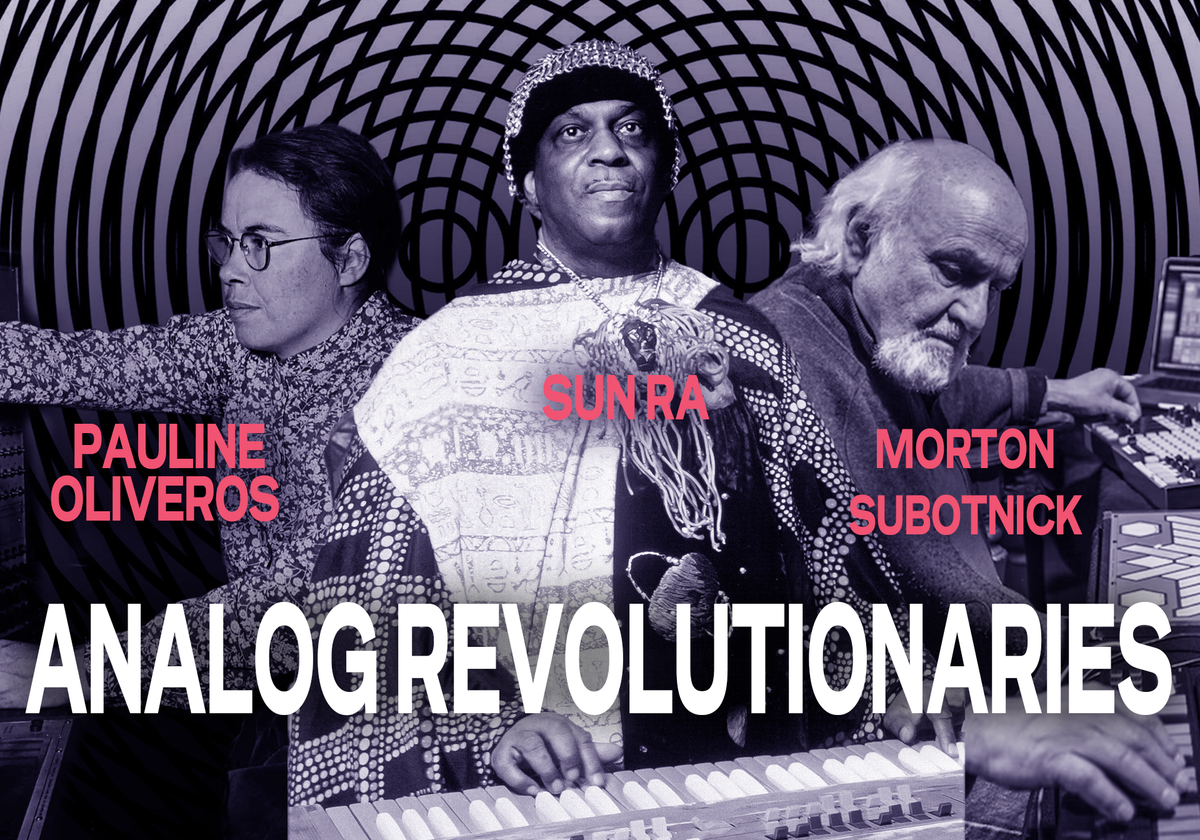
Analog Revolutionaries with Theodore Gordon
Theodore Gordon is a musician, musicologist, and scholar of science and technologies studies. He’s interested in the mystery of the black box of audio technology. We know that there are inputs and outputs in this now ubiquitous music technology, but whatever happens in between remains mysterious and unseen.
In this episode Ted and I explore how this black box has allowed musicians to imagine synths in revolutionary ways, by discussing three visionary musicians who had very different ideas about technology in the 1960s and '70s: Morton Subotnick, Pauline Oliveros, and Sun Ra.
In Phantom Power news, we have just released a new free digital zine! It's called Nothing is Background: Experimental Artists and Thinkers on Sound, Attention, and the Resonant World.
It features portraits of 16 guests from past Phantom Power episodes who have shared their ideas an inspirations exclusively for this zine. Whether you’re a musician, sound scholar, or casual listener, I think you'll find a lot of inspiration here to deepen your sensory contact with the world in this era of digital discontent.
Subscribers will have already received an email link to download the zine for free, and if you are yet to subscribe, and want to get your hands on a copy, you can pick it up for free Nothing Is Background.
And finally, in celebration of the release of Nothing is Background and Phantom Power at Talk Low Festival, we are hosting a limited time giveaway of a hat and shirt of your choosing from our fantastic merch line on the Phantom Power store!
You must be subscribed at any level, free or paid, by October the 31st to be automatically entered to win, so if you aren’t already, you can subscribe to Phantom Power here.
Cited Media:
Music:
Lejaren Hiller & Leonard Isaacson - Illiac Suite (1957)
Karlheinz Stockhausen - Gesang der Jünglinge (1956)
Morton Subotnick - Silver Apples of the Moon (1967)
David Behrman - New Sounds in Electronic Music (1967)
Wendy Carlos - Switched-On Bach (1968)
Roland Kayn - Cybernetics (1969)
Gershon Kingsley - Popcorn (1969)
Sun Ra - My Brother the Wind (1970)
Sun Ra - Nuits de la Fondation Maeght / The Cosmic Explorer (1971)
Pauline Oliveros - Reverberations: Tape & Electronic Music 1961–1970 (2012)
Books:
Theodore Gordon - The Composer's Black Box (2025)
Norbert Wiener - Cybernetics (1948)
Thomas Patteson - Instruments for New Music (2015)
Louis Chude-Sokei - The Sound of Culture (2015)
Andrew Pickering - The Mangle of Practice (1995)
Sun Ra - The Immeasurable Equation (1972)
Abraham Moles - Théorie de l'information et perception esthétique (1966)
Articles & Papers:
Claude Shannon - A Mathematical Theory of Communication (1948)
Film:
Sun Ra - Space is the Place (1974)
Transcript
Intro: SpectreVision Radio
Theodore: It's a composition that you can't understand. It's an unknowable, illegible composition that emerges in this moment of performance.
He's articulating the universe. He's articulating the infinite, right? He's showing you something that, you can't solve, and he's just doing it live.
Intro: This is phantom power
Mack: Welcome to another episode of Phantom Power, a podcast about sound. I'm Mack Hagood. What is a synthesizer? Like so many powerful objects in our technological world, most of us both know and don't know the answer to that question. We're familiar with the sounds the synthesizer produces, but most of us aren't exactly sure how those sounds are created.
This is true not only of casual music fans, but even of many people who use synthesizers all the time. Like other audio technologies, synths function as what scientists call a black box. We know that there are inputs and outputs, but whatever happens in between remains mysterious and unseen. My guest today is Theodore Gordon, assistant professor of music at Baruch College and the Graduate Center at the City University of New York.
Ted Gordon's a musician and a musicologist, but he's also a scholar of science and technology studies, or STS. More than most people, Ted understands what's going on inside the black box of audio technology, but he's actually more interested in the mystery of the black box itself and how that mystery has allowed different musicians to imagine synths in different revolutionary ways, changing the musical landscape in the process.
In particular, we're gonna discuss three visionary musicians who had very different ideas about analog technology in the 1960s and '70s: Morton Subotnick, Pauline Oliveros, and Sun Ra. Ted's new book is called The Composer's Black Box: Making Music in Cybernetic America, and we'll meet Ted in a moment.
But first, I have a whole bunch of exciting Phantom Power news to share with you. First, last Thursday through Sunday, Phantom Power was at the Talk Low Music Festival. Organizer Ryan Hall of Whited Sepulchre Records created another inspiring event here in Cincinnati, attracting attendees from as far away as California and staging amazing performances by groups like Horse Lords, Pink Siifu, Múm, who came all the way from Iceland, and an incredible Rachel Grimes chamber music show, and also just so much more.
Phantom Power had a table there. We got to meet a bunch of listeners and make a lot of new friends, and I just want to thank Ryan for what he's doing and for helping show the world why Cincinnati might be the most underrated city in America.
Second, I am so excited to announce that Phantom Power has a new free digital zine that you can download right now. It's called Nothing is Background: Experimental Artists and Thinkers on Sound, Attention, and the Resonant World. Nothing is Background features portraits of 16 amazing guests, links to their past Phantom Power episodes, and their ideas, and the inspiration that they've shared with us exclusively for this zine.
We're talking about performers like Robin Miles, the great audiobook narrator, Gabriel Mindel from Yellow Swans, Lawrence English. We got theorists and scholars like David Cecchetto, Maura Mills, and Marie Thompson, sound artists like Kate Carr and Hildegard Westerkamp, and a whole lot more.
There's an introduction written by yours truly, and the point of the whole thing is to just prick up your ears. Whether you're a musician or a sound artist or a scholar or just a casual listener to this show, I think you'll find a lot of inspiration here to deepen your sensory contact with the world in this era of digital discontent.
If you're a subscriber to the free Phantom Power newsletter, you should have already received a link in an email to download Nothing Is Background for free. If you're not yet a subscriber, go to mackhagood.com/nib. That's mackhagood.com/nib for Nothing Is Background, and you'll get the zine.
I wanna thank my student, Sarah Frosch, who worked on this for an entire semester, and my son, Abe Hagood, who worked on it all summer. And finally, I wanna thank Julia Warner of Cincinnati Cereal Box Studio for the beautiful final design of this thing. I love it so much that we might actually make a physical zine out of Nothing Is Background.
And finally, in celebration of both the Talk Low Festival and Nothing Is Background, I'm doing a Phantom Power merch giveaway. I don't talk about this nearly enough, but we have some killer hats and shirts. If you go to shop.mackhagood.com, you can take a look at them.
And we'll be giving away a hat and a shirt of your choice. If you're subscribed at any level, free or paid, you will already be entered to win. And if you're not yet subscribed, again, just go to mackhagood.com/nib by October 31st to enter and get that free zine and be entered for the merch giveaway.
All right. That's all the news I've got. Let's get into my interview with Theodore Gordon about Morton Subotnick, Pauline Oliveros, and Sun Ra. As always, there was way more conversation than we could fit into our free episode under an hour. Paid members will hear the full 90-minute-plus conversation, where we talk about Don Buchla taking LSD with Hell's Angels, and Pauline Oliveros' queer Tejano identity and how it affected her music, and Sun Ra's really interesting philosophy of nature and discipline.
Thanks as always to our paid members, and I hope you all enjoy this conversation.
Hey Ted, welcome.
Theodore: Thanks so much for having me. Excited to be here.
Mack: So let's start with the title of your book, The Composer's Black Box. what do you mean by that?
Theodore: Well, I kind of shamelessly actually stole this from Morton Subotnick with his blessing. I could give you the answer of what I mean by that and then maybe what he meant by that 'cause it is a little bit different. What I mean by the composer's black box is a kind of new technology that emerged in the 1960s, that seems to kind of be everywhere in American society, namely, a black box.
A kind of a new electronic device that you didn't really have to know how it worked, but it promised to make something easier for you, to kind of obscure and hide complexity, and to, you know, simplify a complex task, into, like input and output.
You know, so we had like, electric eyes on everything on cameras and cars. We have thermostats, all these kind of new electronic technologies that used electricity and new technologies like the transistor, to like simplify things.
And when musicians kind of encountered that promise, they really took it in different kinds of ways. And that promise is like one explicitly that's embedded in this kind of moment, this information age moment of information theory, cybernetics kind of being everywhere in American society, and really kind of global society.
So some musicians were experts, and they were following the discourse. They were reading experts like Claude Shannon, information theory. They were reading experts like Norbert Wiener, who wrote about cybernetics in 1948. And they tried to really explicitly implement the ideas from information theory and cybernetics, that is to say, self-governing informational systems in music.
So think of, for example, Lejaren Hiller at University of Illinois Urbana-Champaign. He's reading Claude Shannon, he's reading Norbert Wiener, he's reading this French information theorist, Abraham Moles, in French, who's writing about how to kind of think about aesthetics, in informational terms.
And he has the ILLIAC computer at Illinois, and he makes a kind of a software program that kind of automates the composition of common practice music. And makes all these amazing scores, and they're algorithmically generated. And, you know, he's really trying to kind of in a good faith and very precisely translate concepts from science and technology, techno-science into music.
So that's one way that you could imagine a composer's black box. The computer becomes a black box. You input some data into it, some conditions and some rules, and it outputs the score. And then of course, later in the '60s, there are so many well-known examples of composers trying to do cybernetics in music.
You have Roland Kayn, who, you know, titles his pieces "Cybernetics." You have Gordon Mumma, who makes, like, cyber sonic music, and he has all these black boxes. And David Tudor, of course, who makes tons of black boxes. What I'm trying to do with The Composer's Black Box is something different, which is to say, I was trying to kind of put my finger on encounters with these kinds of technologies by musicians who didn't actually know what they were doing and didn't think that what they were doing was information theoretical or cybernetic in the first place.
They're kind of encountering these technologies, and those technologies, instead of amplifying ideas about systematicity, self-regulation, you know, information, they're amplifying kind of more deeply seated ideas about expression, communication, musical agency, performance, embodiment, sensation. And that's what I was trying to kind of put my finger on with that title, "The Composer's Black Box," 'cause You know, it's underdetermined. You could arrive at a black boxed system from so many different angles and situations. So that's what I was trying to do with the title, Composer's Black Box, by stealing it from Morton Subotnick. Morton, if you're listening, thanks.
I mean, thanks for everything, but also thanks for the amazing phrase.
Mack: And for most of the figures that we meet in this book, the black box is the analog synthesizer, right?
Theodore: Yeah, it's some kind of electronic device, and it wasn't necessarily a device that they imagined would synthesize sound.
That actually wasn't really the objective or, like, the output stage for these, what I'm calling these kind of black boxed technologies or black box techniques really.
It was analog, electronic technology. It was, integrated circuits, transistors, oscillators, tape.
Mack: And this was a type of music technology that in a sense was poorly understood enough that people could invest a lot of ideas and utopian ideas into this black box technology, right?
I'd like to get to first is just to think about this moment in history. It's not like electronic instruments didn't exist back in the 1940s, right?
Like, there were organs, there were other kinds of electronic keyboards. So before we meet some of the characters and some of the very like early analog synthesizers that we're gonna discuss, can you maybe just talk about what at least the perceived difference between an organ and an analog synthesizer would be?
Theodore: Yeah, sure. so there are electrical, musical instruments that at least in the kind of like Eurocentric, historical imagination, that go back to the European discovery of electricity in the 18th century. And there are plenty of, operationalizations of, cutting-edge research in electricity, electromagnetism in music throughout the 19th century and early 20th century.
So we have, of course, the famous examples of like the telharmonium, Thaddeus Cahill's giant, You know, it took up an entire factory and it had these big cog wheels that made fluctuating waves of voltage that were transmitted in telegraph lines or telephone lines.
And, you know, electric organs had existed also since the 1920s. And you know, there are composers who are kind of working with electronics. In the early 20th century, there's tons of instruments. Thomas Patteson's amazing book, Instruments for a New Music, which came out about 10 years ago, goes into the history of many of those and the kind of social consequences of that.
What happened in the 1960s in particular was two things. One was that Harold Bode published this article in 1961, I hope I got that date right, which theorized what he called a new type of electronic musical performance. Now, the difference here is between electrical and electronic, right?
Electrical uses electricity to amplify something that already exists. So let's say you have a small fluctuation in voltage caused by a rotating cog, like a tone wheel in a Hammond organ, for example. Electrical amplification will just make that louder. But electronic instruments use electricity as an informational signal, to turn something on or off, to scale a control parameter like frequency or amplitude, right?
Or, you know, the amount of signal going from one point to another in a system. So Bode publishes this article that basically theorizes that you could interconnect different electrical apparatuses and control them electronically with voltage. And you can do this with operational amplifiers, right?
Transistorized op-amps. And people around the world, it wasn't just, you know, Don Buchla and Robert Moog. I mean, it was Peter Ketoff in Rome, it was Peter Zinovieff in the UK. Hugh LeCaine in Toronto. I mean, any engineer who was reading the Journal of the Audio Engineering Society read this article and thought, "Oh my God, yeah, voltage control for musical instruments. Great."
So all of a sudden, we had the kind of systematization of different technical instruments like oscillators, switches, ring modulators that Harold Bode also invented, that allowed you to make a system that used electricity as an informational signal to control parameters of that system rather than just the electricity being the sound, right?
So it's a shift from electricity being sound to electricity being information, and that's a really consequential shift. I mean, now, you can conceptualize a musical instrument not as an acoustic instrument, but an informational instrument. That is to say it processes and outputs information as, you know, electrical signal that just happens to be sound, right?
Mack: Right, exactly. And I definitely want to get more into the sort of musical and philosophical implications of that, but maybe we can stick with the history for a little while.
So, can you talk about, you know, where your book begins, which is the San Francisco Tape Music Center?
What was that and, who were they inspired by? And then we can get into the invention of the Buchla box.
Theodore: Yeah, for sure. So the Tape Music Center really started with Ramon Sender, who was a young composer and he's in San Francisco from 1958 onward, basically. He is studying at the San Francisco Conservatory of Music and also at Mills College, with Darius Milhaud. And, he basically encounters, tapes of European avant-garde composers, Stockhausen, right?
You know, radio stations aren't playing this music yet. I mean, KPFA would very quickly play that music in the '60s. But so he gets tapes because he's a composer, he's at conservatories. He wants to do something like that, you know, like the Gesang der Jünglinge, and he doesn't really know how to start.
And luckily for him, you know, by the late '50s, early '60s, there is just tons of material surplus of 50 years of American investment in telecommunications. We have the two world wars, obviously. We have the railroad and telephone company just kind of constantly making new products and making their old products obsolete, so you have to buy the new thing.
So he's in the Bay Area, and he starts, basically a studio, electronic music studio in the attic of the San Francisco Conservatory of Music. He got an old piano soundboard and turned it into like a reverb plate. You know, he put like a speaker on one side and a contact mic on the other side, that kind of thing.
Meanwhile, there's another composer in the Bay Area, Morton Subotnick, who is also kind of interested in and invested in this new dawn of informational technology. Subotnick had encountered it through the Princeton Seminars in Music, which was supposed to be kind of like the American answer to the Darmstadt Summer School in Germany. It brought together many experts, including Milton Babbitt and John Tukey and, you know, mathematicians, technologists. They taught them about information theory, they taught them about the RCA Mark II sound synthesizer, which was in the process of being moved to Columbia University.
So Mort kind of like knew that something was big on the horizon, and he wanted to make electronic music. People were asking him to make electronic music, and he couldn't because he didn't have any tools. I mean, he could afford like a one-track tape recorder. And you know, some of his earliest electronic music is just essentially what you could maybe call musique concrète, music that is sounds recorded onto tape and then mixed with live ensemble performances.
So, Subotnick went to a concert that Ramon Sender was holding with Pauline Oliveros at the conservatory. He saw that Sender had all these, like, tape machines and stuff, and they were doing all kinds of crazy stuff. Like, they would throw a brick in a washing machine and have it, like, self-destruct, You know, like, kind of like Fluxus-informed, spectacular sound performances. They pooled their stuff together while Pauline was away 'cause she had won this big international award. They formed the Tape Music Center, and they called it the Tape Music Center because they didn't want to align themselves with any kind of musical style, but instead they wanted to valorize the technology of tape.
Mack: Let's get into the role that the San Francisco Tape Music Center played in the creation of Don Buchla's form of…
Theodore: Yeah. Yeah, for sure.
Mack: So, you tell a great story about Morton Subotnick having a desire, a dream of a certain kind of, sort of a black box instrument, right? Can you talk about that?
Theodore: Yeah, I mean, basically the way that Mort often recounts this is that he envisioned a composer's black box. I mean, he was hearing all these promises, in the kind of techno-scientific world around him, and he thought, "Well, why not have that for music?" You know, why not have a black box that can simplify all this tedious tape splicing and oscillators, and it's, like, such a pain in the neck?
And Mort was thinking, "Why not make a composer's black box, a kind of an analog computer for music where I could kind of input my desired parameters and it would kind of output something that was more than just a score. It was like a performance and a sound piece and a kind of a sculptural object that just was directly from me into the sound," right?
The black box would kind of simplify, and mask all those intervening steps. Write a score, have a performer perform it, critique their performance, record it on tape, you know, all that stuff. So Subotnick's fantasy was really this composer's black box, and he remembers putting out a classified ad, you know, looking for an engineer to build it.
Meanwhile, across the bay, Don Buchla is a young, essentially hippie, before the term was coined in 1965. He's in the East Bay. He's kind of, like, doing all these amazing experiments with biometrics. He's, like, an engineer who has been hired by NASA, like one of the experiments he was involved with was to generate quantitative data about animal life in extreme environmental conditions.
This is to prepare for going into space, like manned space flight, right? So Buchla has all this experience. He's, like, implanting sensors into rabbits, and then they're going into vacuum chambers, or extreme temperature environments. He's building these prosthetic devices for the blind that use, like, cutting-edge components like light-emitting diodes, which were, like, brand new at the time, right?
So Buchla is there, and he's, like, going to the parties with the Hells Angels at Timothy Leary's house. He's embedded in this kind of, like, Californian psychedelics culture, and he also has expertise in computers and biometrics, turning, animal phenomena into electronic signal.
And then, the flip side of that is you could read the signal, but maybe you could also write the signal, right? Maybe if the animal is in some way a computational system, an informational system, maybe you could use some kind of technology, whether that's chemical, like LSD, or electronic, to change that animal's behavior and maybe the mind of the animal, like the human mind.
Mack: And this is really conjuring a term that you used earlier, at the very beginning, cybernetics. This idea that between the animal, human, and machine that the substrate, so to speak, of the materiality of those three things being different doesn't really matter, right?
Because information is the thing that can flow between all three.
Theodore: Right. That is the ideology that underlies Buchla's designs and also kind of Subotnick's fantasies also. The idea that creativity could be immediately expressed through electricity, right? That posits that thought, cognition, is itself a kind of an electrical phenomenon.
And this is a pretty common understanding like in cognitive science, for example, right? All the ways that you can measure and make data about cognitive activity, are about brainwaves. So you measure it through electroencephalograms, right? So, in an interesting way, and this gets back to the opening question you gave me, both Morton Subotnick and Don Buchla were operationalizing cybernetics and information theory without making it spectacularized.
Like, Don's instruments weren't like, "Oh, this is a cybernetic instrument." You know, "This is gonna kinda automatically allow you to make music." And Mort certainly was not about a composition at all. The thing that would be automated wouldn't be creativity or thought.
The thing that would be automated would be expression, getting it from your mind into electricity, right?
So that's the difference between, like, a kind of a spectacularization of cybernetics that so many other people did, and what was happening here, which is that both Subotnick and Buchla are taking the basic premises of cybernetics, and they're making these, like, really weird and idiosyncratic systems and techniques with them.
Mack: So Subotnick wanted to minimize the friction between individual's creativity and then its sonic expression.
What did he actually get from Buchla? Like, what was the technology that he received?
Theodore: Yeah. So, Buchla hears that the Tape Music Center has a three-track tape machine, which is rare, and he, like, goes across the Bay to use it. And, again, the anecdote, which I don't know if it's true or not, is that Mort assumes that Don had read his advertisement and was like, "Oh, you're the engineer who saw my ad. Great. Build me the composer's black box."
And they were working together for, you know, about a year, kind of discussing what the instrument would be. So what Mort recalls doing is, like, requesting modules that would allow him to input serialized parameters, like pitch, articulation, rhythmic values, dynamics, all these kind of like classically, you know, musical parameters.
Don says, "Okay. I've made something like that before. I'll do it. I'll do it." But then what Don delivers is something kind of really radically different. And what Don really makes is a centralized analog electronic computer that can control every other peripheral device in the Tape Music Center.
So, for example, he makes this thing called the sequencer, the sequential voltage source. And there's a separate timing pulse generator which generates a little pulse, on or off, you know, start. And they had a cartridge machine, tape cartridge machine made by Viking.
If you work in radio, you've seen these before. These are these endless loop, you know, you plug the cartridge in, right? So, it had 10 tape heads in it, and the dream was we can automate splicing between tapes if we have 10 tape heads and 10 tape loops, we can make a device where we can sequence values like speed, amplitude, with the sequencer. Like, the speed will be the first voltage value, amplitude will be the second voltage value. We can trigger it to be on and off. When it hits that step in the sequencer, it will turn that tape machine on, and then when it goes to the next step, it'll turn it off or something.
And then he made this touch-controlled voltage source with 10 little capacitive metal plates on it so that when you touch the plate, it would turn the tape machine on. And then it would decay after a certain amount of time. And then you could specify different values on the touch controller.
Like, you know, it just had, like, voltage one, voltage two, maybe that could determine tape speed and amplitude or something, right? And then once you have the timing pulse generator, you can automate that. You can have it go in a loop. You can have one step of the sequencer trigger the step of another sequencer, so you can have kind of asymmetrical sequences happening in real time.
And at the end of the program, it sends a signal to turn itself off. That's what Don made, and it was, incredibly complex, and it could very easily affect self-control. It could very easily affect this kind of cybernetic, emergent complexity that was way beyond or very different from, at the very least, what Subotnick wanted.
and what's really it...
Mack: Subotnick wanted something to help him express his own agency as a composer, but what Buchla gave him was something that had a certain kind of agency in itself.
Theodore: Well, it had an agency in itself, but it was also a system in which agency had to be negotiated and in which agency was always kind of emergent. And this was the complaint that Mort had about it. I mean, interestingly, this is the complaint that people had about early Moog synthesizers as well, right?
The oscillators are not stable, they drift. You can't really get it to do what you want. And that's why, you know, when Mort moved to New York and started to work on his kind of magnum opus, "Silver Apples of the Moon," it took him thirteen months. So it was not this kind of immediate, you know.
And so Mort works for thirteen months on "Silver Apples of the Moon," trying out patches, tweaking things, negotiating, you know, kind of dancing with the instrument. I mean, there's all these metaphors you could bring to the table.
As a scholar, I found it interesting that there's just so many concurrences and resonances with all these ways that basically every philosopher of technology and historian of technology and science has discussed that humans interact with technology.
You know, the dance of agency, Andrew Pickering. Plans and negotiated actions, all these things. And in music, no one talks about that because there's just this idea that, well, the composer is the one with the agency, of course. And the instrument is just a tool to do what the composer wants.
Mack: But there were other folks at the San Francisco Tape Music Center who were experimenting with these technologies who had different visions.
So perhaps we could talk about Pauline Oliveros and her relationship to technology.
Theodore: Yeah, absolutely. So what I find really interesting is that, Pauline is having really radically influential experiences and foundational experiences with technology at the exact same moment as Subotnick, and Buchla, and Sender are kind of negotiating this Buchla box. But her interest in technology basically has nothing to do with control.
It's totally separate from the discourse of control or agency. Where does agency come from? Does it come from the composer? Does it come from the box? Is this about psychedelic exploration? Her work is not interested in those questions at all, actually, right? What her work is interested in is attention and sensation, like auditory sensation, and what human consciousness can attend to at any given moment.
Mack: Of course, Pauline Oliveros, in her notion of deep listening has been so influential on generations of people now. But can you tell us a little bit about her early story and how she came to be who she was?
Theodore: Yeah, yeah, absolutely. So, I mean, it's a story that she told many times in her later years. And it was after the kind of concretization of deep listening in 1989, 1991, when she would return to this one, germinal matrixial moment in her early life, where she's in San Francisco, she's at the conservatory studying with Ramón Sender, and she has a one-track tape recorder, like from Sears.
And she puts the microphone of her tape recorder out her window and records the sound outside of her window. And then she rewinds the tape, listens back, and she has this epiphany, which is that technology can sense sound differently than I sense sound. Or rather, there are sounds that exist that I can only access through using feedback of magnetic tape.
And so tape becomes this real catalyst for an exploration of, consciousness and also kind of like musical desire. She starts to have this improvisation group, because her mentor, Robert Erickson, is teaching his students that to get compositional ideas, you should improvise and then record yourself on tape, rewind the tape, see what you did, and then pick out the things you like and write them down, and those are your compositional ideas.
So Erickson, again, has this like almost Subotnickian notion that there are these latent information inside of you that you can access through technology. And Pauline starts to do this, and she's improvising with her partner, Laurel Johnson. She's improvising with Loren Rush. She's improvising with Terry Riley. She's improvising with all these people in the Bay Area.
And, what she's discovering is not really compositional ideas, but instead that the act of improvisation itself is important and interesting and valid and worthwhile to present as music. and there's a whole other, kind of a extremely fraught, racialized discourse about improvisation and jazz that we're dealing with here basically, because Pauline is a composer, she's in the social world of composers.
You know, she would later say things like, "We were the first art musicians to do free improvisation." This is like 1958, '59. And so, you know, I mean, that kind of ignores the entire history of jazz and specifically bebop and all the other innovations that are happening in improvisation at the same time period.
I mean, Ornette Coleman just comes to mind, just to name one person, right?
Mack: Sure
Theodore: But tabling that discussion, she starts to be interested in, like, her desire and kind of like her embodied sensations of sound and what feels pleasurable and good and interesting to pursue in the moment. And so, it's a very different kind of way of encountering electronics.
And at the same time as Buchla is delivering his system, Pauline basically starts to make her first electronic works. She hosts David Tudor in 1964 in March. She sees the electronics and amps, and she's like, "Okay, awesome. I wanna, I wanna do something with that because that's amazing." And she and David Tudor, hit it off because they're both accordionists. Well, David Tudor plays bandoneon, Pauline plays accordion.
And she starts to kind of experiment with oscillators, and it's a really kind of raw experimental practice of, she wants to recreate this very pleasurable phenomenon of beat frequencies. You know, if you have an accordion that's a big accordion, and you play like a minor second, especially in the low bass register, and you pull really hard, you're gonna get this kind of like vibration across your body 'cause the thing is like right on your chest.
And that's caused by the physical, you know, interference of sound waves in the accordion, in the air, in your body, et cetera. And she wants to kind of recreate that with oscillators. And it sounds like it makes sense, but the more you think about it, that's a non-obvious way to think about oscillators.
Mack: What she's gonna do is get a pair of oscillators, and set them up at frequencies that are going to interfere with one another, and produce this kind of beating sensation in the body, right?
So she's really interested in not only, like, composition and aesthetics, but also almost like this sort of psychoacoustic, physiological, experiential dimension of sound. And how it can act upon the body.
Theodore: Exactly. Not only how it can act upon the body in terms of auditory sensation, but also how it can act upon the body in terms of what your hands are doing when they're on the oscillator dials, and you're in this kind of live feedback loop of sound and electronic signal.
And there's a kind of a collapsing of these three closely related but different domains of signals, right? Or different phenomenas in different domains. There's beat frequencies which happen in physical sound waves. There is the so-called Tartini tones or difference tones, combination tones, which are psychoacoustic tones that you hear when two sounds with fundamental frequencies that are close to each other, play at very loud volumes.
That's purely psychoacoustic. That doesn't exist physically, but you perceive these sound waves. This is like similar to the now famous binaural beats. And then there's electrical intermodulation, which is like harmonic distortion and first, second, and third order intermodulation products that are caused by like, the electrical interference in the circuit itself of electrical waves.
So electricity, perception, and physical sound are all collapsed into this one amazing, you know, signal, generalized as like sound.
Mack: If we wanted to listen to a piece, by Oliveros that, that, that kind of allows all this to play out, what would you recommend?
Theodore: So, there's a series called Mnemonics, M N E M O N I C S and it's…
Mack: Nice job, I don't think I could've just spelled that on the fly. I guess you've probably written it a bunch of times at this point.
Theodore: Yeah, I've had to say that word a lot, so I have practice. So yeah, she's doing this experiment. She has two oscillators. They're not audio oscillators, they go into the super audio range. She's, like, electrically combining their signals at the super audio range.
The dials are logarithmic, so when the dials, like, cross over the audio range spectrum, like from 20 to 20,000 hertz, You know, they can sweep the entire audible range of sound in, like, a millimeter of dial travel. So it's like her hands are on these dials, and they're like, they're trembling, right?
Theodore: And it's like automatically playing these oscillators. And she just lets the tape machine run. She's recording all of these encounters. She doesn't know what to do with these tapes, and her friend Loren Rush calls them garbage.
It's not even, like, an improvised performance. It's like, it doesn't make sense as a tape composition. It doesn't make sense as an improvisation. It doesn't make sense as, like, a sound piece. It's a totally new way of doing music in live, in online, in real time, with her, what she calls a very unstable, non-linear music-making system.
And she writes this amazing letter to David Tudor in 1965 saying, like, basically, "I've been doing these kinds of experiments now for, like, six or seven months. Come back again to the Bay Area. We'll do a new kind of music performance. I don't know what to call these things." They're played at this one concert called The Tape-A-Thon that she had before she moved to San Diego in 1967, and they're not commercially released until the Important Records box set, which was 2011, I think.
There was a piece that was commercially released, "I of IV" which was produced in the University of Toronto Electronic Music Studio. That was released by Columbia Masterworks. That was the album that David Behrman produced, New Sounds in Electronic Music," but that was using a kind of a different system.
That was already kind of more advanced than this very basic two oscillator system.
Mack: So like to move on to somebody who had a radically different conception of, of this kind of technology from the folks we've been discussing, and that's Sun Ra.
Sun Ra, somebody who had been working with electric and electronic keyboards, since the 1940s probably.
Can you talk about who he was if anyone's not familiar with Sun Ra and his Arkestra and his cosmic vision? And then maybe we can talk about when he first encountered the Moog, synthesizer.
Theodore: Sure. Okay, hard to give a capsule history of Sun Ra, but, you know, he's born, Sonny Blount in Birmingham, Alabama changes his name to Le Sony'r Ra or Sun Ra in the 1950s. In the '40s, he moves to Chicago and, starts his career as a, kind of a genius, virtuoso pianist, organist, arranger.
The first technology that he buys is a wire recorder, and he records stuff in his apartment in Chicago on the South Side, on wire in the '40s. He, you know, has a Hammond, Solovox, which is a kind of an early keyboard attachment synthesizer, kind of like a monophonic, you know, one octave or 25-key little keyboard that you can play weird timbres on.
So anyway, he's leading a big band. He briefly plays with Fletcher Henderson. He makes it to New York, and I'm skipping a lot of stuff. But basically by the mid-60s, he has a long-established career. He's in his 50s already. he has a long-established career of big band music, but with a kind of a cosmic twist, right? He has this narrative where he had an abduction experience, and he claims that he's not of this planet, right?
He's from a different planet. So immediately we're getting into this discourse of what is a man? And this is a major question in 1950s America. How is a human subject socially defined, right? Politically defined, racially defined? And these are questions that he's thinking about, and making music about for 20 years already.
By the mid-60s, he has a huge kind of array of instruments, anything that was commercially available, electronic keyboard, he would buy it, And he would be the first person to use it in a jazz context. so it's electric organs, Hammond, Gibson. Whoever's making these things, he's buying them and using them in his ensembles.
And, I would just highly recommend, this is a name drop of one album from the '60s, Atlantis, which he recorded at the Olatunji Center in 1965, I think. it's kind of like a real watershed album. So he's in this world, you know, he's in the same social world as Subotnick and Oliveros and Buchla and everyone else, right?
He's in the information age. They put a man on the moon. civil rights movement is happening, you know, in the '60s, And he hears about this new technology, this Moog synthesizer. And I don't go into this history in the book much because it's been well-documented. But basically, around the same time as Buchla was making his modular electronic music system for the Tape Music Center, Robert Moog is also making modules to control electronic sound in Trumansburg, New York.
And so are so many other people around the world, right? It's not just Buchla and Moog. So by the late '60s, Moog has worked with Wendy Carlos. They put out Switched-On Bach in 1968. It's a huge sensation. Sun Ra wants to get his hands on one of these things. He books the session at Gershon Kingsley's studio, Gershon Kingsley of "Popcorn" fame.
It's a novelty song, that was covered by, oh God, Hot Butter, I think they called their, group name in the '70s. That was the hit record. And he records this one album, with a couple members of his ensemble. It's released as My Brother the Wind. But on that album, Kingsley basically programs the Moog for him, and Ra wasn't given the time to use the controls himself, basically.
So, timbrally, the sounds are space age sounds, and they're interesting sounds, but it's not the same kind of performance dynamic or human instrument interaction dynamic that he would get with his Minimoog.
So because of that encounter with the Moog, he's like, "I really want a Moog modular synthesizer" naturally. I mean, who wouldn't want one, right? And there's a guy working for him named Tam Fiofori, who's working on a special issue of DownBeat magazine about electronic music. So Fiofori goes to Trumansburg, interviews Moog, says, "You gotta meet this guy, Sun Ra. He will really take your instrument to the next level and, like, be a true pioneer for Moog synthesizers."
Sun Ra goes to Trumansburg for various reasons, which you could read about in the book. He doesn't leave with a Moog modular, but instead he leaves with this kind of broken, half-built prototype of the Minimoog, what would become the Minimoog two years later.
And so this is the instrument that I am really focusing on, with Ra because I think there's a common reading of Sun Ra which goes like this: The sounds of his electronic instruments, no matter what they were, were futuristic, and they, they signified the alien, They signified the extraterrestrial. And it is the sound of the instrument that affects Ra's, if you wanna call it Afrofuturism, technofuturism, you know, his philosophy of who he was as a person and who his relationship to technology was, right? It's all in the sound. And I actually think that if we look instead of at the sound but at the human instrument interaction, we can maybe put our finger on something more profound about Sun Ra's articulation of himself through music.
Because certainly the sound of the Minimoog was futuristic, and it sounded weird, and it signified the alien, maybe. But also, the way that he interacted with this instrument mirrored the ways that he was conceptualizing himself as an illegible, unknowable, entity, essentially. And this is why in the book I kind of get into the racialized origins of the term black box. And this is not my original thought. This is Louis Chude-Sokei's, book. But I really do think that it's this one interesting period of Ra's use of this kind of broken prototype Minimoog that can reveal something more interesting than just sound, right?
Now, of course, the other common reading is that the sound is emancipatory, it's liberating, it points elsewhere, it points to a cosmic horizon. All these gestures of, you know, lines of flight, right? And I actually think that if you read Sun Ra's poetry, which he's writing at the same time, 1969, '70, '71, '72, he's incredibly pessimistic, about emancipation.
You know, he thinks freedom is a lie, actually, in the kind of raw cosmology.
Mack: A lie written by white people.
Theodore: Right. It's not something that's possible on Earth. It can only be glimpsed in these kinds of moments of illegibility, expressing, you know, the inexpressible, the immeasurable equation. That's the name of his book, right? It's a science that doesn't resolve itself.
There's no answers to the questions. But the questions and the equations are there, and the performance has to happen. The act has to happen. The exploration has to happen. It's just not something that we could achieve on Earth. You know, it's a pretty radically pessimistic attitude,
But again, if you read the poetry, it's, very dark. And it reflects a very profound dissatisfaction with, all of the liberal promises of democracy that he's lived through for his entire lifetime up until the 1970s.
Mack: Let's talk briefly about the musical expression of these ideas, because he does a European tour shortly after he gets the Minimoog prototype, and It's somewhere in France, he does a concert that was recorded,
And he has this lengthy solo piece that shows already, like, how completely he knows the ins and outs this device. He squeezes every drop of possibility out of it in this really overwhelming sonic spectacle, as you put it. Can you talk a little bit about that performance?
Theodore: Yeah. So, about a week after he acquires the instrument, he goes on this kind of preview performance in July, or August 1970 to the Fondation Maeght. I can't pronounce that. That's the one word I can't pronounce. M-A-E-G-H-T. It's in the South of France. And, Maeght is, bringing over many American avant-gardists.
They bring over Albert Ayler, and they bring over, you know, a lot of kind of like New Thing! Jazz composers. And they bring over Sun Ra. He brings the Minimoog with him, and he doesn't play it with the arkestra.
This is something I find really fascinating because It's this brand-new instrument. He's been desiring it for so long. He's already played a Moog modular synthesizer. But, he doesn't play it with... I mean, I've listened to the whole album many times. I'm trying to hear the Minimoog's, you know, timbre in there. I just don't hear it. And instead, he saves the Minimoog for this long solo performance at the end of the set, essentially.
And, you know, on the album that was released in Europe, you know, someone gave it the title The Cosmic Explorer. I doubt that he gave it that title.
Mack: Hmm. That's interesting
Theodore: Yeah. And it's basically a 20-minute solo where in real time, you can hear him twisting the knobs, like changing the switches, doing the different buttons, adding in different amounts of noise.
There is some, like, motivic material, like melodic material that he develops throughout it, but it's not related to any of the other compositions that he's written so far, right? So what I hear in this performance is a kind of a live demonstration of the opaque cybernetic, composition, he would call it.
Mack: Right. He wasn't too into the word improvisation.
Theodore: It's a composition that you can't understand. It's an unknowable, illegible composition that emerges in this moment of performance. And, if you look at contemporaneous poetry, it's something like he's acting under some other cosmic entity's control.
He's articulating the universe. He's articulating the infinite, right? He's showing you something that, you can't solve, and he's just doing it live. And he repeats that kind of performance basically at every stop of the tour in fall 1970, 1971. And luckily for me, there are obsessive Sun Ra fans who have bootlegged all, and, you know, collected all of these recordings.
But if you listen to any of the recordings, there will always be a lengthy Minimoog, solo somewhere in the set. And it's always different. It's never the same. And that is not how he used the Minimoog Model D, which you see featured very heavily in the 1974 movie Space is the Place.
It's not how he used his Crumar six-voice polyphonic synthesizer. It's not how he used any other keyboard instrument, because it was this kind of unreliable, illegible black box that he couldn't really control. I think that's why he got rid of it as soon as he could, or as soon as he could get the proper Model D, he got two of them.
And he kind of left the broken prototype behind.
Mack: Well, the book is a fantastic read. I really learned so much from it. The book is The Composer's Black Box: Making Music in Cybernetic America by Theodore Gordon. Ted, thanks for being on the show.
Theodore: Thanks so much for having me.
Mack: And that's it for this episode of Phantom Power. Huge thanks to Ted Gordon for being on the show. Thanks to Cameron Naylor for editing and to Abe Hagood for our images and social media content. You can find a transcript of this show at our website. Remember to sign up for the free zine and the merch giveaway at mackhagood.com/nib.
Our next episode is a very special Halloween show in which we try out instrumental transcommunication, or ITC. Yes, I'm going to try to contact the dead on this very podcast with the help of ITC expert Joshua Sean and cultural scholar Leila Taylor. It's really gonna be something else. I'll talk to you then.
Peace.
