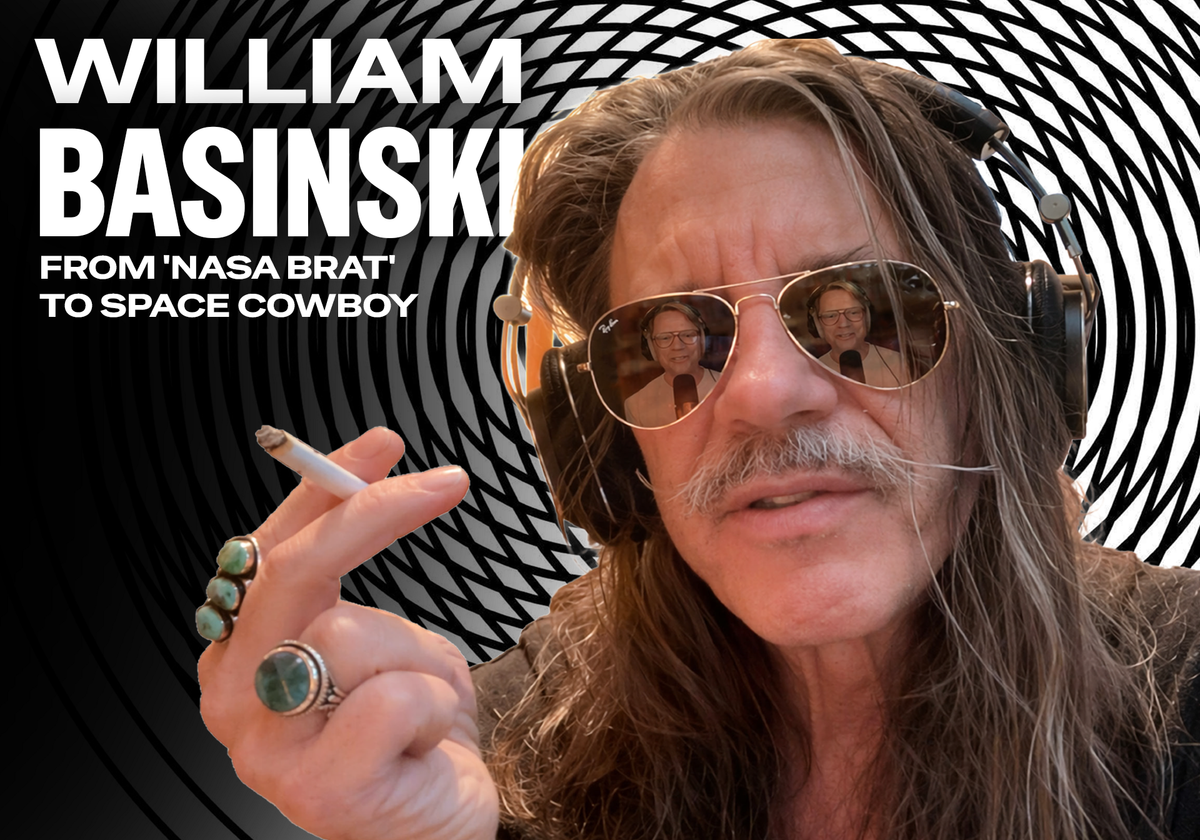
William Basinski: From 'NASA Brat' to Space Cowboy
Listen on your favorite podcast platform!
In the fall of 2001, an obscure experimental musician decided to revisit some analog tape loops he had made back in the early eighties. Inspired by the work of Steve Reich, Brian Eno, and Robert Fripp, William Basinski had created his own distinctive practice of taping easy listening music off the radio, cutting the tape into loops, roughly a foot long, and then slowing it way down.
The result transformed music into something profound as these brief loops of time became capacious ambient spaces. William Basinski's, eighties creations anticipated coming trends in loop based production, noise, ambient and slowed, and reverbed music, but very few people were paying attention at the time.
Then in the summer of 2001, Basinski decided to digitize some of his favorite loops from his 1980s archive, and that's when everything changed. As he played the old tapes back, the magnetic ferrite that had captured the music began flaking off the plastic backing of the tape. The very act of digitally preserving the tapes was also destroying them.
Basinski could hear the sound of decay, the death of an old medium captured by a new one. Grounded in decades of art practice, Basinski recognized what he had and he knew to stay out of the way, adding just a bit of reverb, but otherwise letting the tapes sing their swan song. The resulting tracks became known as The Disintegration Loops, and he finished them right as the events of September 11th unfolded.
From a rooftop in Brooklyn, he videotaped the smoking ruins of the Twin Towers, and then he synced the video to the music he had just made. The Disintegration Loops is regarded as one of the most important artworks associated with 9/11. It's part of the permanent collection of the national September 11th Memorial and Museum.
The record received glowing praise in The Wire and Pitchfork and Basinski became one of the most influential figures in ambient and experimental music. And now 25 years after the disintegration loops creation, William Basinski is on an American tour to mark the anniversary, and I'm thrilled to have him on the show today.
We talk about the tour, his sonic practice, his surprising childhood as what he calls a NASA brat. His background in classical jazz and rock music, our mutual love of shortwave radio, and even his amazing fashion sense.
Click here to find more information about William Basinski’s upcoming tour.
Cited Media:
Steve Reich - It's Gonna Rain (1965)
Steve Reich - Music for 18 Musicians (1978)
William Basinski - Shortwavemusic (1980s)
William Basinski - Water Music (self-released)
William Basinski - The Disintegration Loops (2002–2003)
William Basinski - September 23rd (reissued ~2024)
William S. Burroughs - Naked Lunch (1959)
Pitchfork - Disintegration Loops review by Mark Richardson
Transcript
Intro: Spectrevision Radio.
William: And by then I was smart enough and I'd had enough experience to know when it started doing what it did, when the dropouts started happening, make sure your levels are good and stay out of the way. Just see what happens, you know, let it go. This is not about you. Let it happen, you know?
Intro: This is phantom power.
Mack: Welcome to another episode of Phantom Power, a podcast about sound. I'm Mack Hagood. In the fall of 2001, an obscure experimental musician decided to revisit some analog tape loops he had made back in the early eighties. Inspired by the work of Steve Reich, Brian Eno, and Robert Fripp. William Basinski had created his own distinctive practice of taping easy listening music off the radio, cutting the tape into loops, roughly a foot long, and then slowing it way down.
The result transformed music into something profound as these brief loops of time became capacious ambient spaces. William Basinski's, eighties creations anticipated coming trends in loop based production, noise, ambient and slowed, and reverbed music, but very few people were paying attention at the time.
Then in the summer of 2001, Basinski decided to digitize some of his favorite loops from his 1980s archive, and that's when everything changed. As he played the old tapes back, the magnetic ferrite that had captured the music began flaking off the plastic backing of the tape. The very act of digitally preserving the tapes was also destroying them.
Basinski could hear the sound of decay, the death of an old medium captured by a new one. Grounded in decades of art practice. Basinski recognized what he had and he knew to stay out of the way, adding just a bit of reverb, but otherwise letting the tapes sing their swan song. The resulting tracks became known as the disintegration loops, and he finished them right as the events of September 11th unfolded.
From a rooftop in Brooklyn, he videotaped the smoking ruins of the Twin Towers, and then he synced the video to the music he had just made the disintegration loops is regarded as one of the most important artworks associated with 9/11. It's part of the permanent collection of the national September 11th Memorial and Museum.
The record received glowing praise in the wire and pitchfork and Basinski became one of the most influential figures in ambient and experimental music. And now 25 years after the disintegration loops creation, William Basinski is on an American tour to mark the anniversary, and I'm thrilled to have him on the show today.
We talk about the tour, his sonic practice, his surprising childhood as what he calls a NASA brat. His background in classical jazz and rock music, our mutual love of shortwave radio, and even his amazing fashion sense. If you want our full unedited meandering conversation plus some bonus content, including Williams' incredible reading and listening recommendations, you can become a member atmackhagood.com.
That's also where you can sign up for my free newsletter, in which I just completed a two part take down of Journalists' boring obsession with Marshall McLuhan, and the many problems with trying to understand today's digital world through those disintegrating old theories. Our archive of newsletters and fan of power interviews with musicians, sound scholars, media theorists, sound designers, and more can be found at mackhagood.com.
Alright, let's get to it. Here's my interview with ambient legend William Basinski.
All right, William, welcome. Thanks for being on the show.
William: Thank you so much for inviting me, Mack. What do you wanna talk about here?
Mack: Well, first of all, you've got a tour coming up, I think in like three days, right? As your first show.
I was just thinking about the fact that you're like someone who's known for exploiting the frailties of analog media, yet I was also thinking that might be a bad thing on tour. Like, I'm just curious, what do you tour with?
What, what kind of rig do you bring with you?
William: Well, I have a laptop, and sometimes I take, you know, a tape deck with some loops, but we gotta be careful about that because, you know, this shit's old.
Mack: Yeah.
William: The loops are old already already. And so, when I'm doing my shows, it's a chance to be with people in a fabulous room with an amazing sound system and hear something that gets us all outta this time zone for just a little while.
So it doesn't really matter what I'm doing. There's nothing to see really. It's all about listening and being together and kind of have a little love in, you know, god knows we need it.
Mack: Oh, for sure. Aren't you from Houston?
William: Yeah, I'm from Houston, Dallas, Denton,
Mack: what did your parents do?
William: my dad put men on the moon. We were NASA brats.
Mack: No kidding.
William: Oh yeah. Daddy worked for the Mercury program and the Apollo program after he got out of the Navy when we were little kids. And then, that was in Houston. And then we moved to Florida in about 66 for the moon program.
He was working for a company that was contracted out to do an aspect of the lunar module. And so, you know, everything was need to know. All these aspects were like contracted out and you knew what you were doing, but you didn't know the whole picture. And so anyway, it was very.
Mack: What was his specialization? Like, what was he working on?
William: Dad was a mathematical engineer.
Mack: Oh, wow.
I remember being a little kid and like being such a NASA fan boy and getting like an autographed photo of an astronaut and stuff like that. Like, were you like that as a kid?
William: Hey, I'll tell you one thing. We used to go to church with the astronauts in, in Houston. and one time in the communion line, Dad had me walk with him in front of him in the line, and there was a man in front of me and my dad whispered to me 'touch that man', and I put my hands down and he grabbed my arm and poked the man in the butt. And he turned around and it was Neil Armstrong
Mack: Oh my God.
William: And he shook our hands.
And, so I touched the man on the moon.
Mack: that is completely amazing. So do you think having experienced like that world and that moment? I mean, it just strikes me that that was such a hopeful, futuristic moment, and that
William: It was incredible.
Mack: Your work is about the of technology or like, things falling apart and I'm just kind of interested by that contrast.
William: Yeah, well, things fall apart. I mean, not all of the projects and the experiments that were happening at that time were successful. You know, there was Apollo 13 or something that went wrong? And, see when we lived in Florida, we lived near Melbourne in Indialantic Florida. It's on the coastal island and stuff. And down from Cocoa Beach and we would go watch the launches from the beach. We could see them.
But one night we were in our yard and they were shooting a rocket up unmanned, and it, you know, went off course. They had to abort so big red sky, you know. And we used to hear sonic booms all the time.
There was all kinds of weird shit you'd see like, look up in the sky and there's like, it looks like a, you know how when you see oil in a puddle on the street or something and like this one, like an oil slick in the sky, it's like, 'oh, that's weird.'
Mack: Whoa. So a lot of noise and weird stuff.
William: Yeah.
Mack: What were you into, you know, in your teenage years, like, I seemed to remember somewhere I read or heard that part of the way you got into experimenting with tape was that wanted a Mellotron, but you couldn't afford a Mellotron. and for folks who aren't familiar with the Mellotron, it was a keyboard made to to play tape loops of recorded orchestral instruments or people's voices, and it had kind of an eerie sound, I think like the,
William: Beatles. Pink Floyd. Yeah. Everybody.
Mack: Yeah, yeah, yeah, king Crimson.
William: The big boys had those. They were, oh, beautiful. Little white piano looking thing. You know, like I got to play one at a music store one time with my brother, but, no. So, yeah, that was later on. That was in New York. Um, but, you know, teenage, we were driving around Dallas with my band Queer.
They called us band Queer Friends. In my friend Mike Crawford's car, which his mom gave him, which was a baby blue, 64, Lincoln Continental, you know, and he worked at record stores or something, and he had like a massive four track Sound system in there, and we'd get eight geeks in there and drive around really slow in the suburbs, smoking clouds of weed and listening to, you know, Bowie and Queen and led Zeppelin.
And, you know, he was a geek. He would get the weird shit too, like, you know, Gentle Giant or whatever was, you know how 17 year olds that are into music, they always gotta get the farthest edge of the edge, and be cool. And now I'm kind of one of those far edge kind of guys, I guess for some people. Far out man.
Mack: So, how did you get into your process with the tape loops then?
William: Well, you know, I was a trained musician. Clarinet first chair playing in very rigorous public school music program. Top, top, top award-winning, traveled playing Hindemith, and pines of Rome, and Capriccio Espagnol, and all these other kinds of very sophisticated symphonic band transcriptions also played in the orchestra, which was fine.
and later in the jazz band. I always say they wanted me to be, you know, first chair clarinet at, you know, the New York Philharmonic or something, and I wanted to be David Bowie, so that just wasn't gonna happen the way they wanted it to.
So anyway, you know, then I went to North Texas State University, which is a big, big music school public with a really top-notch, jazz department. But anyway, I ended up meeting all these cool kids my age in the dorm.
And we would go to the practice rooms and get out the real book and practice. And so I develop our own styles and everything. And then of course they're all music geeks, so everybody had the records and everybody was trying to out do each other. So we'd listen to all this music and I got to hear all kinds of stuff that was really expanding my mind.
Steve Reich's early tape experiments come out and It's Gonna Rain and all that. And then when Music for 18 Musicians came out the way he translated that tape delay and stuff into instrumentation, and his timbres and everything, I just loved that piece and got to see him perform it once in San Francisco a few years later.
So, I had switched my major, and so I had a new music class, which was one of my favorite classes there, really cool teacher turning us all onto contemporary music, you know, from like Xenakis up through John Cage and Paulino Oliveros, and all this kind of stuff.
So I learned, you know, you don't have to transcribe orchestral scores. You can use tape, you can use radio, you can use silence, you can use, use your ears for God's sake, you know
Mack: yeah. So you kind of came to the tape through the, for lack of a better term, high art route.
William: Yeah. And it was cheap. I mean, I started out with a little, you know, Radio Shack cassette deck that I would put tape over the erase head. And my friend had an electric, you know, fender roads, and I was, starting out trying things, you know, working with themes and then going back and randomly, you know, overdubbing and doing this and that and the other thing.
So I started experimenting around doing stuff like that. Had a great teacher. but I didn't know who he was. Larry Clark, I think his name was, he was really, you know, he knew everybody, but he was so discreet and I'd just go in there and show him my stuff and he'd go, 'okay, great. Do more see you next week.'
And there was no internet, there was no way to Google him or anything and find out, I was just a dumb kid, but whatever I, I did more and I kept going. And then I met James Elaine and ended up leaving school and moving to San Francisco in 1978.
Late 1978, October. And then Jamie was a huge music, geek, record collector. He worked at record stores. He'd come home from his job on the buying truck with like some real hot stuff that he wanted and wasn't sure the store was gonna be able to sell it. So he'd bring that home and we got to hear everything coming out of Germany and coming out of everywhere.
And so all of a sudden I'm hearing all this drone music and all this other stuff that really resonated with me, and he was a collector of everything. He was an artist. He used, found objects in his work. He'd find old cool little space age black and white TVs on the street that were broken and bring 'em home 'cause they were so cool looking.
And then we'd turn 'em on and see what they do and prop 'em around and you know, I started recording them. You know, I got some old Norelco tape decks at a junk store for, like $10 or something for two and a big old box of old tape. so I started experimenting around doing drone shit, recording everything, the refrigerator, you name it.
And San Francisco has the, such an incredibly rich, city ambience with the foghorns and the fog and the clicking electric buses, the grasshopper buses we used to call them, and the cable cars and screeching and turning and this and that and the other thing. And it all bounces around, and it's quite rich.
Mack: were you doing field recordings of that kind of stuff too? or more just kind of inspired by it?
William: Not inspired. Not so much. No, not yet. Start doing field recordings until much later, but, the richness of the sound field was there. Definitely. So, yeah. Inspiration.
Mack: Another thing I feel I might have come across, correct me if I'm wrong, but, were you inspired by Brion Gysin's Cutup method?
William: Oh definitely, I've mentioned that many times. Yes, definitely.
Mack: Okay. just for folks who don't know, it was like a, I guess Gysin was working on a collage or something like that, and he had a bunch of newspapers underneath, you know, the razor blade that he was working with, cutting something else. And then he looked at the newspapers underneath that it was protecting the table with, and he had kind of cut these newspaper articles, stories into slices and he realized, he rearranged the slices that he could come up with a new text.
And this inspired William S Burrows, and I think he used it in Naked Lunch.
William: Absolutely. Yeah. Really. And Bowie too. Everyone really. I think it was just his birthday I saw yesterday or something. But, no, he was very inspiring. And so, yeah, I mean a lot of my piano tape pieces, the variations, the various variations, came from this piece I was writing since I was, you know, 16.
We had a piano at our house in Dallas, and I was trying, I had a couple of things I was working on for a long time, not very good. But, by the time we got to New York, my neighbor downstairs, Johnny Epperson, later to become world renowned as a crazy comedian, female impersonator, Lypsinka, I don't know if you know who that is, but Johnny is nuts.
But anyway, Johnny was the rehearsal pianist for, I think it was American Ballet Theater or something, so he'd go during the day to rehearse the ballet dancers in their studios, and I could go down and use his piano. We all left our doors open and stuff, and it was really cool. And our, this is on J Street in our first loft.
And so I went down there and recorded and then I bring it upstairs, and then I'd cut it into loops and then I started experimenting with the loops with, by then I had four tape decks, so I could do a, a sort of a Frippertronics thing where you go from one tape deck to the next one and it sends the signal back and you can create a feedback loop.
So I started experimenting with that, with loops and feedback loops. And then eventually I got a shortwave radio, and then I really was starting to go to outer space with, you know, getting all this atmospheric, you know, particle showers coming in and you never knew what was gonna happen. It could switch into a little bit of Middle Eastern music, like a, some smoke wafting through the room or something, and it would just be like, oh wow, how cool.
Mack: Is that some of the material that, I think last year you reissued from like the early eighties, it was called September 23rd.
William: Yeah. Mm-hmm. Yeah, from that 1982, very prolific year for me.
Mack: And there's this kind of repeating piano figure and then what sounds almost to me like a Roland space echo sometimes.
William: It's a, feedback loop. And you had to really surf that because if feedback gets too much, it just ruined it, you know? So I had to be careful about, you know, how much to let in and keep an eye on that. and also, the different frequencies would create different kinds of, you know, frequency loops.
So it would change depending upon how it was looping and stuff. So yeah, that was an interesting experiment. And it was all live one take, you know?
Mack: So when you're listening to a piece like that, like one of your pieces, you're hearing a performance. Yeah. Yeah.
William: That's right.
Mack: I know that you've, sort of spoken in the past about sometimes you just come across a loop through a lot of experimentation and there's something that sets it apart, and I've noticed that you'll start to speak of it almost like spatially, instead of temporarily you'll use word like a bubble, or something like that. I'm kind of curious to know like, what exactly are you listening for a in loop where it sort of blossoms into this other thing?
William: Well, It just becomes a whole spatial realm. You're, you know, you're in outer space. Sometimes when those things would work, it was just, I mean, I like to just chill out, you know? I like to just, okay, this is where we're going. This is, we're here and just be here now. You know, it's like, okay. The eternal moment. And I love beauty and so, I have my aesthetic of what I find to be beautiful.
And, when that happened, it was always just like, 'Wow. Yeah, this is a good one.'
But you know, early on when I was doing all that stuff, these were coming out of the airwaves. I was making something from nothing. This was, you know, recording little bits of Muzak from the radio, from the Empire State Building. This is where we were talking about the Meron. I wanted string sounds so I wanted to make my own.
So you get, you know, these thousand one strings, no syncopation, no singing, except maybe some oohs or aahs and, you know, not a lot of percussion or drums and everything. So, record a little bit on on high speed and then take it down a few speeds and see what happens. And all of a sudden it's.
You know, from anesthesia music, you find this deep well of melancholy lurking under the surface. So it was like, oh yeah, here we go. And at that,
Mack: I mean that must have been such a revelation, when you first heard that.
William: Oh no, it was great. So, at that time I was very interested in really, mixing and being in there. So I would find ones that work together and I sort of group them on this old dead plane tree I had with like a brain in my studio.
It's like, okay, these go over here. This is this piece. These work together.
Mack: you're putting the loops on a tree.
William: Yeah. Dead bush. You know, it was like just.
Mack: That's quite a filing system.
William: Yeah, it was cool.
Mack: Very organic.
William: Yeah, and then on the backside of the brain, there was the ones that were so perfect that I, at the time didn't even know if I could call them my work as much as I loved them.
I would leave those over there. And, I was interested in mixing and like the shortwave music stuff, mixing loops, the river, also one live performance.
Mack: that whole piece is wonderful. I love that.
William: Yeah. Hour and a half, two sides of a cassette, 45 minute cassette. Then I started producing bands and putting on shows and working with real synthesizers and computers and tape decks and all this kind of stuff and then, you know, I started digitizing these things 'cause I knew what can happen to tape. I had friends that were engineers, and I knew that the tapes were old when I bought them in the seventies. So a lot of them that I was using for my loops and everything.
So anyway, as it happened in summer of 2001, I was picking up where I left off. And some of those loops that were perfect that I set aside, came up again and I didn't even remember them. And that's what became the disintegration loops.
And by then I was smart enough and I'd had enough experience to know when it started doing what it did, when the dropouts started happening, make sure your levels are good and stay out of the way. Just see what happens, you know, let it go. This is not about you. Let it happen, you know?
Mack: So you were recording onto a CD burner in real time?
William: Yeah. Yeah.
Mack: That's incredible. And so you had a good sense of what you had there as it was
as it was happening after a while
William: I soon realized, wonder what's gonna happen? And so I just kind of monitored it, like, the first loop. There's a counter melody that sort of randomly arpeggiating french horn sound. It's the counter melody in there. And then in the second one I started to do something similar, but it started to collapse faster.
And I suddenly realized, oh, we don't need this here. So I kind of tried to finesse that out. And then after that I was like, it's not about you. You don't need counter melodies. Let's just see what happens. You know, keep the levels right and make sure you get a good recording. 'cause it's one time only.
Mack: It's lucky for all of us that you had the sense and the taste to stay out of the way, like that can be the hardest decision to make as an artist, right?
William: It is really true and I think, you know, the best producers know that and do that, you know, as much as they can.
Mack: Yeah. so then the disintegration loops, you self released those, right?
William: Yeah, because no one was buying.
I mean, you know, I was broke. Nobody really knew who I was. I mean, Carson Nicola, bless him, that put out a small edition of Short Wave Music, LP some years before, but that just disappeared. But before that, I think I had self-released water music and I started to get some distribution for that.
And then came out. Then in the summer of 2002, I finally had the CDs ready to go out and, Annoni was just, dear friend, loves my music. We were so close. She was getting a lot of attention then and knew everybody, David Tibet and all the people in London and everything, and she was always sending them cassettes of mine and they were all going crazy.
And then, you know, when that came out, well they all went nuts. And David Keenan just a brilliant, brilliant writer, wrote the first feature review in the wire magazine. Right after it came out and, oh, it just broke my heart. I was so thrilled and I just launched it and then, you know, eventually Pitchfork and everything else.
So yeah, I released them one at a time, over a period of, I guess three years or something, and then it just built.
Mack: For folks who don't know, that Pitchfork review was a 10 out of 10, right? One. A very rare occurrence and I think that's how I learned about you. I think that's probably how a lot of people learned about you.
William: Oh yeah. Yeah. I didn't even know what Pitchfork was until one day I opened up my mailbox and there was all this Pitchfork, Pitchfork, Pitchfork, Pitchfork. And I didn't know what it was. And that was the first review. The first review was Mark Richardson and, terrific.
And, you know, I didn't know, but music geeks went to Pitchfork first thing in the morning before they checked their email. That was their homepage. And so all these orders came in and just kept coming in. I was going to the post office twice a day. I'd do some orders in the morning and then have lunch and then come home and then do some more.
And it was incredible. Really took off.
Mack: And so this tour that you're going on is the 25th anniversary tour for the disintegration loops.
William: Oh yeah. I guess, but I'm gonna be doing some other things. I've got a kind of a really cool set, ready for this tour.
It'll be a public service announcement and something lost and something broken, and something and something ecstatic.
Mack: Oh, well, I look forward to that.
William: So it's some archive stuff. Some heard, some unheard, so we'll see.
Mack: Hmm. You know, you started working with tape, it wasn't retro. It was just what you had, right?
William: Yeah.
Mack: And this is the same for me. Like I, when I first started playing around with recording, it was like a handheld voice recorder, and then eventually I was able to get a four track recorder. And now today there are plugins that emulate the sound of tape and there's even a guitar pedal, I just saw this recently, that emulates the sound of the four track recorder that I had because there's this guitarist named McGee basically uses the four track sort of as a preamp for his guitar. He likes the sound that he gets.
So I'm just kind of curious like how your relationship to tape has changed as the culture's relationship has changed and there's this sort of nostalgia and love for tape now.
William: Oh, I don't know. I'm still. Doing what I do. I mean, old dog, old dogs don't learn new tricks. Okay? I just, ugh, all that Ableton stuff, you know, Ableton's amazing. You know, I love it, but I have a very rudimentary knowledge of it. I know what I like and what I can do, but you know, like Preston Wendell, my wonderful, now former assistant, sadly, but, partner in Sparkle Division and everything.
Brilliant, brilliant, brilliant young composer and funky motherfucker and stuff. But he's terrific, and he's my geek as far as shit like that is and stuff. So I need another brain for that. You know, it doesn't go in, does not compute.
Mack: Are you still, playing around with the shortwave because, that's an aspect of your work that I love. Like, I actually had some experience. I worked at a shortwave radio station
William: Ooh, cool.
Mack: I was a college student, and man, it was one of the strangest jobs I've ever had because, the way the place was funded was we would get these tapes in the mail from preachers like fire breathing preachers their sermons to go out over the ether, and oh my God, I wish I still had those tapes, y'know.
William: Oh, I have, I have a tape of a fire breather from Harlem or something. Really good stuff. Oh, yeah.
Mack: I mean, some of these people that we had a regular one that would come in and it was from a snake handling church.
William: Oh wow.
Mack: Some, yeah, yeah. Some Appalachian snake handling church. I mean, Oh man, it sounded like a Tom Waits album, but before Tom Waits was even doing that sound, you know, and then I would just sometimes just sit there, playing these tapes and just with chills running down my spine, just thinking about them bouncing off the ionosphere, and landing in someone's receiver and Borneo or whatever with this scratchy sound, you know? Oh man. So, anyway, like that's one aspect of your work that I really love is just the sound of the short wave radio.
William: Yeah, me too. With the short wave, you have to set up a big old antenna in New York. We were on the sixth floor of big old brick, old seven story sewing, factory building fire escapes all around, you know? And so my studio was in the back and there was a fire escape out the window.
So to get a really good signal, you get all this wire and you loop it around like the length of the fire escapee kind of thing, over and over and over and over and over again. And then you plug it into the, radio. And then you could, you know, here Russia and the Middle East and China and everything just like, wow, wow, wow.
Mack: I was, wondering, like one other question I had for you was, about your fashion sensibility. Because you're a well-dressed man, like, you're a stylish man. Where did you get your fashion sense from?
William: oh, I've always been a clothes horse as they used to call it. Now I like beautiful things and, you know, We were glam rockers, Gary and I, you know, in high school.
He was super fine and, he worked at this boutique in Dallas. It was, you know, the glam rock boutique and these queens that ran, it looked like the New York dolls, you know, so it was like, cool. So, you know, I had summer jobs and part-time jobs and stuff, and so I was making my own money and we'd go and I'd be able to get myself some clothes that.
Didn't come from Sears and some shoes from the wild pair that didn't come from Tom McCann, the buckle shoes from Tom McCann and, you know, freaked my mother out and go to the hairdressers and show them a picture of the latest David Bowie look and they'd go, oh yeah, the Pineapple Shaq.
I'd come home, my mother would be like 'oh my god, get upstairs and practice.'
So we were foxy and so I've always liked clothes, looks, you know, in New York you, you had to have a look every day on the street, you know, here, LA I don't even leave the house anymore until, unless I'm going on tour, I just can't. It's just, we're out in the valley. It's not near anything.
And, traffic's horrible and I can't afford to get sick again. So I just stay home. I don't go anywhere anymore. Thats about it.
Mack: William, this has been, a blast. I really appreciate you taking the time and everybody go catch William Basinski tour. It's the spring tour.
William: Right. All right. Thank you, Mack. You're the best. I'll talk to you later.
Mack: thanks. Take care.
William: Cheers. Bye.
Mack: And that's it for this episode of Phantom Power. Huge thanks to William Basinski for being on the show. Remember, William is currently on tour. For links check out our show notes or go to mackhagood.com. That's where you can also sign up for that free newsletter about sound and media.
Thanks to Ryan Hall of the Talk Low Music Festival for his help and for bringing William here to Cincinnati on May 29th. Today's show was edited by Cameron Naylor. Sarah Frosh is on the socials. I'm Mack Hagood. I'll see you next time.
