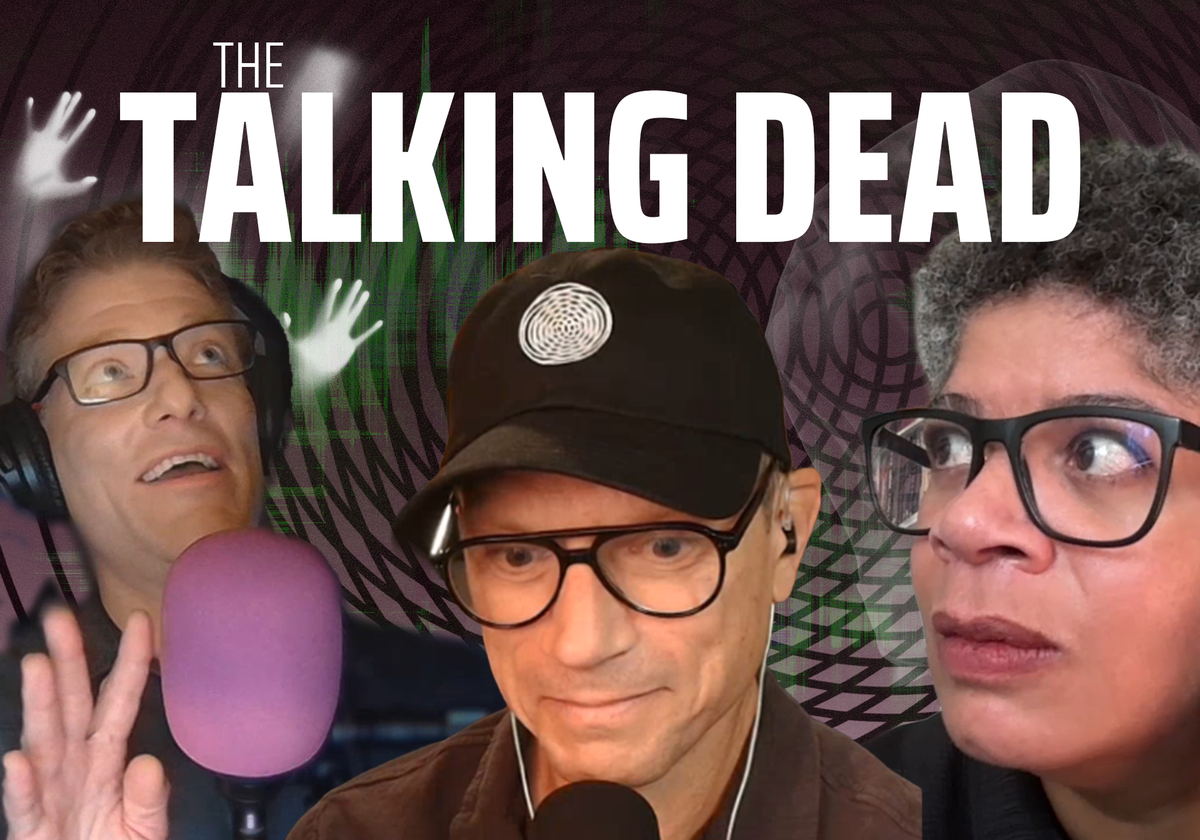
The Talking Dead: Our Live Experiment with Instrumental Transcommunication
Today on a very special pre-Halloween episode of Phantom Power, we try to make contact with the dead using digital audio technology. We are trying Instrumental Transcommunication (ITC) with ITC practitioner Joshua Sean and cultural scholar Leila Taylor, who focuses on the esoteric, horror, and the occult. Join us, if you dare….
Joshua Sean is the owner and founder of Zero-G ITC, an organization dedicated to Instrumental Trans-Communication Engineering Research and Development, Theory and Design. Joshua is an audio scientist and engineer and the inventor of PRISM, an analog emulation system that utilizes quantum dynamics and chaotic light photon interactions to isolate communication anomalies. You can find his ITC livestreams at YouTube.
Leila Taylor is a Brooklyn-based writer, speaker, and designer whose work focuses on the intersection of history, horror and the gothic in contemporary culture. Leila is author of Sick Houses: Haunted Homes & the Architecture of Dread and Darkly: Black History & America’s Gothic Soul. Her work has appeared in outlets like the New York Review of Architecture, Lapham’s Quarterly, and Repeater Book of the Occult. She’s given talks on the eerie and the esoteric for the Miskatonic Institute of Horror Studies, Morbid Anatomy, The Collective for Radical Death Studies, and The Occult Humanities Conference. By day, she is Creative Director for Brooklyn Public Library.
Cited Media:
Books:
Leigh Eric Schmidt - Hearing Things: Religion, Illusion, and the American Enlightenment (2000)
Leila Taylor - Sick Houses: Haunted Homes and the Architecture of Dread (2025)
Leila Taylor - Darkly: Black History and America's Gothic Soul (2019)
Tariq Goddard & Eugene Thacker - The Repeater Book of the Occult: Tales from the Darkside (2021)
Friedrich Jürgenson - Voices From Space (1964)
Emanuel Swedenborg - The Animal Kingdom (Regnum Animale) (1745)
Audio:
Konstantin Raudive - Breakthrough (1971)
Édouard-Léon Scott de Martinville - Au Clair de la Lune (1860)
Film:
Daniel Drasin - Calling Earth (2018)
Transcript
Intro: SpectreVision Radio
Joshua: Okay, I'm gonna keep guiding this communication.
There's a learning curve here to hear this. What do you wanna say to Mack?
'Hey. Hey.'
' Bigfoot.'
Mack: 'Headphones.'
Intro: This is Phantom Power
Mack: Welcome to another episode of Phantom Power, a podcast about sound and listening. I'm Mack Hagood. For millennia humans across every culture have heard the voices of God's demons and other supernatural beings. And perhaps most poignantly, they have often received messages from the other side, words from loved ones who died and left the earth behind.
But then came the European Enlightenment and Modernity, which for all intents and purposes, issued a spiritual gag order. As Religion Scholar Lee Eric Schmidt writes 'The very idea of a God who speaks and listens became a monstrous belief, and the voice of reason was offered as a mechanically reliable replacement for these divine attributes.'
And yet many refuse to have their gods and ancestors silenced by reason. Even within the Western cultures most taken with science and technology. In fact, for over a century, people have been using modern media technologies in efforts to tune in to the voices of the dead. And today in a very special pre Halloween episode of Phantom Power, we are going to try to make contact with the dead using digital audio technology.
Today's show is about the practice of instrumental trans communication, or ITC, and my guests are ITC practitioner, Joshua Sean, and cultural scholar Leila Taylor, who focuses on the esoteric horror and the occult. We had. So much fun. I can't wait for you to hear this conversation that we had with one another and with the dead. So join us if you dare.
But first, just a couple of quick things I wanna put on your radar. First off, some news from my good friend and past Phantom Power guest, Travis Vogan. He's a prolific author and he's a sports media professor at the University of. Iowa and Travis and Adam Kempnaar from the podcast Film Spotting have a brand new podcast out called Field of Scenes.
So in each episode of this show, they invite. Another expert on to discuss a sports movie, and I just listened to the first episode and I thought it was really fantastic. It was about Harold Lloyd's 1925 Silent Comedy, The Freshmen, which as I learned, was basically the first sports movie and it has so many of the tropes that we have come to expect from sports films.
And together, you know, they explore. The massive box office hit that it was and its treatment of masculinity and football and how the film really helped to shape the underdog narrative and the American dream narrative, and so much that remains central to the genre a century later.
So, I mean, look, these guys don't need any promotion for me. This new podcast is gonna drop in the Train Spotting feed, which is obviously one of the most popular podcast feeds about film out there. but I highly recommend it if you like this show and the way we dive deep into sound. This is a really nice companion when it comes to sports media.
Second, I just wanna remind you about our free zine that was just recently released. It's called Nothing Is Background. I've gotten so much positive feedback about this thing. It's a free digital zine on creative listening and sound making with 16 innovative thinkers and creators like. Kate Carr, Lawrence, English, Brian Harnetty, shortwave Collective, Robin Miles, David Cecchetto, Jenny Stover, so many people.
And if you're new to this show, it's actually a really great place to start because it contains links to some of our coolest episodes, as well as all these different ideas for deepening your own listening and sound making practice. So if you're interested, go to mackhagood.com to get the zine, that's mackhagood.com.
And you can also enter our free drawing for Phantom Power Merch. You just have to do it before the witching hour, October 31st at midnight, because that's when the drawing ends.
Alright, back to our spooky, fun. Joshua Sean is the owner and founder of Zero G ITC, an organization dedicated to instrumental transcommunication, engineering, research, and development theory and design.
Joshua is an audio scientist and engineer and the inventor of Prism, an analog emulation system that utilizes quantum dynamics and chaotic light photon interactions to isolate communication anomalies. We're gonna unpack what all of that means, I promise. But for now, the TLDR is, he makes stuff to hear dead people, and he live streams it on YouTube. So just search for zero GITC on YouTube and you can check out some of the past streams.
Leila Taylor is a Brooklyn based writer, speaker, and designer whose work focuses on the intersection of history, horror, and the gothic in contemporary culture. Leila is author of Sick Houses: Haunted Homes, and the Architecture of Dread and Darkly: Black History and America's Gothic Soul.
Her work has appeared in outlets like The New York Review of Architecture, LFAs Quarterly, and the repeater book of the Occult.
Leila has given talks on the Erie and the esoteric for Miskatonic Institute of Horror Studies, morbid Anatomy, the Collective for Radical Death Studies and the Occult Humanities Conference. By day, wait, Lila comes out during the day based on her cv. I kind of figured she didn't. By day Leila is the creative director for Brooklyn Public Library.
That's a cool gig. Alright, so in this conversation, Leila and Joshua discuss the long history of instrumental transcommunication and many of its most important figures. And then after about 30 minutes of discussion, we give ITC a whirl, and then afterwards we will debrief. So Phantom Power members get the full length conversation, including some fantastic reading, listening, and doing recommendations, including how to get started with ITC yourself.
But man, this was a blast. I hope you guys enjoy it. Here's our conversation about instrumental transcommunication.
Joshua and Leila, welcome to Phantom Power.
Leila: Hello. Thank you for having me.
Joshua: Thank you for having me. It's wonderful to be here with both of you.
Mack: Yeah, I'm super excited about this. I've been saying, you know, this episode we're really gonna put the phantom in Phantom Power, so I'm, I'm pretty psyched. So, I definitely wanna get into, like, you guys are and how you got into this, but I thought maybe we could begin by defining what for some folks will be unfamiliar terms. So what is instrumental transcommunication? Joshua, do you wanna kick us off?
Joshua: I'd love to. Instrumental transcommunication essentially is using a device, whether analog or digital, acoustic or electric, to observe, contact, and communicate with an intelligence of an unknown source and origin. Instrumental transcommunication, for decades has operated off of the stochastic resonance theory, which is implying that you're inserting a random noise signal into a nonlinear system, and many people may know instrumental transcommunication through EVP, electronic voice phenomena, Sweeping or stalling on radio frequency or listening to or observing white noise.
Those are some of the most common methods of instrumental transcommunication.
Mack: Man, okay. And I definitely want to come back to this stochastic theme later because that's one thing that really fascinates me about this whole thing. Leila, anything to add or subtract from what Joshua has said?
Leila: No, I think that sounds perfect. I think I'm gonna learn a whole lot from Joshua, so... I'm a... Yeah.
Joshua: I'm looking to learn from you, Leila, so.
Leila: Oh no.
Mack: We'll all be learning from each other.
Joshua: Right. Right.
Mack: Maybe, yeah, let's get into why we're interested this stuff. And, you know, I'd like to hear about your backgrounds, and what led you into ITC. But, like, you know, I guess I'll start first. Like, my spiritual background, I grew up Catholic in a very Catholic town in an era where, the United States wasn't so secularized yet, and there was just no question for me that there was an afterlife, that there was a God.
Like, when I was a kid, I think I heard God's voice in church. When I would go to bed at night, I was a very excitable, maybe neurotic child. Like, I would see things in the dark, I would hear things in the dark. And then by age 12, I kind of, quote unquote, outgrew these things and I didn't see things in the dark and hear things in the dark anymore.
And I, in fact, I announced to my family that I wasn't gonna go to church anymore 'cause I didn't believe in it. And, that narrative of, like, outgrowing something just seemed natural and makes sense to me. But as I get older, I start to take more seriously what the younger me experienced. And, no matter what, those were real phenomena in the regard at least that they happened, right?
Like, had those experiences. You know, leaving aside what those experiences actually were. And it's just interesting to me that we've moved into this more secular world for at least a lot of folks. I shouldn't say we because, a lot of people live in a less secular world.
But I'm interested in the idea that people are using technology to reconnect with something that was once commonly heard sort of in the air or inside your head. I think that's, like, super fascinating, and I guess maybe that's where I'm coming from. When it comes to, like, what this actually is, this phenomenon, like, I don't know. I'm, totally agnostic, and to, to be frank, I don't know nearly as much about it as either one of you. I barely know anything about it, so I'm super excited to learn about it. But I guess that's sort of, like, where I'm coming from and how my story connects to this. Joshua, do you wanna talk about your story?
Joshua: You know, my story goes back to my earliest memories. I was always involved with frequency, vibration, the pressure wave. I was fascinated by recording techniques. I was fascinated by instruments, by music, and I think that carried into my love and passion for audio science and audio engineering into my teenage years, and eventually into my career. And very much like you, Mack, I had experiences as a child that I couldn't validate or explain. I just knew it was my subjective perception, and it was what I experienced, and that's what propelled me and fueled me going forward, is wanting to know why and how it's happening. It's one thing to be aware of it, then to wonder how and why this is happening, and that's what's still driving me to this day.
Mack: Leila?
Leila: Yeah, I mean, I think I've always, since I was very, very small, had a fascination with death, and the macabre and the occult. I remember when, I was little, and this is like pre-kindergarten. there was a graveyard near our house, and me and, like, my little friends used to go and play funeral where one person would be dead, and the other people would sort of cry and mourn them.
And kind of like you, I did not have a very religious background. We grew up not really going to church until this brief period of time when we went to a Congregationalist church, a UCC church, which was very, not about heaven, not about hell. It was very much just be good to people and buy a cupcake at the bake sale kind of church.
Joshua: Mm-hmm. Right.
Leila: So I didn't grow up with any really strong beliefs of an afterworld or strong beliefs of a heaven. I didn't know what happened, and forever I've been fascinated by what happens afterwards, because I don't know, because there's no way of knowing. Maybe, maybe there is, and I think this pursuit of trying to figure out technologically, scientifically, if there is an afterlife has been going on for ages.
You know, and I think the interesting use of technology is that it's gonna change whatever era you're in, whether it's a talking board, or whether you're just drawing on pieces of paper. there's always been a use or a mediation of tools in trying to communicate with the dead.
And I think for me, it's always been this curiosity about what happens next and if there's any way of knowing, whether it's talking to someone who's done it, who's crossed over, or other kinds of proof that there is something else. Like I kind of know what I feel, but I've always been fascinated with people who are trying to go, "I know what I feel, and I know what I see, and I know what I hear, and I know what I touch," you know?
Mack: Well, Leila, I knew from your social media presence that you were a goth when you were teenager. I had no idea that as early as like a, like a little child you were playing funeral, so truly came by it honestly.
Leila: Your boring goth.
Mack: Yes. Well maybe let's talk history because we've already been talking about technology a little bit, and really historically, as soon as we get these audio communications technologies, people start hearing mysterious messages on them, right? Would either or one of you like to talk about the very early history of the phonograph and radio, and telegraph even?
Leila: Yeah, I mean, I can talk a little bit about it. I mean, I think people kind of think of Edison as being the creator of recorded sound. But actually there was a person in France about, I think 20 years before Edison. And I'm gonna pronounce his, name wrong, because I always do 'cause it's in French.
Édouard-Léon Scott de Martinville. That's really bad French . I apologize.
Yeah, but, in 1857, he recorded the sound of himself singing a French children's song called "Au Clair de la Lune," and he was interested more about understanding, the ear and how the voice worked.
So he was interested in recording the sort of movement of the ear and having it translate down, to wax or etching. It was an etching device. And the sound of it, hopefully there'll be a link or something to the sound of it 'cause it's the creepiest sound...
Cause it sounds like what you expect a ghost to sound like. It sounds like someone sort of coming from beyond the veil. But this was before anyone really knew of this, so the idea of a disembodied voice, the idea of a human voice coming from something other than a human being was the sort of intellectual conceptual leap that people didn't really get. So, he didn't really get very far. He kinda like just went into obscurity.
Mack: That displacement of this thing that had just always been associated with specific bodies. The unique voice issuing from a specific body, suddenly it's detached, and then that opens up a whole range of possibilities and possible explanations too, I suppose.
Joshua, does your knowledge of ITC extend back to these early days of recording? Do you know any stories of people encountering weird things in Morse code or?
Joshua: Well, I'd like to take it back a little bit further. And this gentleman I'm gonna bring up didn't capture or record anything, but his importance to instrumental transcommunication and the greater paranormal field is still resonating today, and that is Emanuel Swedenborg. In 1745, he wrote a book called Search for the Soul. He was the first to discuss in detail the sciences of metallurgy, crystallography, and human anatomy. He was the first to theoretically make the connection that we were able as humans to perceive this connection, this communication without any outside influence or device.
Mack: Wow. And so, this crystallography, I mean, I would associate this with new age practices in the '80s, like, people using crystals for different types of powers or health or what have you.
Joshua: Yes, but I have to really point out the importance of crystals. A lot of people say they're woo and they don't do anything.
But I have to actually tell you from a scientific standpoint, that couldn't be farther from the truth. Because they resonate with a certain vibration or frequency, and digital clocks use crystal oscillation to keep things in time. And crystals, without this technology, we wouldn't have modern-day analog-to-digital conversion and vice versa, and we would be in the Stone Age without crystals and the understanding of vibration and the pressure wave. So The knowledge of this topic is paramount with instrumental transcommunication.
Mack: So the crystal, the application, the sonic application early on with crystals was radio.
Joshua: Correct.
Mack: Do we have examples of people picking up strange voices on the radio back in the early days of crystal radio?
Joshua: Absolutely. In fact, involving crystals within radio helps the reception because you're actually strengthening that resonance. Because we're, again, we're looking at the stochastic resonance. So crystals help magnify that weak signal.
Mack: So maybe we can jump a little bit, you know, forward in time. It seems like one important figure was a guy named Friedrich Jürgensen.
Am I pronouncing that right? we got a lot of names that are hard to pronounce in this episode.
Joshua: I get it wrong sometimes. You're doing great with the pronunciation.
Mack: Leila, do you wanna talk about him? He seems, he seems important.
Leila: Yeah. he was a painter, and was out one day taking a walk in nature recording bird song.
Mack: What era is this, by the way?
Leila: This is, I wanna say the '60s. I think it was '65.
And when he played that tape back he heard the voice of his mother, his dead mother sort of speaking right to him. And he wrote about it in this book called Voices From Space.
So I think that might have been the, I guess, more contemporary, jumpstart to what has become EVPs or IVPs. Konstantin Raudive, who was a Latvian parapsychologist who, like, worked with Jung and stuff like that, he read his book. He read Jürgenson's book and, got inspired to try to, I guess, perfect his technique or perfect the recording development.
And he recorded this... It's incredible. It's a book called Breakthrough. And it is thousands of EVP recordings that he took, and there's an accompanying album called Breakthrough where you can listen to them. And they all have a very similar kind of almost sing-songy, sound to these phrases. And it's both uncanny but also really lovely and kind of eerie. So when I saw the Breakthrough and I heard that, Raudive was the person who really got me most interested in this stuff.
One, because of the actual quantity of recordings, but also the very kind of scientific, way in which he went about... There's diagrams about how to put together the radios and the different things that he did, the categorization of the voices and the phrases. You know, it was taking something that could seem very, you know, woo-woo or something totally sort of out of this world and bringing it into a very logical space.
Mack: Yeah, yeah. That's really interesting because, I mean, the common story we tell is the Enlightenment sort of attempted to demystify the world. And in the wake of the Enlightenment, in many ways, the ear became suspect.
It was easily fooled. It was easily deceived. It wasn't as rational as the eye allegedly, right? And this attempt to kind of erase all the messy uncertainty, and get to this empirical reality, and all these scientific instruments that we created to do so, and it's just so interesting to me that this somehow creates just a new environment for cryptic messages to emerge and, like, new machines for ghosts to appear in.
And that there were people who were thinking about this in very scientific ways. Now, I wouldn't say they were necessarily accepted, like parapsychology. We don't see a lot of PhDs in parapsychology out there or what have you, right?
Joshua, you have a PhD. What, is yours in engineering or, like?
Joshua: So I have some degrees that help here and don't help. My highest degree's in economics and finance, and my other degrees are in, I'm an audio scientist and audio engineer. I like to credit a lot of my approach to engineering instrumental transcommunication devices from economics because of the way you perceive the world and perceive situations through systems theory.
Because like a mathematical equation. What happens on one side of the equation has to happen on the other side of the equation. So we have to almost cancel things out, and in that way, systems theory helps me navigate a seemingly infinite of possibilities to receive this communication.
Mack: Interesting too because systems theory applies in audio engineering as well right? Like, When you talk about the importance of, stochastic like emergence or noise in what you're doing, I think that again, that's a systems theory type concern with signal and noise, right?
Joshua: It is. It absolutely is because we have to consider or safely assume that the information or communication we're receiving is intelligent, it's sentient, and it has free will. So this may not be something that we can repeat in a laboratory over and over again.
But by using systems theory, we can understand when and how these things happen given the variable of free will or that this intelligence can choose to cooperate with us. We can still objectively use measurements, system theory, probability statistics to help narrow down what is the best chance we have to receive this communication and observe it objectively.
Mack: So your position is that you are creating a means of objectifying these subjective, perceptions or experiences are really happening? is that kind of what you're claiming?
Joshua: Well said. I wish I said that succinctly before, 'cause that was perfectly said.
Mack: Interesting. And, I mean, obviously you would get pushback from probably most people in the world of science.
Joshua: And I do constantly, yes. There are many of us working on this. A lot of my colleagues aren't public for one reason or another. There are more people working on this than there are not.
So there are universities, there are programs. In fact, we probably know there are government programs working on this. It's just not discussed publicly still at large.
Mack: Does that go for you as well? Do you keep separate... I don't know. You- I, I assume this isn't the way you make your living, right? Like, do you keep a separate life for your work life from this?
Joshua: You know, the last few years it has blended. It is hard to tell where work and life and this research stops. I guess I could say now, no, this is not my work, but it is slowly becoming my work. Because as we move forward with technology and as more and more people accept this, there are more and more people that are collecting empirical data and evidence about this that are finally coming to the awareness that there's something here. It's almost undeniable.
Mack: So, so like, in other words, it sounds like the recordings are becoming more clear, the voices are coming through more clearly.
Leila, I'm interested, as someone who studied this and I know from reading some of your work, you're very intrigued by just the nature of the phrases that emerge. Can you talk about that, like the nature of these transmissions or these perceived sounds because we're talking about things that are emerging from noise, right?
Leila: I mean, from what I've heard, it ranges from just a word that's coming through, whether it's something through the static, the white noise, where you just pick up a name, you pick up a word, to full-on conversations. And I think that's what's sort of fascinating. The thing that I love about Raudive is that he had, these very specific rules, or beliefs about the nature of these recordings.
It was always very brief, wasn't necessarily following any kind of grammar. It was only maybe three or four words at the most. And yet there are recordings, of him calling a colleague, I think it was like twenty years after he died or something, on the phone, and he's having a full-on conversation with another person who's doing EVPs, IVPs, and, like, giving him advice on how to, like, you know, use his material and fix his stuff.
So he broke his own rule. He's, like, saying you can only have, you know, three words at a time, and there's no grammar. I was like, he's having a full-on conversation with this person. So I think it kind of runs the gamut.
So yeah, I think as far as I know, there really isn't any kind of common thread, to, to have these come through. Yeah.
Mack: I gotta say, like, based on, you know, reading your work, I went and found there was this documentary called Calling Earth and it had that phone call between Raudive and his dead colleague, and that part just seemed like a hoax to me. I'm sorry. Like, I felt like I could hear breathing.
Like, I was like, "Well, wait, the guy's dead. Do they breathe on the other side?" 'Cause like that part was a little hard for me to swallow. It sounded really cool, though. Like, I really liked the way it sounded. It's spooky.
Leila: Yeah.
Mack: Joshua, I, I assume you're familiar with Raudive, and he had three methods, right?
Could you talk about those three methods that were established in the, you know, the '60s, '70s? And then maybe we can move on to the type of technology you're using today. But Raudive was using a microphone technique, a radio technique, and a diode technique.
So could we maybe talk about those technologies?
Joshua: Of course. In fact, well, let's start in reverse order. My favorite, and I think the most popular, is the Raudive diode. And essentially a diode is a two-way semiconductor, so I guess the best way I like to look at it as a valve, and it allows current to flow in one direction, it stops it from going back the other. In fact, if you have ever left a parking lot and you see the signs that says, "Do not reverse, your tires will pop," that is essentially a diode for electric current.
And what is amazing about this is because it prevents any other type of hash to get through the signal, so you're getting the purest signal possible.
So there are many ways in which he used the diode, I do know that he was running electrical current through the diode and observing that signal in how do I say, open air. Essentially, that diode, that electricity he was filtering through at such a concentrated level could produce disembodied voice, could produce voice in the room.
Mack: Interesting. So he's basically pushing enough electrical current through this diode that there's like an actual noise that's coming from the diode?
Joshua: There's either a resonance or an actuation or a speaker. There were several methods which he was experimenting with, and there are people still experimenting with that diode technology now. But you can convert or receive a pressure wave or something that the ears can detect.
Another very popular method was inter-frequency recording, and that is picking a frequency between stations to record, because that is the place where you're gonna eliminate the most false positives and also allow the crosstalk between frequencies to help create that stochastic resonance.
To address the last method, probably the most diverse method was using multiple mic recording methods, this varied in different positions, testing different angles, X, Y positions, wide field of recording positions.
Mack: So it's interesting because I think the one that I had heard of long ago was the microphone version, I feel like I heard about people going to haunted houses with recorders recording silence, and then cranking up the signal in that silence, and then you would hear voices in there.
That was the electronic voice phenomenon that I was familiar with. Was that a prominent method for a while there, like in the '70s and '80s, or...
Joshua: Absolutely. Probably the most prominent and the most easily accessible for those that were curious about this phenomena. It was accessible because this isn't exclusive to certain people.
Mack: Okay. Well, pivoting from that very accessible gateway drug version of ITC, let's talk about your method because, man, I mean, I've watched your livestreams. It looks like there's some very elaborate stuff going on. It's like you're in a laboratory. So can you talk about, the technologies that you've created and what they do?
Joshua: Definitely. There, are a number of experiments I've worked on over the decades that have been successful, some that have failed, fallen flat on their face. The one that I'm working on now and concentrating the most on now is called Prism. And Prism, I've tried to find a way to succinctly say this, is an analog emulation of an optical prism creating chaos light.
And by generating that chaos light, we can observe photon production and reaction. Through the photon production and reaction, I'm not looking to solve quantum mysteries of the universe. I'm looking for empirical data to see if this intelligence can speak more intelligibly through this chaotic light source than, say, standard noise or radio frequency. And again, I can't prove anything yet. This is an exploratory experiment.
Mack: Okay. There's a lot to unpack there.
Joshua: I tried to condense that the best I could. I know.
Mack: So would chaos light be the idea that like you would run light through a prism that's like turning and you would not ever be able to predict like the different waves of light that would be produced in that, and then that could be like a form of encryption because it could never be recreated or am I getting anywhere near it?
Joshua: Literally, that is a perfect example because it is chaos. It is random by nature. So it will never happen again the same way it did before, if that's the easiest way to say it. It's always unpredictable randomness.
Whereas sometimes white noise and radio frequency is a predictable randomness. it's a very two-dimensional, method of looking at this communication, and that's why I thought we've gotta throw out the old model. Not that it's not great. I'm not trying to rewrite ITC history here. I was just thinking we need to look at ITC on an X,Y axis, we're adding the Z axis. I wanna be able to spin around this phenomena and look at it from all angles, and that's essentially what Prism is.
Mack: So how does Prism actually work on an audio level? What is the audio signal coming from?
Joshua: So the audio signal is essentially the same theory as we would look at white noise or radio frequency. We look at these as fundamental frequencies. These fundamental frequencies are seen as carrier waves, and the information is coming through the carrier wave.
Mack: Okay, that's just like AM and FM radio. There's a carrier wave and then the content is on that wave.
Joshua: Perfect. So we are literally taking that same theory, and we were looking at the photon generation and reaction as the actual carrier wave for this signal. And from that carrier wave, we are able to receive harmonic information, we are able to receive spectral information, and, Leila, I know you've talked about this a lot, how this communication is picked up spectrally, and we're also receiving fundamental frequency communication.
So we're receiving this layered level of communication where we can literally look at the fundamental frequency, just like you're hearing my voice right now, and then the shadows behind it. That's the best analogy I can, kind of give with that until I could present a more visual example.
Mack: And if you, in the analog version, Like is this an analog technology you could actually make where a prism of light and these light reactions get translated into sound? Would that be something you would actually do?
Joshua: In fact, that is a process that we are working with when we're researching this, and that involves conversion and transposing. Essentially what we have to do is convert this light signal into audible signal that we can not only record and capture the data science points about that, but it's something we can also observe with our ears.
Mack: Would that involve, like, an analogue synthesizer or something, like how would you produce the sound based on the light?
Joshua: Excellent question, we're going to hear that, that's literally the live demonstration I wanted to present today. Actually is going to present that as a resynthesis process.
Mack: All right. Well, Joshua, maybe we should do that demo. I would love to hear this.
Joshua: Okay, perfect. It'll just be audio. I'm going to unmute the system audio, so it'll come through. I just wanted to give everyone a heads up. You need to turn down your volume and then slowly raise it so you don't hurt your ears. This is the spectral or harmonic window into the information we're receiving, and I'm literally receiving these real-time quantum filtering equations that are happening in real time right now.
Mack: And just to be clear, so this is a sort of stochastic signal, for lack of a better word, that is based on this chaos light type pattern.
Joshua: That's exactly what's happening. We are literally observing a stochastic resonance process from the chaos light.
Mack: Okay.
Joshua: Let me unmute, let's see what we get.
Alright guys, don't embarrass me
Hi, what was that?
'Abyss.'
'We clean it.'
One at a time, please.
'Aiden.'
A lot of the times we hear from our contact field, the group of people I research with, their family and friends come through. Aiden is one of my friend's sons.
Can you say something to Leila, please?
'She's cute.' I heard she's cute.
'Nervous.'
'We're dead.'
She's what? It happens Okay, I'm gonna keep guiding this communication.
There's a learning curve here to hear this. What do you wanna say to Mack?
'Hey. Hey.'
'We're grateful.'
'Bigfoot.'
Mack: 'Headphones.'
Joshua: As Raudive got random communication, we get random communication too.
How many are joining us right now, please?
'Help.'
We're, to cont- what?
You said Leila was cute. What's your message for Mack?
'You're awesome.'
'Something episode.'
'Anniversary.' Someone whispered anniversary.
Wait, Mack, you had celebrated an anniversary with your wife?
'Listen.'
'We love you.'
Okay. You guys, real quick, kind of embarrassing me. I'd like you to come through a little clearer, please.
I do this so much we have a teasing relation saving face.
How many can hear me, please?
Jason, that's a friend of mine who, who crossed over.
He's a little bit what? I'm gonna give you 30 more seconds. wanna waste any more time.
'Three.'
Someone said it's over.
'Almost.'
You're not impressing anyone.
'I quit.' Someone said I quit.
I'm gonna count this down.
10 'Hey.'
9 'We love you' someone said.
8 'Three.'
7, 6, 5 'Just speak.'
4 'Three.'
3, 2, Well, I guess we're gonna have to get full sentences another time.
Thanks, guys. Okay.
'Four.' 1
It's a perfect what?
Okay, guys, we're gonna, we're gonna stop the demonstration, okay? Any last words Leilah? There was a lot right there to go back.
'There's a secret.' For you, There's a secret for you, Leela.
Any last messages for Mack? I heard something about dancing. I don't- Okay. Thank you, guys.
So when we get to a point where we can combine the fundamental frequency, the spectral information, and the harmonic information, because right now the best I can do is divide it because that's where I'm at with the research project, and it's hard to put everything back together for presentation, then dissect everything again.
So you're kind of getting literal, just a random walking into my lab on some random Monday and hearing where we're at. So I think you can get an idea though, when we combine the fundamental frequency, the spectral information, and the harmonic information, we can at least get a better idea of real-time communication, and create more of a flow and hopefully improve efficiency. That's the ultimate goal.
Mack: So I have so many questions, but so...
Leila: I was gonna say I have so many questions too.
Mack: So, why does it sound like phonemes? Like why does it sound like speech when noise, as we normally think about it, doesn't have the kinda envelope that the lips and teeth and larynx and everything forms around? Like, we can make a noisy whisper, but we have this whole apparatus that shapes sound into something that sounds like speech. Why is this random light signal creating something that sounds like speech?
Joshua: In the process of reduction, The prism is not an addition device, it's a process of reduction. When we remove what we don't need, we find out what's left over is this communication, and through the resynthesis process that has vowels, consonants, and diphthongs, are able to identify these words coming in.
Essentially, it's like using a microscope to retrieve this information, and this resynthesis process coming through the conversion and transposing that information down to where we can observe it, resynthesis process applies the diphthongs, consonants, and vowels to this communication. And so far, we've had a high, high success rate with this, almost 95 to 98%.
That doesn't mean it's always intelligible, but that just means by this resynthesis process, by doing double-blind studies, by conducting other ITC experiments along with prism at the same time, we're finding we're receiving a lot of the same communication through various methods.
Again, it's nothing that's proven yet. This again is exploratory experimentation.
Mack: The resynthesis, by that do you mean like there's the frequency information and then are you also just injecting a random stream of different phonemic type information and then, and that's being synthesized together?
Joshua: Correct. In fact, the synthesis process or the resynthesis process, again, that involves the consonants, the vowels, and the diphthongs. During that conversion process, there is what's called a statistical digital signal processing process where we have... It's not AI, but it's basically a bank of statistical probabilities of what a word might sound like.
It operates very similarly to a digital voice recorder that's infamous in the paranormal, the Panasonic RR-DR60, that uses a CELP process, code-excited linear predictive process. So we can avoid AI and the false positives that AI bring and use this decades-old technology that's been revised to essentially predict with a high accuracy this resynthesis process.
Mack: Panasonic DR- what was it?
Joshua: RR-DR60. It's not using that decades-old process, but it's...
Mack: And is that a voice synthesizer or?
Joshua: A voice recorder. It was the first analog-to-digital voice recorder on the market that captured audio at eight bit, 6.6 kilohertz, and it used this brand-new analog-to-digital conversion process called CELP, a code excited linear predictive model. Essentially what we're doing here is a far into the future reinvention of this process.
Mack: Wow. Okay. I've got a friend named Benjamin Lindquist who has done a lot of research on the history of voice synthesis and talking computers and stuff.
I might reach out to him and see if he's interested in this stuff.
Joshua: He'll know all about CELP, yes.
Mack: Yeah. That's very, very interesting.
Leila, you said you had questions. Do you wanna jump in?
Leila: Yeah, that sounded nothing like what I was expecting. I don't know what I was expecting, but what's so fascinating about it I was like, this is language. Something in it sounded like language. And at one point you asked how many people there were, because it sounded to me, not only like multiple voices, but different pitch.
I'm like, "This sounds like a woman. This sounds like a deeper voice. That sounds like a man." How do you determine that? How do you figure out how many people could be speaking at any given moment or trying to come through at any given moment, I guess?
Joshua: That is an excellent question, and that is something we're still trying to figure out. Right now, depending on what we make available for communication, we are noticing at times, and I'm gonna cover this in a second, we will hear only children speak or what sounds like younger voices. There are times when we hear deeper what sounds like male voices.
And again, I'm only attributing male and female because this is what we know. I don't know what's out there and based on the frequencies that we provide, we are noticing that the faster frequencies, the frequencies which you would equate to maybe blue noise or violet noise, receive the higher-pitched voices from, let's say, children or women.
Again, I'm just discussing this the best I can. Nothing's been proven. When we use slower frequencies, we hear a male voice or more of a male overtone in those frequencies. And even though the intelligence and the consciousness we have to assume doesn't have a physical body, this is a non-physical intelligence.
However, this is where a neuroscientist would have to come in and discuss how the memory of our past selves, whether we're a male or a female, is able to be reduplicated and observed by us. I'm working with a neuroscientist to uncover this, but essentially what we're finding so far, can't be proven, is that the frequency type can help determine who is speaking. Now, how many are speaking, that is out of my control. There are times when we seemingly only get one voice, and there are times when we get what seems like hundreds, and There's no deterministic factor for that yet. That's still very much largely unknown.
Mack: You know, we've spoken a lot about how you tune the technology in order pick up, these signals. I, in having that experience just now, it brought up for me that we probably need to tune the listener as well, right?
Like, I don't know, if you don't listen to blues music or something, it all kind of sounds the same. But if you get really, really into blues music, you hear, like, this huge world of difference within that genre, right? Because you've learned to discern things.
I mean, you were hearing a lot of things that I didn't hear. But also interestingly, I heard three words, and they were all sort of like very me words. One was headphones. That was the first one I heard. And then I heard phantom, and I heard signal. Those are three words that I heard.
And so it's like, those are words that are easy for me to pick out 'cause I'm already thinking along those lines, or maybe those are words that I'm projecing onto this Rorschach experience.
Like, there's different ways of interpreting that. But I can imagine no matter how you choose to interpret it, the more you do this kind of listening, the better you're going to be at it. Just like the more you listen to Baroque music, the better you're going to be at discerning, you know, the nuances of Baroque music.
Joshua: You stated that perfectly, and that's why I always discuss people have their own subjective perceptions of reality and especially instrumental transcommunication. I have instruments that I consider objectively clear, and I play them for other people and they go, "I don't get it. hear anything." And i'm going, "How did you not hear that full sentence?"
They're going, "I don't hear anything." You know, I hope this isn't your day job type situation. I get that reaction more than anything. And then there are people who just hear it instantly and go, "Oh my gosh, I heard from my grandmother," or, "I hear this," or, "I hear that." And I can't validate either experience. The best I can do is present the best objective instrument I possibly can, and it's really up to the observer.
I mean, really 99.9% of this is up to the observer. In fact, we all know people who can receive this communication who don't need these instruments. You know, these instruments are almost helping aids, if you will, you know, to help us tune into our environment and our world.
Leila: I mean, it's interesting. There were two times when I heard something very clearly to the point where I was like, "Wait, what?" Jason, and the word superb. And I don't know the context, but I definitely heard the name Jason, and I definitely heard the word superb.
I don't know what that means, but there were these moments where I was like, it was a little bit shocking when it came in clear for me. 'Cause you could kind of determine, oh yeah, this part is different. Something different happened there. Yeah.
Joshua: Exactly. You're pointing out the moments which we're trying to highlight more frequently, and we're hoping that the live example I played for you again in, and the fundamental frequency that I played that was a prerecorded instance from a little ways back. Once we combine this and we're able to efficiently produce this, we're hoping to provide you and the listener a more effortless experience listening to this.
But it will always be the case where some people just hear certain messages and others don't. I mean, that happens with a phone call. You know, we use our phones and we talk to people, and we don't always hear them.
Mack: So, Joshua Leila thanks, thanks to both of you for being on. This has been really fun and I've learned a lot.
Leila: Thank you. This was such a great experience.
Joshua: Thank you. It's been an honor to be here with both of you and discuss something that's just amazing, and there's so much left to learn.
Mack: And that's it for this episode of Phantom Power. Huge thanks to Leila Taylor and Joshua Sean for being on the show and sharing their knowledge and giving us that very uncanny experience. I hope you enjoyed it. As always, our editor is Cameron Naylor. Social media support from Abe Hagood.
Remember, you can get that free zine. Nothing is background. Just go to mackhagood.com to sign up and be entered in the merch giveaway. I hope you have a wonderful Halloween and I'll talk to you next time.
