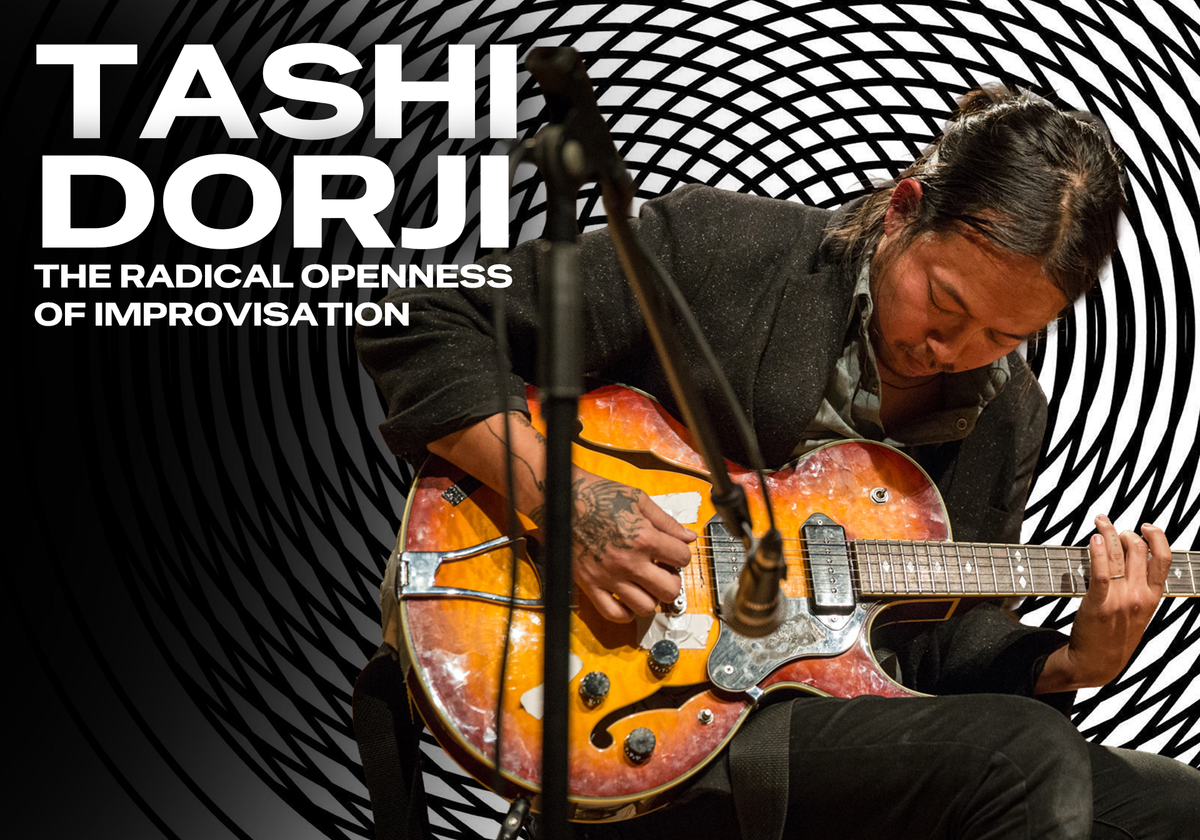
Tashi Dorji: The Radical Openness of Improvisation
In the early 2010s self-taught guitarist Tashi Dorji was recording improvised guitar explorations in his home near Asheville, North Carolina. These self-released outings drew on his unique mix of musical influences from the Buddhist music of his childhood in Bhutan to the Western music he discovered through shortwave radio and bootleg tapes of MTV videos.
Subsequently inspired by punk rock as well as the outsider guitar styles of John Fahey, Derek Bailey, Mark Ribot, and Sir Richard Bishop, Tashi was developing a percussively rhythmic sound all his own. Guitarist Ben Chasny of Six Organs of Admittance was so inspired by Tashi Dorji's playing that he started a record label to release Tashi’s self-titled vinyl debut in 2014.
Since then, Tashi's released records on Drag City, collaborated with musicians like John Dieterich of Deerhoof and Tony Buck of the Necks, and toured with Godspeed, You! Black Emperor.
Tashi is going to be coming to Cincinnati to take part in the Talk Low Music Festival, which is running September 24th through 27th. He'll be performing with Faith Coloccia on Saturday, September 26th. Phantom Power is a sponsor of the Talk Low Festival, which features a great lineup of adventurous music link in the show notes. So I thought this would be a great opportunity to talk improvised music with someone who has dedicated his life to it.
Tashi has developed a philosophy of improvisation that challenges ideas of permanence, hierarchy, and value. We discuss the radical openness of improv in life and music and we talk about the record that opened his ears to open tunings, as well as how a condenser microphone and a pair of headphones changed his relationship to the guitar. We also discuss his early life in Bhutan, that tiny country located in the Eastern Himalayas between China and India.
Of course our members will get an extended version of the conversation, including Tashi's recommendations of things to read, listen to and do more information at http://mackhagood.com .
Cited Media:
Albums & Records:
Tashi Dorji - Blue Twelve (2014)
Tashi Dorji - We Will Be Wherever the Fires Are Lit (2024)
Tashi Dorji - Low Clouds Hang, This Land Is On Fire (2026)
Ry Cooder & Vishwa Mohan Bhatt - A Meeting by the River (1993)
Neil Young - Heart of Gold (1972)
Raphael Rogiński - Plays John Coltrane and Langston Hughes (2024)
Books:
Dan DiPiero - Book on Improvising in Everyday Life
Laozi - Tao Te Ching (~6th Century BCE)
Emma Goldman
Alexander Berkman
Articles & Interviews:
Andy Slater - On Visual Impairment and Sound Art
Vijay Iyer - Writings on Improvisation
Mark Masters - Retrospective on Tashi Dorji
Transcript
Tashi Dorji (FREE)
Intro: SpectreVision Radio.
Tashi: I'm feeling more and more comfortable with the idea of just letting go and just seeing where it leads you and feeling that temporality of playing, you know? Because to me it feels like improvising is completely kinda like this moment of a moment of existence.
It's there, and it disappears. Maybe that's where I get closer to my culture, you know?
Intro: This is Phantom Power.
Mack: Welcome to another episode of Phantom Power, a podcast about sound and listening, I'm Mack Hagood. In the early 2010s self-taught guitarist Tashi. Dorji was recording improvised guitar explorations in his home near Asheville, North Carolina. These self-released outings drew on his unique mix of musical influences from the Buddhist music of his childhood in Bhutan to the Western music he discovered through shortwave radio and bootleg tapes of MTV videos.
Subsequently inspired by punk rock as well as the outsider guitar styles of John Fahey, Derek Bailey, Mark Ribot, and Sir Richard Bishop, Tashi was developing a percussively rhythmic sound all his own. Guitarist Ben Chasny of Six Organs of Admittance was so inspired by Tashi Dorji's playing that he started a record label to release Tashi self-titled Vinyl Debut in 2014.
Since then, Tashi's released records on Drag City, collaborated with musicians like John Dieterich of Dear Hoof and Tony Buck of the Necks, and toured with Godspeed, you Black Emperor. Tashi is going to be coming to Cincinnati to take part in the Talk Low Music Festival, which is running September 24th through 27th. He'll be performing with Faith Coloccia on Saturday, September 26th. Phantom Power is a sponsor of the Talk Low Festival, which features a great lineup of adventurous music link in the show notes. So I thought this would be a great opportunity to talk improvised music with someone who has dedicated his life to it.
Tashi has developed a philosophy of improvisation that challenges ideas of permanence, hierarchy, and value. We go deep on improv and we talk about the record that opened his ears to open tunings, as well as how a condenser microphone and a pair of headphones changed his relationship to the guitar. We also discuss his early life in Bhutan, that tiny country located in the Eastern Himalayas between China and India.
Of course our members will get an extended version of the conversation, including Tassie's recommendations of things to read, listen to and do more information at mackhagood.com.
I hope you enjoy this conversation with Tashi Dorji.
Ah, Tashi, welcome
Tashi: Thank you for having me, Mack. It's really nice to meet you here
Mack: thank you for, being on the show. I've been familiar with your solo guitar work for a long time.
Tashi: Oh, wow
Mack: Yeah, there was a, you know how you go into, like, different modes of listening, you get into certain things? And, for a while there was on a path of, like, listening to a lot of solo guitar stuff, like John Fahey, Sir Richard Bishop, and Mark Ribot, and you're not actually like any of those guys.
Tashi: Well, those guys are the heads. I mean, Rick, you know, so incredible, and Mark Ribot.
Mack: Were you into his stuff? Were you into Sun City Girls?
Tashi: Oh, absolutely. And Mark Ribot too. I think more so Sir Richard Bishop, because, you know, he's friends of mine, and Mark Ribot was very important in the initiation for me early on to get, like, into free jazz and stuff
Mack: Oh, really? So you know him as well?
Tashi: I don't know Mark Ribot. I wish. I love his music.
Mack: I do too, yeah. So how did you get to know Sir Richard Bishop?
Tashi: Through Ben Chasny, actually. Six Organs of Admittance. He's close friends with him, and when Ben Chasny put out my first LP, actually, I had a tour lined up, and the booking agent was involved with Drag City, and she booked me a tour with Sir Richard Bishop, my first tour actually.
I was really intimidated, and I was like, "I'm going on tour with this guy? Come on." Like, you know. He hadn't toured US in, like, three or four years or something like that, or for a long time. He was living in Thailand. I forget where he was, and he was doing one of his first tour after a long time, and, you know, he's, he's a shredder.
You know, it's, it's intimidating figure, it was amazing that he was just like a chill, chill uncle.
Mack: Yes. That's awesome. That album, was that the self-titled album, like around 2014?
I really like that record. And, I was reading, I think it was Mark Masters, the critic who was doing a retrospective on you, and he said something that made an impression on me.
It was something to the effect that recording that record was the first time you heard your guitar through, like a condenser microphone. And that that had a real effect on your playing.
Could you talk about that?
Tashi: Yeah, so that album was a compilation of few different stuff that I put out, like cassettes. So Ben picked a bunch of things for the LP. And few of the recordings was actually recorded at the university here, because I knew some kids who went to school there, and they had access to this really wonderful studio.
And my friend, Frank, he was just interested in doing all this different placement of mics, so it was really insane. He had like this, $30,000 mic right close to the guitar and like place it in places where it was very hard for me to move, but the proximity created this intense physicality almost. I'd never heard that in recording before of my own playing.
And that really, like prompted me to play differently in many ways, especially like percussive, textural, and it really worked with a lot of prepared guitar that I was investigating around that time, and it just exaggerated the sound to like this maximum sonic experience.
So yeah, it was really, it really helped me sonically understand what the possibilities were, you know, with timbre and just those dynamics of guitar playing.
Mack: Yeah, that's what really struck me about some of the tracks on that record, it was that you could hear the physical guitar in this way, and you could hear that you were hearing it and, like, exploring the materiality of the guitar. So you could hear, like, the fingerboard or,
Tashi: Or the buzzing, like
Mack: Yeah, yeah, yeah.
It, it is, it was so, like, visceral and punchy and I thought that was amazing.
Tashi: Oh, thank you so much.
Mack: Yeah. So I assume you were wearing headphones while you were doing that..
Tashi: Yeah, yeah, I was wearing headphone. That's why it was like the sound, the impact was so much more intense when I have this fancy headphones and playing it. I was like, "Whoa." Like, you know, I'm able to hear these timbres and dynamics that otherwise it's really kind of hard to hear through acoustic guitar sometimes, you know?
Mack: Cause you're improvising, so you're responding to what you're hearing. That must take you on a different path than what you would've been on without the headphones, without those particular microphones.
Tashi: I think it's different, you know, it's all contextual, so it's different without the headphones. I mean, studio recording with my acoustic stuff is just, I usually just record it on my own with a little Zoom, you know, now especially, because it just makes more sense. Like, I'll sit, place the Zoom on the table and play, and I can hear the dynamics, and it's a very different experience playing without headphones.
But with the headphone, I mean, I definitely pushed it further into hearing differently. But I mean, it really definitely opened up a lot of different ideas, and yeah
Mack: So when you record at home with a Zoom, you don't wear headphones?
Tashi: No.
I mean, I think I tried. I mean, I improvise, so everything is just kinda has to be in some ways experienced in the moment of playing, you know? It really works when I play like I'm just playing, like in a normal situation where I'm not, not even thinking about it in a audience or people who are listening.
It's just playing and letting out whatever ideas that I have, and the immediacy. And yeah, that's basically how I play. You know, a lot of solo improvising is- I mean, it's just basically sitting down and placing yourself and just play.
I learned how to do that over the years. I'm still learning how to do that, you know. It's sometimes I will fall into patterns, especially when I'm on tour. When I tour with electric guitar, I tend to fall into certain modes and patterns through, like, playing for four or five days, six days, seven days. Then I realize, I'm like, "Wait, I'm playing the similar motifs every night, and I'm improvising around that."
Mack: How do you feel about patterns like that?
Tashi: I think it's good. I mean, it's finding little places of meeting points, you know, convergence with ideas. I like that. Like, I think it's different from people that I've been inspired by, people like Derek Bailey, and like some of those like, you know, heavy improvisers. I mean, Derek Bailey's playing was so not that, you know?
He never had like, "I'm gonna have a reference." It's like anti-reference point.
Mack: Yeah. But do you think that comes with... Because you're a very rhythmic player, so there's a built-in repetition, at least when you're doing a rhythmic pattern, right?
Do you think that that takes you in a different direction than some of those folks?
Tashi: Yes, I don't know if it's from how I grew up. I'm always thinking about that, like why rhythm and patterns is so important for me, or it's very attractive for me, even playing as a guitarist.
And I think so, and Also, I think it impacts from things I listen to so much. A lot of the stuff I listen to is very rhythmic. I love things that interplay, things that repeat, and create complex rhythm. Not that I can do any of those, or my music I put out has any complex rhythm patterns.
But those are some of the things that I really get attracted to. So yeah, on tour, it always tends to happen that I'll kind of find some kind of a rhythmic patterns.
And they're disjointed, you know, they're not like interplaying in this complex pattern, but there are some patterns, and I love playing with that.
I love playing and building off of that and furthering whatever patterns. And I don't know. I don't know how that became what it became . I always think about maybe it's cultural. You know, I was really drawn to traditional Bhutanese, like, monastic music when I grew up, which is a lot of rhythm. But I wouldn't say it's complex rhythm, but it's, like, very repetitive, droney kind of a patterns. And I grew up with a lot of that, and I feel like somewhere deep in my consciousness, it just comes out sometimes.
As I'm getting older, I'm like, Oh! I reconnect. You know, maybe there's that aspect of that, yeah.
Mack: Yeah. I mean, Are you right-handed or left-handed?
Tashi: Right-handed.
Mack: Yeah, I mean your right hand. I mean, I would say you do some very complex rhythmic patterns. Like, you have a really amazing right hand. And also you mentioned on that first album or that... It's not your first release ever but, the first one I was aware of there was treatments, like you used treated guitar. Can talk about what you mean by that and what you did with your guitar?
Tashi: Yeah, yeah. I, I don't know, for that first record, I mean, there were so many different tracks from different recordings. I mean, basically I just kind of mute the strings a lot of times, and I place, like, hair clips in between or put, like, little masking tapes around the fretboard, and they all vary.
And sometimes I also put a bobby pin on the string, kind of dangle it, and it just rattles.
That might be a newer idea, but I know I've been doing that kind of stuff. I don't know where that comes from. I mean, there's a lot of traditional music that has rattling sounds, like with the mbira, you know, the thumb piano it has.
And I'm like, maybe that's where I got inspiration. But yeah, I simply love, like, things rattling and buzzing in this percussive way. And those were basically inspiration of, like, how do I play guitar and sound like I'm playing other things other than playing guitar? But not, like, intentionally trying to make my own sound or whatever.
It's just purely curiosity, I think.
Mack: There are moments on that record where I was like, " That actually doesn't sound like a guitar." Like, "What's going on there?" You know?
Tashi: I'm also like, oh, a lot of people do this better than I do sometimes. And I find out about other guitar player, you know, wow, like actually my friend Che Chen from 75 Dollar Bill. I don't know if you know that band.
Mack: I've heard of them, but I haven't listened.
Tashi: Yeah, Chase sent me a link to this guy, Raphael Rogiński, I think he's a Polish guitar player. I mean, He plays this prepared guitar thing, and he did this whole album tribute to John Coltrane, and he's playing Coltrane tunes, and it's just like insanely beautiful, and it's just like, wow.
Now, you know. And Chase said he went and saw him in New York City, and he was just like, "I was completely floored how beautiful, you know, this prepared guitar," like kind of a, a gesture towards John Coltrane. Anyways, yeah.
Mack: That's amazing.
Tashi: I am just learning in my very cross punk non-academic style of, you know, learning how to play.
Mack: There was one tune on that record that was an electric tune, and it was interesting to me. I don't know, to me, it sounded like you were playing with a pick or I don't know. But there were a lot of repetitions of notes on that piece, on that improvisation. And it sounded to me like you were almost, like, testing something out.
Like, you would play the same note, but I could hear you were using the pick attack differently or hitting a different part of the string.
Tashi: I probably was.
Mack: It was like the same note, but it was also a different note, and it kept changing and changing even though on a sheet of music it would have been the same note.
And I thought that that was really interesting. And I was just the other day, reading an interview with this blind sound artist named Andy Slater, and he talks about how, you know, sighted people can tell what a room is like just by walking in and looking around. Blind people have this way of interacting with a space in order to see what the nature of the space is, so they're like clicking their tongue or tapping a cane or whatever. And so he said this amazing thing. He was like, "Blind people have permission to disrupt in order to figure out where we are."
And then he said, "I record those disruptions." So, like, that's his sound art is to record those disruptions. And I just kind of thought, like, when I read that and I knew I was interviewing you, I was sort of like, I feel like that's a similar thing to what you're doing, where you're kind of testing out, you're tapping the string in different ways and seeing what happens so you can discover something about it.
Tashi: Yeah, I mean, you know, that's really profound. I mean, you know, I feel like a lot of the times improvising for me, what I'm trying to maybe, not intellectually, but, like, at least philosophically, metaphysically, is trying to incorporate that as, like, a life force, you know?
Like improvising as part of who I am, and I feel like that's basically kinda translates into my playing sometimes. It's completely, I mean, disruptive, but also I think a lot of flaws there, you know?
It's completely unbalanced sometimes. It's very volatile. It's vulnerable, and that's difficult sometimes, you know? I tour a lot, and I play in front of people, and their expectations, you know?
But I'm feeling more and more comfortable with the idea of just letting go and just seeing where it leads you and feeling that temporality of playing, you know? Because to me it feels like improvising is completely kinda like this moment of a moment of existence.
It's there, and it disappears. And I think that's what becomes of my playing a lot of time, is just kinda like, yeah, like feeling out, as I'm playing live, figuring out as I'm playing. yeah, and that becomes, like, kind of maybe praxis of improvising, is this constant disappearing, reappearing.
And yeah, it doesn't stay at the end, there's nothing. Maybe that's where I get closer to my culture, you know? The Buddhistic kinda, epistemology of, like, you know, the non-self existence, you know? Like kinda In a humble way, and I feel like maybe that's where I feel like I place my music in some ways.
Mack: You said something there about improvising live and you're responding perhaps to the day that you had. And how you're feeling at that time, and then it disappears. And, my day job is I'm a media studies scholar, so I think about media all the time, and I wonder, maybe a lot of our problems right now are that we don't allow things to disappear anymore.
Tashi: Yeah. I mean, I think understanding capitalism is temporal. This things that are materiality of world, it's illusion to me sometimes, you know?
Coming in terms, and I feel like Improvising and the music that I'm playing feels closest to a meaningful interaction with art for me because it has this non-hierarchical, horizontal tendencies that this material capitalist, this idea of immortality, permanent seeking forever, you know, material objective kind of defies that with improvising.
It has this tendency of it's here, but it's not here. You know, all these imaginary borders and imaginary whatever. There's like the saying, you know, the most yielding thing in the world is the most perishable or something. You know, the things that are most easy or flexible will last longer than the rigid. I think it was Laozi.
Mack: Yeah, yeah. Right, right. Well, that's funny though what you're saying there about capitalism 'cause I know that there's the jazz musician, and scholar Vijay Iyer. He's written about improvisation, and one of the things he points out is, like, we have this Western copyright law that's all created around, like, musical objects, right? Like it's a fixed copyrightable song or melody or lyric or whatever. And so he says, so in that context, improvisation has literally zero value in the Western economy. Which is, like it reminds me of, like, a Zen teacher I read once said something like " Meditation is good for nothing."
Tashi: Absolutely. I mean, you know, like, making music in this time and period, to me it's like, you know, just for my own sake, what is most important is, like, connecting with people, you know, creating that mutuality through improvising, you know, creating communities, and defying the idea of materiality and the just capitalizing on that.
Improvising kind of provides that in some ways, you know? It's like it defies the logic of capitalism and logic of Western rigidity.
Mack: I heard the record you did with John Dittrich from Deerhoof, Midden, and that was the first time I think I heard you improvising with somebody else. So, you've been talking about listening as a really important part of your practice. How does that change when you're bringing somebody else into the mix, you're improvising with other people?
Tashi: I mean, improvising with other people is absolute requires listening and mapping out things together. And again, that's where you have the idea of horizontal collective improvising. It's challenging, but it's also is one of the most beautiful thing I've experienced, is playing with other people, and that's where most fun is.
You know, solo is really fun playing, but improvising with other people is just even more gratifying. And yeah, playing with John, John is incredible. You know, his language is vast. He can play things that I can't. You know, I was recently playing with this drummer, Tony Buck, who is the drummer from The Necks, you know.
And he just does so many things that moments where I'm playing, I just kinda have this moment of like, oh my God, like, how do I even respond to that? This, you know, shower of cymbal and bells. You know, it's, it's, it's beautiful. You're just like, I don't have those language in this minimal six-string thing.
But then you kind of find ways to talk to that in whatever ways I can. And they work, and they don't work, and yeah, it's really incredible to play. I play with a lot of different drummers because, like I said, I love call and respond percussion kind of rhythmic patterns. And sometimes it kind of translate into playing with other guitar players too, so it's fun.
Mack: So, oh, well that's a whole other thing. Like, it doesn't sound like you're using conventional guitar tuning, I would assume.
Tashi: No, I mean, it changes every time. You know, I'm like, while I'm playing, I'm retuning things, and it's just kind of like, it could turn into a real, you know, nightmare, but it's worked and I have no boundaries. I just kind of let it go as it is, you know?
But I mean, I'll be playing with my friend Faith at the Taplow Festival, but those are a set of songs that I have to learn.
Tashi: When I come back from Europe next week, I have to start learning on my own. You know, it's makes me really nervous because I don't do that ever.
But it's beautiful at the same time. So though that is a set I can still improvise around the forms that Faith has created. So that's a very different style of improvising that I rarely do, but I'm really excited to do, but also have fears that I'm like.
I use all kinds of different things to process guitar, but I'm gonna have to do this live through pedals in this massive church, and there'll be a lot of people.
So there's a different idea of improvising within kind of a confine of forms, but at the same time hoping that you can still translate. But I'm really fortunate that I can do things like that, you know?
Mack: Yeah, I'm really excited to hear that. So do you use like open tunings?
Tashi: All. Every tunings is, like, weird open tuning, and they are all everywhere. There's no set of tunings that I use.
Mack: I can't remember where I think I read this, but while you were still in Bhutan, you heard the Ry Cooder and Pandit Vishwa Mohan Bhatt record, and that that had an impact on you?
Tashi: Huge, huge impact. It was so funny. I was, I think in middle school? And I was just learning how to play. Like, Maybe like early high school, I don't remember exactly. When I was learning, I would just learn, like, Neil Young and just, you know, Heart of Gold, maybe, like, some classic rock. But there was this guy, Song is his name, and he's this really cool older guy.
He just graduated college, and he had access to all this music because he knew a lot of expats in the capital. So he, he was also the radio jockey at the one and only radio station in Bhutan. It's called BBS, Bhutan Broadcasting Service, and he played music there, and he played a lot of cool stuff.
And I knew him, and he knew that I played guitar, and he was always like, "Yeah, come to my house. I'll show you some music." And I went to his house, and he had all these CDs. I don't remember, CD or cassette. And he started playing that Vishwa Mohan Bhatt and Ry Cooder. He was like, you know, "This stuff is, is all improvised," or something like that,
Tashi: I said, "What do you mean?" He was like, "They're just listening and building things up." And I was like, "What?" And he said "Listen to his guitar. It's weird. Like, you know, it's like, sounds like sitar. It's open." I don't know what he said, but along that line, I remember being like, "Whoa, so he's just playing, like, this open tuning, and playing with this Indian guy who's playing this weird hybrid sitar?"
Oh, yeah, it just blew my mind. Then I went home. I mean, it, it just takes that. Like, and I just started tuning the guitar differently. Then I was like, "Wait, I can just have a open tuning and figure out how to play around that." And I didn't-- I don't know I ever started improvising, but I knew there was this possibility.
Mack: What had you been listening to before that?
Tashi: Oh my God, like, you know.
I mean, everything under the sun because we didn't have record stores. I would find cassettes at, like, grocery stores. You know, people would sell bootleg cassettes. I listened to Tesla, Cinderella.
It was right before I started listening to Nirvana, and that changed my whole, you know. I was like, "Whoa, this is crazy." I was listening to, like, Metallica, Slayer, Jon Bon Jovi. I mean, everything. Everything that was there, I would just, like, soak it. But then, you know, there was, like, moments of finding little gems like that, and he kind of opened that.
And it's interesting. Right around that time I knew some expats. It was this teacher from New Zealand, he was a trumpet player, and I was playing with him and bunch of other expats, just like cover band, and they asked me to play with them 'cause they knew I play guitar, and it was small town, so everybody knows everybody.
They had access to so much other things. And that's around the time when I heard from the teacher, the New Zealand guy, Joe Pass, a solo guitar record. I remember being like, "What?" So there I had moments of all this while I was listening to all this classic rock, hard rock, Metallica, whatever, you know?
But I had moments of, like, hearing Miles Davis and, Joe Pass, and vishwa Mohan Bhatt and, like, just little snippets. It opened my mind in many ways
Mack: I heard somewhere that you listen to shortwave radio?
Tashi: Oh yeah, so much.
I mean, that was literally my access to the outer world because we didn't have TV then.
Mack: Yeah. what, stations were you listening to on the shortwave?
Tashi: So funny. It's always a big talk with my partner because I have three shortwave radios at my house now.
I was telling my kids, it's like, "Daddy had no access to TV." I listened to Radio Australia. I listened to Deutsche Welle. Radio Deutsche Welle, I think that's a German radio, and I listened to Radio Moscow.
I listened to Voice of America, the propaganda. BBC, big time, 'cause BBC had way more, catalog of different programming.
I listened to, oh my God, so many different, but those were, like, the main ones that... And Radio, Indian radio from India. And I listened to Radio Mizoram, like, you know, Northern, Northeast India.
But my dad used to listen to a lot of shortwave radio, and it was just fascinating to hear about other part of the world through just statics. And that's when I started. I had my own small radio cassette player. That's where I listened to all my bootleg cassettes, and that's where I listened to all the stations.
So I would listen to Voice of America, and they would have countdown, like top 10 Billboard. That's when I first heard Nirvana, I think.
Mack: Did you ever hear a station called WRNO Worldwide?
Tashi: No.
Mack: No? Oh, shoot.
Tashi: was like a shortwave radio?
Mack: It was a shortwave station based in New Orleans. I was a board operator there. And we used to play, like, Casey Kasem's Top 50, or, you know, whatever, Top 40.
Tashi: Wow. And it would go all... It's shortwave, it would go all over the world
Mack: yep, yep. Yeah, I love shortwave.
Tashi: I mean, so amazing, right? Like, little box I was like, "Oh, I will listen to Radio Moscow." And they would have a rock show of, like, just Russian bands. Just like, what? You know? I think I heard, like, Midnight Oil, you know, the Australian band, through Radio Australia.
Nobody even knew in the capital. And my kids, like, my friends was like, "What? Who cares? Listen to Europe and Jon Bon Jovi." I was like, "Man, I heard this band, Nirvana." They were like "What? Weird name."
Mack: Yeah. I remember when I was teaching English in Taiwan.
And there was a, like an English language bookstore. So like once a week I would go downtown and go to the English language bookstore and like look at the Billboard magazines, Rolling Stone, like whatever, 'cause there was no internet.
I mean, the internet existed, but normal people weren't on it. And so, I remember having my mind blown the time that I went and looked at the charts, and Michael Jackson had been knocked down to number two, and number one was Nirvana, which I had known Nirvana as just this little Pacific Northwest band.
Tashi: Oh, so you heard of them before?
Mack: Oh yeah, sure. You know, 'cause I'm the right age for that. Like I'd saw Soundgarden play in front of like 20 people in, in New Orleans and stuff like that before.
Tashi: Amazing.
Mack: they were nobody. So those were just those bands that, you know, I was
Tashi: It's like we all knew, like now, like it was some punk bands.
Mack: So, to just flip through the music charts and to see Nirvana as number one, I just couldn't even fathom it.
I was like, "How? Like, is this real? Is this counterfeit? just happened while I was gone?"
Tashi: That's so crazy. '90s was, I think, strange, right? Like, with music. I mean, you guys were experiencing that. I mean, I was in, like, a landlocked country, we all got into Nirvana like bonkers. After Nirvana's all that, after they started becoming well known, I mean, it was big.
But, but we were, like, the alternative kids, you know? We were like, "Oh, like, there's, like, this weird band, Alice In Chains, and Soundgarden. They're not like, you know, Tesla or Jon Bon Jovi. They just sound, like, there's no riff." But I remember it was like, wow, that's strange. Like, I remember looking at the pictures like, "These guys don't look like rock stars."
It must have been so wild, like, growing up as, like, a young...
Mack: Yeah. And then there was sort of like a feeding frenzy, so some of the bands that, you know, you just never, ever would've thought would get a major label, like the Butthole Surfers or whatever, are suddenly on a major label You're like, "What is going on here?"
Tashi: Though, yeah, that's my experience of, like, I listened to a lot of, you know, normal music that was accessible through bootleg cassettes, and I had glimpses of, like, Vishwa Mohan Bhatt and Joe Pass or something random like that.
And that came through, like, those volunteers and expats who were in the country.
So yeah.
Mack: So you said your dad was listening to a lot of shortwave radio. What did he do?
Tashi: He would listen to, like, a lot of news.
Like, he listened to a lot of Voice of America because He worked for the government, and he was intellectual, and he just wanted to listen to news. So there was no TV. so, I think he listened to a lot of BBC and Voice of America.
But then I started listening to it more than him because I would hear the music, and I was like, "Oh my God." And my dad would be like, "Yeah, they have a countdown every Saturday." Then I would take the radio and I would just like...
my dad had this Japanese small shortwave radio. When he was in Japan, he bought one. It was, like, incredible. It would just, signals were so good.
Mack: So you must have been living in the capital if your dad worked for the government?
Tashi: Yeah. All over. He moved around quite a bit, but towards the end, before I came to US, we were in the capital for I think most of the '90s we were in the capital, like mid to late '90s. But yeah, we lived all over the country, like really remote. He was posted in different places working for the government. So Shortwave Radio was, yeah.
Mack: I gotta say, like, I just don't know that much about Bhutan. Like, I can tell you what I know about it. It has the national happiness index or whatever.
Tashi: Gross, gross national happiness.
Mack: Gross national happiness. I know it limits the amount of, like, foreigners who can come in to avoid, like, disrupting everything.
Tashi: Preservation, I think the big thing is the preservation of culture, the harmony of culture as it is. So limiting tourism limits that impact. So yeah, that's one of the tenets of...
And the other one is, you know, preservation of environmental incentives, which is huge in Bhutan. You know, I think it has-
Mack: Oh right, Bhutan's carbon negative, right? That's amazing.
Tashi: Only country in the world. It was just like, "What?"
Mack: So I guess what that makes me wanna ask you is, like, I mean, that's amazing that a country is thinking in that direction, but then for you as a young teenager, you wanna reach out to the world. You're so curious. Like, was that, like, something you wanted to rebel against?
Were you, like, kinda like, "Ah, all this Buddhism and..."
Tashi: I think I was rebelling more towards no information. I was so interested in rock and roll and blues. So I was rebelling against, I think not directly against the tradition, but, like, moving out of that, like, insularity of living in Bhutan.
Just everybody knows everybody, and I watched these pre-played MTV videos of, you know, Smashing Pumpkins and Nirvana. I'm like, "I wanna go there. Those kids are having fun!"
Mack: Like people had VHS tapes of MTV.
Tashi: MTV Replay, yeah, we had all these VHS of like Top 100 and we would watch it at our neighbor's house sometimes. And eventually we had TV at the house. So we watched like, you know, rent it from friends. I don't know, just this like, it would be like a year old sometimes and it would be like, "Oh, top 100. Watch Nirvana's Smells Like Teen Spirit." And just like, I wanna be around rebellious kids.
Mack: So you, you live in Asheville, North Carolina, right?
Tashi: Yeah, I live like 30 minutes outside, like way up in the mountains.
Mack: And then you originally came here to study?
Tashi: Yeah, I came to go to school at a small liberal arts college here.
Mack: Which one?
Tashi: Warren Wilson College.
Mack: Okay. How did you find out about Warren Wilson College in Bhutan?
Tashi: So my dad worked for the government, so ... Okay, this is still kind of like it's a blur now. I'm like "did my dad bring this brochure of this hippie college? How the hell did it end up at his office at the high court?"
Mack: He was a judge?
Tashi: So my dad was a judge at the high court.
Mack: Oh my gosh.
Tashi: There's, there's seven judges, seven justices, and he was one of them.
He was the only Sherpa justice in Bhutan. The one and only Sherpa judge.
Mack: Wow. Sherpa, like...
Tashi: yeah, as an ethnic... Yeah.
Sherpa is like an ethnicity. So he was, he's the Bhutanese Sherpa. A lot of the Sherpas are in the southern part of the country. So he was one of the first Bhutanese Sherpa judge.
But anyways, cause I had finished high school, and I was just kind of bummed out and doing nothing. I think he brought this brochure of this, maybe it was like an alumni magazine. This is always like a mystery now at this point.
So I think I remember just looking through them, but like, "Wow, this is so cool." With all this like tie-dye shirt and long-haired kids playing guitar. In some of the pictures, I was like, "They look like they're having a lot of fun. I am done being in Bhutan." I wanna go hang out and play music, you know? I wanna go learn how to play blues. I think I remember vaguely having those feelings that I wanna leave.
'Cause there were a few other Bhutanese kids who were going to school in America, and I would hear stories. They were like " I went to a rock show," or something like that, or blah, blah, blah.
Mack: So what year did you first come to the states?
Tashi: I came to US in 2000.
So I wrote a handwritten letter to Warren Wilson College. I mean, that takes like two months or something.
And they wrote me, sent me like a massive amount of information, like financial aid, letter addressed to me. Like personally, the dean was like, "Oh, this is such an hon- like, you know, Bhutanese. The last Bhutanese student was like in the '70s or something, so if there's anything we can do to help you get blah, blah, blah."
It was... I was like, "Wait, what?" I didn't know how the process worked. I was like, "Does that mean I can go?" Then I remember showing that to my dad. My dad was like, "Oh, okay." But there was nothing. We couldn't do anything 'cause, you know, we don't have the financial means to go to a private college.
Long story short, my dad had a friend who was American consultant. She was also a lawyer working with the Bhutanese court doing consultancy work, and she was helping Bhutanese students with applications on the side, like her friends in Bhutan. She was helping them with application. And my dad talked to her, and next thing I know, she had took all my application and filled it up and sent it when she went back to US, she had talked to them, and next thing I know, I have, like, this application letters from the college saying that I was granted all this financial aid.
In a year, I was in the US.
Mack: That's amazing. That's amazing. Wow.
Tashi: Unprepared to be honest, I was completely unprepared, and I barely had any money. My dad worked for the government. He was a judge, but, you know, we were not rich.
My dad was a very simple, kind and, you know, very sincere human being, so we were not rich. So I came to US with, like, maybe $500. I had no clue.
I mean, like, we had no clue. Going to college, the, the books cost money. Things cost money. Next thing I knew, I was in Asheville at this small college, and I was very shocked that it was like a farm school. 'Cause I had no clue. I couldn't browse online and look what the school looked like, you know?
It's a work college. It's like kids work on campus in different crews. A lot of Carhartt, a lot of dirty kids. I remember getting off the car and I was like, "Wait, is this right? Where is, like, the big buildings and..."
Mack: So wait, what did you study?
Tashi: Again, it's Warren Wilson College, so there was a lot of integrative studies.
Initially I was like, "Oh, I'm gonna study environmental studies because I come from Bhutan. I want to learn about, you know, ecology and stuff like that." Then I think I quickly went into, like, studying about anarchist history and radical...
Oh, all the punks. I love the punks. And 'cause I, right when I got there and I started meeting all the punk kids who were going to school there, going to shows in town, then I became good friends with them. That just blew my mind, and I was, like, trying to find a way to study about American radical history, and Emma Goldman, and Alexander Berkman, and Palmer Raids, all that stuff.
It was like in a sponge. that's right around the time when I started just learning so much about American radical history, but also learning about punk rock culture, going to punk shows, and yeah. And quickly just ended up dropping out.
Mack: You're off and running. Yeah.
Tashi: I wanted to hop trains and, you know, go across America with a bunch of punk kids.
Mack: Yeah. That's amazing. So I mean as you've already kind of hinted at, like Asheville is a pretty lefty town.
Tashi: I think so, yeah.
Mack: Do people have conceptions about Buddhism that are surprising to you? Or like having grown up in a Buddhist culture, do you think people see Buddhism in a particular way in the United States?
Tashi: yeah, I think it's classic, like stereotypical conception. I know that new agey kind of view of like it feels like the conception here is more individualized. It's a lot of like kind of a self-healing type thing, you know? They see Buddhist teachings are. I don't practice, you know?
But I feel like in my country or in the culture there, it's more collective, you know? It's more community-oriented. It's more about getting people together, and there's like a larger kind of a collective responsibility. At least in my kind of a conception, I feel like there is larger responsibility.
People have more empathy, and there's more collective empathy. But I think that's kind of a negation of capitalist conception. Because it's all, I feel like it's consumptive, you know, how they view any tradition, Dharmic or any religious spiritual practices. It feels very kind of a individualized and, yeah.
that's the main difference, but that's pretty general observation.
I don't really indulge with people much about that. You know, people always like, "Oh, you're from Bhutan," blah, blah, blah. And I'm like, "Yes. It's a great country and I miss it." You know, it's like, it's probably one of the most peaceful and healthiest place to be with air quality and the water, you know?
Mack: Yeah. So do you go back often or?
Tashi: Yeah, yeah. I, it has been longer this period, but we're gonna go soon, sometime in the spring.
Mack: So, I was just listening to I think it's your most recent album, Low Clouds Hang, This Land Is On Fire.
You've now had a few records out on Drag City, right?
I mean, legendary label, home to, like, Pavement and Bonnie Prince Billy. How did that happen? How did you build that relationship?
Tashi: That also goes back to Ben Chasny. He introduced me to Drag City, and, I think that was his intention. I think he wanted to put my solo record and eventually hoping that Drag City would. I really had no intention of kind of releasing anything. But he introduced me to the folks at Drag City and, and I proposed them solo record, the first one.
But it took me forever because I think I thought too much about it because, oh, this is like a nice label. I need to write something that's more solid or has kind of rigid ideas. But then eventually I just went into one of my rooms and just recorded something and just sent it to them and they put it out.
But yeah, it's, they're great. I mean, it's an honor for me, you know, as somebody who just plays kind of a broken guitar music and to have this label kind of usher that and curate it for me, it's really nice. I feel privileged, you know?
Mack: That's really, really cool. Tell me, I mean, I could be totally off base here, so just, just tell me if you disagree, but like cause this is an electric album, I feel like your acoustic playing often, not always, but often is like you're attacking the guitar harder and then the electric stuff is more spacious and leaning back a little bit.
Do you agree with that or?
Tashi: Oh, yeah, absolutely.
I have two electric that I put out physically, I think one is called Blue Twelve, which came out a very long time ago, and this one. They're both very a lot of space. I don't exactly know. I think the last record, We Will be Wherever the Fires Are Lit, which is an acoustic, was very disruptive kind of an album.
And I think I had a free time at my house, and I put two amps. And this is all accidental. You know, they, it's all chance space. I don't really intentionally go into recording saying, "I wanna make this quiet album." I had two amps in my living room, and it has a lot of space, and I just started recording, and I think I just had a volume pedal and a tremolo pedal.
And I was not intending to record an album. I just had my Zoom, and I started playing, and I just felt the space kinda ushered the album, you know? But when I play live, it's way more louder and disruptive, and it's very different. I don't know why.
I mean, it's funny. The album, it has almost, like, this kind of a combative title, and all the song titles are very, you know, there's, like, you know, rebelling titles, but the songs are all very quiet.
Mack: Yeah, they're very quiet. I noticed that.
Tashi: Black Flag Anthems, and it was like, you listen to it, it's just space. Maybe this is, like, my punk songs, you know?
Mack: Yeah. Well, I love it. It's great.
Tashi: Thank you.
Mack: Well, Tashi, thank you so much for talking with me. This has been so much fun.
Tashi: Thank you, Mack. Thank you for having me. I'll see you soon.
Mack: And that's it for this episode of Phantom Power. Huge thanks to Tashi Dorji for being on the show. Tashi is playing the Talk Low Music Festival September 26th at Christ Church Cathedral in Cincinnati, Ohio with Faith Coloccia. Tahi and Faith also have a new record coming out on Whited Sepulchre Records. More details through Tashi's Band Camp, which we've linked to in the show notes.
Today's show was edited by Cameron Naylor. We've had social media help this summer from Abe Hagood, and we're in need of a new social media intern. So if that sounds like something you'd be interested in, drop me a line.
Sign up for the free newsletter at mackhagood.com. That's mackhagood.com. It's one of the best ways you can support the show and keep up with everything I'm thinking about in the world of sound and digital media.
Take care. I'll talk to you again in a couple of weeks.
