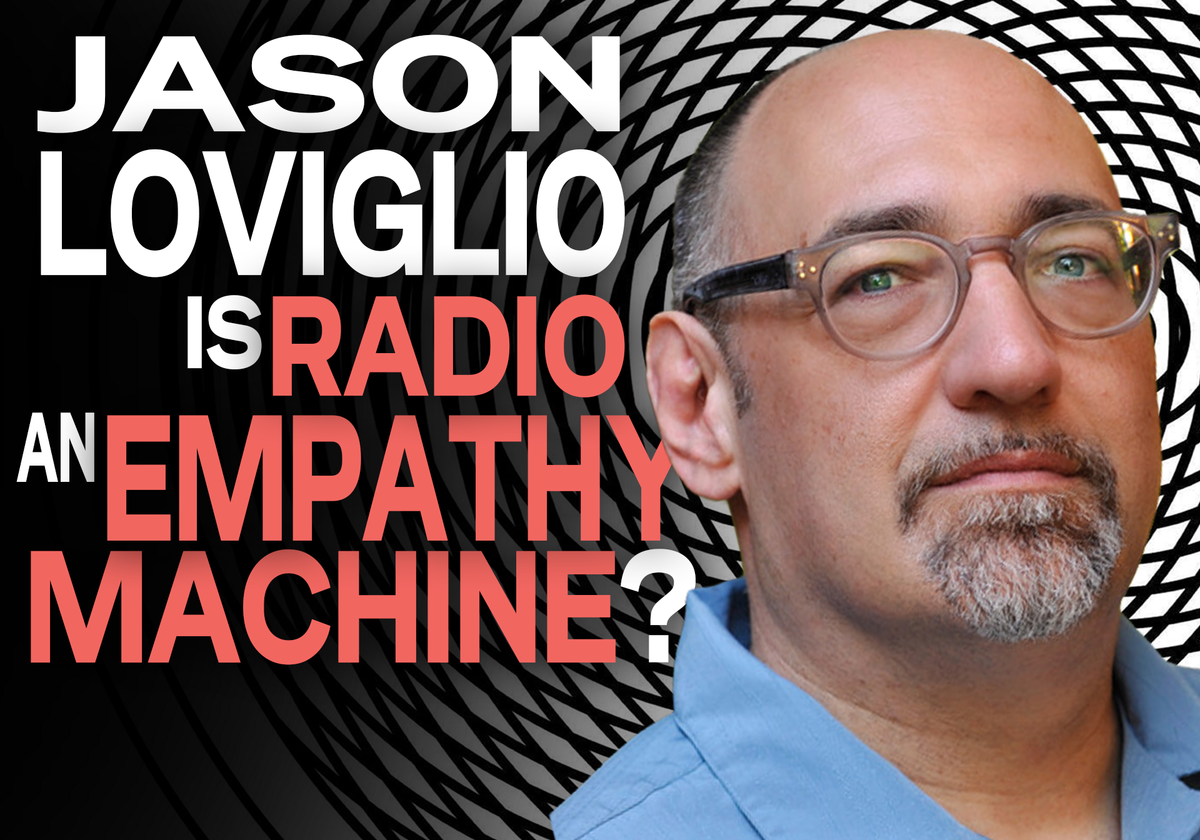
Podcasting's Politics of Empathy with Jason Loviglio
Today we talk radio, podcasting, and democracy with Jason Loviglio. Jason is an expert on the history of National Public Radio and a key theorist of how audio media have changed the public sphere. He traces the politics of radio down to the smallest details, like the kinds of mics that are used, the way radio personalities use their voices, even the fan mail that comes in.
One quick correction: Jason accidentally refers to Julie Shapiro as Senior Producer at This American Life. In fact, Julie Snyder held that role. We regret the error.
In this episode, Jason Loviglio discusses everything from FDR's fireside chats to the politics of NPR to his new book, Empathy Machines: This American Life, Podcasting and the Public Radio Structure of Feeling, the first full-length book on This American Life. He argues that TAL was designed from the start to function as an empathy machine, but over the years, the politics of that empathy have changed substantially.
Jason Loviglio is Professor of Media and Communication Studies at University of Maryland, Baltimore County. Jason is the author of Radio's Intimate Public: Network Broadcasting and Mass Mediated Democracy. He's the co-editor of Radio Journal and he has edited three different volumes on radio.
Cited Media:
Books:
- Jason Loviglio - Radio's Intimate Public: Network Broadcasting and Mass-Mediated Democracy (2005)
- Jason Loviglio - Empathy Machines: This American Life, Podcasting and the Public Radio Structure of Feeling (2026)
- Benedict Anderson - Imagined Communities: Reflections on the Origin and Spread of Nationalism (1983)
- James Tobin - The Man He Became: How FDR Defied Polio to Win the Presidency (2014)
- Eric Nuzum - Make Noise: A Creator's Guide to Podcasting and Great Audio Storytelling (2019)
- Sara Ahmed - The Cultural Politics of Emotion (2004)
- Raymond Williams - Marxism and Literature (1977)
Podcasts / Radio Programs:
Essays / Speeches:
- Newton Minow - Television and the Public Interest "Vast Wasteland" Speech (1961)
- Theodor Adorno - The Culture Industry Reconsidered (1975)
Transcript
Intro: SpectreVision Radio.
Jason: The idea that radio is an empathy machine is not the first, nor is it the last, right? Since the Tower of Babel, I think there's been this idea that if humans could organize their symbolic processes properly, there would be a better way of getting along.
Julie Shapiro, the executive producer of This American Life calls them, empathy machines, radio. So, the problem is whose empathy, whose machine?
Intro: This is Phantom Power
Mack: Welcome to another episode of Phantom Power, a podcast about sound. I'm Mack Hagood. Today we're talking radio, podcasting and democracy with one of the United States best radio scholars, Jason Loviglio. Professor of Media and Communication Studies at University of Maryland, Baltimore County.
Jason is the author of 'Radio's, intimate public network broadcasting, and mass mediated democracy;. He's the co-editor of Radio Journal and he has edited three different volumes on radio. For a couple of decades now, Jason has been exploring radio's role in the American democratic experiment.
Besides transmitting sound over a distance, one of radio's affordances is its ability to foster an "imagined community," political scientist Benedict Anderson's term for how media enable us to imagine ourselves as part of a collectivity, even though we'll never actually know all the other members.
It was entrepreneurs printing books and newspapers in the local vernacular that allowed people to have a shared discourse and imagined kinship making possible the nation state as we know it, or at least that's Anderson's thesis.
For me, Anderson's theory highlights the fragility of nationhood as something that ceases to exist when we stop imagining it. In my teaching, I often compare it to when Tinkerbell dies and Peter Pan breaks the fourth wall, pleading with the audience to clap their hands if they believe in fairies.
If a nation exists only if we believe, and if media are the only evidence that we can have to support our belief, well, then you can immediately see why something like National Public Radio, which Jason's an expert on, is such a politically charged and contested institution.
One reason I like Jason Loviglio's work so much is that he thinks about this big political picture as it pertains to radio history, but he attends to the smallest details. The kinds of mics that are used, the way radio personalities use their voices, even the fan mail that comes in. He's interested in how the politics of radio and podcasts are always deeply personal.
So today we're talking the politics of Radio. Jason Loviglio discusses everything from FDRs Fireside chats to National Public Radio to Jason's new book entitled Empathy Machines: This, Podcasting and the Public Radio Structure of Feeling. It's the first full length book on This American Life.
And members will get an extended version of the conversation, including some great advice for scholars and an explanation on how Jason has gotten to interview almost every famous NPR personality you can think of. To become a member, go to mackhagood.com. That's also where you can sign up for my free newsletter on sound, listening, and other things.
I'm still getting a lot of emails and messages on my last newsletter about the state of college students today, and I'm just starting to write my follow up on how I'm thinking about teaching this fall. So if you want to get that, go to the website.
You can also find Phantom Power merch there. And just one bit of housekeeping. I am going to be taking a summer break for the coming month, so we'll be re-releasing some classic Phantom Power episodes in July. I'm really trying to make progress on my book and also my wife and I are celebrating our 25th anniversary, so we are gonna take a vacation. But I will see you back again in August.
Alright, without further ado, here's my interview with Jason Loviglio.
Alright, Jason, welcome to the show.
Jason: Thanks for having me, Mack.
Mack: So you've had a long and successful career in radio studies, and one of the things that I really appreciate about your new book is it's drawing on all of these themes that I've seen in your prior work and really using that as a platform to build this argument about This American Life. But I thought maybe we could just start off by talking through some of those themes that you've engaged with in your career.
And so the first one that I'd like to talk about is this beautifully contradictory phrase that is in the title of, I believe it was your first book. So what is an intimate public?
Jason: Thanks for the question and for the time, this is a real thrill. This is like when Johnny Carson asked the comic to come sit at this chair. It's getting to be on Phantom Power, so I appreciate that. a bit of a, a deep…
Mack: No, hey, I recognize it.
Jason: Yeah, so, Intimate Public was my first monograph, and I was trying to capture the way that early network radio, tried to remediate a lot of the imagined and real public institutions of a democratic republic, in their names, lots of town meetings of the airs and theaters of the airs and courtrooms of the airs, lots of attempts to sort of skeuomorphically attach familiar public institutions to the radio program. And both sort of public in the sense of government, municipal, accessible institutions, but also the sense of a kind of a commercial consumer republic. Kind of a going out sense of public. and that the way to do that in a medium that is defined by a close-miked voice, amplified close-miked, broadcast is, very different from the kinds of sounds of a noisy public square or, the very specific sounds of political and social institutions.
It required its own sound which was intimate. And the m- evidence for that was in the 15 million pieces of mail that Franklin and Eleanor Roosevelt received. I did not read all of them. But the ones I read at Hyde Park at the Eleanor and Franklin Roosevelt Museum and Library, really attested to this sort of parasocial fantasy that people would be writing to the president during the fireside chats, like in the middle of the broadcast and, you know, comment on his vocal quality, noticing when he coughed, you know, making sure to close this loop of parasociality that, I'm hearing you, but I feel invited to be heard by you.
And then just sort of tracing that impulse across many different kinds of radio genres, including soap operas and quiz shows and thriller shows like The Shadow in addition to national broadcasts like the fireside chats, which were more political and governmental in nature, to really show how the public-private divide was constantly being transgressed. Not in order to obliterate it, but to sort of reconstitute it in terms favorable to new ways of thinking about national identity that sort of encouraged national identity through consumerism or national identity through a kind of imagined racial and political unity for the war effort. The public-private thing is still with us today. It's a border that seems to exist only to provide occasions for powerful forms of transgression.
Mack: I really love the move you made there, which, you know, everybody gestures to FDR and the first radio president. But the fact that you went and read the letters that people wrote to him, I just think is so great. And I'm wondering, like, were there any surprises when you did that work? Like did it just sort of confirm notions that you already had or were there any things that jumped out and you said, "You know, I did not anticipate this"?
Jason: I think one of the surprises has been how much the telegrams and letters sent to Roosevelt in the '30s and '40s sound like the letters and telegrams sent to Eleanor in the '40s and '50s, and how much they sound like the fan mail sent to Susan Stamberg in the 1970s, and 90's.
Mack: NPR's Susan Stamberg.
Jason: Yes, the founding mother, voice, with a similar ambition and a similar success at bringing together affairs of state, a kind of a national, political, civic public with an emotional appeal, to a kind of parasociality and a kind of intimacy.
Franklin D. Roosevelt: My friends, I want to talk for a few minutes with the people of the United States about banking. To talk with the comparatively few who understand the mechanics of banking, but more particularly with the overwhelming majority of you who use banks for the making of deposits and the drawing of checks. I want to tell you what has been done in the last few days and why it was done and what the next steps are going to be.
Jason: So, people write to these folks in very similar terms and express to them the importance at an emotional level of the sound of their voice.
Mack: What did FDR- Because this is one of the things I love about your scholarship, is that you really do pay attention to what the voices on the radio are doing and then connecting that to these sort of higher or political conceptions that you have. But down on, a sort of performative level, what was FDR doing with his voice that sounded so fresh and resonant to people at that time?
And was that something that he was trained to do? Was it something that he just naturally a sort of skill he had? You know, this is something that gets discussed a lot, but it's really worth talking about. It's like a different mode of address.
It doesn't sound like a person standing at a lectern speaking to 1,000 people. It sounds like someone speaking to one person, to the listener
Jason: Right. Right. Which if you've had any training in radio broadcast or podcasting broadcast, that's still the first voice coach instruction, right? Is to imagine you're talking to one person, and maybe even to imagine you're talking to a specific person, like your mother or your aunt or your some friendly relation or friend, but that was an invention, right? Like they had to figure that out.
So the thing that made Roosevelt distinct was he worked at it for a really long time. So when he was governor of New York, he was doing periodic broadcasts. I don't have hard evidence to prove the rumor that he listened to radio broadcasters like Dr. John Brinkley, of the goat gland cure, A medicine quack, who encouraged people to come down to his clinic in Kansas, to have goat testicle tissue inserted in their scrotums, to give them the kick.
And he made millions and actually ran a successful write-in campaign for Kansas senator, and it was only because the write-in ballots were mostly ruled ineligible because they didn't write his full and complete name with the middle initial and everything like that. so he was enormously successful.
Mack: Wow. Is that clinic still open today? It might be just what I'm looking for. I mean, I don't know. It sounds like a great technique.
Jason: It is in the sense that you will hear similar cures for various masculine maladies in the man-o-sphere, in the podcasts and the radio shows and late night. So that is a theme running through.
But so he was very keen to use the radio as a governor in the '20s in New York, and he was very keen to continue to develop this sort of non-physical political presence after the onset of polio made it difficult for him to do the kind of retail politicking. And it was really part of a very conscious strategy with the very active and crucial help of Eleanor, his wife, to develop this sort of prosthetic, kind of, voice, that could be heard with her moving around and doing a lot of the politicking in face-to-face retail kind of politicking.
But also with him developing an incredibly sophisticated letter-writing relationship with his constituents even before he hit the White House. And then finally, you know, he was meticulous. There was a slight whistle that his voice produced when he was speaking into a microphone because of a space between his teeth, and he was fitted for a dental prosthetic to remove it, and he wore it only broadcasting.
He kept the broadcasts very infrequent, maybe only four a year. So it wasn't a regular thing. It was an event. So he understood the sort of the concept of a media event, maybe helped to invent one. And he also spoke in a cadence, and a pace that was much lower, much deeper, and he also had this sort of, strangely middle Atlantic accent that was neither foreign nor completely quotidian, right?
Mack: like the Hollywood accent of the day.
Jason: Yeah, and someone, some wag said that if Hoover had delivered the first fireside chat, instead of booing America's spirits, the market would've tanked even more and all the banks would've closed. which is again a nod to the sense that here was someone who knew how to perform and that it wasn't so much the text of the speech, as it was his delivery, which was slow and confident.
Mack: It's so interesting. It's almost the opposite of what happened with Biden, right? Where he's using the vigor of his voice to overcome perhaps certain worries around disability that the public might have. Whereas with Biden, it was this faltering voice, and you could hear the lack of power in the voice over time that really seemed to mark him as being old and feeble, maybe more than anything else
Jason: Yeah. Right. And, I hadn't thought about that most recent political manifestation, but right, it go- it runs right through the history of the country. People have talked about the faltering, shyness that bedeviled Thomas Jefferson, which made him want to deliver his address to Congress, which we call the State of the Nation Address, by letter because he was uncomfortable with oratory.
And of course, the Nixon-Kennedy debates, which people have long sort of decried because of the televisual advantage that Kennedy had. They always are very quick to say that people who listened to the, you know, the radio, tended to think that Nixon gave the better performance. Which is funny to me because it assumes that the radio was an unmarked, neutral way to experience them, right?
That that was somehow more authentic. But it was, of course, just as much a construction, as the television version.
Mack: I just want to mention if anyone wants to read a great FDR biography that really thinks a lot about his polio, my colleague James Tobin's book, "The Man He Became," is really fascinating, yeah.
Okay. So that's the sort of intimate public dimension of things. I think another concept that I'd like to pull out before we get into the specifics of this book is, just sort of the way you've increasingly been, maybe not increasingly, but you've definitely been thinking about radio as an affective medium, right?
Like that intimacy part has to do with the transmission of affect. You've written in the new book about radio as a feeling medium. So could you maybe talk about some of the theoretical underpinnings? Like, you know, I know you're drawing on Raymond Williams and Sara Ahmed.
Jason: Yeah. So, I'm drawing on Raymond Williams' notion of structure of feeling, which which, like the concept itself, he never fully precipitates, right?
Its just sort of... But it really has spoken to me and many, many others, in the many years since he...
Mack: So how would you, how, what's your definition of structure of feeling? 'Cause he doesn't quite nail it down for us.
Jason: No, he doesn't. But to me, the reason it proved to be the thing that I really clung onto when I was writing this book, the most recent book, Empathy Machines, is because it captured for me this sort of, this sense of being in a historical moment, which we always are, but sort of getting it, but also sort of not getting it.
The phenomenology of the present, right, with this sort of a ghost of historical sensibility, right? That we don't know, which of the jokes or memes are going to become the defining features that people refer to in historical films about 2026, right? But we are living them, So we're in this sense of possibility, right? And we're also very much in this sense of a moment of danger. Is it Walter Benjamin who talks about a moment of danger that's, that rises up in a moment of crisis and he says, " If we don't meet the moment, then even the past won't be safe from history."
So there's this kind of a powerful sense of the ephemeral quality of history as it's lived. in the air, but it hasn't actually hit a surface, and condensed into something we can describe. And I love that sense of it because of the way that radio has sort of emerged, not only as a kind of an archive of daily life for the last century, but also 'cause it instituted, as Kate Lacey says, it sort of created a new sense of time, of sort of a new temporality of the kind of the broadcast present. This kind of, collectively shared, electronically mediated now. That was sort of a new thing in the world. So I guess I find Williams attractive precisely because he is so interested in, well, television in particular, but also just in the sort of the 20th century technologies of producing this mediated now, and how available it is phenomenologically, effectively, and how hard it is to grasp historically or materially.
Mack: Mm-hmm. And then the Sara Ahmed, I think dovetails really nicely with that because she's talking about, you know, how our emotions aren't innate. They're not simply interior, but they kind of emerge in this possibility space of this now, right? Like, the types of emotions that seem to come from us internally and naturally are actually very much in conversation with things like radio.
Jason: Yeah. No, that's very well put, and that's the reason I think that she was the person that I relied on most for thinking about this because unlike a lot of other brilliant folks who write about affect, like, Lauren Berlant, who I love, and Massumi, a lot of great work out there, she writes about it in a way that's so immediately understandable and that so immediately evokes the way that things that are often, like, hard-won and tortured, torturously expressed by academics, are just completely part of the normal daily lexicon.
Like my students talk about catching feelings for someone that they might be having a relatively superficial relationship with. And again, this notion of feeling just something that sort of moves that way, right? And that sort of covers them and forms them into new social formations without actually residing in them, I think shows the kind of common sense way that Ahmed describes the power of affect.
And also, of course, she's making an intervention, along with many, many others a-about sort of moving away from a Freudian notion of interior feelings and interior psychic constructs that sort of need to be resolved with the outside world rather than a much more complicated entanglement.
Mack: So for you then, like radio is a space where we have new kinds of publics. We have ways of engaging with the political, but it's also this very sort of intimate personal medium, expressed through the voice, you know, the one-to-one voice. And so there's this interesting doubleness. It's this space where we can catch feelings, but it's also a space where our politics is being formed.
But it's also very individualistic in that intimacy, right? So there's a contradiction there between, are we really creating a public? Or are we doing something that is in a clear trajectory towards like the personalized social media feed where it's really aimed at the individual?
Basically, we're talking about neoliberalism here, right?
Jason: Yes. Yes. Right. Well, so yeah, so I mean, and I, and I do, I think, just a person have a bit of a tension between my own profound affection for radio, going back to my time as a child who had trouble going to sleep and had a little red transistor radio he put under my pillow and would listen to all the crazy late night radio talk shows and just that tremendous feeling of comfort. So on the one hand, there's that, on the other hand, there's, yes, v- clearly, all the folks, all the theories and political concepts that I've drawn from my career in reading, has been pretty unanimous from Adorno to Williams that, you know, these are culture industries, right?
These are not a democratic- bertolt Brecht says, you know, "If only we could have two-way radio." I wonder what he would think of social media as two-way affordances. He might have some thoughts about the shortcomings of the algorithmic media, two-way forms of communication. So there's always this problem, right? Which is that we are, you know, alone, in places of isolated reception, experiencing a fantasy of connection. and that's sort of what drew me to This American Life because of its virtuoso achievement of this kind of community building, compelling storytelling, but with a kind of a built-in, disregard for the role of politics and history in constituting the communities that we long for, that we are drawn to, that we find, impossible, or that we critique.
Mack: Yeah, you know, you mentioned Adorno, and I have very mixed feelings about Adorno. When I was younger I Especially his writing on jazz, and I was like, "Oh man, fuck this guy," you know? And, and, and we're like, we're studying British cultural studies and everything, and we're like, "Yeah, come on, Adorno."
And, now that I get older, I'm like, is this like a blinking red light on the dashboard that I'm becoming an old crank? Because Adorno is starting to make more sense to me. But like, you know, in "The Culture Industry Reconsidered," he talks about how the culture industry creates what he calls substitute gratifications, and so it's basically cheating you out of an authentic human connection and then replacing it with this commodified thing that isn't as nutritious, which is something that I've kind of been thinking through lately when it comes to social media feeds and so forth. Just talked about it in my last episode.
So yeah, I don't know if I'm going off some kind of deep end with Adorno or not. I'm gonna try to not go too far in that direction. But it is interesting to think about This American Life, and NPR more generally, because you have sort of traced the history of NPR in a really skillful way, as embodying this tension, right?
Is it giving us a feeling of democracy, or is it actually, you know, manifesting a kind of fruitful democratic experience that's really important to our society?
Jason: Yeah, I totally identify with your mixed feelings about Adorno. I think you might wanna add into the equation not just the change in your age, but the change in your country the change in the capacity of corporate telecommunications conglomerates, right? So
Mack: Yeah. Yeah, for sure.
Jason: There's other things going on there.
Mack: For sure
Jason: but I, I'm right there with you. your question?
Mack: Oh, just thinking through, I mean, you know, I, I guess it's a good way to pivot into NPR, because I would say that's a- another theme that shows up in your work, right? Is like the long history of NPR and the way it does parallel- Basically, it appears around the same time as neoliberalism, and that you've kind of really studied this parallel and interplay between the two.
So could maybe talk a little bit about when NPR was founded, what its mission was, and then what tensions have surfaced in that mission?
Jason: So yeah, most of your listeners, I'm guessing, are American or familiar with the American context of broadcasting, but that may not be right. And for those around the world, it's worth mentioning that United States is almost unique in the world for having a broadcasting system starting in the 1920s that was, almost entirely dominated by commercial interests. And we only had a very kind of anemic community, a nonprofit station, patchwork, usually connected to colleges, universities, occasional church, right up until the very end of the 1960s. And so that makes us a bit of an outlier.
Throughout the 1960s, there was an increasing awareness of the shortcomings of the commercial broadcasting system, particularly a kind of moral panic around payola, which was a sort of the illegal then payment to disc jockeys, to play certain records, in higher frequency than they might otherwise have done.
There was also a moral panic around television quiz shows which were seen to be rigged. And finally, Newt Minow, the FCC chairman's famous 1961 speech to the National Association of Broadcasters comparing their commercial television offering to a vast wasteland, and kind of putting them on notice, right?
So there's this attention to the threat, very real after World War II, of robust government intervention into broadcasting's access to the public airwaves. And then also a kind of a great society hand-wringing about ways to solve some of the lingering problems in the country, particularly those problems that got in the way of Cold War rhetoric about America as a city on a hill, and as a beacon of freedom, and as a beacon of equality.
So all of those things really come together in various committees and panels and gatherings that are organized by the Congress, but are overseen by private individuals, which results in a report in 1967 and subsequent legislation the 1967 Public Broadcasting Act, which produces the Corporation of Public Broadcasting, which then funds public television and NPR. It's worth mentioning that the Corporation for Public Broadcasting was shuttered last year when the Congress and the President finally made good on a half-century of threats to defund completely public media.
So public radio was born with a very impossible mandate, and I think that that mandate is kind of a metaphor for the weakness inherent in Cold War liberalism, right?
It's given this vast and utopian Great Society kind of mission to educate, to represent the underrepresented Americans, which include African Americans and children, and the highly educated who maybe did not wanna watch "The Beverly Hillbillies."
Jason: So it was also underfunded. It was just a tiny fraction of the bill, authorized money for radio.
Epublic television was underfunded, but not nearly as badly as public radio. So it sort of hobbles into the spotlight in 1970, with almost no resources and an impossible mission to produce highbrow quality broadcasting, to solve the kind of ingrained racial inequalities in representation on the media and also to avoid periodic rounds of congressional budget cutting, which were constantly being threatened from Nixon, right up until last year.
Mack: So kind of a the age-old story of the American government not being sure what it wants to do, and creating mission statements and then not funding them and that sort of thing. And then that brings about this tension that we see in other things in the United States, like the post office or what.
It's like, was this designed to serve the public or is it supposed to be some quasi-commercial system that's supposed to somehow run a profit? It seems like that tension leads to a certain kind of confusion in the mission of probably both television and radio in terms of public radio.
Jason: Yeah. I mean, I think that a very parallel story's happening on PBS during this time. But what makes public broadcasting different from public schools and public libraries and many other public institutions that are sort of funded just enough to disappoint everyone and to reinforce a kind of Hayek neoliberalism, is that the networks decided free market principles and to tailor them to fit public radio and public television.
And in particular, they embraced audience research and psychographics, which was this sort of quasi-scientific study of people's values and tastes, in order to create a sort of, hybrid monstrosity that was one part public mission, and several other parts serving a very particular kind of listener, a very particular kind of audience member, that was wealthy enough to make annual donations. And, in addition to paltry public funding and, and some foundation grants, and the membership fees, they also had lots of underwriting, which in any other context would be called, genteel advertising.
But again, the advertisers were looking for a very specific demographic of highly educated, and well-to-do listeners.
So it actually thrives, and NPR by the end of the 1990s has a massive audience and you know, is competing with CNN and The New York Times as the news, right? Like that for more and more Americans, tens of millions of Americans a month are tuning in by the turn of the century.
Mack: You know, that's so interesting, right? Because, again, we get into this tension between serving the public, whatever we imagine that to mean. But then, like, to succeed in any kind of media in a commercial setting, usually you need to zero in, as you say, on a specific listener. And in fact, I'm thinking right now about, Eric Nuzum's, a old hand at NPR, and he has a book on podcasting that I've taught in my class before. And, like, one of the very first things he tells you is, like, "you need to identify a specific listener down to, like, what does this person look like? Find a picture of them, put it on your wall. And of course, the minute you do that, the idea of a public is out the window.
You know, you're narrowcasting. And so there's been this really interesting tension I felt just in teaching, between what I feel like is the sort of democratic ideals of being a humanities professor and then the best practices, which are to tell my students to, like, find a very niche audience and, like, drill down into that.
And it's like, forget the idea of a society, right?
Jason: Yeah, he was there at the foundation of NPR's very first efforts to create their own boutique podcast in the early 2000s. And I don't know if the Joan Kroc money that came in, in the middle of that decade I think really helped NPR to move into the digital platform age, among other things. Yeah, it's the problem that the second chapter of the book really explores all of the audience research documents and reports, and they make for hilarious reading because they're very clearly, you know, men in ties with suits, as Alan Stawiski described them in his dissertation about audience research in the '70s and '80s at NPR.
They're clearly defensive and anticipating the kind of public radio hippies rolling their eyes at all of this audience research. But, you know, at one point one of them says, you know, "This is how radio works," right? Like, you have to do this. I mean, I've been to Australia where they have a wonderful third sector community radio system where you go on and you talk about radio for half an hour and as you leave, in comes the anarchist who's got half an hour on anarchist politics, and there's the Brazilian chef waiting for her slot.
So we know that radio can be many things, right? And there are many models to success. But the idea of a continuous flow in which not only is the audience identified precisely, but that there is no upset program to program, program to station break, program to news hour, top of the news.
All of these things have to be meticulously engineered, so as not to create a sense of rupture or impasse. So there is a very strict rule about not doing any kind of audio compression, when sending the uplink to the satellite, so that everyone gets everything at the same volume.
Also, of course, there's no pitch compression which you hear on AM radio, particularly when they're trying to squeeze a few extra half seconds out of an broadcast hour by speeding it up. So you get also this, pretty rigorous, doctrinaire approach to vocal performance.
You have vocal coaches who teach everyone how to speak the same. One woman at WBUR was told she was pronouncing her last name wrong.
Mack: Oh, wow
Jason: And you also have an industry standard microphone. Everyone has to use the Neumann U87 microphone with the bass shut off so that the voices would resonate higher than the low rumbling frequencies that people would hear with their tires on the road, because most of American radio reception happens in the car.
So there's really a kind of an entire sonic regime that is built up around making sure that not only do you appeal to a very specific person, but that that appeal is sonically as well as narratively and politically, socially, culturally consistent, over the, you know, multiple day parts.
Mack: Yeah. Yeah, that's fascinating. So I think we've set the stage of like some of the thematic concerns that you've been addressing really throughout your career, as well as like the history of NPR. So maybe let's get into what the new book is about, which is This American Life. I don't know, do we need to tell anyone what This American Life is?
We probably need to talk a little bit about it. So, do you wanna tell us who they are and, and its cultural significance?
Jason: Yeah, happy to. So, This American Life starts in 1995 as a local radio program in Chicago on WBEZ once a week. It's called Your Radio Playhouse at first, which is a kind of a nod to radio's olden days. Remember I was talking about the skeuomorphic ways that early radio shows tried to sort of, you know, say they were a theater of the air or a playhouse of the air or something like that.
So Your Radio Playhouse was sort of a very '90s arch sort of nostalgic throwback to what were some of the wonderful affordances of old radio, which was the sort of emphasis on stories and emphasis on first-person vocal testimonies and, you know, sort of narrative enchantment. And the show very quickly becomes a big success, gets picked up and distributed by a national distributor. NPR famously passes on it. and people often don't know that when you turn on your public radio station, you're not necessarily getting NPR. You might be getting some distributed contract from PRI, something produced by your local radio station, increasingly getting things from the BBC.
So, This American Life essentially puts pressure on the entire public radio way of doing things by really issuing this challenge to start to loosen the collar of public radio sound, introducing this much more, conversational, chatty, informal, playful style.
Ira Glass: Okay, we're what? About a minute. We're one minute five into the new show. Right now, it is stretching in front of us, a perfect future yet to be fulfilled. An uncharted little world, little baby coming into the world, no little scars, no little anything. Nobody hearing my words right now is thinking, "Oh man, remember what, that show back when it used to be good?"
Mack: And to just give a prime example of that, you give a close listen to the very first episode of the show which I've never heard actually. It made me realize, when I was reading, I was like, "Oh, I gotta go give that a listen." But you describe sort of the ritual slaying of Joe Franklin and then also the show's debt to Joe Frank.
So maybe could you talk about those two very similarly named radio broadcasters, and how This American Life kind of positions itself vis-a-vis the two of them?
Jason: Yeah. Yeah. so there's a wonderful history, a prehistory of This American Life and of public radio, that would begin with folks like Joe Frank.
Joe Frank: It was twilight, dusk. I was in a deserted part of the city with a six-year-old boy, presumably my son, though I sensed somehow that we just met, that I didn't really know him. We were in a residential district of low-rent, single-dwelling houses with beat-up wooden porches and small, untended backyards and sidewalks with grass growing up through the cracks.
Jason: Who was a, uh... It's very hard to capture his style, and I think what Ira Glass does is and wildly different. But Joe Franklin embraced a kind of comedy of the absurd, a theater.
Mack: Joe Frank
Jason: Joe Frank. Sorry, Joe F- Yes, we're gonna have to keep me honest here. Joe Franklin was a kind of... He claimed to be the person who invented talk radio.
Joe Franklin: When, uh, movie stars were movie stars, there was one glamorous, one enchanting lady. She became known, I guess, if you want to look at the picture on the back of the cover, as the Scream Queen. She was the most sizzling and gorgeous, and still is the most dazzling heroine in the movies, Fay Wray, author of a brand-new book.
Jason: Which, there are many, many claimants to that history, and we have luckily a wonderful dissertation by Sadie Couture coming, I think soon, that looks at the history of talk radio, the early, early years of.
Jason: So he's more of the traditional white male mid-century, Larry King style broadcaster that, Ira Glass is very keen to distance himself from by doing this much more arch, ironic, and media savvy kind of like, you know, now embracing radio's more emotionally effective traditions, and now fending them off as if to say, "You know, that's so lame."
So he's sort of doing a lot of that work in the first episode, but he's also really trying to channel some of the, really lovely early public radio work of, you know, of the Kitchen Sisters were early pioneers in this really carefully, lovingly audio sound pieces, documentary pieces. Joe Frank does these very, deadpan comedy bits where he describes, you know, the situation of going to the bathroom and having to spend more time wiping than he had assumed because of a kind of persistence that can't be easily removed. And again, it's like a situation that nobody had ever spoken about on the air, even I don't wanna talk about it now, but that is also universal.
So a kind of an arrestingly honest and absurd and provocative, you know, David Sedaris described Joe Frank as like a fist coming out of the radio.
So Ira Glass is doing a very different thing. But he's sort of claiming multiple radio histories as he's trying to also do something that is, he's explicit about as a critique of the serious pomposity of public radio circa 1996.
Mack: Yeah. And so, you know, Ira Glass somewhat famously, I think, only had two jobs in his whole life. He was a birthday party magician, and he was a radio producer.
So I mean, could we talk about how Glass does his magic? Like, I would say you, you have a chapter where you really drill down on this, on like what he's doing aesthetically, how he tells story.
If I had to boil it down to the most simple basic form, it seems to me that you're sort of saying he oscillates between empathy and irony, and when we get too empathetic, then we do something ironic, at least, especially in the early years of the program.
Jason: Right. No, that's exactly right. And it's sort of the one thing that keeps happening again and again, I mean, even right up to the most recent year of shows. I mean, it's still going, by the way. We should say the show started in 1995 at WBEZ. It's still going strong as a radio show, that is heard on the air in the US, but also in Canada and Australia, and is heard by many millions as a podcast.
It's often in the top 10 podcasts. So we have an extraordinary run for a radio show. I don't know if it's unmatched for this kind of show, but it is extraordinary. It also is a, as I say in the book, a multimedia franchise with movies, with a shortly lived television show,
live performances. It's a sort of a multimedia kind of platform, for a particular kind of sensibility. But chapter three where I talk about magic, there is a kind of a ta-da built into almost every story where he sort of uses music, as a sort of a bed. You know, this sort of little vamp happening, to punctuate and to sort of remind us how to feel.
But, you know, anecdote, anecdote, insight, you know, this sort of takeaway. he, he, he actually has talked about this in interviews dozens of times. People always ask me if I interviewed Glass, as if he hasn't been the most explicit and most transparent person, he's like the magician who tells you how he does the tricks which is a no-no.
And I'm sure as a magician, he would never do such a thing. But as a radio musician, he is dedicated to performing little gems of stories that produce these moments of anticipated delight and amusement, and these are the terms he uses for his listeners. And really, he's kind of hoping that people are mirroring his delight and amusement, and his sort of MO is like, "I go for things that I find delightful." And then because he is a meticulous editor, he then produces a seemingly casual conversation which has in fact been extraordinarily highly produced to produce a moment of delight or amusement, or increasingly empathy, for someone.
Mack: Yeah. And I gotta say, I don't really listen to the podcast anymore, not because of any particular reason except that I tend to be kind of a fickle fan and I get tired of things. I feel like, oh, I've kind of absorbed that and I, I don't really go in for when something becomes routine anymore.
But I mean, there were a number of years there where I was a passionate listener to that show in, sort of the early years of the show. It did seem to just embody a sort of Gen X sensibility. Cause I grew up hearing NPR in the car, and it was like suddenly I was hearing an NPR that was speaking directly to me, and I had never experienced that before.
I'd always appreciated NPR, but I was never like, "Whoa." And then there was this sort of sense of adventure, like in the best sense of like what radio can do, that many radio scholars have talked about. But like this feeling of transportation into these different spaces and with different personalities, and so we're encountering strangers as you point out.
So can you maybe speak a little bit to that? Because I think that's where we start to get back into some of the tensions we were talking about earlier between individualism and trying to create a society through radio.
Jason: Right. Yeah. So, I did a few, Python data scrapes of all the transcripts. First of all, every episode is available online for free. Every episode has a transcript for free. And for a while, I don't think they have it anymore, they even had like a, a little editing tool where you could like see the waveform and take snippets of the show and pull them out.
So that was great when I was giving papers because I could just, you know, pull the sound clips out I wanted. They don't have that anymore, but that gives you an idea of how completely the show has always embraced the sort of early internet give it away free ethos, right?
But Magic was a word that I used, the Python thing to scrape hundreds and hundreds of times the word magic appears.The only other word that even comes close in terms of frequency is stranger. There are episodes entitled Strangers. There are so many episodes that are about, chance encounters with strangers that produce moments of unexpected empathy, humor, danger, and they all tend to be resolved.
It's an incredibly formulaic story structure, and I don't say this because I'm a great literary structural critic. I say this because he has said, Ira Glass has said again and again and again that they build every story the same: anecdote, anecdote, big reflection. and, you know, there's something about the kindness of strangers.
That's, you know, literally a quote that he says as a way to caption a series of stories about encounters with strangers. So, you know, he's kind of telling us, you know, in the same way that the musical bed tries to give us an emotional register to experience the stories. He's also pausing to say, you know, just in case for those of you who are a little slow on the uptake, I'm trying to make a grand comment about the human condition, right?
And it's incredibly persuasive, right? In the same way that a magician bedazzles us through misdirection, he's constantly giving us something very clear to focus on so that we don't really realize the other things he's doing in order to produce this very powerful effect. Which, like you, when I was a younger man in the '90s, I felt like this was a show that was speaking for me.
I imagined that he had a little photograph of me in the studio, and he was like, "Talk to this guy."
Mack: Yeah. Yeah, That's incredible. I think one of the things that tells you though is that like, if the show is oriented around 'we are encountering a stranger', then there's a certain type of person implied in the we, people like you and me. And then the stranger, who's the stranger, right?
Like sometimes the stranger is somebody like ourselves, right? Sometimes the stranger is somebody else who does not resemble us. And so there's a whole sort of dynamic that you kind of pick away at. Can you talk about your interest in that and what you've learned from exploring that?
Jason: Yeah, and again, I, I can claim no great insight or even kind of theoretical rigor in trying to say, "Aha, you say we, but who do you really mean?" Because he you know? He says, like, "If you're like me, middle class with responsibilities,"
You know, like, he's intentionally identifying the fandom with a particular, you know, Bourdieu would call it a habitus, right?
A whole set of cultural and socioeconomic characteristics, right? Which are the exact socioeconomic characteristics that the audience research mechanism at NPR are in the process of perfecting even as he's sort of intuiting them.
Mack: Yeah. So then, I mean Is there a problem with that? Like is it at its worst simply that, okay, here we are a bunch of, you know, intellectual-ish libs and progressives and patting ourselves on the back because we're having experiences of empathy and diversity. Like, is that the worst case scenario, or can there be something more toxic about it than that?
Jason: No, no, that's a great question, and I think had it stayed that way, then maybe it would have just be something that we might, you know, put into the category of stuff white people like with like a small amount of, shame. You know, white there standing in for a whole bunch of other things.
Mack: Sure.
Jason: But, after 9/11, the show kind of realizes it has to grow up and becomes increasingly preoccupied with politics, and, particularly the American in This American Life. I think most of us assumed This American Life in the first five or six years, American there was sort of a, a lazy way of saying, you know, everyone's life, right?
In the national boundaries of broadcast signals, American could seem capacious, right?
But the American becomes a little bit more specific and a little bit more precise after 9/11, and they become a little bit more ambitious in wanting to do journalism and wanting to engage in the most important and the most urgent stories that are happening in the world. And so with that great power comes great responsibility to do a journalism that is open to critique, particularly on the lines of whose stories are you telling and who gets to tell the stories. And if empathy is produced always by a highly educated white person behalf of somebody who isn't those things, then it sounds very liberal and maybe very well-intentioned, but it also means some people do not get to speak, right?
The subaltern can't speak as Marx says, they must be represented, right? So it gets back to some very old questions about political agency versus being sort of the beneficiary of a kind of feel good liberalism as an object of a particular kind of politics of empathy rather than as an agent of one's own stories.
Mack: And you actually lift a term from Lisa Nakamura, toxic empathy.
Jason: Yes. And I only encountered a book very late in the process where she writes about that, and I think she's talking about virtual reality as the latest empathy machine, right? So I mean, the idea that radio is an empathy machine is not the first, nor is it the last, right? We have, since the Tower of Babel, I think there's been this idea that if humans could organize their symbolic processes properly, there would be a better way of getting along. And the novel is probably the empathy machine par excellence. Studies continue to be done on how reading a novel makes you more empathetic. Roger Ebert, the film critic, called famously movies are machines for empathy.
Julie Shapiro, the executive producer of This American Life calls them, empathy machines, radio. So, the problem is whose empathy, whose machine?
Mack: Yeah. And again, when you've got a public medium that has to operate on a basically commercial level, or has to organize itself around commercial logics in order to survive, you're probably never gonna resolve this problem, right?
Jason: Well, that's what's so interesting, and I think this is why it took me so long to write the book, is like I kind of needed a beginning, a middle, and an end. And what I found was that of the really highly rated, and extremely popular downloaded podcasts that emerge in the 2010s out of this sort of efflorescence of this public radio sound that This American Life kind of gives birth to, they all start to collapse in the second half of the 2010s as the contradictions inherent in this idea of privileged people telling beautifully made stories about underprivileged people in order to produce among other privileged people passing frisson of empathy, the better to go about their job of, you know, I don't know, foreclosing on houses or teaching media studies, whatever, going about their lives, that it actually kind of reaches this sort of period of crisis where the crisis is actually, impossible to contain narratively.
It's impossible to contain institutionally. The entire financial model of these kind of public radio-esque podcasts becomes unsustainable, and what you begin to see is in the same way that other neglected media spaces become places for creativity and risk-taking, as venture capital turns its back, as, the old model of the empathy machine seems increasingly politically bankrupt, you begin to see the folks who actually have something to say and are willing to try new ways of saying it emerge.
So you have folks who've never given up, keep going, like Chenjerai Kumanyika has been producing banger after banger of investigative podcasts that are beautifully told. You also have lots of people of color who've been very active, across media genres getting scooped up by This American Life.
So, during this period of turmoil when so many podcasts get canceled or just start to become rote, This American Life quietly decolonizes itself. So you have Ira Glass still at the top, but the executive producer and the managing producer are both Black women. You have an increasingly diverse staff of reporters and producers, and you have increasingly guest hosts who are not white men, standing in for Ira Glass and managing the acutely observed anecdote formula, but in the service of much more complicated stories and a much broader swath of the human experience.
So what's astounding to me is the show's ability to kind of chart the impossible contradictions it begins with. And then to sort of somehow limp into the beleaguered state we're in in 2026 in terms of media, in terms of politics, in terms of empathy, in terms of our own kind of pathological relationship to media consumption for many of us, as robust and as creative as ever, and as having kind of provided, at least for me, a kind of a respite from the very worst contradictions and tensions of this sort of liberal to neoliberal structure of feeling.
Mack: That's really interesting. Yeah, I, I would like to check out some of that. I honestly haven't listened since the very early 2000s, so I, I
Jason: Well, y- but you kinda don't even have to because whatever you're listening to, I'm gonna sorta say grandly, is I’m guessing, been touched by that,
Mack: Oh sure.
Jason: I think we’re listening to voices that I'm guessing that you would've sought out interesting and obscure things, but I, think we're seeing a platforming of a smaller ambition, podcasts and audio work and other kinda journalism and other kinda storytelling that really is no longer beholden to this culture industry that This American Life kind of invented, and then I think has kind of tried to deconstruct, you know, while flying the plane, rebuilding the plane while flying it.
Mack: So that's on the production side. Do we have data about whether This American Life and NPR more generally have managed to diversify their listening audience?
Jason: The data that I have for both of those things are a little dated to 2024, where it seemed like that at least on the podcast side, as podcast listening becomes more diversified by age and other demographics, NPR and This American Life are as well. I don't know that they're outstripping the general public, uptake of these shows.
The other thing is that there's like this Cambrian explosion of podcasts. I think that we could say maybe in 2014 that like, oh, you know, every quarter the number of people who are listening to a podcast goes up a little bit or every year. But now I think in the mid-2020s, we don't talk about podcasting so much as a thing to listen to as much as a thing to do in the same way that we might think about punk, the punk thing is to start a band, right?
Or, or with Steven Duncombe, like it's making a zine that makes zine culture, right? So, when I started teaching, it was a sort of a sine qua non to have a resume and a business card. Now it seems like any sort of self-respecting individual subject needs to have a podcast as sort of, as sort of a, a, a, a, extension, or sort of a proof of life.
I don't include you or this podcast in that.
Mack: I mean, you should probably. It's been interesting for me, as I've tried to learn more about podcasting in order to teach it and also to do it, to just to see how many small businesses rely on a podcast to do certain kinds of work for them, right? In this kind of, personality-driven, neoliberal everyone's their own business world that we live in.
Podcasts are terrible for exposure. It's really hard to grow a podcast audience. So, people are mistaken if they think they're gonna grow their business by starting a podcast and that that's gonna get people's attention. There are other mediums that are much better at that.
But what podcasts are so good at doing, and I think this is borne out by the This American Life experience, is establishing trust. And that this parasocial relationship that a person is then, like, willing when they are ready to make that big financial decision or whatever, "Oh, I've been listening to this person's advice pod for a long time.Now I'm gonna go ahead and close the deal with them."
Jason: Right. Yeah. they're enormously, good also at, you know, producing those first jobs for our students, right? I mean, I've been teaching long enough, my students would be the person who would build the website for a business, a local business. Now they're getting the job as editing or producing a podcast. and I think it's not bad that we are learning how to edit, compose, and think in, audio, well, in audio-visual, in other formats, and that our students are learning these kind of forms of composition and forms of presentation.
Mack: Yeah. Well, I don't know. This has kinda landed on a surprisingly positive note. how often does a scholarly conversation do that?
All right, man. Well, this has been really, really fun. Thank you.
Jason: It has. Thanks so much. Take care.
Mack: And that's it for this episode of Phantom Power. Huge thanks to Jason Loviglio. Be sure to buy his book 'Empathy Machines'. Today's show was edited by Cameron Naylor Social Media by Abe Hagood back episodes, newsletter, and more at mackhagood.com. Thanks for listening. I'll talk to you again in August.
