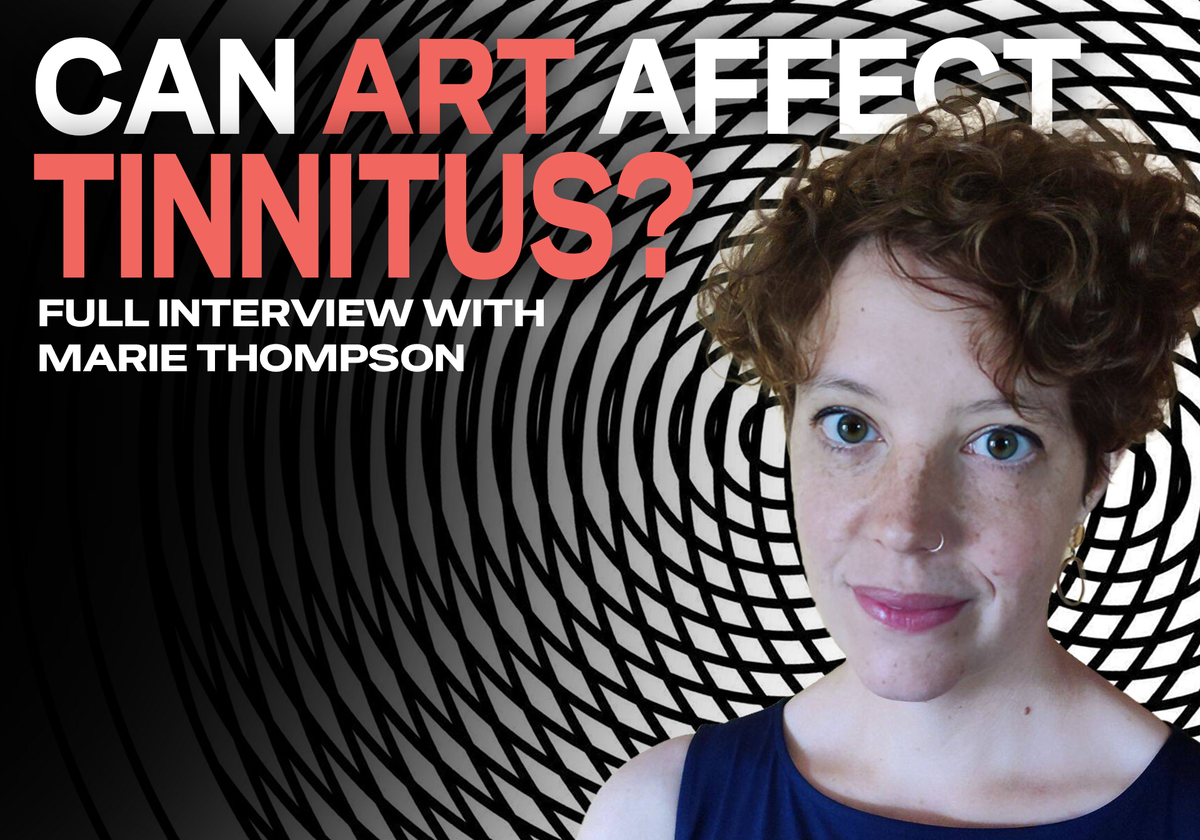
Noise, Tinnitus and Affect Theory: Marie Thompson Extended Interview Recast
While Mack takes a summer break, we bring you this treat from the archives: the full-members-only version of his 2024 interview with the influential theorist of noise and affect theory, Dr. Marie Thompson. This episode features 40 minutes of additional content on Thompson’s research on tinnitus and hearing loss. To get access to all our members’ content, past and future, become a member at mackhagood.com.
Feminist sound scholar and musician Marie Thompson is a theorist of noise. She has also been one of the key thinkers in integrating the study of sound with the study of affect.
Noise is a notorious concept that means different things different people. In this conversation, Marie Thompson examines noise through the affect theory of Gilles Deleuze and Baruch Spinoza as well as the systems theory of Michel Serres. We’ll also talk about her critique of acoustic ecology and a rather public debate she had with sound scholar Christoph Cox. And if you don’t know what any of that means, don’t worry—we break it down!
Dr. Thompson is Senior Lecturer in Popular Music at the Open University in the UK. She is the author of Beyond Unwanted Sound: Noise, Affect, and Aesthetic Moralism (Bloomsbury, 2017) and the co-editor of Sound, Music, Affect: Theorizing Sonic Experience (Bloomsbury, 2013). She has developed Open University courses on topics such as Dolly Parton and Dub sound systems.
Cited Media:
Books:
- Steve Goodman - Sonic Warfare (2010)
- Marie Thompson & Ian Biddle (eds.) - Sound, Music, Affect (2013)
- Marie Thompson - Beyond Unwanted Sound: Noise, Affect and Aesthetic Moralism (2017)
- Jacques Attali - Noise: The Political Economy of Music (1985)
- Michel Serres - The Parasite (1980)
- R. Murray Schafer - The Tuning of the World (1977)
- Anahid Kassabian - Ubiquitous Listening (2013)
- Rosemarie Garland-Thomson - Extraordinary Bodies (1997)
- Eric Drott - Streaming Music, Streaming Capital (2024)
- Paul Rekret - Take This Hammer: Work, Song, Crisis (2024)
- Melinda Cooper - Family Values: Between Neoliberalism and the New Social Conservatism (2017)
- Claude Shannon & Warren Weaver - The Mathematical Theory of Communication (1998)
Articles / Journal Pieces:
- Marie Thompson - "Whiteness and the Ontological Turn in Sound Studies," Parallax (2017)
- Annie Goh - "Sounding Situated Knowledges," Parallax (2017)
- George Lewis - "Improvised Music after 1950: Afrological and Eurological Perspectives" (2002)
- Christoph Cox - "Sonic Flux: Sound, Art, and Metaphysics” Parallax (2017)
Journals:
- The Senses and Society: The Aesthetics of Tinnitus
- Capacious: Journal for Emerging Affect Inquiry
Transcript
Intro: SpectreVision Radio
This is phantom power
Mack: Hey everyone, how's it going? Mack here. So this is a little bit of a preamble for a rewind episode, and I am taking a break for the month of July, and I have a couple of my favorite episodes from 2024 for you to listen to, and these will be the extended members versions of those episodes.
So hang tight for that. But before we get into it, and not to get all NPR on you, but. I would like to take a moment and ask for your support. I think some folks are under the impression that I am making money off of this show. You know, especially because of the relationship with SpectreVision. I feel super fortunate that SpectreVision have picked up this show as part of their network, but they're not paying me anything. And the way that I would get paid is to run ads and we would split the revenue from the ads. But aside from promos for SpectreVision shows, I'm not running any ads. And that's because I just don't like what it would do to the podcast itself.
Now, if I ever find a sponsor who is doing something audio related that I think my audience would like, I'm kind of open to that possibility. But, but in terms of like just blasting y'all with ads for socks or sports betting or whatever, fuck no. No, that is not gonna happen.
And there've been super patient with me about that, and like, it's just been amazing. They're not getting really anything, they just like the show and they're being supportive of it at this point. Maybe sometime down the line we'll make some money, but right now we're not.
And ironically, as the show has gotten more popular and grown its audience. I've actually been spending more money, you know, we've doubled the cadence, we're doing two episodes a month. I couldn't handle that on my own. I hired Cameron Naylor, who does an amazing job of editing and creating transcriptions and doing some of the other backstage work that needs to get done.
I'm still doing all the fielding of queries and scheduling interviews and reading and listening and watching and prepping to get ready for these interviews and, You know, there's software costs too, there's all kinds of software that goes into doing this show, that all tends to be subscription.
And I am super grateful to the Phantom Power members who are helping me pay those costs, but I'm nowhere close to breaking even right now, and I would love to get to that place where at least I'm close to breaking even on doing this podcast because. You know, I hope you're really getting something valuable out of it.
So, if you're somebody who's just been listening to the show for a long time and really finds value in it, if you could find it in your heart to kick in five or 10 bucks a month. I would be thrilled, and so appreciative. , Another way that you can help out the show is to subscribe to the newsletter and to tell your friends about it.
But the financial contribution would be amazing to if you've got the means. And by the way, if you don't have the means and you know, like you're a grad student who's studying sound or something like that, and you want to be a member, just drop me a line and I will comp you a membership. That's something I'm more than happy to do. So yeah, think about supporting at mackhagood.com.
And just to give you a little taste of what you will get as a member, we are providing the full member's versions of a couple of my favorite 2024 interviews. One with Robin Miles, audiobook, narrator extraordinaire. And in the second half of the interview, which was only, available to members, we got deep into the financial side of the audiobook industry and the gendered pay gaps there.
And we even talked microphones and recording software and her process, it was. Really, really fascinating. Likewise our episode with Marie Thompson, the Scholar of Sound and Affect theory. She and I got to talk about our mutual research interests in tinnitus, and we went really deep on that.
Okay. Enough for me. I hope y'all have a great summer, and I will be talking to you again in August. For now, just enjoy this episode from the Vaults.
Marie: And this is difficult given the habits of the discipline or disciplines that I'm engaging with, I think, is that we can't point to a particular set of sounds as inherently emancipatory or radical or, or having a kind of liberating potential. There's a need to think carefully about that.
Mack: Welcome to another episode of Phantom Power. I'm Mack Hagood. Today I'm bringing you an episode with a scholar who I feel is just an intellectual kindred spirit. We have a lot of the same interests. We've written on similar topics, and she's someone that I've learned a lot from. My guest is Marie Thompson, associate professor at the Open University in the UK.
Marie is a theorist of noise, and she has been one of the key thinkers in integrating the study of sound with the study of affect. Starting around the early 2000s, a number of scholars began to feel there was a tool missing in the toolbox of cultural scholarship. We had plenty of ways to talk about ideology and representation and rhetoric and identity, but what about sensation?
How is it that a feeling like joy or panic can sweep through a room without a word being uttered? By what mechanism does a life develop a kind of texture or a feeling over time? Affect studies is a field interested in these questions, interested in how the world affects us. Words can produce affective states, but affect isn't reducible to words.
So I think it's easy to see why affect theory has been so attractive to sound and music scholars. And Marie Thompson's work has used affect as a tool to pick at one of the densest theoretical knots in sound studies, noise. Noise is a notorious concept that means so many different things to so many different people.
And in this conversation, Marie examines noise through the affect theory of Gilles Deleuze and Baruch Spinoza, as well as the systems theory of Michel Serres, and we're gonna talk about her critique of acoustic ecology and a rather public debate she had with sound scholar Christoph Cox. And if you don't know what any of that means, just hang tight. We're gonna break it down.
So how does one become a respected theorist of noise? Perhaps unsurprisingly, for Marie Thompson, it started with a love of edgy music. Marie grew up in the south of England in Kent. It was a pretty slow life there. There was the seaside and the countryside, but it wasn't the most exciting place to be a teenager interested in esoteric music.
If she wanted to go to a show in London, it took her nearly three hours to get back by train that night. It wasn't until Marie was an undergrad at the University of Liverpool that she was truly able to immerse herself in music.
Marie: It was the degree in music and popular music, although there was a slash separating them.
So I ended up having this education that was a bit of a mixed bag in terms of I was learning stuff from popular music studies, but I was also learning, I guess, the kind of more traditional capital M music of a university department. But I had the great fortune of studying composition with a composer called James Wishart, and I think his influence was really formative.
His work really had this modernist intensity, and I was already interested in, I guess, music at its limits and quite intense, and I don't want to say difficult music, 'cause that sounds obnoxious, but, you know, kind of noisy and timbrey- music with quite a complex timbre.
My background was as an oboist as well, and, you know, I kind of think the oboe is an instrument that draws you to both timbre and limits. It's an instrument that likes keeping life difficult.
So I was studying with James, who was opening up the sound world to me, but I was also taking classes with people like Anahid Kassabian, who was really formative for my thinking about sound and affect. And I was also playing in bands. You know, Liverpool at the time had a really vibrant underground music scene, which was also contributing to my education. I feel like that moment- I say moment, you know, it was three, four years, but was formative in ways that I'm only just starting to really understand now, I think, now that I can look back and see those connections.
But yeah, like playing sort of loud, dissonant music in bands, plus having this education in what was at the time quite an unusual music department in that it was quite expansive to its approach to music. It wasn't all sort of historical musicology.
Not that there's anything wrong with historical musicology just that. It was quite expansive in what it was trying to do within the rubric of music. And yeah, I think that set me up for thinking about sound more broadly in some of the ways that I try to.
Mack: So Marie was studying composition with James Wishart. She was also studying with Anahid Kassabian, who at the time was doing research on sound and affect, which would become her book Ubiquitous Listening. And Marie was playing in noisy bands by night. She was hooked, and so she immediately applied to graduate school.
Marie: I did a PhD at Newcastle University, and I was in the music department there. And again, the music department there was important to me, but also so was the city and its wider music and artistic community, I would say. And what was great about Newcastle at that time, and I think continues, is that there was quite a porous boundary between the music department in the university and the wider underground music culture there.
There were people like Will Edmonds, who plays in Yeah You, who was, were really instrumental in ensuring those boundaries remain porous. And now there's Mariam Rezaei, who's there as well, who's still into ensuring that things flow both ways, I guess, or, or certainly trying to make that the case.
And yeah, like Newcastle is an incredible place to be writing about noise and thinking about noise because it has a very strong and rich history of noise music, experimental music, just underground, underground musics in general.
Mack: The first time I came across Marie's work, I was working on my own PhD dissertation.
I had gotten wind of affect theory and immediately saw how it could help me talk about the personal and social dynamics of the white noise machines and noise-cancelling headphones that I was studying. I started looking for any books out there that used these theories to talk about sound. First I found Steve Goodmann's book, 'Sonic Warfare', which was the first thing that I read that was really putting affect theory and music and sound more generally together.
And then I saw your edited volume that you did with Ian Biddle, 'Sound, Music, Affect' and I was like, "Oh my gosh." Like, that was the one that I could really relate to because you were dealing with, like, the exact same theorists I was interested in, and you had already thought this through, and I was like, looked at the back of the book and I said, "Oh my God, this is a PhD candidate. She's not even , she hasn't even gotten her degree yet." I was like, "Who is this person?" You know?
So can you talk a little bit about, like, what you were doing in grad school? How did you become so productive that you had an edited volume before you had a PhD?
Marie: I mean, I feel like there's a kind of state of academia answer to that, isn't there, where it's like, well, probably the complex psychodrama of wanting to be a good girl and, you know. You know, I was super young. I went straight through from undergraduate to MA to PhD without a break. And, yeah, like that book in many ways symbolizes so many different things to me. You know, what was I doing editing a book while writing my PhD?
That seems like a ridiculous thing to do now.
Mack: It's insane. It's absolutely insane.
Marie: Why was I doing that? And, I feel like that's a good question. Why was I doing that? But, you know, I was very fortunate that the authors that contributed to that collection were great and really experienced in some cases, and were just excited about sharing their ideas.
Mack: As Marie put it, there was just something in the air at that time. A lot of us were grasping at ways to talk about what sound and music and noise do to us, how they affect us, and how that relates to the politics of sound and noise. Thompson and Biddle's volume was one important space where this nascent conversation was taking shape.
Marie's other important project at the time was, of course, her own dissertation, which eventually became her 2017 book, 'Beyond Unwanted Sound: Noise, Affect, and Aesthetic Moralism'. I wanted to dig into that book and some of its guiding theorists in this conversation, but first, I asked Marie about a couple of themes I saw operating in that book.
You address these things in your book 'Beyond Unwanted Sound'. There's for one thing the problem of noise being this sort of floating signifier. Noise means so many things to so many different people. And then there's a second problem that noise is almost always really doing some kind of work for the person that wants to theorize it or write about it or talk about it, some kind of almost moral work, right?
Like, noise is either something really good or something really bad. I believe you called this aesthetic moralism. Do you wanna maybe unpack a little bit of these issues around noise and what you were trying to address with that book?
Marie: Yeah. Yeah, sure. So I think to go back to some of what we were talking about earlier with my relationship to music and the use of noise in music as well, this perhaps explains why someone like me might feel dissatisfaction with the definition of noise as unwanted sound.
So, this notion that noise is of the ear of the beholder, and what defines it is its unwantedness. And for me, starting from a position where noise has often been used as a musical resource or something interrogated through art or sound, you know, this didn't feel like a particularly satisfactory conclusion.
And at the other side of this was at that time when I was starting to start thinking about noise more critically and more theoretically, there was a body of work coming out where... And again, this was kind of mirrored in practice too, where noise was seen as this radical, extreme, awesome force that was kind of transcendental and was a limit experience.
And I also found that to be somewhat unsatisfactory in that noise often is none of those things. And, yeah, and even within noise music, which often is about limits and the extreme, there's also a whole body of practice that isn't really interested in that, and, you know, one of the criticisms that I've seen come from sort of people active in noise music scenes is that there are all these theorists who are writing about noise music as this kind of limit, or this idea of extremity or whatever, and that's not actually what the intention is, or that's not really what the interest is.
There's a different conversation there about, you know, the relationship between musicians and theorists, and whether actually we need to take musicians at what they think they're doing or, you know, but I guess we can kind of park that.
Mack: Well, I mean, you're reminding me of, like, Jacques Attali's 'Noise: The Political Economy of Music', which kind of seems to preordain the role that noise plays, you know, as being this radical thing that changes the landscape, and then it gets incorporated into the status quo once again.
Like, I just never had much tolerance for, for that book or that, any of those ideas. It just seemed like this very schematic way of thinking about noise that, like you say, doesn't map onto many experiences of either music or noise that I've had.
Marie: Yeah. Yeah, I mean, Attali is kind of fascin- that's such a weird book, and-
Mack: But so influential. Like, taken as gospel, and I just, I never got that.
Marie: Yeah. Yeah. I mean, I, think it's that thing of, there's a question here of why do theories get taken up, and I think there's a ambiguity in that text that is actually very productive and is perhaps why people really seize on it.
You know, improvisers like it because the final chapter is about, music of the future, and there's certain things that, that can be read as endorsing improvisation. There's a sense that, you know, there's something hopeful about music in this. There's a kind of music as structure of mediation.
And, you know, I feel like there's a risk that I'm gonna end up doing a deep dive on Attali here and, and the kinds of, margins that move in that text. But I guess that there's a sense, you know, even more basically from a sound studies perspective, that people get excited because it's about history, but it includes sound.
And there's a sense that, you know, the historical is for listening too, and I can see why people in sound studies read that and they're like, " This is my guy. This is who I need to, this is who I need to engage with." So yeah.
Mack: But it's also a very Marshall McLuhan-type way of historicizing.
Marie: Sure sound, I think. Yeah. And it's very top-down. It's light on the details. It's, you know, it's a general model, which, you know, I would say that what my book is doing is also providing a general model. But I try and situate that model and say, there's a specific interest that is guiding this, and that's to do with, practice and to do with noise music and to do with noise as used as a musical resource, and that's conditioning the general model of noise that I'm seeking to develop in that book.
Mack: Yeah. So instead of the aesthetic moralism of an R. Murray Schafer noise bad, you know, hi-fi soundscapes are the good soundscapes that we can hear everything clearly, and they're not occluded by noise. And that, or something more like this liberatory version of noise, bring the noise, you know, this Attali thing, that noise is this revolutionary disruption.
You were interested in putting something else on the table. So maybe we can move on to what that is. What were you trying to do?
Marie: Yeah. So, I was using sort of affect theory, mainly coming from Spinoza or Deleuze's reading of Spinoza. I always feel like I need to qualify this because a, a lot of the political theorists or political philosophers who are familiar with Spinoza would not recognize Spinoza from what I'm writing. and I was also engaging with Michel Serres, who is in turn very influenced by information theory and is drawing on Claude Shannon and Warren Weaver's work.
And I'm using this work to try and think about noise as something that is both necessary and transformative. So this, again, is coming from media theory and information theory, which suggests that noise is something that is necessary in terms of communication and connection and making relations. You know, you and I, Mack, are talking through two computers and a piece of software and microphones.
Not cameras because the bandwidth can't cope with that. And at all of these points, those forms of mediation are shaping and transforming what is sent and what is received, and leaving an impression. So, the sound of my voice, for example, differs in the room that I'm sitting in, which, you know, itself is shaped by the walls, the temperature, the, you know, all kinds of things, the carpet.
You know, my voice transforms as it's going to the microphone, which introduces other timbral qualities to the signal, and on and on and on. And at every point, the separation of noise and signal is kind of an abstraction because we can't really imagine one without the other. And this was the idea that I was trying to start with, the idea that noise is the necessary relation to relations.
It's not something external in a straightforward sense of inside and outside or music and noise or wanted and unwanted. It's something that's present whether you notice it or not, or whether you want it or not, because it's necessary. So that was the assumption that I was starting with. And so, yeah.
Mack: And Serres is saying that we tend to think of noise as an interruption of a system, and it certainly can be that, but noise is also intrinsic to the system itself. It has to be. Which is actually something Claude Shannon also said, right?
Marie: Sure. Yeah. and Serres is drawing on Shannon, but also I think making things a bit more fluid.
Mack: Yeah, he's emphasizing that middle space that Shannon kind of doesn't think very much about.
Shannon thinks about the sender and the receiver and this kind of linear transmission of information across this, well, I think what Serres called the excluded middle, right? and the middle for Shannon is just the place where the noise lives, and we wanna minimize that.
But Serres was much more interested in the productive aspects of that middle. That, and in fact, the noise in that channel can be a signal in certain contexts, right? Or it, it could be productive of a entirely new system. It could interrupt one system, but in so doing, create a new system of some kind.
Marie: Yeah. Yeah, precisely. And you know, I think it's always really important to remember why Shannon wanted to minimize noise, and this is something that people like Jonathan Stern have been really keen to emphasize, is that the general model of communication that, Shannon came up with, it was informed by the economic imperatives of Bell Labs and the desire to develop efficient communication.
So the need to minimize noise is an economic imperative. It's something that's coming from the context of that work. It's not a universal concern. So I think that's something that's really worth recognizing.
Now, Serres as a philosopher has very different concerns, so he is able to have a slightly more open perspective in- Serres is tricky because there are other books of Serres where noise is very much the enemy and is very much something that is derided. Whereas in The Parasite, which is this text where a lot of these ideas are playing out, Serres has a much more interested idea of noise and is interested in how these relations are both necessary and changeable.
You know, there's this great line that systems work because they do not work, and this idea of, actually you said it's the excluded middle, but for Serres, noise isn't of the middle, it's also of the offset. It's of the start because we can never really separate signal and noise.
So even the kind of linear model that we tend to have in mind when we think of Shannon and Weaver's, you know, he is saying noise appears in the middle in that model, but actually it's there at the start. It can't be escaped.
Mack: One of the few times that I really engaged with him was, um, my friend Travis Bogan and I wrote this article about the role of fans' voices, of fan noise in the NFL, National Football League, the American football.
And there was a time in the sport where the league was looking to penalize crowds for making too much noise when the visiting team's offense was on the field, right? Because that crowd noise was a disruption Of the gameplay on the field, and so they tried to regulate that noise. They tried to minimize that noise to sort of maximize the signal of gameplay, so to speak.
But a really interesting thing happened. First of all, fans completely rebelled against that. But secondly, they gradually realized that this so-called noise of the crowd was actually a really productive signal in itself, and then it became part of the story, right? It became part of the story of the game.
And the TV networks started to realize, oh, we could actually mic this crowd noise up, and especially when surround sound came in, we can send it to the rear channels of the speakers in the home setting to make it a more immersive experience for the people being there. And to me, that, that was like this crowd noise is sort of inherent, right?
Like the, the people just spontaneously, it's kind of an affect of the joy, the excitement, the rage of being a sports audience member. But then also it turned out to be a signal in itself that could be profitably used by capitalism.
Marie: Right Yeah. And I think that's a really great example of why, again, I find some of the attempts to position noise as a site of autonomy or freedom, you know, there is a need to caveat that with the fact that there are lots of ways that capital finds uses of noise, as it does with silence and quietude as well.
So I think one of the themes of the book is that it's... and this is difficult given the habits of the discipline or disciplines that I'm engaging with, I think, is that we can't point to a particular set of sounds as inherently emancipatory or radical or, or having a kind of liberating potential.
There's a need to think carefully about that. And, you know, I think it's easy to see noise as... Or it's not easy, but, you know, it's easy to see noise in some ways as this resistive site. But that requires us to kind of discount or interrogate, well, what do we do about all these occasions where noise and the various things that it stands for is capitalized on?
Mack: So there's no, yeah, there's no essential nature to noise, positive or negative, in part because it's relational and maybe that's a good segue into the other influence that you mentioned, which is, you know, Spinoza's Ethics through Deleuze. Could we maybe walk through that a little bit and how that relates to sound?
Marie: Yeah. So I mean, I've been thinking about Spinoza because again, with theory there are trends and then things come and go, and it's kind of easy to look back at stuff you wrote a few years ago and be like, "Oh, you know, this was all about Deleuze and Spinoza, and that was kind of fashionable at that time, and now it's no longer as fashionable and maybe I need to just disown this all." But I think th- I think there's a reason why I was drawn to that work. And with Spinoza, it's probably worth noting that in Spinoza's work, affect is not just synonymous with feelings or emotions. It's not just about what the subject feels as emotion.
It's not necessarily the same as affection. But it's also about forces of change and relating to the capacity to act and be acted on. So there's this notion of capacity and ability, and yeah, there's something quite resonant there with thinking about systems. And to think about noise is to think about systems or relations or infrastructures, you know, certainly in the approach that I take.
And I think what's particularly prescient for people interested in sound and music is that Spinoza enables us, I think, to think about these things as part of a wider series of relations. So thinking about the technological, the ecological, the social, the aesthetic, kind of in relation to one another.
I think there's a capacity in his work for that. But I've also been thinking more and more on this about what's useful in Spinoza, not to just have a kind of horrible instrumental approach to these theorists. But I also think there's something in here about harm and damage which sound and music studies, I think, has often struggled with.
You know, I think even though there's some really fantastic scholarship that deals with the ways that sound and music are bound up, including your own work, bound up with conditions of exploitation and oppression, I still think there is a challenge to articulating music's capacity to be harmful and sound's capacity to be harmful in ways that are not just a kind of top-down moralist kind of we'll probably come onto this later but, you know, loud sound is bad for you, everyone must wear earplugs. I think there's something in Spinoza that allows a careful interrogation about the bad side of these phenomena that I think is perhaps useful.
I don't know, what do you think? You would think about these things too.
Mack: Yeah. Yeah. I think the thing that you highlighted about his focus on the capacity to act, right? That basically he's thinking about bodies- And the term body writ very large, right? Could be human, non-human, organic, like it could be a lot of different things what a body could be.
And that bodies are constantly affecting one another. And from the perspective of a particular body, those interactions are either diminishing the ability of that body to act or enhancing it. And so as I understand it, a joyful affect would be the feeling of feeling enlivened and enabled to do more, or conversely, feeling diminished, feeling disabled by some other body, some other set of relations is kind of a sad affect.
And just having that kind of non-moralist, non-judgmental, stepping back, kind of looking at the material relations, but also the psychic relations. Because what's really, I think, so helpful about this system is it engages with both what we would think of as the mental and the material.
Marie: Yeah, and I think that's really useful to highlight because I think there is a tendency to see Spinoza as, you know, it's the body and its mind. And I think there's been, in a kind of rush to see this as a non-Cartesian model, the mind has kind of been thrown out a bit. And actually you're right, there, there is something about the mind in this that needs to be retained.
You know, in Spinoza, understanding, it plays a really important role. And, in the ethics, understanding is key to what he sees as a kind of ethical enhancement or a joyous life. Where it's not just about maximizing what happens to you, it's also about understanding these affective relations, and that plays a key role.
Mack: Because when we misunderstand those affective relations, we tend to do things that are harmful and unethical.
Marie: Yeah, or we attribute them to the wrong things as well, and you know, for Spinoza, it's inevitable that we don't really have the full picture, that our understanding is, we can't have the kind of position of ultimate understanding, but it's an issue of degrees.
You know, We can improve our understanding of acting and being affected.
Mack: An example I often use is it's very easy to demonize the coworker in the cubicle next to you who eats loudly or something like that, right? And focus on them as the problem that's affecting you.
But to perhaps have a wider understanding, you, you might think about, well, okay, what is the structure of this room that I've been put in? And, you know, how are we expected to maintain our attention on these very detailed things on these computer screens? But we've been placed alongside one another in this particular arrangement that generates an experience of noise.
You know, it's just so tempting to attribute the noise maker to being the individual next to us who we're mad at, right? And everything is encouraging us to think that way, and yet I think from a Spinozan perspective, we might step back and say, "Okay, well, how are the bodies arranged in this space? What kinds of experiences of noise are being encouraged in this setting?"
Marie: Yeah. Why, why are workers having to eat their lunch at their desk? What are the demands? it kind of goes back to our why is a PhD candidate editing a collection when they've got no business to be doing that.
Yeah, like, it's a similar thing, right? I think that's a good explanation and illustration of some of these things. But, whenever I have these conversations about noise, there's this kind of having written a book called 'Beyond Unwanted Sound', there's a sense that I can never complain about noise ever again.
And I have to just kind of move through the world completely unbothered by auditory experience because I've written a book called 'Beyond Unwanted Sound'. It's very annoying. I have regrets. But there's something interesting about the affective here, where there's that thing of, you know, even with understanding, even if you understand the structural conditions, on an affective level and on a kind of an emotional level, that can still feel really annoying.
Mack: Yeah. Absolutely.
Marie: The other great example of this is noisy neighbors. You know, we can think, okay, the problem is poor quality housing, which in the UK is poorly insulated. The problems with the rent market, the problems with a day structured around the wage. You know, there are all these problems that contribute to experiences of neighbor noise as particularly egregious and annoying.
And yet on some level it's just annoying. You c- even with that understanding. And I guess that's one of the challenges for these theoretical works is, you know, how does this relate in practice as well, and in, in the every day as well.
And, you know, I'm sure there's a smart Spinozan answer for that as well, but, yeah, I'd need to go back and read the ethics and figure out how to square that one.
Mack: No, it's such an important point though, because, you know, with my own work there's a critique of these ways that we use technology not to listen, and one of the things that I wanted to do is challenge the notion that media are always there to help us communicate better. I actually think they're not.
But at the same time, people might think, "Well, oh, you're just like anti noise-canceling headphones, you're anti white noise machines." Like, no, I own all of these things, right?
Like, there is a difference between analyzing it and trying to be charitable towards the others who are embedded in this system alongside you, and on top of you, and interfering with you. It doesn't make it not annoying, and it doesn't mean that we shouldn't use technology to try to diminish some of these affects, right?
But it, I do think there is a sort of moral imperative to try to use those things, trying to avoid the word mindfully I don't know. But, but like ethically and thinking about their position within the system and what the knock-on effects of using these things are going to be, right? Are we just exacerbating a problem, or are we actually mitigating it in a way that's gonna help us deal with other people better?
Marie: Right. And I think there's that thing, isn't there, of it's one thing to use these technologies and engage with them, and I guess this resonates with some of the work I've been doing recently on, I'm interested in sort of technologies that are engaged in processes and practices of social reproduction, so things like Amazon smart speakers.
I've been looking at these prenatal sound systems and, yeah, what a world. And things like sonic sleep aids as well, which I know that your work engages with. And it's one thing to talk about using these things and another thing to talk about the wider conditions that make these technologies possible and make these technologies a thing.
Do you know what I mean?
Mack: And make them feel so necessary and natural.
Marie: And natural as well. Yeah. You know, So I think there's, the conversation about using these technologies is always partial because ultimately what it is about is a wider context in which these things become seemingly sensible technological interventions. And I think that's where some of these disjunctures occur as well.
And yeah, it's tricky. It's tricky squaring these things, dealing with what happens on a individual, personal, affective level, and the wider conditions and context through which these things occur. I think those tensions are in some way the point. It's difficult.
Mack: I was wondering, we've been kind of talking about these rather materialist, in many ways, conceptions of sound, Right? Like, in both the Serres and in Spinoza, they both engage with what we might call non-representational aspects of sound. But you've also taken issue with, like, certain materialist conceptions of sound, and I don't know if you feel like talking about this.
We could cut it out if you don't. But Back, like, in I think it was 2017, you were in a back and forth with the sound art scholar/philosopher, Christoph Cox. You wrote an article in Parallax, as did Annie Goh. Do you wanna talk about, like, the sort of critique you had of Cox's version of materialism and, what that was all about?
Marie: Sure. So I mean, again, it feels- 2017, it feels like these issues that were really pressing at that time. At that point, object-oriented ontology was still quite an influential body of thought, and that's something that this critique was drawing on.
Not in a, way of advocating for OOO, as it was known back then. but drawing on critiques of speculative realism and object-oriented ontology to think about the application of these critiques to some of the discourses and debates that were going on in the sonic arts and sound studies. And yeah, I mean, I don't know if you can call it a back and forth if you write something and then someone writes something back, and then you, you, you write a Twitter thread, and then you're just like, "Do you know what? I've said what I've said." "Let's leave it at that."
Mack: But he's got... I mean, he had this concept of sonic flux, right? It was a very influential concept, and it's this sort of idea, as you said, of sound itself. Sound is this material phenomenon outside of human perception.
And to me, what I heard you doing, as I recall, and this is not entirely fresh in my mind either, but you were basically critiquing the idea that we could make claims about what that is, what sound is outside of any human perspective. and that, that sort of alleged objective distance is actually this sort of, you know, re-imposition of a European masculinist epistemology rather than an ontology, right?
So it's an epistemology it's a way of structuring our thinking about something, but it's claiming to be the reality itself, the ontology. Is that a kind of fair-
Marie: Yeah. I think it's also about the desire itself and not a kind of why would you want to do this in that kind of crude sense, but the notion that we can go beyond identity, we can go beyond the social stratifications that constitute life, I guess, and have this kind of pure sound.
You know, I, think thinking about it in terms of purity is kind of useful actually. you know, that desire in and of itself is bound up with, or as I trace it, sort of discourses and ontologies of whiteness. This idea of the frontier, was very prevalent in that discourse.
And this idea of going beyond, you know. I say this as someone who has beyond in the title of their book. But yeah, so there is this notion of getting to this itself or this beyond that has a connection to a frontier logic. And there's also to whom the ontological is accessible as well.
And then just in general, there is the question of the exemplars of who is exemplar of sound itself because, you know, within this notion of sonic flux, the things that can give us glimpse to it in Cox's account are particular works of sonic art. And that requires quite a particular reading of those pieces of sound art, and also the compositional intentions behind it, I think.
So I draw on George Lewis's critique of Cage and his discussion of what freedom means in Cage's work for example. But ultimately within this, there's a kind of innocent or a, an unmarked aurality that is being constructed, where we kind of have to do away with aurality in this in order to allow for this kind of pure sonic, sonic flux.
Mack: Yeah. I mean, I understand maybe because I am a white man, I don't know. But I understand the impulse in the sense that I sometimes remember when I was a graduate student, you know, speaking with professors who were pretty extreme social constructionists, right? And they really didn't want there to be any space where I could talk about an effect of sound on the body that wasn't socially constructed.
And I was like, Yeah, but you know what? If I go stand next to a jet engine, you know, on a tarmac and I don't have any ear protection, those sound waves are gonna damage my ears, right? Like, there's something not socially constructed happening there.
And so, like, now, now the fact that that's the example that I draw, and, like, all of these different ways, the way I'm framing it, the words that I have to even describe that experience, like, yes, that's all completely socially constructed, but there's something I'm referring to that is in dialogue with the social, but is not completely included by it, unless we have that more expansive, you know, Serres version of the social, right? Like where the social includes the material.
Marie: Yeah, and I think, you know, I would be terrified to just subscribe to a real crude determinist model where everything is predetermined by identity and preexisting structures. You know, that's definitely not what I'm trying to advocate for in that article.
Mack: But I think in Cox's letter that responded to your article, I do think that's more... That's how I read his portrayal, that you were denying that there is a material reality that exists outside of human experience.
Marie: Yeah, that's definitely not what neither Annie nor I were aiming for to articulate. But I think our point is that who gets to lay claim to these things and how are claims to these things made? There's definitely that kind of, you don't believe in science kind of aspect to some of the response, which that's not really where we're at.
But at the same time, we've often appealed to science as this above all objective field when we know actually time and time and time again, its conclusions have been bound up with race, gender, colonialism, and coloniality. You know, the exploitations of capital. You know, to kind of posit these things as neutral spaces, I just think there's better ways of doing this and engaging with the material and-
Mack: It's really interesting too that these debates that we were having within academia, like, have really become so dominant in the wider culture today, right?
I mean, it was almost like that what you guys were arguing about was a harbinger of things like, I don't know, people who are saying, "Hey, there are just two sexes, and you know, gender constructionists think there's this plethora of genders, but there's really only materially two sexes," which is definitely not true because my wife works in a clinic that works with people with developmental sexual differences, and there are definitely plenty of intersex people, a lot more than, than you would really, realize. But anyway, like those kinds of debates, I feel very familiar. And also, it's kind of interesting because the same people who are angrily waging these kinds of debates also seem to think that within the academy we don't have these debates ourselves, right?
Marie: Right. Yeah.
Mack: Maybe we can move on to another shared interest of ours, which is tinnitus. We had a dialogue. I should say, this is the first time that we've actually gotten to speak in real time with one another. But we have had a sort of back and forth written dialogue, greg Seigworth, the great affect scholar and just generally great connector of people asked us to sort of have this dialogue about tinnitus and affect in his journal, Capacious. And you talked in that, and that, that was several years ago now, I guess.
But at the time, you were just starting this project that was a grant project about tinnitus and aesthetics. Do you wanna maybe talk a little bit about that grant, what you were up to?
Marie: Sure, yeah. So in 2019, actually, I managed to secure a grant with Patrick Farmer here in the UK. This was a Arts and Humanities Research Council grant, and the purpose of the grant was to explore how the arts can enrich understandings of tinnitus and the diverse ways it affects people's lives.
So there is a sense that the arts might have something useful. And again, when I say useful here, I'm trying to avoid that crudely instrumental model of artistic usefulness that's often been employed. But there is a sense that there might be an affinity between tinnitus and the arts in the sense that the arts often are about, you know, expressing things that are difficult to express.
The arts have this close relationship with emotion and affect, and the arts, kinda have a history of capturing subjective interior experience, and I'm sort of putting interior in scare quotes here based on everything we've said so far. But, so there is a sense that there's an affinity there.
And also, you know, I know this is something you've written about too Mack. On a, a more basic level, as someone coming from a music department, there was a sense that lots of people I know had tinnitus. They were musicians, and they were involved in music, and they were, you know, very passionate about music.
But we didn't really talk about it, or we didn't really talk about its connection or relationship with music and sonic arts practice, despite it being something that seemed to be going hand-in-hand. And, you know, that relationship is definitely intimate. So this project was based on this potential intimacy between tinnitus and the arts.
And there are three strands of activity. So one, we developed an exhibition with two newly commissioned artworks by Fern Thomas and Nina Thomas, who are both artists who themselves have tinnitus. And their works were considering, you know, how their own art practice might interrogate tinnitus.
And we also thought about the exhibition space and how tinnitus might inform that. So there was the construction of an exhibition as part of this project. We ran a series of workshops for people living with tinnitus that was looking at how different methods and modes of art making in sort of hopefully quite simple and accessible ways might be used to express different experiences of tinnitus and how that might go down.
The workshops were a kind of experimental space to figure out how art activities might be used by people who live with tinnitus and what they might express. And then there was a third strand of activity, which was the development of a special issue which you contributed to, Mack, which was about the aesthetics of tinnitus and was doing more of the theoretical work around the relationship between tinnitus, the aesthetic arts, and what we were calling auditory knowledge.
So yeah, it was, the project was really rich in terms of these different strands of activity. Unfortunately, the grant was awarded in 2019. The project started in 2020, which for those who can make that connection that was not a good year to be starting a new project, not least a project that was involving people. That was not a good time to be doing it.
But we, we still ran the workshops during the pandemic, and actually there was something quite valuable in that, I think. We were planning on doing these workshops in person, and then we just couldn't. So we delivered them online, and that meant that we could have people from all over the country, participants who were in the UK joining us and having a space, you know, to work with one another.
Mack: Yeah. I... You know, it's kind of interesting to think about the effects of the pandemic on tinnitus, and I do think tinnitus was actually one of the plethora of symptoms that the coronavirus seemed to, to have. But also just that experience of isolation. As somebody who does experience tinnitus, I know that I tend to notice it more at home.
I tend to notice it more when I'm alone, and maybe we can talk about the affective dimensions of that and why that is. I've actually talked about that on this podcast a little bit before, but it's probably worth revisiting. So I can imagine it might have been, for some of your participants in those workshops, a particularly fraught time to be thinking about tinnitus.
And I know that we have kind of discussed this before in our written back and forth, but there's a tricky component to talking about tinnitus with other people because it is, to some degree, a question of attention right? Like, and so you'd never wanna problematize someone's tinnitus for them.
Like for a person who merely experiences tinnitus and doesn't find it problematic, you don't wanna make blanket statements, and this is completely relates to your theories about noise, right? We don't wanna make blanket statements about noise. We don't wanna make blanket statements about tinnitus that problematize it in this one-size-fits-all way.
There are plenty of people with a very loud tinnitus, and it doesn't really bother them, and that's great, right? But on the other hand, there are people who have tinnitus, it does bother them. And so then the question becomes, how do we communicate about this without making it worse? How do we communicate about this in ways that maybe helps people have a better relationship with it?
And I think exploring these artistic dimensions of it seems like a really productive way to go about that. And a practice, you know, you're saying you're not a practice-based scholar, but again, I think that there is this sort of practice-based dimension to your work that I just, I see between the lines.
Marie: Yeah. Yeah. I mean, oh, there's so much I could say to this. The issue of how do we think about or how do we articulate something that gets worse with attention, and, what are the ethical challenges of working with something that gets worse with attention is. And, you know, particularly in the environment of the pandemic.
During the pandemic, I developed a really intense new form of tinnitus that was new to me, which was really low frequency, which was very unnerving because it's not the stereotype of tinnitus. When you have a kind of throbbing bass rumble, that is not what people think of as tinnitus usually.
And it was really disconcerting. And, you know, going back to some of our conversation earlier about understanding, you know, it's I guess from the position of 2024, for some people it might be hard to remember how terrifying the early months of the pandemic were. And, you know, maybe not everyone experienced it that way, but I certainly remember feeling pretty terrified.
And tinnitus is something that can be exacerbated by stress. It can be exacerbated by anxiety. It can be, yeah, really affected by times of heightened emotional pressure, shall we say. So I think the pandemic was a time where suddenly lots of people were thinking about tinnitus or experiencing tinnitus that may not have done before, and that's to put aside, you know, many different types of viral infection or post-viral infections can be related to the onset of tinnitus, and COVID, it seemed, was one of them too.
Mack: Just to underscore what you're saying, I mean, when I did my ethnographic research on tinnitus, and I interviewed so many people with tinnitus, and there was basically almost always, I hesitate to say always, but I do think it was pretty much always a trauma In that period of time where the person's tinnitus appeared, and sometimes it was literally like "I had ear surgery." And it was a physical trauma, right?
But sometimes it was, like I met a gentleman who was really struggling, and there was this thing here in Ohio, the emerald ash beetle, and he lived in the woods, these woods that he was really attached to, really loved. And the ash beetle had gotten into his trees, and they were basically cutting down, like his entire, you know, woods.
And it was this tremendous loss, and it was also this really, you know, loud chainsaw sound and everything. And like, that's when his tinnitus showed up. And, and we might even say, you know, the silence of no longer being surrounded by bird song, right? Like, and the wind through the trees, like, because one- just to talk about the affective dimensions a little bit- like tinnitus gets louder in quieter settings.
So there's just again, and again, and again, this relationship between tinnitus showing up when something traumatic had happened. And then the question rises like, well, did they always have tinnitus, and they only noticed it when they were in this heightened state of anxiety and being more vigilant about their sensory experience?
There's no way to know these things and really tease them apart, but it's such a pattern. So I, I just wanted to underscore what you were saying.
Marie: Yeah. And I think this is what's so fascinating about tinnitus, but also what's really challenging about it as well, because it is so inextricable from these other things.
And part of the issue is we often don't know the causalities of tinnitus. we're still not quite sure how tinnitus happens. You know, there are some exceptions for people who have sort of ear trauma, for example, where there might be a physical cause. But we're still not quite sure, as far as I understand it, as to what exactly happens when tinnitus is happening.
But there are associations with things like hormonal changes. So pregnancy, for example, is often related with the onset of tinnitus, which, you know, in and of itself can be kind of a stressful thing as well. Things like the menopause, but then also things like medication for chemotherapy and other types of medication, and there are certain types of antibiotics, for example.
So there are these whole host of physical and emotional and psychological and biochemical processes that can be bound up with this, what, you know, sometimes gets called, just a ringing in the ears. And actually, what that ringing in the ears can entail is very, very diverse, and how people react to it can be very, very diverse.
As you said, Mack, you know, there are some people for whom this is an unremarkable part of their auditory experience, and then there are other people who experience real distress and unhappiness relating to this experience. So it's a very complex thing to draw generalizations about, but that's probably why both you and I are drawn to it as well, right?
Because I think there's something really compelling about tinnitus as a As something that's often been silenced in discourses about sound and music as well, I would say, as this really complex site of experience that is quite difficult to generalize about.
But I really hear you on the, no pun intended, on the difficulties of communicating. You know, we had experiences in the workshops where people just didn't have the same terminology for their experiences. And sometimes there was this kind of great exchange of ideas that would happen, but sometimes there was real conflicts and tensions that emerged as well.
And I don't wanna just talk about the arts as this crudely instrumental, useful product, for want of a better term. You know, one of the things I think the workshops were good at was holding space for complex and contradictory attachments, feelings, and sentiments. So these workshops were, holding space, I guess.
There were some real tensions and some real conflicts that, you know, not conflicts in the sense of people yelling at one another, but real differences of perspective sometimes opening up as well. But what was great about using art activities, and the participants would create responses to these art activities, is that you could kind of de-center tinnitus a little bit and ask about the artistic decisions that had been made.
Mack: So, you know, one of the things that I think connects your earlier work and this subject matter is just, as you were saying, for Serres, noise isn't just in the middle. it's on either end, right? And, like, this is another kind of noise that is inherent to the auditory system itself, right?
Like, if you put 100 people in an anechoic chamber one by one, like, 98, 99% of them are going to hear tinnitus, right? It's a kind of noise that's always already there in a sense.
Marie: Yeah. That's- Yeah, that-
Mack: You don't have to respond.
Marie: No, no, I'm just thinking about, cause I have been trying to think about, you know, what is the relationship between some of the things that I'd been thinking about and writing about.
You know, on, on the surface, noise and tinnitus go hand in hand. The relationship is definitely compatible. But thinking about the connections there, and tinnitus' implications for wider discourse and practices around sound as well. Yeah, I mean, there's also something here about, and again, there's a coherence with noise about this kind of being a bit of a secret.
There are people who are incredibly open about their experiences of tinnitus. I'm not gonna pretend that nobody talks about it. But if we think about sound studies and music studies as these broader discourses, it feels very striking that tinnitus is not often mentioned.
Your work is an obvious exception, and there's a few other obvious exceptions, but one of the things that, you know, I've been thinking through and drawing on this work to think about how this talks back to sound studies and music studies is this sense of we often assume this sort of clear and silent aurality, where we assume that sound is received by, you know, what we might c- I'm sort of paraphrasing Schafer here, with all its problems, but clean ears.
We have this assumption that sound and music are experienced by these clean ears, and that tinnitus isn't really part of the conversation there. And there's lots of reasons why tinnitus is challenging to include in the conversation because what version of tinnitus do you think with, you know?
And how do you think with it? But there's definitely a parallel there with regard to noise, where it's this, something that is so present and yet is so rarely remarked upon in certain conversations about sound and music. So-
Mack: I think when I first started writing about tinnitus, and I looked to see what else was out there. I think in the humanities there was literally one piece by Steven Connor.
And that was it. Like, it was crazy. And in fact, it was interesting because there were audiologists who were doing humanistic work on histories of tinnitus in audiology journals. That was the only place where I could find out, like, oh yes, in ancient Egypt, tinnitus was a bewitched ear.
Or maybe I got that from Connor, actually. But that kind of work was just completely rare, and I do think there's a kind of, you know, implicit ableism in sound studies, and definitely, like, a hesitance to admit that one's own auditory system is not this pristine instrument with which we can do our sonic studies, right?
Like, it reminds me a lot of audio engineers, right? Like, especially live sound engineers. I've always been fascinated by this. These guys subject themselves to really high decibel levels as part of their profession night after night. There's definitely hearing loss happening there, right?
And all of these people who use their ears day after day whether in the studio or in the nightclub, it's just hearing loss is an occupational hazard. And a couple of things are interesting to me about that. One is that, you know, the quality of their hearing sort of has to be, as you put it earlier, unmarked, right?
Like, it needs to be a standard by which other people will judge their professional abilities. So it would be very disadvantageous to admit that one has a hearing loss. I just know that a lot of these folks do have hearing loss, right? They just have to, and the way that they can manoeuvre around that and still be really good at their jobs is kind of fascinating to me.
But I mean, that's a little bit afield from the critique of sound studies. But, yeah, I do think that there is this kind of similar ableism in sound studies that's sort of implicit there
Marie: Yeah. And I mean, this is something that I've thought about a lot, and one of the challenges is even using some of the terminology of disability studies, including ableism, to talk about something that for many people isn't experienced as disability, right?
Yeah. I think it still is an ableism, and I, I think it's bound... You know, if we think of ableism not just as a prejudice against disability but as a wider framing structure, as it were, you know, I, I think we can make the argument that this is ableist.
But again, one of the challenges is how do you account for the people for whom tinnitus is just this unremarkable accompaniment? they don't consider it a disability or an impairment in any way. It's just akin to me having freckles. it's a factor of their hearing. But then you have a whole host of people for whom it does interfere with their abilities to do their jobs, as you say, sort of audio engineers, and at the same time is a product of their jobs.
Tis kind of where I would like to take this project next, is to think about how do we talk about the relationship between tinnitus and musical listening and musical labor? Because this is another knotty issue and set of relations where the top-down personal responsibility, everyone needs to just wear earplugs.
That doesn't work as a solution, and There are lots of reasons why it doesn't work as a solution, and there are lots of implications for making the individual responsible for their hearing, which is, you know, something I know that you've written about as well, Mack. But there's something interesting here about what tinnitus is not and the models it doesn't fit because I think in sound studies and music studies as well, there is a growing interest in disability and deafness, and I'm separating those two things here.
Yeah, with regard to deafness, tinnitus can be an accompaniment to deafness and also hearing loss to kind of distinguish those two things. But equally, it doesn't have to be. So there are all these intersections and overlaps, but tinnitus is quite messy when it comes to these ways of thinking and these kind of I don't want to say trends because that sounds dismissive, but these areas of interest that I think are increasingly being addressed.
And yeah, tinnitus doesn't fit very well, but that, I think is probably a reason why some of us are drawn to it as well, and we're interested in the lessons that can be learned from tinnitus, I guess.
Mack: Yeah. Yeah. One of the aspects of your tinnitus research that I was just reading in the brand-new special issue of The Senses and Society, which is finally out.
Yay. you have a phrase that I really liked, normate philosophies of listening. And to me, this is sort of like in the tinnitus realm, this is, very related, I would say, to your aesthetic moralism critique of acoustic ecology. So could you maybe talk about that concept of normate philosophies of listening and how listening with tinnitus can actually challenge those philosophies?
Marie: Yeah. So this is coming from Rosemarie Garland-Thomson's notion of the normate, which in disability studies is the ideal body that is unmarked by disability. And it's not just a bodily and mental ideal, it's also that which institutions, discourses, infrastructures are organized around as well, Yeah.
Like a really great and obvious example of this is captioning, for example, is still missing in lots and lots of meetings that I go into, for example. And that, that's an example of the normate in action because the assumption is that we're all functioning with the same abilities and capabilities related to this kind of bodily and mental and psychological ideal.
So I'm using this notion of the normate to think about aurality and listening in the sense that I think there's been an investment within writing about sound and music in an idealized listener who is unmarked and unimpaired by disability, and that manifests in sort of various ways.
One is, you know, what we talked about earlier, just the assumption that sound and music are heard by clean ears, as it were, and I'm using R murray Schafer's term there again. But then there's also this figuring of aural disablement, for want of a better term, as sort of exceptional or rare or kind of monstering of aural disabilities as well.
So there are lots of campaigns for musicians to protect their hearing that rely on the notion that hearing loss is a devastating thing that can happen to you. And I'm not here to say how people should feel about acquiring disabilities. This is something that is complicated. But at the same time, a more general positioning of hearing loss as devastating works to conceal how common and prevalent hearing loss is both within and beyond musical communities, right?
So there's this aural disablement as exceptional, and then we also have a really gross tradition in sound and music studies where aural disability is used as a kinda shorthand for bad things. So acoustic ecology, I know that I always bang on about what's bad about acoustic ecology.
But acoustic ecology is great for this. You know, Schafer in The Tuning of the World opens with the fears of a universal deafness, right? and even this notion of clean ears and ear cleaning is the idea of enlightening these deaf ears to the fullness of the auditory environment.
And there are all these ableist and audist tendencies that are being used as shorthand for bad hearing, basically, and bad listening. Yeah, I mean, there are other ways that this normate shows up. The, valorization of attentive and accurate listening, for example, I think itself is constructed around the normate.
And yeah, there's lots more we could say on this, but I think this is part of why tinnitus disappears from the conversation, is this investment in a normate aurality and normate philosophies of listening.
Mack: An example that you give that I really like a lot is, and that relates to your work on noise is in this sort of normate philosophy of listening, noise is bad, right?
But for people with tinnitus, you know, as I've written about extensively, a lot of people with tinnitus rely on noise to help suppress their tinnitus, because when that environmental sound gets louder, the tinnitus gets quieter. And so the, just the very idea that noise is bad is normate in that sense.
Marie: Yeah. And actually, what was really interesting about the workshops, and this comes up in this article in The Senses and Society, is actually that was the assumption I was working with, right? That I went into this project with, and that's kind of where my starting point was, that actually for people with tinnitus, aesthetic moralism is terrible because it really doesn't account for the ways that noise can be helpful and soothing for people with tinnitus.
But actually, what came out of the workshops and, these various art activities reflected some of this, is that there are a whole spectrum of engagements with quiet and noisy sound environments that, again, resisted that tendency to draw really dualist conclusions about good and bad sound environments.
So there were people for whom the theme of bed came up a lot in... We did this activity that was based on sound maps, where we asked people to map their environment in relation to tinnitus, and would choose different places where their tinnitus was more or less noticeable. And understandably, a lot of people drew bed and their bedroom, because bedrooms tend to be quiet environments, the nighttime tends to be quieter than the daytime, and so for a lot of people with tinnitus, bed is associated with tinnitus being particularly loud.
Mack: Well, there's also that added pressure of anxiety that the tinnitus is going to keep you awake right? And I think that's a huge part of it as well.
Marie: Right. So the kind of preemptive worry that tinnitus is going to appear. But then there were some people for whom bed was this space that was, where tinnitus was particularly loud, whereas there were other people for whom they were saying things like, "Well, yeah, my tinnitus is loud here, but I expect it and I anticipate it, so it's not as bad. Whereas if we're in an office environment, for example, I find my tinnitus much more stressful and much worse."
Even that association of tinnitus with quiet and noisy environments was getting pulled apart in quite interesting ways during this activity. And there were people who did these really incredibly detailed maps where some noisy environments were fine. Environments with music in, for example, were considered fine, whereas environments where there were additional stresses, emotional stresses were not fine.
And so, yeah, again, it's the problem of abstracting sound from other things when you're talking about tinnitus because as we said earlier, affective and emotional states can have a real impact on how tinnitus is experienced as well.
But it just goes to show how complex it is to capture and generalize about these experiences. And actually, maybe the difference in the complexity is the point
Mack: Oh, yeah, absolutely. I mean, it goes back to that interplay between the mental and the physical being an affect in itself, right? Like the way that one thinks about tinnitus changes the valence of the tinnitus itself.
And yet this is a very tricky thing to talk about because it very easily lapses into a sort of victim-blaming, "Well, why don't you fix your thinking," right? And a kind of cognitive behavioral, like, "Well, you just need to fix the way you think about your tinnitus, and that responsibility is on you." Even though we, the clinicians, have no idea how to fix tinnitus ourselves.
Yes. We're gonna expect that you be able to master that relationship, and we're gonna provide you with these tools, and if they don't work for you, then it's your fault. that's not an extremely charitable way of positioning the clinicians here, but, it is tricky.
I like to say that tinnitus instills a certain humbleness in me about perception, about these kinds of generalizations because I have found ways to mitigate the sort of affective relation that tinnitus used to diminish me and sort of negatively affect my ability to act, right? And it doesn't so much anymore, and I did find certain practices that helped me reach that kind of relationship with it.
But having said that, I have no confidence that that will remain the case for the rest of my life, You know? Because it is a multimodal thing that I can't as an individual be responsible for because as we have discussed for the past couple of hours, you know, sound doesn't exist in a vacuum.
Sound is a production of all of these different social and material and mental relations, right? And It's impossible to master all of those things.
Marie: Yeah, exactly, and going back to something I raised earlier about responsibility. It's really challenging because you know, tinnitus in many ways is the most subjective experience we can think of Yeah ... because it cannot be heard by others, with the exception of objective pulsatile tinnitus which is really annoying. Like, I always have to say, with the exception of this.
But, with the exception of this one type, you know, which itself is, let's not get into that. But, in some ways it is the epitome of subjective experience. If you wanted to be like, "There is the individual and there is nothing but the individual," tinnitus would kind of be the thing you went for, right?
But, and I think this is something both you and I have been drawn to in our previous conversation about tinnitus, you need to open it up to a wider context because it's never just the individual and their tinnitus. There are things that stress the person out, and that can make their tinnitus worse.
Or there are particular mindsets that we get into where we're anticipating or listening out for our tinnitus, and that can make it worse. And there's very good reasons that we do that because we're frightened about it. For example, when I had this low-frequency tinnitus, despite, you know, being quite well-versed in the tinnitus literature, I was terrified because suddenly there was this base frequency following me around, and I for ages thought it was just outside the house, and then I realized what was going on.
You know, and that's scary. But there are other things, you know, in the UK at the moment, you know, for all the challenges of an audiological framework for tinnitus and a clinical framework, ENT and audiology waiting lists in the UK are pretty long at the moment.
It's hard to access primary care and GPs at the moment and I had a great GP with my tinnitus who did all the right things and was like, "Off you go to audiology," but some people don't have that experience. And one of the things that has often come up in my conversations with people in tinnitus support groups, for example, or as part of the workshop, is that people have had quite difficult experiences with audiology and ENT sometimes.
And there's that sense of needing a wider set of relations and this being related to a wider set of relations that isn't just the individual and their ear.
Mack: Well, here in the United States, you know, Medicare Which is our national healthcare coverage that is used by older people and others, doesn't cover hearing aids at all.
Marie: Wow. Yeah, that's bad.
Mack: When you think about, like, sort of the neoliberal pressures on the individual to treat oneself as a business and to succeed and then the lack of a social safety net in terms of hearing care and so forth, right? Like, As you said, we need to widen it out and think about, well, okay, it's known that hearing aids mitigate tinnitus quite well for a lot of people, amplify the sounds of the world around you that suppresses the sound of the tinnitus.
That is not something the government provides here. At the same time that we have a system that pressures individual excellence if you're even just going to keep your head above water financially. So these are the contexts that we need to discuss tinnitus within.
It's really not just something in someone's head. There's an entire system that's supporting the stress and torment of tinnitus for some people.
Marie: Yeah. Yeah. And I think that question of where does the individual end in the wider set of relations? One of the people I've read a fair bit on neoliberalism is Melinda Cooper's Family Values, which talks about how with neoliberalism, it's never just about the individual, but the individual is propped up by the institution of the family.
Family being the second part, right, that is crucial here. And, you know, thinking about some of these conversations about tinnitus, it's not just that tinnitus affects the individual. In, in many cases it affects their wider relationships with their nearest and dearest too.
So, one of the things that came out with the workshops were people saying things like, "Actually, I really wish I could..." I mean, they show, um, you know, the things that I've made to my family because then they might understand what I'm experiencing a little bit more.
But even within that I know that there are instances where care for people with tinnitus when they're experiencing real distress is very much on the shoulders of the family. And this isn't trying to be like, people with tinnitus make their families miserable. That's not what I'm trying to say here.
But it, it has a wider effect. You know, when someone you care about is in distress and can't get help with that distress, that has a wider effect, and it's often down to families to pick up the pieces as well, for those fortunate to have families that are in a position to do so. So that expectation in and of itself is something we can trace here as well.
Mack: Yeah. Well, clearly the two of us could go on forever talking about our mutual interests. I've so enjoyed talking to you. I'm so glad we finally got to do this. Thank you so much for being on the show, Marie. Thank you for having me. It's been a pleasure. Okay, so let's do our little bonus thing. So it's time to do our bonus that we have.
It's our What's Good segment, where our guests share something good to read, something good to listen to, and something good to do. Marie, what do you have for us?
Marie: Okay. So something good to read, I'm gonna be cheeky and propose two things here. So one is Eric Drott's 'Streaming Music, Streaming Capital' which has just come out, and yeah, I won't provide too many spoilers, but this is a really smart book on the political economy of streaming and fills in lots of gaps, I think, for how we think about what streaming is and does.
And the other I don't think is out yet, but I have been fortunate enough to have a sort of sneak preview, is Paul Recurt's 'Take This Hammer: Work, Song, Crisis' which is, I guess, about the politics of popular music, and that's coming out on Goldsmith's Press, so yeah, that's exciting. Something good to listen to, go and listen to Capuzzi, which is baritone sax and electronics.
Very, very good. And something good to do, it's spring, so go plant some seeds.
Mack: Nice. All right. it is spring, whether it should be or not.
Marie: Yeah. Early spring.
Mack: All right. Thank you, Marie.
Marie: Thanks, Mack
