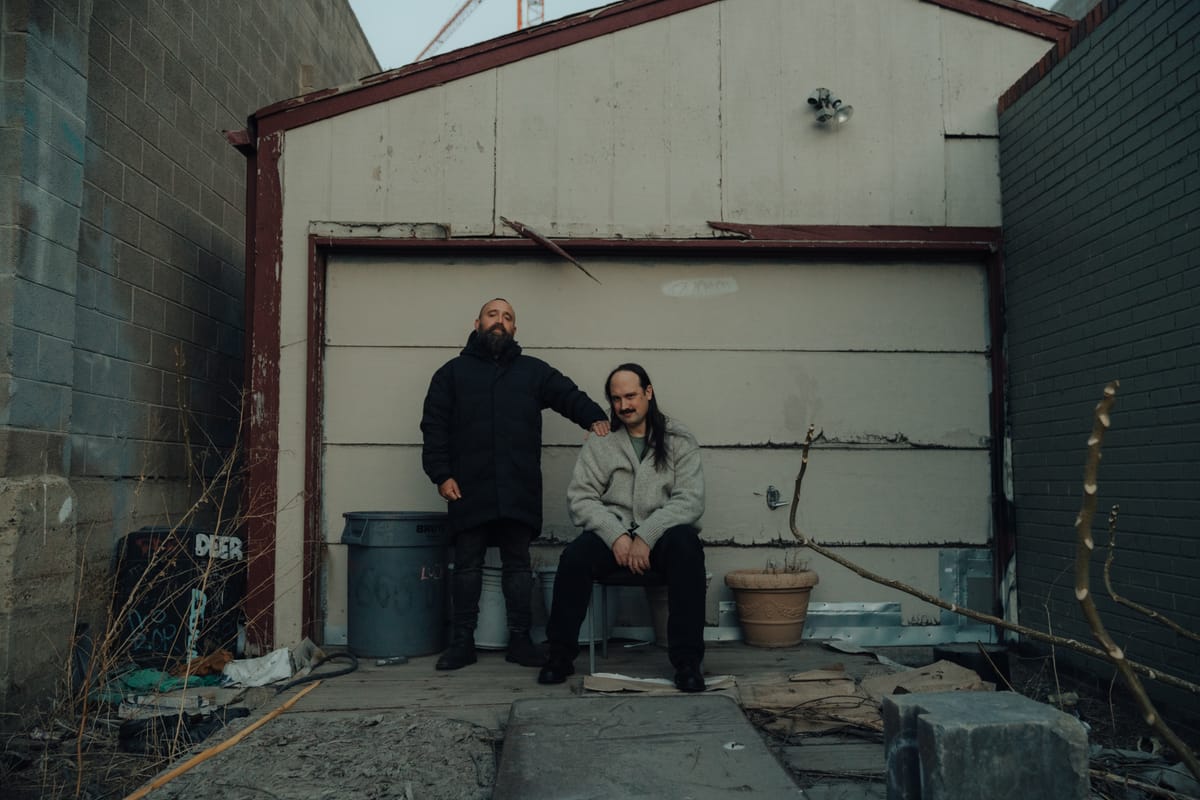
Gabriel Saloman Mindel Pt. 1: Yellow Swans, Noise, and the Art of Pushing Boundaries
Gabriel Saloman Mindel is a lot more than one half of the United States best known noise bands. He's also an interdisciplinary artist and a scholar whose research studies the interplay between sound and power, as he theorizes how noise can push the limits of the body in struggles over space and political autonomy.
Gabriel has an MFA from Simon Fraser University and a PhD in the History of Consciousness from UC Santa Cruz. He's also a longtime Phantom Power listener and supporter of the show. We first met a little over a year ago at the Unsound Festival in Poland, where Yellow Swans played a packed reunion show. It's been a lovely thing to get to know him--he's a gentle soul who makes aggressive sounds tied to some serious ethical and political commitments.
In today's interview, we talk about the history and music of Yellow Swans, the interplay between noise, ethics, aesthetics, and politics. Gabriel even breaks down how he and Pete produced the track we were just listening to. Even if you're not a fan of noise music, I think you're going to love this fascinating conversation. And next month, we'll play part two of the interview, in which Gabriel discusses his scholarship on the work of other artists, including Raven Chacon, Hildegard Westerkamp, and Prince.
You can find Yellow Swans online at Bandcamp and Instagram.
They will be performing at GRM's annual Présences Électronique festival on Feb 13. In London, first at the Lexington on Feb 16 and then Corsica on Feb 18, and then finish at Bozar in Brussels.
Chapters
0:00 Intro & Welcome
5:53 Gabriel Saloman Mindel
6:52 What is a Yellow Swans Show?
12:48 Early Influences & Discovering Noise
13:45 DIY, Punk, and the Noise Scene
21:57 Noise, Community, and Spirituality
22:45 Performance, Consent, and Audience Experience
24:00 Paradoxes: Noise, Calm, and Reception
29:17 Crafting the Sound: Gear & Process
41:43 Band Dynamics & Collaboration
45:07 Legacy, Recognition, and Touring
51:04 Art, Politics, and the Noise Scene
53:09 Fascism, Provocation, and Identity in Noise
59:44 Inclusivity and Change in the Scene
60:24 Outro: Thanks & What’s Next
Transcript
SVR: SpectreVision Radio.
Intro: This is Phantom Power.
Mack: Welcome to another episode of Phantom Power, i'm Mack Hagood. Right now we're listening to the opening moments of a track called Opt Out, created by the Prolific Noise Duo, yellow Swans. My guest today is Gabriel Saloman Mindel. Between 2001 and 2008, Gabriel and his partner Pete Swanson, turned out some 70 releases of ambient sounds that test the limits of intensity.
Gabriel Saloman Mindel says he thinks of his sounds as a kind of space, and that's just how I experience yellow swans. In these opening moments of Opt Out, I hear an enigmatic, shadowy, cavernous space containing RH Geiger esque alien technologies.
But as the piece evolves over 12 minutes, it eventually reaches an intensity that seems to overwhelm my imagination. At this point, I can't picture anything at all. Instead, I just feel an incredible fullness, like my sensory capacities have been exceeded. The sonic cup runneth over.
But Gabriel is a lot more than one half of one of the United States best known noise bands. He's also an interdisciplinary artist and a scholar whose research studies the interplay between sound and power as he theorizes how noise can push the limits of the body in struggles over space and political autonomy.
Gabriel has an MFA from Simon Fraser University and a PhD in the History of Consciousness from UC Santa Cruz. He's also a longtime Phantom power listener and a supporter of the show. We met a little over a year ago at the Unsound Festival in Poland where Yellow Swans played a packed reunion show.
It's been a lovely thing to get to know Gabriel. He's a gentle soul who makes aggressive sounds tied to some serious ethical and political commitments. In today's interview, we talk about the history and the music of Yellow Swans and the interplay between noise, ethics, aesthetics, and politics. Gabriel even breaks down how he and Pete Swanson produced the track we were just listening to.
Even if you're not a fan of noise music, I think you're gonna love this fascinating conversation. And in fact, I thought this conversation was so great that I wanted to share it in its entirety with my entire audience. So, next month we're gonna play part two of the interview in which Gabriel discusses his scholarship on the work of other artists, including Raven Chacon, Hildegard Westerkamp, and Prince.
At the end of today's episode for my subscribers, I'm gonna share my list of 10 books that changed my listening in 2025. So if you're interested in subscribing, go to mackhagood.com. That's M-A-C-K-H-A-G-O-O-D.com. And by the way, thanks to everyone who has signed up for the free newsletter and especially everyone who signed up to be a paid member.
This has been a head spinning year for me. New book deal. New podcast Network. New website, new newsletter. Your support means everything. There's literally no reason to do any of this stuff without you. I'm so grateful that you find my work worthy of your attention, and you're the reason that I'm working so hard to create attention worthy work, so thank you.
Also, some folks have been asking me for a book update, and it has been a while since I talked about what's going on with that. So my manuscript is officially due in June, and I'm halfway done at this point over halfway done actually. So it is possible that I will actually get this book done on time, but I must say I have never written so much so fast in my entire life, and at least half of it has ended up on the cutting room floor.
I've had a lot of false starts, a lot of material that I spent weeks and weeks on and then end up getting rid of. It's been a struggle to find the right voice for this trade press book. But I think I've found it, and I think a lot of people will be shocked at just how non-scholarly this book is.
I know I am, and, and I'll be honest, I'm a little nervous about how my fellows sound scholars are gonna feel about this book. It goes a bit against the grain, against some sort of cherished central sensibilities and sound studies. So, uh, yeah, it'll be interesting to see what folks think about that. Okay.
That's enough on that. Let's turn to my interview with Gabriel Solomon. Mendel. Gabriel, welcome to the show.
Gabriel: Thank you for having me. It's really a treat. I'm a long time listener. I think since almost the very beginning. Uh, huge fan.
Mack: That's amazing. And in a sense, I kind of get that because I feel like you're the perfect guest for this show because you are both a performer who has been obsessed with sound for a really long time, but also a scholar and a critic. So you're both of my kinds of guests at once. So it makes sense.
Gabriel: nice.
Mack: So, um, I thought maybe we could start talking about your career with Yellow Swans, which I think is what you're best known for. And I thought maybe a fun way to start off would be to just, for those who are not initiated, put the listener in the position of just, they're standing in front of the stage.
A Yellow Swan show is about to begin. What are they going to see and hear, and feel? what's about to happen to them?
Gabriel: Sure. That's really kind of you to invite. I, guess I would have to just begin with who's there. I am one half of a duo that has been Yellow Swan since 2001. Uh, my collaborator is Pete Swanson. Pete is a curator based in Portland, who is one of the folks behind Freedom to Spend, which is a great archival label.
If anyone is familiar with it, you'll know. Pete is at least a foot taller than me, so there's something kind of comic about our proportions. Um, has long, long, long hair, always has.
Mack: Mm-hmm.
Gabriel: or more or less always has and is an opposing kind of Viking figure. A table between us.
Usually these days it's two tables. They run perpendicular up and down the stage. The tables are covered with a weird mishmash of electronic gear. Everything from guitar pedals to contemporary, uh, synthesizers. there's a real to reel tape player. I'm holding a guitar. There's a bunch of things that we don't necessarily know what they sound like or what they do, but they're on the table and we will pick them up eventually when we're performing and make noises with them, when we start every single time for as long as we've been a band.
Pete kind of silently broods over the table and I give a speech. I've always been a talker, so it's just my natural proclivity. But a long time ago, it occurred to me that it was a privilege to be on stage, that it mattered what people say from a stage. And to be fair, we spent a lot of years playing on the floor, immersed in the crowd, but that's not as possible anymore.
Mack: Mm-hmm.
Gabriel: And to my mind, the music itself is about something. It's always been about something. It is a way of trying to address and navigate our contemporary politics, our experience of being alive in this moment, and an aspiration that the world could be different than it is.
Mack: Mm-hmm.
Gabriel: So I give a talk, I give a speech.
it's rambly, sometimes I seem to know what I'm talking about. it's passionate, it's honest. And I try to explain the context, what we are thinking or feeling in this moment, what it means to be there. our gratitude for being there. And part of why is because what comes after that is, anywhere between 40 minutes to an hour and a half of a very visceral, very physically challenging, world of noise and sound. And for someone who is prepared for seeing it, hearing it, feeling it. even then, I think it can sometimes be a surprise and overwhelming for someone who's not. It would be very easy to see too masculine, presenting people on stage, pushing their physical limits, the audience's physical limits.
Mack: Mm. Mm-hmm.
Gabriel: the thing that matters to me is that I'm not trying to do something to people. I'm trying to do something with people. And
Mack: Yeah.
Gabriel: is something I want to be collaborative and shared and generous. And so the speech beforehand is a chance to give people a sense that I know that I'm grateful that they're there and that I'm doing this for a purpose that is, is my own, but also communal. And as silent as Pete is about it, um, you know, we've been doing this on and off for 25 years, so he's got my back with that.
And then the music itself, it's abstract. It is mostly improvised though it's structured around certain kind of movements or concepts that we practice and rehearse. To us there are songs
Mack: Mm-hmm.
Gabriel: there. You could kind of compare it to a free jazz performance where there's a head or a motif that carries through or comes back, but is also just the opening up of a space for improvisation and co-creation.
When I try to describe it to someone who has no real cultural context for noise music,
Mack: Mm-hmm.
Gabriel: I usually say it is like a very emotional film soundtrack to which people almost immediately say, oh, like, interstellar.
And I say, yes, like Interstellar,
Mack: hmm.
Gabriel: but it's played through a speaker that's in a dryer that's tumbling around and it's as loud as, a, explosion. And it continues for about 30 minutes. And I let people sit with that feeling of whether they would like that or not like that. Most of the time I see on people's face a genuine, like, curiosity.
What would that be like? And, the music is rooted in, a kind of push and pull between extremities, frequency, volume, and elements of melody and rhythm, sometimes more implied than actual. but it's, deeply abstract and it's, not music that I think most people are accustomed to hearing. another way to kind of contextualize this for people who are music heads is, I think Brian Eno, if I remember once said that, if you play heavy metal or, grind core music at a really quiet volume, it is still ambient music. And our theory is the inverse, which is that if you play ambient music at a really intense and loud volume, it becomes this other thing. and that's, yeah, I would say that's yellow Swans in, in a nutshell,
Mack: Wow. Yeah. So there's a lot I I want to dig deeper into in what you said, thinking about like the connections between your ethical and political commitments and the sound of the noise and, the experience of the audience and all of these things.
But, first maybe I want to get a little bit more into how you entered this type of music, or if we're gonna call it music, um, I would certainly call what you do music. Maybe not all noise, would I call music, but I think what you do, I would think of that way. But like my first noise exposure, so to speak, was in the eighties. everyone needs that friend in high school who knows more about music than they do.
I had my buddy Stewart Ellis, what's up Stewart? He's might be listening, but like, he turned me on to, Boredoms and Mebo and, and like a lot of the Japanese noise stuff. and then I moved to Taiwan like after I graduated college, and so that time it was the early nineties and that scene was still going.
And because I was in Taiwan, people would pass through there sometimes. So I got to see like Yamantaka Eye and John Zorn. And there was this really amazing festival I went to called Broken Life
Gabriel: Hmm.
Mack: that was in like a deserted wine factory. And it was just noise groups. CCCC was there. I don't.
Gabriel: Oh yeah.
Mack: Yeah, they were amazing.
Gabriel: thats great.
Mack: but anyway, like, I guess what I'm, slowly arriving at as a question here is because you were, working in the early aughts, were you influenced by that previous wave of noise? Were you engaging with that sound?
Would you distinguish what you do from what a lot of those groups were up to?
Gabriel: absolutely, hugely influenced by Japanese noise music. I should say, I grew up in the Bay Area, San Francisco and Oakland, but I spent my teenage years in what then was a working class, beach town, a few minutes south of San Francisco called Pacifica. weirdly, there were punk scenes all around me in Daley City, south San Francisco, even in Half Moon Bay, which was a farm town.
Mack: Uh,
Gabriel: Pacifica didn't have that. We had plenty of weirdos. We had people who listened to Frank Zappa and the Dead. some people who were Yngwie Malmsteen fans, uh, my circle of musical friends They would get whatever they could get their hands on.
Mack: yeah.
Gabriel: you and I are the same generation, so we understand that, you found things through the most weird sort of serendipitous ways.
It was
Mack: Yeah.
Gabriel: lucky if there was an older kid or an older sibling who could pass on knowledge. I had an older brother who was into metal, so I was listening to metal, but it didn't really mean a lot to me when I was probably the perfect age for it. I saw Smells like Teen Spirit on MTV in the
Mack: Uh, Uhhuh
Gabriel: immediately felt this connection because not only did I appreciate the music and feel connected to it, but also could identify with this person.
Like, I could tell they were kind of vaguely queer and, artsy, and they were not a jock. They were not
Mack: Uhhuh.
Gabriel: guy.
Mack: Uhhuh.
Gabriel: else.
Mack: Uhhuh.
Gabriel: that just led me to, try to figure out, well, where are they from? What's their context? who are they connected to? Because, everything else was presented through the mall or through, these kind of corporate contexts. They seemed to come from somewhere else. And so that just led on beyond this pursuit of, what I understood to be an underground or a subculture that I wanted to be a part of.
Mack: Yeah.
Gabriel: and so, you know, to some extent, I was really at a loss 'cause I could get, what I could get my hands on through, printed media through MTV late at night, to some extent the radio. And I remember I was trying to teach myself how to play guitar. My parents were really skeptical that I was gonna commit to something like this, so they didn't wanna buy me a new guitar. But my dad, who was a kind of failed Bob Dylan, in his teenage years, still had a beautiful Spanish, nylon string guitar.
He gave it to me. And so I was learning chords, learning scales, but I kept on thinking, well, how do I sound like Nirvana on this thing? And so I started putting things like paper and tinfoil between the strings, putting, hanging stuff on the strings.
Mack: Prepared guitar.
Gabriel: was doing prepared guitar, but I
Mack: Yeah,
Gabriel: context for it.
I had no understanding that what I was doing was somehow avant-garde or even contemporaneous to other musicians, who were, being written about in the wire. I didn't know what the wire was.
Mack: sure.
Gabriel: I knew is that if I hung some paperclips on the strings and then played my chords, it sounded distorted and that was close to what I was looking for. At first I thought I wanted to be Neil Young and play songs and write songs, but what all I really wanted to do was take the end of a Nirvana set when they would destroy their instruments
Mack: Yeah.
Gabriel: play that forever. so I started trying to cultivate a band that did something like this.
Mack: Mm.
Gabriel: I remember my friends, they were all talking to me about my way of playing guitar. And they're like, yeah, it's kind of like that dumb band, Sonic Youth. And I said, who is that? And they said, oh,
Mack: Hmm.
Gabriel: band that holds like a blender up to their guitar. And for me it was like a epiphany.
There's a band that does that.
Mack: Yeah.
Gabriel: and so for a lot of people, my generation Sonic Youth was just such a gateway, right? A gateway
Mack: Hmm.
Gabriel: to
Mack: Yeah.
Gabriel: alternative music, punk, hardcore, free jazz. You know, there was a great column Thurston wrote in Grand Royale, the Beastie Boy Magazine. That was just a list of then very obscure free jazz records.
and on MTV Thurston was hosting one evening and, showed some video clips of Masonna and Merzbow and the Boredoms, and I just thought, wait a second, in Japan they just make music like this? Now again, no conception of how big or esoteric or popular it was. In my mind, what we had was alternative rock bands, and in Japan they had people driving bulldozers through the club.
And I just assumed, well, that means I'm gonna have to move to Japan when I graduate high school,
Mack: Yeah.
Gabriel: else am I gonna do this kind of music?
Mack: Yeah.
Gabriel: and, I eventually figured out that there was an American Noise underground, that was connected.
I think when I was 20 or 19 maybe, I saw Masana and Merzbow on tour. They played in Oakland at a warehouse space. That was very important to me later in life. I was one of, probably 50 people who were there, but many of those folks are folks I eventually have met in the American noise underground scene.
And I never necessarily wanted to imitate that music, but I wanted that freedom. And that was what I was pursuing in a lot of ways. And so that's not the only way that I arrived at Yellow Swans, but Yellow Swans. Was only possible 'cause I knew that this kind of music existed. and in a lot of ways it was my attempt to seek a kind of freedom that I experienced in Merzbow, in also John Coltrane and in a lot of other extreme music forms that I was unpacking and uncovering, just through obsessive investigation.
Mack: Yeah, there's a lot there in terms of like, I think one way Noise music has been framed by scholars has been sort of like as an anti commercial or anti-capitalist or critique of consumer culture, type of performance. And I don't think that's necessarily wrong, but. In my experience of it, that's never been the important part.
And it's been really more like what you just said, which is sort of like this, type of presence or, this non mediated relationship between individuals. Like somehow the noise sort of cleanses away some boundaries and creates a different kind of space. like what Victor, Turner would call like a liminal space, right?
Like where you could have this communitas, this anti structure where people just, come up right up against one another and have a sense of community. And I think that ties into the speech that you give before your performance as well.
Gabriel: I think that's right. a lot of noise music people access or enter into it as a genre or as a community or scene coming from different places. So you'll find people who are, part of a new music world that wanted to just push the limits and found a more receptive audience for what they were doing in this kind of underground culture.
You'll find people who were punks, this is the other part of the Yellow Swan stories, that both of us were very involved in punk scenes, very committed to the methodology
Mack: Yeah.
Gabriel: of being a punk, DIY culture. And at the same time, we didn't want to be limited by these kind of norms and modes of performing and playing that we felt like punk had kind of ossified into.
you'll find people who don't know that they're doing noise music, they're pursuing something else. And I, guess would just say that, for all the different reasons people approach noise music, which can range from misanthropy to a deep desire for communion through sound,
Mack: Yeah.
Gabriel: I was always really drawn to people who I felt were trying to express the inexpressible, who saw this as a medium for doing so, and who needed other people to be there as part of that. And even though that could sometimes look like aggressive or even antagonistic performances.
Mack: Yeah.
Gabriel: I always felt like I could tell behind the scenes what was really happening and that it often was deeply rooted in emotion. And though I think most of my noise peers would bristle at this, I a spiritual like search
Mack: Hmm.
Gabriel: well.
I really felt that there was something similar to the kind of spiritual searching that I heard in someone like John Coltrane's music or Albert Ayler's music,
Mack: Mm-hmm.
Gabriel: and the music that I saw my peers making as noise musicians. And, something important that you picked up on, which is really crucial to how I think about what I'm doing in Yellow Swans.
But also eventually we can talk about how that leads into a lot of my questions and, and pursuits around scholarship, which is, I, think that noise music is about producing space, uh, that it is a production of space, that it is creating a particular kind of space that is distinct from other kinds of performance.
Mack: Mm-hmm.
Gabriel: other performance also does this, but there's something about what noise is trying to do. And I think it is producing a space where, the boundaries, the edges and maybe this is where the liminal space really is, right? they're not as defined, they're not as clear cut. there's a kind of, consent to not have consent in the space of noise music,
Mack: Yeah.
Gabriel: I am consenting by being here to be challenged and pushed to my own limits and my own capacities. through the experience of whatever sounds you're doing. I'm willing for it not to be safe. I'm willing to take that risk. I think for me, because I'm so sensitive and care about people and their experience, the speech is an attempt to invite people into that unsafe space, or space of risk or space of bravery. And I think a lot of noise musicians justifiably assume if you're at the show, there's only 20 other people here and you all know what we do, so then I'm not gonna ask your permission. I'm just gonna do what I do, and if you open to that, you'll get an experience and maybe that's enough.
Mack: Well,
Gabriel: yeah.
But Yellow Swans always try to reach outside of that niche and outside of that small community. And because of that, I take very seriously, that there needs to be some invitation, I guess.
Mack: yeah, and there's almost a paradoxical thing that happens there because I think, Jonathan Stern, I believe he used the term consensual de which I can't remember if he got that from, Dave Novak's book Japanoise or not, but, he also used the term, aural scarification.
But like, there's a sort of surrendering yourself to what's about to happen about this sort of sheer awesomeness
Gabriel: Mm-hmm.
Mack: and I don't mean that in like a hey dude sense, but like, a overwhelming amount of sound that you're, gonna be confronted with.
But then there's also a strange calm, often, and Dave Novak definitely talks about this in his book. And even when I, I got to see you guys perform at the Unsound Festival in Poland, little over a year ago, and I brought my wife who has, not the same musical tastes as I do. And, Bridget often makes fun of what the things I'm listening to.
She'll walk in the room, she's like, are you really enjoying that? Um, like, yeah. so I didn't know what she was gonna think when she went to a Yellow Swans show, but she loved it. Like she said, she entered this state of utter calm, and I've heard many people say that sort of thing. Can you maybe talk a little bit about that kind of paradoxical, relationship between noise and calm?
Gabriel: Sure. I mean, one thing I'll say is it is long been the case with Yellow Swans that people have really radically different experiences of
Mack: Uhhuh?
Gabriel: not necessarily positive negative binaries, but just simply their experience of what it is and what's happening for their bodies and how to respond to it can be really different in the same crowd.
It is very normal to see somebody, flailing as if they
Mack: Yeah.
Gabriel: at, the most intense rave or, punk show. And then also see someone just standing in utter stillness, eyes close in deep meditation,
Mack: Yeah.
Gabriel: very happy that the music can facilitate that range of experience. my philosophy about art and maybe even this extends to other kinds of social relations including political organizing, is that it's not actually healthy to overdetermine for people what their experience should be and that good art creates a clear enough set of intentions that it empowers or enables people to engage with it, but that it actually leaves a lot of room to be defined by people's experience.
Mack: Mm-hmm.
Gabriel: you know, so one way to think about this is we play a show. We are having a very intense and personal experience of it that's rooted and grounded in our years of having played together. We can tell if we've played a good show or a bad show.
Mack: Yeah.
Gabriel: it is a rule that we have held to from almost our entire career that we will never, ever tell people what our experience of the show was, because it actually doesn't matter. What matters entirely is how they experienced it.
Mack: Yeah.
Gabriel: want to come up and tell us that they had a meaningful or moving or profound experience hearing from us.
Oh yeah. But I played really badly is just negating the meaning of what they just experienced and negates the purpose of what we just did. there's that, right? There's that practical part of what happens with our shows, but think that we mistake something about what being overwhelmed means.
my partner has misophonia and what that means is that, she has, a kind of very acute, and I would say, synesthetic response to sounds, so certain sounds produce physical sensations that are not normative or not what we would assume a person would experience. So in some ways it's a little bit like when people hear music and see color, it tends to be more of a physical, intensity or a pain.
Mack: Yeah. Yeah.
Gabriel: And this is something I think that's really, really common, but it's especially common for folks who are survivors with PTSD or folks who are on the spectrum. But lots and lots of people will, for example, hear mastication, the sound of someone chewing and it's deeply disturbing. Or anyone who's been in a classroom and heard someone clicking a pen and can't think about anything else, or, you know, a coffee shop where you're working and there's just this one voice all are way across the room that is like penetrating your brain. we process sound in lots of different ways. This is a classic trope of sound studies. the cocktail effect, what allows us to be able to zero in on certain sounds and block out other ones. my partner's misophonia goes away when it's noise music, when there's a, kind of noise performance.
And I think it's because, on the one hand, they're actually allowed to let go of control, right? Part of the anxiety that we have around noise is this sense that it's interrupting or disrupting. We don't know when it's gonna finish. We don't know who's doing it, why they're doing it. And it produces this intense anxiety that can produce a really negative response.
And I think that when we go to a noise performance, what we discover is that we can actually let go of control and be, I don't wanna say passive, so much as just receptive. We can be receptive in a way that we're not comfortable doing out in the world. And I think that's gotta be especially true for certain folks who feel very vulnerable to sound and other people in the world.
that's one way that I think about it, is that is just a, permission to be receptive and to be embodied or be inside of your experience. and I think we have comparable spaces that we allow that, one of those being when we're out in nature, right?
Mack: Mm-hmm.
Gabriel: we're in a beautiful place and we don't expect to be interrupted and we feel like we can relax, we might just be receptive in a certain way that allows us to hear, you know, allows us to listen deeply, that allows us to, feel our body to feel our sensations, the smells of things, the, tactility of things in a way that we don't give ourselves permission in our every day.
Mack: Yeah. So maybe we can just spend a little bit of time talking about like how you create these sounds. Um, 'cause I'm super interested in noise as craft, and as art. we were chatting recently, you know, that my favorite album of yours is going places, and then you informed me that that's actually like a lot of people's favorite album of yours.
so then I got curious and I started, poking around. I looked at your band camp and stuff, and, it turns out my favorite track on that album is also many people's favorite track, which is Opt Out.
Gabriel: Mm-hmm.
Mack: could you maybe talk about what that song sounds like? Because it's something that builds over time and transforms over time has a lot of different elements and different parts of the Frequency spectrum.
and it almost has like a, narrative structure to it, even though it's this very unstructured sounding noise. So can you talk about just like, how do you make that, like what tools did you guys use to make that, how did you think about making it?
Gabriel: Yeah,
Mack: take it where you are.
Gabriel: sure. I mean, first of all, thank you. it means a lot just to know you're listening to it and it means a lot. That you listen to it enough to have a favorite song.
Mack: Yeah.
Gabriel: you know, if you'll forgive me, a little bit of biography about the band
Mack: please. Yeah.
Gabriel: audience to this cast, can put it in some context. we started in 2001. we carried on as a band recording constantly. we mostly performed improvisations, but we did kind of create songs. we would often move between releasing small edition Fluxus style, CDR tape releases that were really meant to be these kind of, works in progress, progress reports, discrete objects.
It was helpful on tour to sell merch, but then every once in a while we considered an album, and for years those albums were recorded in the studio. and they never really quite were as satisfying for us, though. I'm proud of those records, for any fan that would include Psychic Secession or Bring the Neon War Home or At All Ends. But we realized what was not satisfying about it is that the studio process disrupted the actual way that we were performing music, in writing, music in real time. All of the music ongoing places, with very minor edits usually at the beginning or end, all that music was live. And all of that was recorded with, a right channel and a left channel going into our computer. So, to explain how we were able to do something that was kind of that complex and rich. I mean, I'm very proud of that record. I think it, it really is still the most exemplary, piece of music that we recorded as a band and, in that period. we just were playing all the time.
We toured constantly. We were a real
Mack: Mm.
Gabriel: working band. I mean, we understood music in the, terms of, Henry Rollins Get in the Van,
Mack: Mm-hmm. Mm-hmm.
Gabriel: working band plays, shows, plays constantly, rehearses constantly. And we recorded almost everything that we played. We didn't put out everything.
We didn't keep everything, but we recorded everything. And listening back to it was in a way, part of our process of
Mack: Mm-hmm.
Gabriel: well, what are we doing and what's working and you know, how is this mix working? are we happy? Is it, static or are we making decisions to transition and, move things along? So, you know, improvisation is not just making things up. It's, building on, knowledge and practice and intuitions and senses of how to perform based on practice and rehearsal.
Mack: Mm-hmm.
Gabriel: the actual setup of the band is, it's hard for me not to start with me. Uh, songs it a hundred percent is starting with me, but I play guitar.
Mack: Mm-hmm.
Gabriel: have my guitar in a open C sharp tuning. I've had it more or less in the same tuning with just subtle tweaks for about two decades. And, I run it through some guitar pedals. I have one DD-20 that I use for looping. My commitment to looping is to constantly move back and forth between performing things live and allowing a loop to make unclear or ambiguous what is happening that's live and what's happening.
That is, being fed into a loop. I want there to be as much ambiguity as possible.
Mack: just that I'm clear, what's the signal chain really?
Gabriel: So the signal chain, yeah, typically it starts with one, sometimes two distortion pedals that I move between. often I play clean, I go into a fake fender amp, pedal that gives it some reverb and gives it a little bit of depth and it makes it sound like it's going through an amp.
And then that goes into the DD-20, which is a pedal that allows me to do sound on sound. So there's lots of things you could do with the pedal. I almost exclusively will layer sounds on it.
Mack: Yeah.
Gabriel: then that goes into a mixing board. Once it arrives in my mixing board, I send it into a few different circuits.
For a long time I was using no input mixer. Well, I guess it's not properly no input, but I would send it into a mixer. a small really crappy Behringer that would be plugged into itself. And so I could both play that mixer as its own instrument, but I could also use it as a way of distorting and, transforming my guitar sound. So you'd be getting the, I dunno if clean is the right word, but the direct guitar sound from the guitar pedal chain, but then you would also be getting these sounds of the guitar moving through this, mixer feedback. More recently I've gotten a Strega Make Noise, which is a, small synth by Make Noise, which is a great, synth company. And I have the guitar running through that. and I've actually used that instead of the mixer feedback, mostly because it travels a lot lighter. Um, and
Mack: Hmm.
Gabriel: to challenge myself to try and develop a new instrument. there's, both the clean guitar sound and also it being affected.
everything is running through reverb and delay in order to kind of create this contained sound, because I'm also running loop tapes. so I have these Sony Walkmans that are an amazing instrument. I think they're kind of expensive now on eBay, but once upon a time they were actually affordable.
so I have about four of those. At any given time, I may be playing two loop tapes. those tapes are field recordings. sometimes they're the same tape I've used for years because it provides a particular set of sounds that I
Mack: Mm-hmm.
Gabriel: sometimes specific songs have specific tapes, and this is one of the weird ways that we conceptualize a distinct song. And so the sound from the tapes, the sound from the guitar, are running into these auxiliary outs because the reverb and delay, they kind of blend them together in this way. That's exactly seamless, but that creates ambiguity about what is making, what
sound, And there is also a, and this is a tribute to Masonna, the Japanese noise musician.
There is an Altoid box with coins in it and a contact mic, made by, Gray from, Chondritic Sound. And the contact mic is running into a grunge pedal, which is,
Mack: Uh.
Gabriel: I still swear, one of the better distortion pedals ever made in terms of just sheer versatility. so all that stuff is running into a relatively small mixer.
And then I'm sending my signal into Pete's mixer. And so Pete's mixer is large, it has lots of ins and outs, and it is sending my guitar signal into several different outlets, as well as some of his own original sound making. Uh, he has a modular synth set up. this is relatively new. After the band broke up for a period, he got more involved in modular synths, but at this point, that's a, central feature of the processing that's happening.
He has a, Noise Swash, which was made by 4ms, who's now better known for making synthesizers.
So four MS used to be, and, and maybe I'm getting some of the history wrong, but they
Mack: Okay.
Gabriel: a, a kind of open source anarchist pedal building collective. The idea was they would come up with these different, open source, pedal builds that then individual pedal makers could create their own versions of, and if people made interesting tweaks or additions to it, they would upload those schematics. and so it was really
Mack: Wow.
Gabriel: to get pedal building to be a more communal project. Pete has this incredible pedal that is, just a hunk of metal with a bunch of knobs. It's a self oscillating distortion pedal, and I think the circuit is actually on cardboard, if I'm not mistaken. But this thing has survived over two decades of abuse.
And,
Mack: Wow.
Gabriel: he'll use it as a way of creating, you know, kind of unique sounds. But he'll also send things including the guitar through that pedal. And in doing that, it creates all of these erratic weird effects that can be sometimes very rhythmic. So almost like a gate that opens and closes and then sometimes just really chaotic and, disorienting.
And then all of that, everything that I've mentioned, including some other noise making of things that Pete has, uh, he has some tape players. He has, a kind of contact mic box that has a spring in it,
Mack: Uhhuh, Uhhuh,
Gabriel: use to make, make noise. of that runs into reel-to-reel tape. And I would say the band, and its sound, a huge part of it is Pete's manipulation of EQs and signals, kind of like a, dub producer
Mack: Uhhuh.
Gabriel: best way to think of it being sent into this reel-to-reel tape. And the tape creates a kind of warmth that really makes possible, certain densities and certain qualities of sound that the individual instruments on their own wouldn't necessarily achieve. Not everything is going through tape. We're also hearing some of these raw sounds, including my own music, unprocessed simultaneously. But the tape, because it's really a territory. It's not, a process so much as a, place and as things are arriving on the tape, they're competing for space and he's using the sound on sound function.
So there's just this sort
Mack: Is it a loop? Is it a It's a tape
Gabriel: it's not a tape loop. but it, it is a. it's not a tape loop. This is funny after 25 years, I should know exactly how it works, but it's, it's kind of like, I, I don't ask any questions because it always sounds great.
And
Mack: Yeah. Yeah.
Gabriel: Pete's the maniac who, who handles this machine, um, it's not a tape loop in the sense of like a very narrow, circle,
Mack: You're not, you're not hearing like the repetitions.
Gabriel: Not Frippertronics, it's
Mack: Yeah. Yeah.
Gabriel: But there is the sound on sound function that allows, for layers and layers of sound to kind of get layered on top of it. and there is this way in which, you'll hear elements from earlier in the set. So it, I guess it has to be a loop. I want to, I desperately ask that you edit this out because
Mack: Okay. Sure.
Gabriel: no, I'm only gonna say this because Pete's gonna make fun of me for not knowing
Mack: Yeah.
Gabriel: what it is that he's been doing in front of me for
Mack: Yeah. Yeah. We can edit it out.
Gabriel: No, it's fine. You can keep it. Uh, so all that is to say, um, there are these kind of high-pitched outer edge frequencies. There is deep, deep, deep base that is also coming through. And part of this is, things being done through the synth. Some of this is through gating that Pete's doing.
Some of it is music I'm making with the, lower end of the guitar. Some of it is an effect of the guitar running through the tape. and so there's just this really full frequency range, which is one of the reasons I think our music feels different to a lot of other noise music.
Mack: Yes.
Gabriel: isn't just a block, there's a tradition of harsh noise called wall noise that is an seemingly undifferentiated white noise wall. We're doing something different. We're constantly exploring and moving between frequencies. And for me as the guitar player, there's a lot of me trying to figure out, well, where is there room? Where is there
Mack: Mm-hmm.
Gabriel: so then playing along with myself and with what we're doing in order to try and, figure out where can I insert or produce dynamics?
And Pete's doing the same thing as a mixer. and I think a lot of what we're interested in is to constantly make a feeling of movement happen without necessarily relying on abrupt start and stops. And
Mack: Yeah.
Gabriel: we're sort of constantly trying to figure out what increases a feeling of intensity through adding and subtraction and what allows for the music to feel as if it's moving in order to not be just sort of this static straight line coming through your ears.
Mack: Yeah. A couple things come to mind when listening to this. One is that this is very complex and it must have taken years of experimentation and being on the road to arrive at this system. And then secondly, it's really interesting to hear that like your output is going into Pete's board and like you're giving over control.
and that's something that is pretty uncommon in a typical band scenario and especially, With a bunch of dudes in a band, like it can very quickly turn into this very, uh, narcissistic dick measuring contest and people turning up the volume over the other person. It's just very interesting that to me, to hear about you guys kind of like fusing your signal path into one and creating this giant volume, but it's not, there's not, doesn't really seem to be a space for one person to be louder than the other
Gabriel: it's funny. I mean, we're old friends and we started the band because we were friends. we broke up the band because we were friends. After years of being on the road, we weren't enjoying it. The music was great, but we weren't enjoying each other's company. It didn't seem worth ruining our friendship over a noise band that was never gonna be you two. We were never gonna make a living off of this in this
Mack: Uhhuh.
Gabriel: we loved the music and we loved what we could create together, but it was hard. And after breaking up, the reason we even got back together to play is because we're friends and when friends are musicians, it's one of the ways that you share your life with each
Mack: Yeah.
Gabriel: Um, I, you know, I think on some level that tension always still there. the kind of frustration, I mean, he's really dependent on what signal I'm sending him. He doesn't control that. I'm really dependent on what he does with that signal, and I don't have control over that.
Mack: that's fascinating. Wow.
Gabriel: we trust each other.
You know, we've done this for a long time and we trust each other. And, because we're very different personalities. There's a lot that goes unspoken. But we wouldn't still be doing this if we didn't really love what we can do together. And we both, after we broke up, stayed friends, but went off and had other musical careers.
I was doing for contemporary dance and putting out some solo stuff. Pete, you know, this might be a hot take or controversial, but I would say Pete kind of invented the noise techno, movement that happened in the 2010s, with his amazing records. and he got really into synths.
And, he did great. He had a successful solo career, but he became a psych nurse and started focusing on, just his career and adulthood. you know, I was very proud of the music I made, but I think both of us felt like there were things we could do together that we couldn't do apart. And just having had enough time to be really aware of that, that was enough for us to realize this is important and special. There's something we do when we're together that is unique that we can't do ourselves. Uh, we can't imitate, it's meaningful. I think again, years and years of playing together leads to trust. And also there are things that we do as musicians that I don't think we would do with other people because there's a way that we're responding to one another's choices,
Mack: Yeah,
Gabriel: sound palettes, intuitions, and our own collective or, sort of psychic, correspondence that's happening you can't just replace that.
You can do something else, but you can't just replace that.
Mack: yeah. I mean, you've kind of, know, hinted at this, but you guys are doing a pretty obscure genre of music and yet within that space, you're pretty legendary and you're, not the kind of band that's a household name, but you are the kind of band I think that a lot of people's favorite band would consider to be one of their favorite bands like that.
More like that, sort of,
Gabriel: correct
Mack: me if I'm wrong, but that's the way I've always thought of you guys.
Gabriel: us as a very, very big deal to a very, very small number of
Mack: Yeah. Right.
Gabriel: honored to be a big deal to that group of people. every once in a while, I have a moment where I see, you know, like Sabrina Carpenter, and I think we have the same job, but it's radically different.
The consequences, the opportunities. I'm okay with that.
Mack: but do you feel like the world has maybe caught up to you guys? Because I, I mean, that show you played at Unsound, that was a big room. I mean, I'm not sure what the capacity was there, but it was a huge crowd. is your resurgence, the rediscovery of you guys happening?
Is it, one of those sorts of things right now?
Gabriel: mean, this is a funny thing, I mean, I'm sure you have similar memories of a certain band seemingly pulled from obscurity that becomes, at least within the community of music fans, a household name. So like This Heat always comes to mind
Mack: Yeah,
Gabriel: a band that, you know, if you asked anybody who was alive during the time but wasn't in that music scene, have you ever heard this band?
Did you have this record? They would just say, no,
Mack: yeah,
Gabriel: of that band.
Mack: yeah.
Gabriel: but among folks in the nineties and early aughts who were listening to post rock experimental music, guitar music. Everyone either had This Heat record or a bootleg, or a tape.
Mack: Absolutely.
Gabriel: think that there's always gonna be a band's band.
And I think that there's some extent to which we are that I also think that, we toured relentlessly. We played in front of as many audiences as we could.
Mack: Mm-hmm.
Gabriel: we made it to Europe and Oceania. we went to Europe a lot. mostly North America. But there's a lot of people we never got to meet or play with in South America and China in Asia.
but that being said, those folks remember us. They get older, they're now running festivals. a lot of the people who are curating these festivals, they had an experience with us that stuck with them, and they see us playing again. and they want to share that because they know it doesn't sound like or feel like what's happening now.
I think there are groups or artists that, come close. You know, I, still see someone like Sun as a peer or, Tim Hecker, I mean, there's, people who have kept at it who I think are from our generation
Mack: Yeah.
Gabriel: are producing similar effects, but we don't sound like electronic music that most people are listening
Mack: Mm-hmm.
Gabriel: and that's not a criticism
Mack: See, it's not a dis it's just, yeah. It's different.
Gabriel: I mean, to be honest, both Pete and I are really unsure what is the meaning of these opportunities? We're incredibly grateful to get asked to play, these festivals in Europe or Australia. We don't get invited to play shows in the United States because we couldn't reasonably sell out a rock club. we've played in LA in New York and San Francisco. We had great shows. But there's not a demand for Yellow Swans.
Mack: Yeah.
Gabriel: I think that that is just a consequence of the way in which, the business side of music which people like Liz Pelley have explored at length on your show. there's just things that we, don't play along with. We're not on social media. we have an Instagram if someone wants to, but,
Mack: Yeah.
Gabriel: in self-promotion. We're not interested even really, I mean, we wanna put out records, we want people to listen to our music in that way.
But the live experience is what really matters to us. And I think curators at a festival like Rewire, we're gonna be playing at GRM's Festival in Paris in February, and then London and Brussels. The curators who are inviting us understand that the experience is its own purpose, right?
Mack: Yeah.
Gabriel: selling a record or promoting a tour. We are coming to be present for a moment and gone. And,
Mack: It's, it's interesting, you know, like, from an American perspective, you're in a small, band. You go to Europe and you quickly realize how many of your shows are subsidized by European governments, you know, and it's just like this non neoliberal model of, the arts that it just provides more spaces for a group like Yellow Swans.
Gabriel: in that context, art can be an end to itself.
Mack: Yeah.
Gabriel: or maybe a pure means. I mean, a way of, living life and having a meaningful life is to, be an artist. To support art. To experience art. And I think in the United States, we have just been pummeled by culture wars at, the very least since the eighties.
But, you know, certainly, we can go further back and,
Mack: Yeah.
Gabriel: wars have done everything in their power to convince us that, art is only valuable as a product if it produces wealth. if it's a viable job, then it has value. And you can tell who's a good artist by who is selling out venues versus who's making work that has some sort of intrinsic value. And I think there's festivals and curators and spaces, in the US that push back against that. The Lab is an amazing venue, in San Francisco, they host music, for music sake. And not just music, but sound art and, and other forms. Big Ears I think is a great festival.
Mack: Absolutely.
Gabriel: There are places, even like The Empty Bottle, which is a rock club, but has consistently been, just an amazing space for, bringing artists, whose work is non-commercial, but giving them an audience.
Mack: Yeah,
Gabriel: and at the same time, those are exceptions to the rule.
The rule is, if you're not selling drinks, if you're not selling tickets, you're not a viable band.
Mack: yeah,
Gabriel: I think maybe if we were younger, we'd be hungry enough to push back against that. We certainly were in our twenties and early thirties in the aughts
Mack: yeah.
Gabriel: but at this point, Pete and I have jobs, we have, dogs, we have lives that we're trying to live. weirdly, and sadly, it's easier to fly to Brussels to play a museum for a show
Mack: Right.
Gabriel: than it is to go on a West coast tour.
Mack: Yeah. Yeah. Well you mentioned culture wars, and that might be a good segue into one thing I wanted to ask you, which is just thinking about the relationship between sound and politics, because I know that, after you guys did break up, I believe that was 2008, you moved on to do an MFA, which I wanna talk about, and a PhD.
And, one of the central themes of your work since then has been thinking through this relationship between, noise and power. And I guess, we've had, the noise scholar Marie Thompson on our show, and I think she's pretty convincingly, just sort of undermined the concept that there's an intrinsic relationship between, noise being good or bad or liberatory, you know, she calls it aesthetic moralism.
and so if we accept Marie's point, that noise is neither intrinsically some kind of, challenge to power, nor is it necessarily some kind of bad thing. How do we think about the politics that get attached to noise as a genre? Let's just say like, are we just part of a taste culture?
Like, there definitely seems to be a lefty bent, certainly to your work, but also to most noise groups that I'm aware of. I would say that if they think about politics at all, they, tend to range on the left end of the spectrum. Is that just sort of like a meaning that through history got attached to a certain thing or is there anything inherent about this sound that, you would say, fosters that relationship between sound and politics?
Or is it really just arbitrary attachment that happened between this sound and these politics?
Gabriel: I guess I'm gonna have to push back on your intuitions about the noise scene only because noise music as a genre, and then I think we should bracket that and, talk more broadly about noise and how it functions
Mack: Okay.
Gabriel: politically. But, noise as a genre or as a, underground or a scene has a lot of the same characteristics of any other extreme music culture that you can think of. there are far left and far right elements in both noise historically
Mack: Huh.
Gabriel: always had a, kind of fascist adjacent, wing. Some of that is even more prominent now than ever. Um.
Mack: are, are there any groups that I might have heard of that would be associated with that.
Gabriel: So, I mean, with the caveat that, these are not simple or these are still arguements that are happening among fans
Mack: Okay.
Gabriel: but, the white House is probably one of the most important noise artists that came out of England. their style of kind of mixing noise and extreme vocalisms, often with very, violent and suggestive lyrics is, in a way the base for what is called power electronics, which is a whole genre of noise music that within noise, as a culture, is understood in these very formalistic ways. white House has often long been accused of,
um, being a kind of crypto fascist group in
terms of its musical content. A lot of groups who are inspired by them also share some of those ambiguities. I think what happens in a lot of extreme music culture, and let's say prior to some of the social and cultural, transformations that came out of things like the Me Too movement, Black Lives Matter movement, and a lot of other political uprisings and, congregations of the last 10 years.
I think prior to that it was very typical in extreme music cultures, and I would include hardcore, certain dance music cultures. even I would extend this to, underground, not popular hip hop, uh, but certainly metal, certainly noise. was very, very common for there to be these spaces of ambiguity, right? And so some artists, I think would be taking up these topics where the subject matter, the visual imagery, the language, the aesthetics of it, pointed to the darker sides of social culture, things that were very much being repressed and denied. and so in the case of fascism, I mean, one way you could think about this is punks in Los Angeles and the UK wearing swastikas because they were
Mack: Right.
Gabriel: shocking abhorrent images that also in some ways were meaningless at that time. not because there weren't Holocaust survivors or veterans who had fought Nazis, but because the idea of that having any real purchase in society was seen as absurd.
But it was just like an extension of all these other modes of rejection, rejecting gender, social norms, stylistic norms. I don't like it, it's not tasteful, but, you know, but whatever. Siouxsie Sioux had a, swastika
Mack: Yeah.
Gabriel: on her arm in a photo. this is part of punk history, right? And I think what's different is that white supremacist culture, which, was much more of an underground culture in North America.
In Europe, it had slightly more visible, proponents, but even then, it was still intensely marginal in the eighties, even into the nineties, these kinds of neo-Nazi and white supremacist cultures would often use, musical subcultures as ways of both hiding what they were doing, but also forming communities. So, neo-Nazis in America used punk and a lot of black metal and other,
Mack: Sure.
Gabriel: punk and metal and dance musicmusic scenes in Europe also had these kind of obscure, very occulted and hidden,
Mack: Sure.
Gabriel: fascist wings. Noise music also had this. And I think what was complicated is because its connections with industrial culture as well.
So Boyd Rice, Throbbing Gristle
Mack: Mm-hmm. Right.
Gabriel: But also things like Current 93, like this kind of, politically ambiguous and, culturally and socially, marginal world of music that was interested in the extremities and shadow sides of culture.
Mack: Yeah.
Gabriel: you know, for some people they accepted it As a kind of aesthetic confrontation or subversion or at least a provocation, whereas other people saw this as a safe space to actually explore, right-wing far right ideas. So in the US context, I'll just say, my sense was that most people were interested in extremity and whether that meant visuals that included, violence or, there's a long history of sadomasochism
Mack: Yeah.
Gabriel: part of noise culture.
This partly an inheritance from Japan. And, there's also, you know, lots of traditions in punk rock that also carry over to noise music of depicting war and other forms of capitalist and industrial violence as a refusal or an, expression of anger or agony over the existence of these things.
But there was also folks who, tried to see what they could get away with, whatever their actual internal beliefs are. but, you know, there was a lot of people who were just interested in provocation.
Mack: Right.
Gabriel: and what I'll say is that I was very out and public about being a self-identified feminist, being, very left in my politics, being an anarchist, being, opposed to racism and homophobia, Partly because at the time it felt like I didn't really have a choice. I just refused to seed ground. We never supported groups that we thought were actually, if you'll excuse the technical language, fucked up.
Mack: Yeah.
Gabriel: but we, played in spaces that were ambiguous because we also refused to seed that ground. I was always amazed because I just felt like, here are all these mostly white men who are so interested in provocation and extremity, and yet the idea of talking about feminism was the most disturbing thing that just sent them into, um, absolute, upset. Right. So I, you know, to be fair, there was also a lot of very sweet and deeply sensitive people for whom, this language of semiotics, of, violence, was a way of, pointing to a world that they felt was also harming them.
There was also a lot of closeted queer folks. There was also lots of women and folks of color who were involved and who appreciated having a place where they could push back on a certain level, that there was a kind of permission to be extreme and outside of the norms and scope of what that particular identity was supposed to be able to do. I think that after, the political upheavals of the last 10 years, what ended up happening is people made very clear distinctions and said, look, either you're, pro trans, feminist, pro queer, pro folks of color, in solidarity with X, Y, z, political, marginalized community, or you're not.
Mack: Yeah.
Gabriel: it's, and the ambiguity is no longer, allowed. And, that makes sense and I can understand the value of it, because now you go to a noise show and it's really possible to see a lot of trans women, a lot of folks of color in the audience and on the stage. And in fact if anything
Mack: Yeah.
Gabriel: I think noise has become more of an important scene specifically for some of those communities.
When I go to play these festivals like Unsound, a lot of trans folks, a lot of
Mack: Yeah,
Gabriel: women, a lot of, folks from other countries besides Europe and North America. And that couldn't have happened if there hadn't been such a, fight for space.
Mack: yeah.
And that's it for this episode of Phantom Power. Huge thanks to Gabriel Saloman Mindel for being on the show.
Yellow Swans will be performing in Paris at GM's Annual Presences Electronic Festival on February 13th. They'll also be performing in London on February 16th and 18th, and then finally in Brussels, February 19th. You can find details on all of that at mackhagood.com or in the show notes.
Catch part two of our interview in January when we get into a conversation about sound studies, and we analyze compositions by Raven Chacone and Hildegard Westerkamp. Talk about indigenous ways of sensing, and we talk about Prince.
Today's show was lovingly and expertly edited in the United Kingdom by Cameron Naylor. Phantom Power members stick around and hear about the 10 books that changed my listening in 2025. if you don't yet have access to our bonus content, you can join at mackhagood.com. Otherwise, happy holidays. Happy New Year.
I'll talk to you next year.
