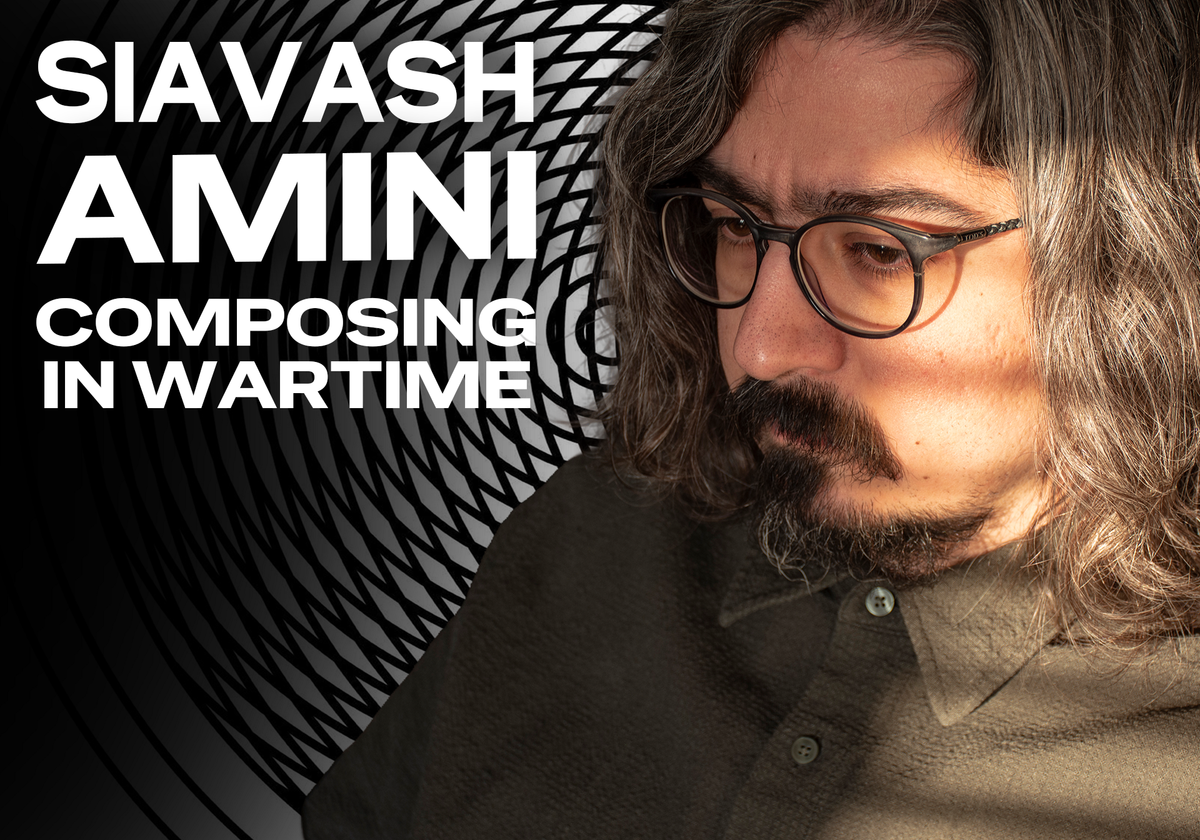
Disquiet in Tehran (Siavash Amini)
Siavash Amini is an experimental composer living in Tehran, trying to live his life and hone his craft amid United States bombings and government crackdowns. Amazingly, he is still creating. August 28th will see release of his collaboration with the American theorist and poet Eugene Thacker, Songs for Sad Poets Vol. III (Hallow Ground). He’ll also soon drop a solo record, Beneath the Pine on Lawrence English's Room 40 label.
In this conversation, we talk about the war, Siavash's daily life, and what he'd like to ask of people on the left in the United States and Israel. We also dive into his two albums and his text-based composition techniques. For the full unedited conversation, become a member at mackhagood.com.
Finally, please consider joining Siavash's Patreon page. It's the best way that you can support a great artist going through the unimaginable.
Cited Media:
Music:
Mazen Kerbaj - Starry Night (2006)
Albums:
Siavash Amini & Eugene Thacker - Songs for Sad Poets, Vol. 1 & 2 (2022)
Siavash Amini & Eugene Thacker - Songs for Sad Poets, Vol. 3 (2025)
Siavash Amini - There Beneath the Pine (UNRELEASED)
Literature:
Sadegh Hedayat - Three Drops of Blood (1932)
Sadegh Hedayat - Buried Alive (1930)
Theorists/Writers:
Eugene Thacker - In the Dust of This Planet (2011)
Transcript
Intro: SpectreVision Radio
Siavash: I'm not gonna let them take my individuality away. Not the Iranian government, not the American government. My work here is just maintain something, something of an individual trying to dream something, trying to imagine something.
Intro: This is phantom Power
Mack: Welcome to another episode of Phantom Power, a podcast about sound and listening. I'm Mack Hagood. Siavash Amini is an internationally acclaimed creator of complex abstract dissonant sound works. Often inspired by poetry and literature. His recordings have been praised in the Wire, the Quietus and Pitchfork.
Also, as of late, people have been dropping bombs on his neighborhood, and by people I mean the United States Department of War. Siavash Amini is an Iranian composer living in Tehran, trying to simply live his life and hone his craft in circumstances that make it nearly impossible. Back in 2020, we profiled Siavash on this podcast telling the story of how he went from being a metalhead on the strait of Hormuz to getting a music degree in Tehran, working in that city's experimental music scene and reaching an international audience.
Now both the strait and Tehran are caught up in Donald Trump and Bibi Netanyahu's War. Things were already bad enough. Last year, saw a brutal crackdown of the Iranian government on its own people. So Siavash has been through quite a lot and I've been wanting to reconnect with him for quite some time.
Amazingly, Siavash has new music coming out. August 28th, we'll see his collaboration with the American theorist and poet Eugene Thacker come out. It's called Songs for Sad Poets Volume Three coming out on Hallowed Ground, and Siavash is also soon to drop a solo record based on the short story Three Drops of Blood by Sadegh Hedayat. It will be released on Lawrence English's Room 40 label. I can highly recommend both, but more than anything I recommend Siavash's Patreon page. It's the best way that you can support a great artist going through the unimaginable. The link is in the show notes.
In this conversation, we talk about the war, Siavash's daily life and what he'd like to see from us on the left in the United States and in Israel. We also dive into his two albums. For the full unedited conversation, become a member at mackhagood.com. That's where we get into the nitty gritty of Siavash's production technique, including a lot of stuff in Max DSP, and also some details of Persian music that we just really couldn't fit into the main program, and we also get into his excellent reading, listening, and doing recommendations.
But without further ado, let's get into my interview with Siavash Amini.
Siavash, welcome.
Siavash: Thank you, Mack. Nice to see you in person, kinda.
Mack: Yeah. Yeah, I know. I think the last time we did this, it was during COVID and we weren't doing video yet, so I don't think we've ever been, at least virtually face-to-face.
Siavash: No, no. It was end of 2019, I think.
Mack: Yeah, yeah. Exactly.
Well, I mean, I definitely wanna talk about the new releases you have coming out, but I mean, I feel like I just would wanna know, like, what's going on in your life? Like, how is this all affecting you? What's your day-to-day life like?
Siavash: I don't know really. Like, since last June till now, has been like 10 years. And like every day is so fucking long. And, my memory is a little bit fuzzy and everything.
And in part too, that I had to be medicated because they dropped a bunker buster like, less than a two, three meters from our house.
Mack: Jesus.
Siavash: And, I kinda went, you know, I'm bipolar so I had this manic episode.
After that I couldn't sleep. You know, I was paranoid, And then I had a lot of medication, so I'm a little bit fuzzy. I'm still on medication, but, I'm a bit more, clear-headed now. It's not good. It's awful. it shouldn't happen to anyone. Some people are having it worse than we are right now in Tehran, like my parents in the south,
Mack: Well, I was I was gonna say when we did our first interview together, you told me a lot about your childhood growing up in Bandar Abbas, and I mean, that is right the Strait of Hormuz, which is currently, you know, the most famous strait in the world, and the center of this entire conflict.
So, like, how are your parents doing?
Siavash: They're, at least what they're projecting to us to get our worry levels down is something that they say, like, " We've been to war, another war, like a 18-year war, and we've had like bombings and stuff, and, we can get through this." Like, it's not as scary as it is for us.
But, they're destroying the town. And, they say they you know, targeting military only, and that's bullshit. Like last night, they killed a two-year-old child, like just a bomb dropped on a house in Qeshm Island, like 20 minutes from Bandar Abbas by sea, by ferry.
So the situation there is dire. People are unable to work. Like two weeks ago, like the second day, I think, they just bombed a fishing port, and along with it, every fishing boat that people, you know, depended on their daily lives for. Like, it's like everything went up to flames in five minutes.
And, you know, how, how they're gonna, you know, get their life back? And this is just they're doing, you know, constrained war or whatever the fuck they mean, by, like, tit for tat or I don't know. You know, the targeted attacks. Fuck.
Mack: I mean, my understanding is, like, our military is literally running out of bombs, so it must not be that constrained.
Siavash: No. And they're running out of bombs because Iran has a lot of cheap drones and, you know, missiles heading towards the military bases, and they have all these, like, 100,000 rockets to defend themselves. And, you know, that's a winning strategy, you know. They, they're gonna lose. They're gonna run out of 100,000 Patriot whatevers.
And, at some point they're gonna say, "Okay, we're gonna stop."
Mack: Yeah, It really seems reminiscent of Russia and Ukraine, right?
Siavash: And the thing is, I'm really puzzled by the, like, the liberal Westerners' reaction to this. Like, everyone seems okay with it somehow that, you know, that's life. We bomb Middle East, you know. It happens. And like, they bombed a school in the second day, the second day of the fucking war. They dropped, like, a million dollars of bombs on 200 schoolchildren and nobody seems outraged like they were at Ukraine or, you know. It seems.
Mack: Or Gaza. I'm baffled as well.
I'm very confused about where we're at in the United States. I mean, obviously we have like a malicious clown as our leader. He's profoundly stupid. He's got personality disorders. But in terms of like the lack of feedback, resistance in the United States this second time around, I'm just bewildered.
I honestly don't understand it either.
Siavash: It's like, strangers on the internet ask us, "What should we do?" I don't know, stop your government? Like, be involved in your politics. That's the start.
I don't know what you're gonna do. You're the democracy. I don't know. You probably know what to do. You're lecturing everyone what to do, you know, every day, so.
Mack: Yeah, yeah. I hear you. So I take it you're still in Tehran?
Siavash: Yeah. we were up north at some point that Tehran got really bad. So we were-
Mack: So you evacuated?
Siavash: Yeah, we went north and we came back again. Like, we were there two, three weeks and then came back.
Mack: Mm-hmm. And from what I read in the newspapers, daily life there is also sort of ground to a halt. Like economically, people are having a really hard time, right?
Siavash: It's a bit surreal. Like, this isn't economics. I don't know what this is. It's like a hostage situation. You know, economics, like, needs a free flow of something. We have a limited amount of something, and then we got a blockade on the other side, and we have a falling currency.
What do you call that? because you, you don't understand the prices anymore, like, every day, like you say. I wrote on Blue Sky, like, I went to buy a bouquet of flowers for our anniversary, for, like, wedding anniversary, and the bouquet I got very, just normal bouquet, like- And it was priced in riyals at like twice the price I bought my first MacBook, and like this is 2010.
Like, try to imagine, like, a MacBook is like, what, 4,000 now? Imagine like, 15 years from now you gotta buy flowers for $4,000, and you haven't got a better pay or anything, and there's a war, and there's a blockade, and there's a shortage of everything.
Mack: Yeah, yeah, I can't even conceive it. I don't even have words. There's nothing coming out of my mouth. You know, Gabriel from Yellow Swans turned me onto this piece of music by, the Lebanese artist Mazen Kerbaj, it's called Starry Night. And he was performing this kind of atonal trumpet solo on his balcony in Beirut in 2006 as the city's being bombed by Israel.
And it's a chilling, and amazing thing to listen to. But it also just sort of flies in the face of something that, I don't know, I, like, learned in high school. We had a psychology class, and we learned about Maslow's hierarchy of needs, right? And it's like, well, first you need physiological, Your physiological needs met.
Like, you have to eat, you have to drink, you have to sleep, and then you need safety and that kind of security. And then you can think about higher things like self-actualization. But sometimes art is made under exceedingly terrible circumstances, and art that speaks to those circumstances. And I was thinking about that piece when, you know, we got back in touch and I learned you created these new records. I'm just like, how does that work from an artist's perspective, and from your perspective?
Siavash: Well, the first, like the work with Eugene was done a little bit before. So it's coming out right now. But the second one I sent you, the solo album that's based on Sadegh Hedayat's short story, that was made, like between the war and the protests and the second war. So it was this type of, you know, atmosphere that I made that.
I was telling my wife today, like I was trying to listen to it again for our talk, and I couldn't.
Yeah, I was just like, "Oh, this, this is like too much for me." I'm finding out that I'm making stuff that's a bit more elaborate and bit more chaotic, and at the same time, more claustrophobic I think.
Like the new stuff sounds claustrophobic, and I'm not aware of that until I listen to it, you know, while I'm doing it I say, "Okay, this sounds good. Maybe I did do this to it again." You know? And then becomes something more weird and, you know.
And I think I'm trying to maintain my individuality, you know, to maintain my sanity. The first thing for me here is, I'm not gonna let them take my individuality away. Not the Iranian government, not the American government, any of them. Look, like my work here is just maintain something, something of an individual trying to,
Trying to dream something, trying to imagine something. Because it's really hard to imagine something in the, situation we are right now. For the first months, I couldn't listen to music. First month I couldn't. Like, music sounded like clay in my mouth. Like the taste of clay in your mouth, that's how music sounded to my ear.
All the stuff I listened. And I tried to bring myself out of that by writing, you know? So, okay, I cannot listen to music, but I can write. You know, I can write about my experience and then put it out there and trying to find myself. Because that's a society that authoritarian governments, no matter where in the world they are, that's the type of citizen they want, devoid of individuality and imagination. And that's why you have AI art, you know? That's, you know, what it's gonna do. Imagine it for you.
Mack: You mentioned the forthcoming solo album. And it was the Sadegh Hedayat's work, right? He's like a trailblazing in modernist Iranian literature, worked in the '30s.
And it was based on this short story, Three Drops of Blood. And one of the very first things the narrator says in that short story is like, "They finally gave me paper and pen." Like, all we know at first is this is a person in captivity. We don't really know why. He's like, "They finally gave me paper and pen so I can write, and now I, I don't know what to say."
That's kind of the way it begins. It goes a lot of different places after that. But it's interesting to hear you talk about writing as this way of resisting, as a way of maintaining selfhood in these times.
Siavash: Yeah, because you can read his work in a grander scheme like Eugene does. Especially his work called Buried Alive. But there's this suffocating aspect of Iranian life. Life in this country that has been consistent no matter who was in charge.
Mack: Even before the revolution.
Siavash: Yeah, the geography has this conflict within it because it's where it's, like, located. Because what people want from it or want to walk through it or whatever. It has been a crushing society. Like, it has been a crushing feeling living in this society because there's always uprisings and upheavals, people full of hope, and then they just get down and, you know, destroyed, and every hope destroyed.
They become the hopeless generation that the next generation despise. Somehow this is universal a little bit, but there's an element of it here that's special, I think. Hedayat has it jotted down perfectly. The guy in an insane asylum, you know, trying to figure out who the fuck he is, you know?
Until the end, you know, you don't know who he is. Like, is he his friend that he killed or... you know, he, personality shift.
Mack: Yeah it's so, it's so artful in the way it almost sort of creates in the reader, the state of mind that this character is in because there's a strange shifting that happens where it sounds like someone else is doing a thing, and then suddenly we realize maybe it's the narrator who's been doing that thing.
There's a strange hall of mirrors quality to it where certain things recur again and again, that it's very disorienting.
Siavash: I think that that's a very Iranian thing. Because it happens to you. It happens to you when there's so many disasters coming back to back in your life, you know? He took his own life, he couldn't take it. That's it, like, that's the hopelessness, and that's the confusion that comes with all these conflicts that we've been through from the end of the 19th century, the first revolution till here.
It's been all, you know, conflict after conflict after conflict after conflict. Revolution after revolution after revolution. And Conformity is something that you have. Like, there are a lot of conformists on that asylum. Like, they're staying in their lane, doing what the doctor says, or like chanting this or shouting that or something like that. But mainly they're kinda in the background people, you know? There's no subjectivity into them. Like, they're hollow.
Mack: I listened to the new solo record. By the way, Do you have a title for it yet?
Siavash: There Beneath the Pine. It's the first line from the poem that's recited throughout the...
Mack: Yes. Throughout the short story.
I listened to the record before actually reading the story. I didn't actually read the story until late last night. And I was struck by resonances between the story while I was reading it, because there's this really interesting phenomenon in the first track of the record where there are these different kinds of sounds that sound very organic to me.
Like, some sound like bird calls, some sound kind of like animal sounds, but the envelopes of the sounds are kind of morphing and shifting, and I got this crazy image in my head when I was listening to this track of, like, this cloud in the air that was morphing into different kinds of animals that were shape-shifting, and it was like this sort of ball of confusion. And then when I, when I read the story and I saw that there were these effects of not being sure who is what and things kind of morphing into one another, I was kind of astounded that you had evoked that similar state in me just as a listener when I hadn't even read the story.
Mack: And then, you know, as you're saying, you're, you're using some kinds of Persian music, at least gestures, but it's still your style of noise. And I heard those... I mean, they're not very overt, like the gestures towards Persian music. It's timbrally, it doesn't sound like that. But you can hear it in the musical notes to some extent.
And I was really kind of amazed to hear that because we had a really good laugh in our last interview about how these Westerners are always trying to get you to play, quote-unquote, "Middle Eastern music."
Or, you know, "Why don't you work the oud into your compositions or whatever?" And you're like, "Oh, why didn't I think of that?" You know? So I was like, "Whoa, wait a minute. He's finding a way to make a Siavash type of Persian music here."
Siavash: That's it. That's the way in was to understanding these radif dastgahs that we have that are very, very strangely preserved. Like, I think, preserved to the likings of a certain people with certain philosophies. And then coming back, if like, I'll still listen to for the next album, to any ghajar recording from the early 20th century, late 19th century, that I can find from Iranian players, because there are some.
Actually, there were a lot of shellac recording, like 78 recordings. And, they're more free. They're just doing what they want.
I thought, like, "If I was this guy, and I saw this poem, how would I set it to music? Okay, now let's replace the tar, get it out of the picture, and let's do Max MSP," you know?
And let's fragment it. I don't have to declare stuff. Like, it's not a declarative kind of story or music. It's, fragmented as it can be. You see, it's like there are all these fragments coming and going from the start of the dastghah, from the end of the dastghah, and they're just going around each other, as you said, like a cloud.
Like, fragmented like a schizoid fragmented, as like the character is trying to figure out what's happening.
Mack: You tend to use a text. You tend to use a written text of one kind. Can you talk more about why that's so integral to your process?
Siavash: Yeah, text gives, gives me structure. Like, because I'm thinking in images mostly than sounds, and text gives me images. And then I, you know, mark them. I mark this, I mark this, I mark this, I mark this. Let me see if I have it here This is Three Drops of Blood. Like, you see I'm just, you know, finding pieces and stuff, you know.
Marking things out. And then these will be my main tracks. The first goal from the library. I think, "Okay, this sound from the library goes here. That sound from the library goes here."
It's a very old method of composing rhythm. Like, that, that's how like, I don't know, Pierre Schaeffer did his stuff, like recording onto libraries and using the libraries to, you know, structure stuff. And then I, I close the book and I just listen, and then I start to, you know, fine-tune everything.
Mack: You know, it's funny, but I had an audiobook narrator on this show once. Her name is Robin Miles. She's like a really well-known audiobook narrator, and she was talking me through her process, and, you know, she's marking up the book very similar ways to say how she's gonna do her vocal production.
Siavash: Nice, nice
Mack: It's really cool to hear about that.
Siavash: Excellent. Yeah. So that's it. Like, for the past few albums, I've been doing that. And I, actually, I got this way of working after I started working with Eugene in 2020.
Mack: Oh, really?
Siavash: Yeah. I thought, "Okay, this is excellent."
Mack: Because when we first met, you were working with another American writer, I'm spacing on his name.
Siavash: Matt Finney, yeah. He had spoken word stuff, but that was a different approach.
Mack: Different Process.
Siavash: Yeah, a different process. But this one is the one with the library. Like, because I want to be, like, in complete control of the sonic stuff when they're happening, you know? I don't wanna think about the structure or the story. I'm gonna you know, have fun making sounds, and exploring, you know?
Because it takes time. And then after I did all that, I wanna have fun with the story and the structure. And because Eugene has this compressed style of writing.
Mack: Yeah, you've mentioned Eugene a few times now. I should just clarify. So we're talking about Eugene Thacker, who a lot of folks in my world would know as a media theorist and philosopher. I forget if he's at Parsons or the New School, probably on the New School side.
Siavash: New school, yeah. Yeah.
Mack: Ah, man, just a super interesting thinke, who kind of blends media theory and philosophy and the occult, and definitely has been known for a kind of nihilism, philosophy of nihilism or some kind of like dark media, I is another concept of his. So I honestly was not familiar with him as a poet.
So when I first learned about your first collaboration a couple years after we did our first interview, was just super intrigued to learn about you guys working together and that there's this other side to him. How did that collaboration begin?
Siavash: In 2020, I think it was in the COVID era, I got an email from him that he is into my music, and he wanted to send me some of his stuff. And I was like, "What? Dude, I've been reading your stuff, like, since 2013, so you know." I actually, like, screamed when I saw him, saw him.
He emailed me. Yeah. So, I was like, "No," but I told him like, "Can I keep in contact? Like, I have a lot of stuff to send you." And he said, like, "I got something better. Maybe we can do something together." And that's it. That's how we started. He sent me a couple of his poems, and we talked about it, and we developed the idea further, and I came up with the first track, and that was it.
Like, it was set. Like, it was, like, 10 emails, and it was done.
Mack: That's amazing. So that was Songs for Sad Poets,
Siavash: Yeah, volume one and two. Yeah. Volume one and two of Songs for Sad Poets. It was on Hallow Ground back then. It sold out. It did very well.
Mack: Tremendously well received by critics.
Siavash: Yeah, yeah. I was surprised because it was a bit long. Like, it's 72 minutes, and I was like, "Okay, maybe we should have done, we should like two albums." But it worked.
Mack: Yeah So you guys are back.
Siavash: Yeah. After that we decided to, continue this stuff. We decided to do something with an old form, like a requiem or something. And, like do a vocal piece. And maybe he, like, changes the text or something. But at the end I thought, like, we can make a vocal piece out of your poems and, you know, he was okay with it and, you know, that was that.
And after that we were thinking, like, he was very adamant about him not liking the human voice. And as that makes vocal pieces a bit, you know, tough.
Mack: Wait, he didn't want, he didn't want the words to be intelligible? Is that what.
Siavash: He didn't want humans, he wanted to be un-human. And I was thinking, like, we have synthesizers that, you know, do that, and they're very old and they're very free. Like there's a lot of them. Like, they use it for anime, you know, songs.
Like, because there are these anime fans, like, I found all these software on Reddit for writing anime songs or something. So, it's called UTAU.
Mack: So are these like Vocaloid type things or?
Siavash: It's like you make a sound bank out of vowels and, you know, things like that, and then you type in and it brings out the thing from the sound bank. It's a very, very old way of doing things. So you have to sing some of the stuff to make a sound bank. There are some sound banks out there you can download.
So what I did was, like, if we had a, like a choir, I wouldn't be able to have, like, 140 sopranos doing something. But I have with this very, very, lightweight software, I can do everything I want. like, I made the scores.
Mack: We should, be clear that just like with the Persian or you know, like the traces left of voice that are really audible to the average listener are pretty scarce. Like, I really didn't hear anything that sounded fully like a voice to me until like maybe towards the end of the whole album.
Siavash: Yeah. Yeah, but that's the fun part, you know? What can I do with this really software for anime that sounds like they get it, you know? I made very, very, it would be really bad choices for making a good pop song, those parameter choices I made on those. And then I've made clusters and clusters and clusters of all of them singing something different.
I made a Max patch that I inserted one line of vocal into it, like a score, and it generated something a little bit different. Just a bit different. And I had, like, 140 MIDI files after that, and then it becomes this sea of things that you don't understand.
Mack: So these slight variations on these vocal lines, when you put them all together and there's a hundred plus of them. It becomes a noisier more atonal texture.
Siavash: Yeah, it becomes something else, because you cannot have them on full volume. You have to automate the gains and volumes, so that becomes part of your orchestration. What I'm going to bring out of all these 140-some things.
I couldn't make really good basses with them, so the basses on them are synthesizers.
The basses, or like sub-basses on the album are made with synthesizers. But the rest, everything you hear is just made with, you know, fucked up anime vocaloid thing.
Mack: That's an amazing technique and, I can't wait to go back and listen to it again, having a better understanding of how it was done. I should say that the poetry, it's enclosed with the record. It is kind of, like, crazy to me because he's using the, the sparsest, scarcest amount of language.
There's almost no words here, but they evoke these huge depths and heights and just sort of like existential vast plains of destruction. Like, I'm gonna quote a couple of these, cause th- they're even, they have less words than haikus.
Siavash: Yeah. Do, do. Please do.
Mack: So there's from the track 'Sigils of Decay', there's one line that goes, "10,000 moons hanging in silence." And there's another one that is, "Dread of infinite space. Dread of distant skies." So it's crazy because you have so little and so much to work with at the same time. And the- to me the music truly sounds like this. It's conjuring up like, these dead planets for me.
Siavash: Okay.Good. I know a little bit of something about dead planets.
Mack: We're all learning, aren't we? But you're getting a bigger lesson than most.
Siavash: Yeah, crash course.
Mack: Yeah, crash course.
Siavash: Yeah, yeah, the thing is, It was weird how well our styles, like, clicked together, and they're very different things. But when you put them together, I thought like, "Okay, this is the words to my music," and, you know...
Mack: yeah. No, you guys are made to work together.
Siavash: yeah, but that's it.
Like, I would read the poems, like, five times. If I read them more, it would destroy everything. Like, I would conjure the image that it made. That was the point I wanted to make. Like, as same as here. Like, after some point, I'm not reading it. I'm just trying to remember something about it.
And Eugene's poetry has evoked some incredibly strong images in my mind. So I can, like, have them, right?
Mack: Yeah Yeah. I'm just so struck. I sort of gestured towards this in the beginning of our interview, but there's an utter strangeness to the fact that, you know, we're ostensibly enemies according to our governments, but we're having this conversation about you're collaborating with now multiple Americans on these artistic projects. I read an interview with you, I think it was in The Quietus, where you were saying given... And this was a while back, this was, like, years ago. You were saying your international commissions were sort of a lifeblood for you as an artist because the local economy is so terrible. I don't know, there's just a weird doubleness between online and offline people and political leaders.
I don't know. Do you think about that much?
Siavash: Well, I have to, like, clarify a few terms first.
Nation states don't do anything for me. Like, I don't understand nation states. So, when Iran and America are in war, yes, I understand there's a force that's coming to our land. I don't recognize a nation state as my own most of the times.
Yes, they're coming to my land. they're the ones who can protect us for now. My enmity lies in with the right-wing American people. And the only people who can fucking kick right-wing American to the curb are the American liberals I'm working with.
That's a strong connection that like, we can work together to, you know, maybe I can tell you something that you understand and you do something about it in your own country so your fucking uncle doesn't vote for Trump, so bombs don't fall on our heads. You know? that's the dialogue I believe in.
Like, we have to be in dialogue. Like, those right-wingers don't hear me. They don't understand what I'm saying. You're the good listeners. So if you become more politically active, you know, that's it.
And friendships are very hard for me to, you know, be invalid. And I think a lot about it, and I don't think this is something that me not talking to anybody there or leaving behind friends who were there for me for many things that didn't, you know, have anything to do with this, that doesn't do anything for me and for them. And I'm not that misanthropic, you know? I am a little bit, but not that much.
I actually feel I expect more from my Iranian friends that live there. I get angrier with them sometimes because they know what's happening here. They've lived here, and the shit that comes up out of their mouths all the times recently just baffles me. That breaks relationships for me.
Mack: it's very humbling for me to hear you say that. Like, when as we speak, my country is dropping bombs on yours. And I wish American leftists would share that generosity of spirit sometimes because, you know, in the academic world, there has been this movement to try to do embargoes on educational exchange with Israel, for example.
And I'm like, those leftist scholars in Israel are our allies. They're the only people there that we could talk to, to have a dialogue and help move the needle. And again, it's the same thing. Like, I feel as an American, who am I to judge the citizen of any nation based on the behavior of their government?
Like, we have a responsibility here in this nation to make change.
Siavash: Well, I think Israel is a bit different for me.
Israel is a bit different because, when a very small country, like with a very small population, calls themselves a democracy, they hold elections and stuff like that, and the left is almost like not there or there but not doing anything even for the littlest, littlest of things.
I get suspicious a bit, like, Or maybe they, they needed a little push. Sometimes they need a little push because I don't know how they're not outraged and out of their country.
Mack: I mean, I think I know some folks there who are outraged. I hear what you're saying though. But for me as an American, I feel like our focus should be cutting off funding for the horrors that that state is committing and...
Siavash: yeah, most definitely just don't sell them weapons.
Mack: To me, that's like that's the thing, right? like whether or not I can talk to a media scholar over there, I'm not sure that that's... I don't know. But I think that's a difference of opinion that maybe we can, we can just have.
Siavash: Yeah, definitely. Because I think it's a conversation that shouldn't be a taboo and should be had. It's been too many years of this there, over there. Too many.
And I just get baffled, like, why isn't anybody doing it? Why isn't there protests every day? Why aren't there political prisoners there?
Because they will put people in prison if they do it too much. I assure you, they're not a democracy. It's obvious Netanyahu is not a Democrat. We're doing it here every day we're fighting them and the other enemy, and it's weird.
Like people got on the bus and not less than a year ago. Like, I didn't agree with them, but I understand that they're frustrated at this government and they did what they thought they had to do. I wasn't one of them. I wasn't part of it, but my heart broke when what happened. And why don't we have protests like that in a, what they call the biggest democracy in the Middle East?
I think that's something to think about, and this shouldn't be a taboo to talk about, and shouldn't be a point that, you know, of course people are gonna disagree about it.
Mack: Yeah. Yeah. That's fair So, I feel like it's strange to jump back to music after this discussion.
Siavash: It's like the, those CNN ads, you know?
Mack: Just, I'm curious about what you're working on now. Like, are you able to work given all that's happening right now? you say you're writing currently. Do you mean you're writing music or you're writing words or?
Siavash: Both. Both.
I've been able to write music for the past month and a half. Since the bombing stopped in Tehran, I was able to, you know, get back to music. But if it comes back, I don't know if I can, you know?
I have, I don't know what, some sort of PTSD when I hear the sound, like, I have a lot of panic attacks and I get the feeling that I need to go to a cover, but the sound is over there in the distance, but, you know, I get too scared.
Mack: Yeah, I can't imagine that experience
Siavash: It's not good. I hope you, you never do, like, experience it. I hope nobody experiences it.
Mack: Well, I'm glad to see you looking well and I'm glad that you have, you know, new music coming out, that you're still sharing with us. And I hope, I hope we can talk again you know, in the near future.
Siavash: Definitely. Definitely. Yeah, I've been working on stuff. I have a Patreon actually, if anyone cares to judge. I put exclusive albums there. I've released one exclusive for this year, and I'll be doing one other. And, I'll be continuing this for some time. And I'll probably finish this album I'm working on in a month or so.
And, there's gonna be at least one album next year.
Mack: Fantastic. Amazing. well, we'll definitely, you know, put a link to the Patreon and to the new records.
Siavash: Yeah, yeah. Patreon is the best way and comes straight to me after one month. And records goes to the generous people who put my crazy stuff out there, so.
Mack: Well, man, thank you so much for talking to me. This has been, you know, quite an experience and, again, I'm just glad you're getting by.
Siavash: Thank you. Just, you know, remember voting counts. Vote on the smallest thing you can. If you're a democracy, your vote counts City council, the, I don't know, school board, whatever. I will be thankful for everything you've done for me, and this has been fun and excellent both at the same time.
Mack: And that's it for this episode of Phantom Power. Huge thanks to Siavash Amini for being on the show. Look out for Songs for Sad Poets Volume Three, as well as Beneath the Pine and join Siavash's Patreon. The link is in our show notes. Today's show was edited by Cameron Naylor, graphics and Social Media by Abe Hagood.
I'll talk to you again in two weeks.
