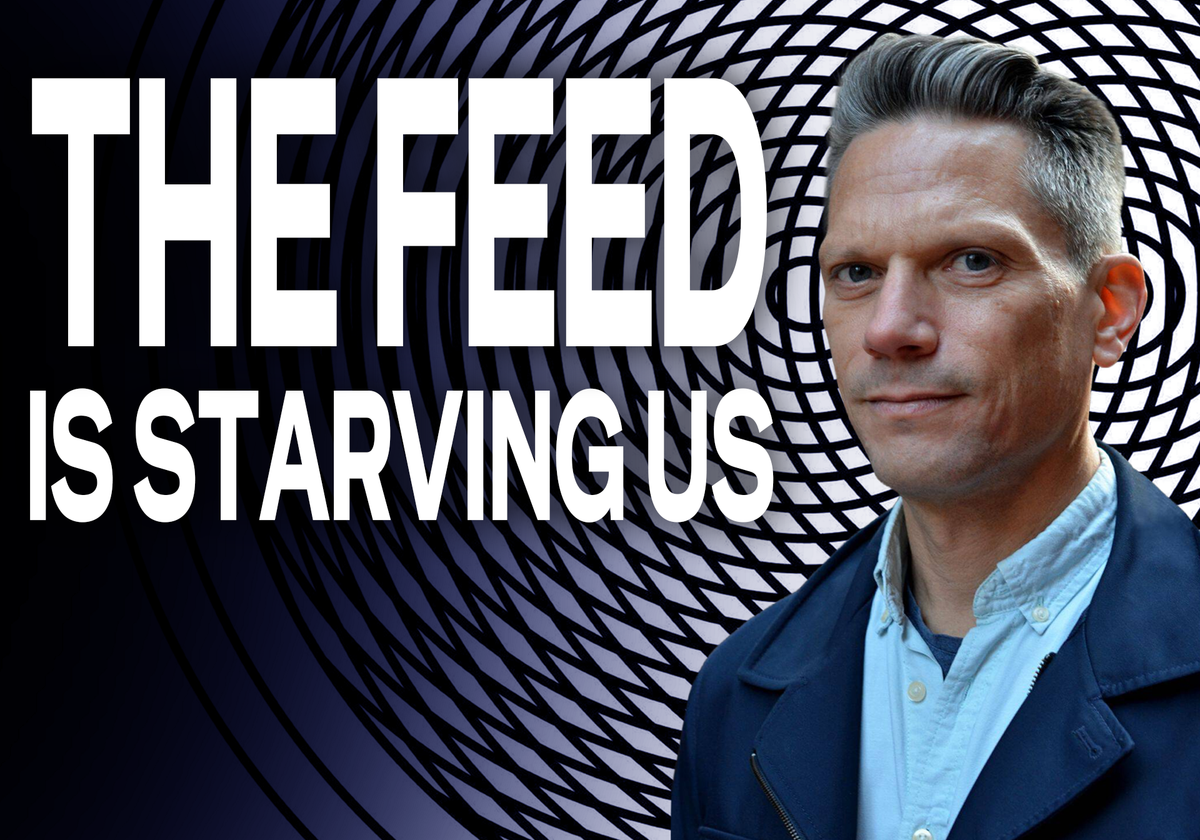
Digital feeds, malnourished students
Today we’re doing one of our occasional episodes where host Mack Hagood talks about a new essay he’s written for our newsletter “Feed Logic and the Failure to Thrive” Mack writes that students and professors are struggling, both academically and spiritually. He tries to diagnose the issue he felt in his classrooms this year and the role technology may play in it.
For new listeners, Mack is a writer and researcher who studies sound, technology, and culture. He is the author of Hush: Media and Sonic Self-Control, a book on noise-canceling headphones, white noise, tinnitus, and the ways people use sound to manage modern life. He is currently writing a new book for Penguin Press, and he also hosts this podcast Phantom Power, where he interviews artists, scholars, musicians, and sound designers about the invisible power of sound in everyday life. Besides all that, Mack is a university professor and that’s what his most recent essay is about.
Click here to read the newsletter for free.
Cited Media:
Film:
Mary Bronstein - If I Had Legs I'd Kick You (2025)
Books:
Ben Lerner - Transcription (2026)
Mack Hagood - Hush: Media and Sonic Self-Control (2019)
Hartmut Rosa - Resonance: A Sociology of Our Relationship to the World (2019)
Newsletter/Essay:
Mack Hagood - Feed Logic and the Failure to Thrive (2025)
Lecture:
Amar Bose - MIT Lecture on Engineering
Publish only, email is a separate entity
Transcript
Intro: SpectreVision Radio
Mack: Something that I've noticed is that students are in a very double position because they've grown up with all these technologies. They want the easy thing, they want the efficient thing, and at the same time, they've realized that they're not being nourished by these things.
Intro: This is Phantom Power
Cameron: Welcome back to Phantom Power, a podcast about sound. I'm Cameron Naylor, Today, we'll be doing one of our occasional episodes where host Mack Hagood talks about a new essay he's written for our newsletter.
As we've gotten a lot of new listeners lately, I thought I'd actually introduce Mack. He's a writer and researcher who studies sound, technology, and culture. He is the author of Hush: Media and Sonic Self-Control, a book on noise-cancelling headphones, white noise, tinnitus, and the ways people use sound to manage modern life.
He's currently writing a new book for Penguin Press, and he also hosts this podcast, besides all that, Mack is a university professor, and that's what his most recent essay is about.
'In Feed Logic and the Failure to Thrive', Mack writes that students and professors are struggling both academically and spiritually. He tries to diagnose the issue he felt in his classrooms this year and the role technology may play in it.
That's what we'll be talking about today. If you'd like to read the essay, go to mackhagood.com, that's mackhagood.com, and click on the newsletter to read. And while you're there, subscribe. It's completely free.
Mack: Hi, Cameron.
Cameron: Hi Mack. So we're here to discuss your latest newsletter. The title was Feed Logic and the Failure to Thrive, which seems to have struck a chord with a few readers.
Mack: Yeah. Yeah. it's been interesting. You know, I really haven't gotten this much of a response to a newsletter, and the interesting thing was I was very reticent, A, to put this newsletter out, and B, to promote it. So I really didn't promote it very much at all. You know, I did one Facebook post and then by the end of that day I had gotten all kinds of emails and text messages and people were sharing it on Facebook, which is where I posted it.
Lots of comments. And so yeah, it seems to have struck a chord with people, particularly with, with, uh, people who teach at universities and high schools.
Cameron: Absolutely. And I mean, we'll get into that a bit later on. But I wanted to start with the beginning of the essay and the sort of, the very first sentence you say " Two disquieting works of fiction I encountered this spring feature the same menacing figure: a young girl that refuses to eat."
So can you talk about these two works a little bit, and also this sort of choice to call a young girl menacing?
Mack: Yeah. Well, so the two works were Mary Bronstein's film "If I Had Legs I'd Kick You," and, Ben Lerner's novel, "Transcription." So one film, one book, both have, a character that's a young girl that just refuses to eat, who apparently has, you know, this very serious condition, ARFID, which stands for avoidant restrictive food intake disorder.
And, you know, they're, they're doing different work with this disorder in each one. In the Bronstein film, there's this character played by Rose Byrne, who's the mother of the child who's not eating, and, you know, she's just going through all of this drama. She's also a therapist, and you can tell she doesn't feel like she's doing a very good job as a caretaker, either of her clients or of her daughter.
And the film is very much about the types of social pressure that our society puts on women to be nurturing, to be mothering, but then the way society rejects that nurturing and then blames the mother for the rejection, you know?
So we watched the film on, I think it was a Friday night, which is usually we kind of decompress with a comedy, and it kind of was promoted as a comedy. We had no idea what we were in for. I mean, this is a brutal film. but, you know, it, not a pleasant, watch, but I think, you know, a nourishing one, at least intellectually, and, and it gave me a lot to chew on. Oh God, I'm saying all of these eating metaphors, and then Ben Lerner's novel, "Transcription," also features a character suffering from ARFID, but he seems to be, you know, thinking through this condition within a larger context of our relationship to digital life, which is very much what his book is about.
And in fact, while in "If I Had Legs," the daughter has a feeding tube directly into her stomach, that's, that's how far her condition has gone. In the Lerner book, there's a YouTube feed that actually allows the girl to start eating again. She starts watching all these unboxing videos, and then by sort of watching this display, this performance of consumption, it takes her mind off the fact that she's actually eating, and she's able to start eating again.
So a very, you know, two very different but very interesting commentaries on our present day, I think.
Cameron: Yeah, absolutely.
So you describe in the title it's feed logic and failure to thrive, and within the Learner book, there's this discussion of failure to thrive versus as terms. But did you have any trepidation about using a serious condition such as this as a metaphor for these larger social issues?
Mack: Yeah. I mean, I definitely did. You know, as someone who's worked in the space of disability studies I'm very, you know, conscious of the representation of disability and I try to avoid ableist metaphors. You know, I'm, I'm not big on the blind men and the elephant and that sort of thing.
But I also think that I, in my own work, have been interested in how we can use disability as a normal part of life that helps us think through disability itself, but also larger social issues of which disability is a part. So, for example, in my own work, you know, I've frequently used my own experience of tinnitus as an entry point into thinking about sound and listening.
So to me, the problem is not, you know, metaphors per se or literary images like the ones being used in this film. to me, it's more about, you know, what kind of work those things are doing. And, for me, what I was trying to talk about in this essay was, like, the experience of being a parent or the experience of being a professor or a teacher being faced with this other person who is doing something that doesn't seem sensible to you, and the feelings of failure, the feelings of rejection that one can have, you know, uh, if we focus on ourselves as the parent or the educator, and how that can prevent us from trying to understand what's going on with the child or the young adult that's in front of us, and what they're doing.
And, and just sort of sitting with that complexity and that pain of being on the outside and seeing somebody who's suffering and not having an ability to reach them, I think that's really what resonated with me in these two works, and really I could just totally relate to as a professor in 2026.
Cameron: Yeah. And so that is the sort of tie-in that you have in relation to this academic year. Would you for those who don't know, tell us where you teach and sort of what made these works resonate for you in the academic year?
Mack: So, I teach at a fairly large state university, not a flagship state university in the Midwest in the United States. So, everything that I'm writing about kind of comes from that perspective, that experience. And I'm sure listeners are well aware that the university is under all kinds of political, financial pressures, you know, being demonized by the president, by the federal government, by state legislatures, particularly like those in the state where I live, who have passed a number of laws, and often ones that affect the humanities, which I teach.
So there's all this going on, and then plus the just, you know, fucking hellscape of AI turning humanities and our central tool for helping facilitate thinking, which is the essay, into this one big, long, terrible Turing test where we're suddenly policing whether or not things are actually written by humans, which is not why any of us came into this type of work, right?
So that's all shitty, and yet that wasn't the most disheartening thing that I experienced in the past academic year. I mean, really the thing that affected me the most was the most recent batch of students were just really struggling, to... I don't-- I, I just felt like they didn't have a sense of why they were in college, that we weren't on the same page, that they didn't, you know, want to do reading to a level that I haven't seen before.
And so a lot of this is like, what's that Hemingway quote? Like, they ask the guy how he went bankrupt, and he's like, "Gradually and then all at once." I think that's the, the line. Anybody who's been teaching for a while now has seen declines in reading, in critical thinking, even in things like attendance. it's been happening. but this year, in my experience, and I've talked to a lot of other faculty, and they seem to, you know, have noticed this too, this year was way worse. students Just not turning in the work, lots of students resorting to AI. The majority, I would say, in my classes not wanting to do the readings, or just s- not actually doing the readings.
And test scores way down. so, Just for example, I teach one really big class. I think I started out with 117 students. This is a class that used to have an embarrassing number of A's. I had two A's this past semester. Two. So, that's the year that I've had and the feelings of, you know, like the parents in these two works, you know?
There's just, like, all kinds of feelings about that. You feel baffled, you feel worried, you feel guilty. You know, you question your abilities. And then also, you know, you feel resentful. Like, I worked hard to create this class,
Cameron: Yeah
Mack: with you guys in mind, and you're basically rejecting what I'm putting on the table.
So, like, you know, that's kind of where the AFRID metaphor comes in. At least I think that's why it resonated with me when I encountered these two works this year.
Cameron: Yeah. So what is your diagnosis of the situation then? for example, you mentioned feed logic. How are people interfacing with the world instead of resonating with it?
Mack: Yeah, so first of all, I should say, like, you know, in the two works that I'm talking about, the children are rather young, and they're sort of these ciphers, right? Like we can't really see into their experience very well. They're not really good narrators of their own experience.
These narratives are much more about the parents and their experience of this. And, you know, the fortunate thing about being a college professor is you're working with young adults who can speak for themselves. And, so, you know, for me, I'm always fascinated to talk to them, to listen to them, to get their experience.
And then as a media studies professor, also have them kind of focus in on their own use of digital technology a lot and do sort of basically informal autoethnographies where they're studying their own daily practice with digital media, but also some quantitative stuff. nothing too complex, but I have them track their own screen time numbers.
And what I've seen over the whatever decade that I've been doing this, the, uh, more than a decade, is that their screen time numbers have gone way up, and then the nature of how they spend their time with their phones is changing.
And so just in terms of, you know, raw hours, I only have them track their smartphone time. And at the beginning of the semester, I asked them how many hours they think they spend on their phone. So the average answer to that was six hours. in fact, once they tracked it, the answer was seven and a half hours, phone alone.
Now all of these students have laptops. All of these students have, you know, other devices that they spend time with. That's just the phone, okay? Almost a full-time job, you know. Well, especially when you count the weekends, it's more than a full-time job just with their phones. That alone, you know, depending on what they're doing, that may or may not be worrisome right?
There are lots of things that we can do on the phone that I think could be, you know, nourishing, so to speak. But another interesting thing is that I've over time seen them move away from posting to simply scrolling and consuming, and the thing that they're spending the most time on is TikTok. And if you ask them if there is one app that they could get rid of on their phone, they also say TikTok.
So, you have this really interesting duality where students are spending huge amounts of time using an app that they don't feel good about. And yeah, okay, maybe they're telling me what they think I want to hear, but I make it pretty clear that I'm just interested in their own self-reporting and analysis, and if they think their life is awesome, tell me that, you know?
Like, I want them to think about it and think about it critically. So they're basically spending, spending long stretches of their day on this feed. They're not actively selecting the content. They're passively receiving these sort of decontextualised stimuli.
And I think the elephant in the room here is, like, these new students, these new freshmen that I was teaching this past year are the students who really had their formative years locked inside with COVID and using apps as like sort of form of everyday life, so that this kind of feed logic, as I'm calling it, becomes like a sort of orienting structure of the day, and I think there's just a lot of problems with that.
Cameron: Yeah, I think you use the term ultra-processed communication in that sort of idea of sustenance and nourishment on the screen versus something that keeps you sort of pouring, over the content. And you mentioned that this sort of interfacing with the world and orienting your day around the phones or whichever devices, maybe multiple at the same time, it has ramifications for education I-
Mack: mean, just to say, to say a bit about the sort of ultra-processed communication. This is a concept I've been batting around for almost two years now, and, and it, it has its strengths and its weaknesses, I think. But obviously it's, it's sort of a comparison to ultra-processed food. And so what I'm sort of suggesting here is, like, this is a form of communication that has gone through a number of processes to amplify its tastiness, to amplify how quickly you can and easily you can consume it. And yet in that process, to do those things, which benefit capitalism, just like potato chips benefit capitalism, you wind up losing nutrients and also the sort of satiated feeling.
And so a key thing with ultra-processed foods is the more you eat, the more you want to eat, right? Like, and you can never feel full. And so I think that what we've been doing is, and this is something that's been pointed out by other scholars, but we kind of went from social networking sites, which helped people organize the social networks, the friend groups that they already had, and make new friends, right?
And I think that that was a pro-social moment, that had a lot of benefits, actually. I'm in touch with a lot of old friends through Facebook that I'm sure I would have lost track of. But then gradually it became social media and it became a more passive, less engaged sort of thing. And for most of these platforms, it just doesn't make sense for my students today, my younger students, to post what they ate for lunch like the millennials did, right?
And I mean, you can make fun of the millennials for doing that, but you know what? They were communicating with their friends and that was a form of sharing. Whereas my students today, that just doesn't even make sense. Now, and that's not to say they're not doing social things on their phones.
You know, when I see a student and their top two apps are Snapchat, and iMessage, and let's say the number three is, like, FaceTime, even if their overall phone numbers are high, I'm like, "Yeah, man," like, "You're, you're doing it right." Like, "You're communicating with your friends." And I feel like that's a benefit, right? You know, now luckily the Snapchat is usually floating around in there and, and there are problems with Snapchat too, believe me. Like, don't get me started on streaks. But, at least it is a sort of pro-social thing, but it's more processed, say, which is, you know, has all these other modalities of communication going on that Snapchat can't replicate.
But it's still pretty good. But compared to TikTok, TikTok is ultra-processed. you'll never be able to get your needs as a young person who wants to self-actualize through TikTok, and yet that's the place where they spend the most time.
And then when you're participating in this kind of feed, you're replacing these nourishing experiences and processes and relationships with these kinds of digital facsimiles. And so all the distinctions that made life what it was get kind of eroded because they all get squeezed into the same feed. So just things like different genres of art, they all start to seem the same, right? I've noticed this with my own musical consumption. Like it doesn't feel as meaningful to me if I catch some new music on Instagram or what have you.
Like, I just don't resonate with it the way I would if I go to the record store, buy an album, put it on my turntable, right? Like those are two very different things. So, the notion of what is a friend, right? Like, we get all of these less nourishing versions of these things that are distilled into this single endless feed.
That's what I'm calling the feed logic. It's this context-less context that our students are spending their days in, and then we have to kind of try to pop in there in the middle of this and like present a meaningful educational experience, and they're not primed for it. Like nothing in their day is telling them like, "Oh, this is the special allotted time education, and this is the sacred space."
All space and time are just this indistinguishable sort of like blah when you're spending your day with a feed, okay? And I know I'm giving the maximalist version of this. I don't think this is our students' lives. They're, they're still doing lots of interesting things. But the worst case scenarios and you'd be shocked at the numbers I see when I have my students track their own screen time, again, just on the phone alone. So I think that's part of what we're dealing with
Cameron: Yeah. And so when you are clocking in seven or eight hours per day, I think you've outlined a lot of the problems in the newsletter, but to break it down even further in this regard, in the sort of shift in consumption, first of all was the students being already overfull with these empty calories.
To extend the metaphor, their spoiled appetite.
Mack: Yeah. I'm really taking this eating thing pretty far. but yeah, we're like, "Hey, it's dinner time." And they're like, "Ah, you know, I filled up on chips." Like, there's just only so much information a human being can consume,
So just on a basic level, like basically I outlined what I perceive as five problems with this kind of feed logic when it comes to the whole practice of coming together as students and professors to create an educational experience. so the very first one is simply, yeah, they've got a lot of information running through their head, and so they're kind of full. It's pretty much that simple for the first one.
Cameron: Yeah. and on top of that, the second point is that professors aren't these dancing clowns. They're experts in the field, but they almost become these inept content creators offering what may be perceived as an inferior product.
Mack: Yeah, yeah. Basically, if the logic of the day this kind of feed of content, I think that we as professors, you know, we're hired because we're subject matter experts, and so we're not necessarily good at presenting content, right? And if content is the logic of the day, if the feed is the logic of the day, can we really blame students for thinking that we as professors are just inept content creators?
Like, we're just not good at it, right? And like, "Why do I have to show up for this? I could stay home and watch this as a video," and that sort of thing. Like, we seem like we don't offer a very good product. If, if one has bought into this concept that the purpose of education is to put information in someone's head, well, they experience that all day long with people who are a lot better at it than we are.
But for me, that is not my belief in what education is at all. But, you know, if that's the case, we're gonna have to make an argument to students about what we think education is. Like, we need to have a meta conversation about a lot of these issues that I've outlined. But yeah, that's the second one.
Like, we're never gonna be as good as TikTok, so we're gonna have to differentiate our product, to use a gross word, from TikTok, right? And we're gonna have to explain that, "no, we're doing something different here."
Cameron: And that brings us nicely onto the third point, which is the sort of speed and ease of the content that they are consuming on their phones is a sort of friction-free, experience. They're interfacing with something that is maximized for speed and ease and learning is inversely proportional to that mode of content which can discourage learning at a certain point.
Mack: Yeah, I mean I tell my students this all the time, like learning is about the grind. So anytime you're thinking the word efficiency to yourself, you're doing it wrong. There is nothing efficient about learning. Learning is about making mistakes. Learning is about doing revisions. Learning is about, you know, banging your head against the wall, reading something for the fifth time over.
I was just yesterday, because I'm, you know, writing this book about sound technologies, watching a lecture at MIT by Dr. Amar Bose, who started the Bose Corporation which popularized noise-canceling headphones and so forth. And he was discussing this experience that he had as a PhD student studying with Norbert Wiener, and basically being handed 50 pages of equations, and Wiener and his colleague tell him, like, "Come back to us when you understand this." And he just like day after day, twice a day, for hour after hour, kept reading these equations with no help, and he kept coming back to them like, "I don't get this." And they're like, "Don't worry. You'll get it. You'll get it. You'll get it. Just, just do it." And then eventually he did get it, right?
And, like that's learning, you know? And we're constantly being pressured as professors to minimize the friction. We use these content management, or learning management systems that, you know, make our students feel like, okay, education is just one more type of digital content, and it should all be very neatly organized, and you should be able to click through it real fast.
And I've got students who get on that LMS and do all of the work in advance if you don't put in stuff to stop them. I'm like, "You're answering questions that I haven't you know, like what are we doing here?" And so there's an entire digital infrastructure that's been created around the speed and efficiency and ease of transmitting information, and I'm here to tell you that all of that is anti-learning. It's all anti-learning. It's the faster, slicker, most efficient thing you can do is gonna produce the least learning. And the apotheosis of this is fucking AI, man. Like AI is the perfection of ease and efficiency, right? You can use AI to write your essay for you or to take your test for you, and you will learn absolutely nothing.
It's perfection I, well, I don't know what to tell you. Like, if you, if you wanna learn, that's, the situation. But I'm not blaming the students here, but the university is encouraging this, you know? The system, the nation, the world, the Silicon Valley, like, we're all encouraging these kinds of practices that discourage learning
Cameron: Yeah. And it's putting it up against something that is bound to not be as efficient as the content as well. So it, it's doomed to failure by very nature. You know, it's never gonna be a TikTok feed, and you wouldn't want it to be. But, the fourth point is that, white-collar jobs are increasingly online now.
You know, the, the best case scenario is spending your time working from home staring at a screen, you know, that sort of isolation that comes with it. It's all within the milieu of the computer now.
Mack: Yeah, this is another reason I think that students aren't motivated because the jobs that they're allegedly being trained for at the university are just gonna be more staring at a screen, right? Like, and one point I wanna kind of play with here, and there's something that I've noticed is that students are in a very double position because they've grown up with all these technologies. They want the easy thing, they want the efficient thing, and at the same time, they've realized that they're not being nourished by these things. So for example, they wanna use AI to get through the class as easily as possible, and yet they hate AI, Like, they boo the speaker at graduation if they start celebrating AI.
They're like, "No, we hate this stuff," right? They want the ease and lessened anxiety of avoiding face-to-face contact, and making friends at the university, and yet they know that that's keeping them from feeling happy, right?
They want to get that job where they can be a digital nomad or just work from home and never have to go into the office, and yet they know that that is gonna starve them of actual mentorship and friendship that can be generated in the workplace, right? And I mean, you just have to walk around the halls of a college campus today, and they're so empty compared to when I was a student or even when I first started as a professor 15 years ago.
So there's this doubleness going on, and so there's a lack of motivation, I think, for the students because they kinda don't see the point of the whole thing, it's demoralizing.
And then that sort of works into the final point that I make in the essay, which is that because we have reduced work and thinking to this kind of pixel pushing, students feel that AI is gonna be able to do everything better than them very soon, if not already.
And so that not only saps their motivation to learn, if they think learning is just about generating skills for the marketplace, right? But also, it just saps their sense of purpose and meaning as human beings. I know it affects me, you know, to see a machine that can write while I'm struggling to write a book. It's demoralizing, right?
So those are the detrimental effects that I see right now. And then, you know, the question becomes What are we supposed to do as professors in this scenario?
These are the things that I've observed in my students. These are the things that my students have told me. That's my diagnosis of the problem. again, though, I'm a media scholar, so I'm a hammer and everything is a media nail. You know, I think there's, like, other social dimensions to all of this.
It's not reducible to smartphones exactly, but it's part of a larger problem to be sure.
Cameron: Yeah. And so to sort of wrap everything up, you, you've mentioned this refusal to continue is this rational choice that students are making.
Mack: yeah. I mean, I, I'm glad you mentioned that 'cause that is like the point that I sort of land on is that Students seem grossed out by what we're putting on the table as professors this year. That's the way I've perceived it. And I think it's because we need to do a better job of communicating to them what is the value of college, cause it's really not self-evident anymore.
And I think, you know, the feedback I've gotten from, faculty has been that, you know, it, it's been a lot of like "You have described my year to a T." A lot of faculty saying " I'm so happy that I'm gonna be able to retire soon," and then other people saying, "I'm so sad because I can't retire soon." You know, there, there's a, a lot of feeling discouraged, but I, I think, people were sort of like saying, "Hey, thanks for sort of articulating this." And again, it was something I was very hesitant to do because I was basically saying, "Man, I feel like I'm not good at this job right now."
Some feedback I got, and it's interesting 'cause this is where I wanna go with this in the future is talking about why are we doing this, you know? And, and what does particularly humanities education have to offer? And I think it has a lot to offer.
But people were talking about how process-oriented, classes where the students are actually making something, they're making podcasts, or they're creating some kind of art, or doing field recordings or this sort of thing, like, they found that their students actually really love that. And that they haven't figured out yet is, well, how do we turn humanities classes where we're just talking about ideas and writing essays, like, how do we turn those classes into something more like that which the students do seem to actually, uh, appreciate?
So that's, potentially one direction we could go. But I've got a lot of ideas swimming around in my head, and I'm very, very interested to hear other people's ideas, because I think what we wanna do is think about a type of education that is about resonance instead of the transmission of information.
Cameron: You mentioned resonance in regards to the students and the way that they're interacting with the world, but how does that fit within teaching?
Mack: There's a line in the piece where I say there's a difference between interfacing with the world and resonating with it. And that is in part inspired by the sociologist Hartmut Rosa, whose work I've been kind of really getting into lately, who's been talking about the concept of resonance as a contrast to control. And, you know, basically saying we can control the world or we can resonate with the world, but it's very hard to do both at the same time. And obviously we can't go through life controlling the world, right? We need to do things like eat and build houses and stuff.
But if we control to the exclusion of resonating, then there's no meaning to, to what we're doing. And so, what I notice about digital technologies is they provide these interfaces that give exquisite control over aspects of life that are usually outside of our control, right? So you can mute somebody if you don't like what they're saying or what have you, right? Or the noise-canceling headphones can just shut the noises out around us. And so these are all technologies of control, they can in some ways help us resonate. But when, I think when they become that we operate in life, we tend to be applying logics of control rather than logics of resonance or practices that help us resonate with one another in the world.
And then this is something I'm gonna talk more about, I think in a future episode, future newsletter article, and indeed in the book I'm writing right now. But that's, basically the concept. And then, so for me, the challenge is to communicate to students that education might really be more about resonance than control, or at least bring resonance back in, because resonance is, where the meaning is.
And so doing things like, you know, uh, sound walks is a way for those of us who work in sound studies and who work in podcasting and audio production to give students an opportunity to resonate with the space around them.
And resonance doesn't necessarily mean something positive, right? Like you can resonate with something in a way that is you're picking up on negative aspects of the environment, but you're engaging with the environment as it is instead of trying to control it.
And so to me, that's sort of the essence of what a sound walk is all about. We don't have a very strong agenda except to listen to what's there. And similarly in the classroom, like obviously there are things that we do wanna learn, there are skills that we wanna learn, but a lot of what we're there to do is to encounter, at least in the humanities, a text and kinda resonate with it, you know?
And then, uh, my favorite professors were always the ones in grad school who said, you know, 'cause they would say, "Okay, let's talk about the thing that you read." And all of these, you know, feisty young grad students like myself are like, we're ready to come out with the hatchets and the bows and arrows and, and like, attack the thing.
And the great professors were always like, "Whoa, whoa, whoa, wait a minute. Like let's give this, you know, a hearing on its own terms. What was this person trying to say?" You know, "We'll get to the critiques, so just hold on a minute."
And I think those kinds of moments for me are like the magical moments of education. And what I found very concerning was Not only could we not rely on students having an ingrained understanding of that sort of thing, right? Which we could say was possibly a class privilege to have a sort of knowledge of this way of interfacing with the world at this point or, or engaging with the world, resonating with the world.
But like I came across some students who were actively hostile to it, really like, "Why are you wasting my time with this?" Or even, I had comments like this and I know some other faculty have had comments like this. They take this class too seriously. They think it's important and they, they need to understand that a lot of us don't really care about this. And it's like, well, don't you want me to take it seriously? Like, what? Like, you know.
So, I forget who said this, but you know, somebody once said something about the cynical bargain that can happen between faculty and students where the professor pretends to teach and the students pretend to learn. And that's the safe route because you know, you're, you're not challenging the students. They get a decent grade. They're not mean to you on the evals and everyone parts ways and nothing was learned, but nothing was lost, you know, from both sides.
And to me, education is about something more risky than that because the whole thing about when we get together and resonate with one another is like we don't know what's gonna happen, and that's an uncomfortable area. And so that's what I wanna explore in the future and that's what I want to figure out how to make a compelling argument for 'cause I wasn't able to make one with some students in this past year. I mean, it wasn't an all bad year. I had some amazing students and some wonderful experiences but, there were a lot of students who were not picking up what I was throwing down, that's for sure.
Cameron: You can't win them all.
Mack: Yeah, can't win 'em all.
Cameron: But Well this has been fantastic. I mean, it's great to hear that there's been such a response to, what you're saying, that there's, there's a consensus in these different views. but yeah, is there anything else that you'd like to, make known before the end of the episode?
Mack: I mean, if you are interested in hearing the next installment or reading the next installment, you know, you can go to the website and sign up for the newsletter. It's free. I'm gonna continue to discuss this topic among others. So, yeah, check it out if you're interested.
Cameron: Great. Well, thank you for your time.
Mack: Yeah. Thanks,
Cameron: Cheers. Lovely to see you
And that's it for this episode of Phantom Power. Thanks to Mack for breaking down his most recent newsletter, 'Feed Logic and the Failure to Thrive'. If you want to read the full article, you can find it on mackhagood.com. That's mackhagood.com. And if you like what you read, you can subscribe for future newsletters and updates.
And if you like what you heard here today, then you can become a paid member and support the show.
This episode was edited by me, Cameron Naylor. Thanks for listening, and I'll catch you next time.
