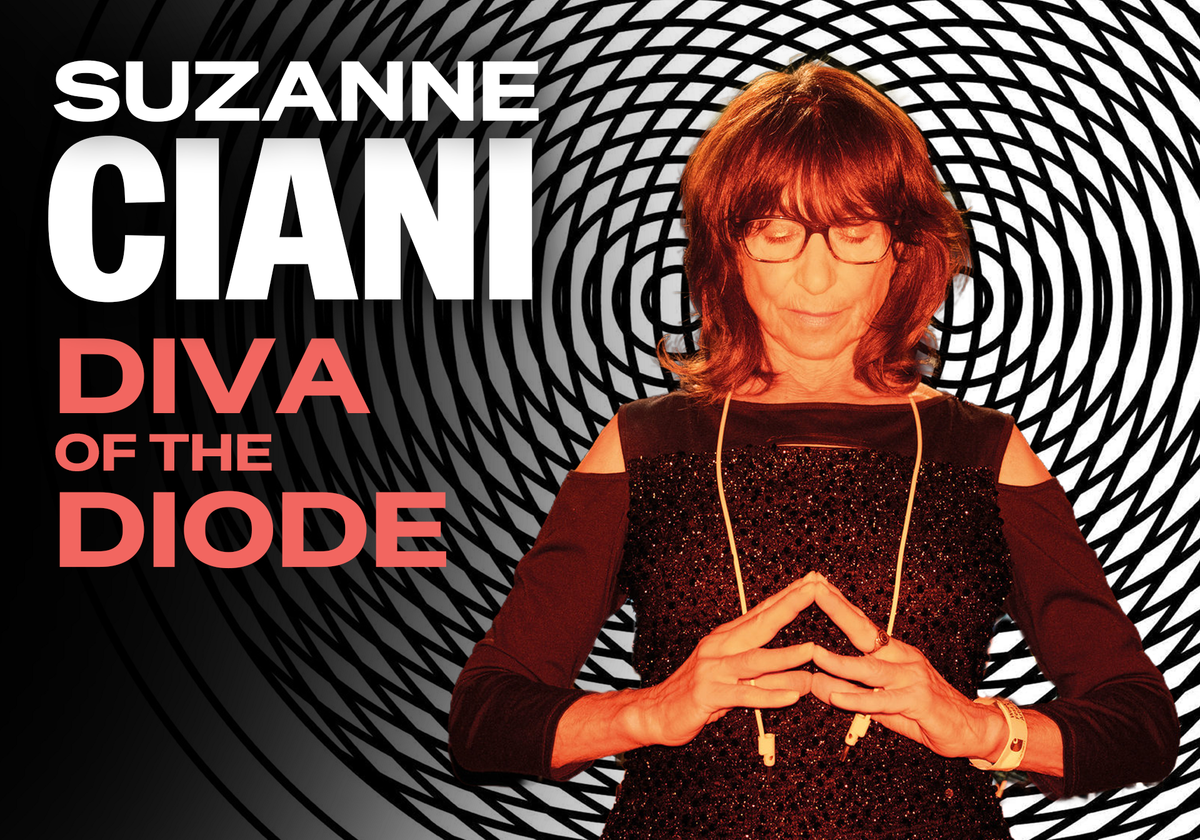
Did Moog ruin synths? Suzanne Ciani reveals analog's original sin
Today we talk to modular synth pioneer Suzanne Ciani and MIT Spatial Sound Lab researcher KamranV. Suzanne and Kamran both love quadraphonic sound, and they have a new quad release coming out on June 4th called Ciani/Orkest. They are on a mission to make quadraphonic music accessible to both musicians and to listeners, and in this interview, Kamran will explain how, you, with no special equipment, can listen to their new album in quad.
We'll also get into how analog synthesizers actually work, the early history of Buchla synths versus Moog synths, why Suzanne thinks keyboards diminish the potential of synths, and how Suzanne designed some of the most recognizable sounds of the 1980s.
Suzanne Ciani is a Grammy Award nominated composer, electronic musician, and neoclassical recording artist who has released over 20 solo albums, including Seven Waves and The Velocity of Love. Her work has been featured in Hollywood films, video games, and countless commercials. She was inducted into the first class of keyboard magazine's Hall of Fame, alongside Bob Moog, Don Buchla, and Dave Smith. And she was the subject of the feature documentary, A Life in Waves.
KamranV is an arts technologist and MIT Spatial Sound Lab researcher, and he's a National Endowment for the Arts grant recipient. He's worked at Interscope Records, produced immersive music releases for Nine Inch Nails, Sting, and Beck, and he ran the music tech fest, Moogfest. He's also on the board of dublab.
Cited Media:
Music & Albums:
- Suzanne Ciani - Ciani/Orkest (2026)
- Suzanne Ciani - Live Quadraphonic (2016)
- Suzanne Ciani - The Velocity of Love (1986)
- Suzanne Ciani - Seven Waves (1982)
- Wendy Carlos - Switched-On Bach (1968)
- Stevie Wonder - Talking Book (1972)
- The Rentals
Film & TV:
- 3-2-1 Contact, PBS (1980–1988)
- Brett Whitcomb - A Life in Waves (2017)
- Suzanne Ciani on David Letterman (1980)
Events & Festivals:
Tools & Plugins:
Record Labels & Archives:
Transcript
Intro: SpectreVision Radio
Suzanne: The keyboard was the enemy, the absolute enemy, and that was the main distinction between the East Coast and West Coast, because Bob Moog was equally frustrated by the inability of the marketplace, of the people at large, to understand that this was a musical instrument. And so he put a keyboard on it, and that ruined it, because...
Mack: tell us how you feel.
Intro: This is phantom power
Mack: Welcome to another episode of Phantom Power, a podcast about sound. I'm Mack Hagood, and today we're talking to modular synth pioneer, Suzanne Ciani, and MIT spatial sound lab researcher KamranV.
I grew up in the 1970s and 80s in the golden age of educational television in the United States, eating cereal in front of PBS shows like Sesame Street, The Electric Company, and Mr. Rogers. But my favorite show was a science program called 3-2-1 Contact. And in one segment that really stuck with me, two young women stood in a music studio surrounded by synthesizers and an oscilloscope having a conversation that was sophisticated on both a technical and a philosophical level.
This segment didn't talk down to kids. In fact, I didn't even really completely understand it. Luckily, there were lots of reruns for me to rewatch, but it was an early experience for me in thinking analytically about sound and music. And the interviewee in that 1980 segment was Suzanne Ciani. So it feels like a full circle moment for me that she's my guest today.
Mack: Suzanne Ciani is a Grammy Award nominated composer, electronic musician, and neoclassical recording artist who has released over 20 solo albums, including Seven Waves and The Velocity of Love. Her work has been featured in Hollywood films, video games, and countless commercials. She was inducted into the first class of keyboard magazine's Hall of Fame, alongside Bob Moog, Don Buchla, and Dave Smith.
And she was the subject of the feature documentary, A Life in Waves. Also joining us today is Suzanne Ciani's collaborator, KamranV, who produced her Landmark LP Live Quadraphonic, which was the first Quadraphonic vinyl record in 30 years. It also restarted Suzanne's performances on an instrument she pioneered, the Buchla Modular synthesizer, which we are definitely gonna talk about.
KamranV is an arts technologist and MIT Spatial Sound Lab researcher, and he's a National Endowment for the Arts grant recipient. He's worked at Interscope Records, produced immersive music releases for Nine Inch Nails, Sting, and Beck, and he ran the music tech fest, Moogfest.
He's also on the board of Dub Lab. Suzanne and Kamran both love Quadraphonic sound, and they have a new quadraphonic release coming out on June 4th called Ciani/Orkest. They are on a mission to make quadraphonic music accessible to both musicians and to listeners, and in this interview, KamranV will explain how, you, with no special equipment, can listen to their new album in Quad.
We'll also get into how synthesizers actually work, the early history of Buchla synths versus Moog synths, why Suzanne thinks that synths shouldn't have keyboards, and how Suzanne designed some of the most recognizable sounds of the 1980s. This conversation was a blast. If you want to hear the full version with another 30 minutes of bonus material where we really nerd out on quad and get into Suzanne and Kamran's music and reading recommendations, go to mackhagood.com.
That's mackhagood.com. That's where you can also sign up for my free newsletter on sound and listening. Alright, let's get into it.
Mack: All right, Suzanne ciani and Kamran, welcome to the Show.
Kamran: Hi.
Suzanne: Hi, thank you for inviting us.
Mack: Yeah, it's a real thrill. I'm so excited to have you both on. And Suzanne, there are so many things we could talk about with your career. You're a five-time Grammy nominee. You're a trailblazer in terms of women scoring Hollywood film. You're certainly a legend on the Buchla synthesizer, which I definitely wanna talk about. But I thought maybe I'd start by playing a sound from my childhood, and I'd love you to just tell me all about it.
All right, here it comes.
Coca-Cola pop and pour.
Suzanne: That would not have been republished in the world had it not been for Andy Votel at Finders Keepers. So I had a long history of designing sound in world, Madison Avenue, and it was basically an anonymous, form. And so I just was very dismissive of it, really. And Andy wanted to publish of the commercial work that I did, and that's how it reappeared in the current airwaves.
Mack: And that's a Finders Keepers re-release. Am I remembering that correctly?
Suzanne: Yes. I mean, Andy Votel came to me about, oh, over 10 years ago. I think he actually kickstarted this revival of my electronic music identity, because it had been dormant for quite a few years after I moved from New York City to the West Coast, where I, you know, reconnected with the piano.
Mack: And what do you remember about designing that sound for Coca-Cola? Because I talked to my wife about this, and the minute I mentioned it to her, she immediately knew what I was talking about. But she also didn't realize that it wasn't just the sound of a Coca-Cola bottle opening, that it had been kinda juiced, so to speak.
So could you tell me a little bit about that process?
Suzanne: Well, the main electronic feature of that sound is those perfect little bubbles going up. And what those are harmonics of a sub-audio tone.
So all sounds that we hear except, you know, sine waves are famous for having no overtones, but square waves, sawtooth waves, and other, you know, typical waves that we use in sound design have harmonic series above. And so if you put a very low tone into a band pass filter and you send a voltage up scale there, it will pick off the harmonics of that sound. It's very musical. They're bubbles, but they're basically very musical.
So that was the essence of that sound, it was a sound designed originally for a little, tiny space in a radio commercial.
So they presented me with this black space said, "Can you do something in there?" And of course I always said yes of course, and so this was new. Madison Avenue, custom design of both images and sound was something totally new because it was the dawn of technology in these fields.
So, Robert Abel was starting to make digital visual images. And these images called for a new kind of sonic, you know, dimension.
Mack: Yeah.
You know, it's interesting because recently on this show, I've begun exploring the everyday sounds that surround us and the hidden labor that goes into making them, and y- you actually used the word anonymous. In our last episode, I interviewed two scholars who wrote this book called "Anonymous Sounds" that's about the history of library music in film and television.
and it's just kind of fascinating for me to think about the ways that you were an architect of a lot of sounds that I heard as a child growing up in the '80s, and the just kind of like the character of the TV world, the sonic character of it.
Like, you were someone I had no idea existed, but were building these things that just seemed to naturally emanate from my screen.
Suzanne: Yes. As one person said, it was subversive because, these sounds were new, and advertising is very prolific.
I mean, millions of listenings of these sounds occur, and so they do really enter the fabric of our culture.
Mack: Kamran, When's the first time you encountered any of Suzanne's sounds? Do you have any memories of...
Kamran: well, it was definitely subversive. You know, I'm a product of the '80s as well, and there are even, like, random local jingles that I can't forget from 1981 or something. And so I didn't know I was interacting with Suzanne either, with the Atari symbol or the Coke sound or any of these amazing things back in the day.
Yeah, I mean, in fact, when I first met Suzanne in person, I didn't even know who I was meeting.
Yeah, it was through a mutual friend of ours, Mr Bonsai had,
Suzanne: Aw.
Kamran: yeah, were at NAMM, I think.
He had me take a photo of all of these legendary engineers and Suzanne was the only female, of course, 'cause this is the pro audio world of a bunch of white guys in sport coats. And, I think it was for SPARS or one of the organizations, and I took a photo. When I had properly met Suzanne while doing Moogfest, I somehow came across this photo that I had taken for some publication and was like, "Oh, I met you a long time ago."
Mack: We should say you were a curator of Moogfest. I don't know if curator's the right word, but you were managing moogfest. right?
Kamran: Yeah, yeah. I actually started a business with the Moog company and another partner of mine, Adam Katz, to reimagine what Moogfest is, was, became. And Suzanne was a critical part of what it became for many reasons,.
Mack: Well, I definitely wanna talk about Moog synthesizers and Buchla synthesizers in a bit. But maybe before we get to that, I just wanna play one more sound from my childhood since I'm walking down memory lane here.
Let's check this out.
Xenon. Xenon. Xenon
oh, oh, oh, oh, oh, oh, oh, oh.
I love that last one. Can you tell us a little bit about that, Suzanne?
Suzanne: Well those sounds were all done for the scene on Pinball Machine. Those were actually the raw development of sounds and they were all done with my voice I had an assembly of tools, the high tech possibilities of the day assembled in something I called the voice box, and this was something that you could see on the David Letterman show when I did that episode there.
Suzanne Ciani on the David Letterman Show: I just, can you talk into this one? Yes, I sure can. Hello, hello. Testing one, two, three. Testing one, two, three.
Okay. Hello, hello, hello, hello, hello. What do you want me to...
Make some, uh, make the thing make noises for us. Okay. Now, w- first of all, why, why do you have this stuff? What do you do with this stuff? Um, well, this is how I make a living. But, I mean, you don't go door to door saying, "I'll make you sound goofy," Yeah, they call me. They call you.
Suzanne: And the voice box was a compilation of these, rack mount processing tools like the harmonizer, the vocoder. And what I'm doing those sounds is I'm putting my voice through a harmonizer and dialing the pitch up and down, but it's also going through a vocoder, which maps your vocal sound without any of the pitch information.
That's why you get those spacey kind of robotic voices, that's with a vocoder. So I used all these things to play with.
Mack: And so these were like raw sounds that the player would trigger in interacting with the pinball machine, basically.
Suzanne: Yes. It was an interactive design that while you played the machine, it responded, to which moves you made. It was a lot of fun to do. It was really like making a musical composition that was live performed by the person playing the machine.
Mack: You know, I can just hear you having fun in the, in those sounds, you know?
Again, talking about subversive. I mean, there is just something subversive sounding about it.
It's really interesting to me because I feel like there's always been this like low culture, high culture divide in the history of electronic music, right? So we get the theremin, and of course that's like, Clara Rockmore playing this art music.
But on the other hand, most people, the first time they ever heard the theremin was probably some B movie from the 1950s where there was, like, a UFO, and then it's just these creepy sounds happening, right?
And it seems like what's so interesting to me about your career, Suzanne, is that you've been on both sides of that divide.
Suzanne: Yep, that's true, I grew up in academia. So, as a child I was a pianist and a composer, so I always identified as a composer.
I majored in music, in undergraduate school at Wellesley College, and then I went to UC Berkeley for a master's degree in music composition. And there I discovered really that in academia, yes, which was in many ways the birthing place of some of the electronics.
There was the Columbia-Princeton Music Center and Milton Babbitt. So it did kind of have a fertile ground in academia. But, I guess what I would say is that, in general, the academic basis of music had closed doors for women.
It's a very simple thing. I mean, you know, if you were studying music, you were studying the music of dead men, and that was it.
If you were listening on the radio to a classical station, there were no women at all. Zero. So maybe from my perspective, I noticed that very acutely and felt blockade of actually going forward in that field.
So when I discovered electronics, it was a real promise for being able to do it all.
Mack: Well, let's talk about something that's definitely on the high art side of this divide that we're talking about, which is your new project. Maybe Kamran, do you wanna tell us a little bit about Suzanne's new release?
Kamran: Sure. I mean, I had the privilege of being involved after it had happened. I remember Suzanne had told me she was going out for this adventure in, in Amsterdam for the Amsterdam Dance Event.
And for Moogfest, we had actually done some similar experiments, where she worked with the Berklee School of Music on doing a composition for a silent film. and, you know, it spawned into this amazing project, and me being the, sort of disciple of hers in quadraphonic sound and immersive audio What better way to exemplify this incredible intersection of her career and of what spatial audio can be than with this incredible orchestra, the Metropole Orkest.
And so Suzanne asked me to come in and turn it into something after she had worked so hard to miraculously make it happen live with Simon Dobson. I mean, she can go into the trials and tribulations of making that happen, but I'm just so privileged to be a part of it. It's such a culmination, for me of everything that Suzanne's been so generous to include me in this adventure.
So it's been such a ride to put this kind of record out.
Mack: So the album's called Ciani/Orkest?
Kamran: Orkest, yes.
Mack: And, I mean, I've gotten to listen to it. It's this wonderful like, constantly evolving piece that moves through a lot of sorts of atmospheres and genres. Like the third section, you know, this live breakbeat comes in, and there's this crescendo that just builds and builds and builds and a jazz trumpet solo and just, it was...
Kamran: it's very European, right?
Mack: It's really intense.
And I was thinking, like, Suzanne, even after all of these years, it must have been just incredible to be on stage in the middle of all of that and hear your composition come to life in that way.
Suzanne: That was it, just the decibel level alone, you know? Hearing the timpani at my back, you know, and the stage shaking with the, sound. it was amazing, really. You know, I have the greatest awe and respect for those musicians.
I don't think, you know, as a person who straddle both sides of the classical and the more contemporary sound, I've noticed that dealing with classical musicians in this country very often is strictly classical. You know, they're married to that printed note, and there's very little improvisation. The two sides just don't touch, and what you notice about the also a growing evolution in classical music now is the ability to embrace also improvisation. You know, they've had to loosen up a little bit. Not just play the repertoire from the past.
But, yeah, contemporary music. I mean, I developed the idea at Berklee College of Music where I was teaching, and they are, you know, perfect representation. They have merged with the New England Conservatory, so they have a deep classical identity, and then they have jazz.
And so it was developed in that place and, I was just making notes this morning 'cause I never know what's happened. And, that was in 2018, where I had the idea of working with a Berklee orchestra and including, you know, written music with improvisation with the Buchla, and how do you integrate those two things?
You know, the Buchla is a freeform performative machine, instrument. And, integrating it with the conductor. You know, we developed one routine. With Simon Dobson, we did a different one. But, yeah, so that was 2018. 2022, four years later, came the Amsterdam performance, and four years after that, thanks to Kamran, we have the graduation of this-- Actually, it's the PhD. So we had four years and four years.
Mack: that's so cool.
So Suzanne, you mentioned the Buchla. Maybe this is a good time for us to really get into the history of analog synthesis a little bit here. The electronic music tradition as I understand it, like it goes back at least to the '50s. There are people like Stockhausen using oscillators in Germany, and there's the musique concrete tradition in France, people, using recorded sound to orchestrate things.
There, there was also John Cage using radios as a composition style. But really, I think electronic music, as most people think of it today, gets its start in the United States in the mid-'60s, where there are these two different guys, one on the East Coast and one on the West Coast, who basically invent very similar technology at the same time.
So I'm talking about Robert Moog on the East Coast, Don buchla on the West Coast. Could you maybe just talk a little bit about that? I'd love to hear both of you talk about it because you both have expertise in this area.
Suzanne: Well, it's interesting to look back from a perspective of today as to what happened back then because in the moment back then, for me it was just an eruption of possibility and joy in this new instrument that you could perform.
But Don Buchla for me, is the Leonardo da Vinci of this instrument design. And he manifested, on request. You know, the power of request. I love that. Morton Subotnick asked him, "Could you make me something that I could use to control sound And Don made it.
Mack: This is Morton Subotnick of the San Francisco Tape Music Center, right?
Suzanne: Exactly. Yes, and that's where the first Buchla 100 went.
So Buchla, I play the 200, the original one was the 100, and I did grow up on that at the Tape Music Center.
Mack: But maybe can you talk about the Buchla 100? Like, what exactly did he invent? Maybe you can tell us what an oscillator is and then take it from there.
Suzanne: Yeah. Well, what you're talking about is modules, modular synthesis. So there are these little units, and each one has a special job to do.
And in a modular, you get, the oscillator makes the sound. The envelope generator controls the volume of the sound. The filter controls the color of the sound. The sequencer controls the pitch of the sound, et cetera. So you have all these individual modules, and you assemble them and patch them with cables so that they can talk to each other in a way that you decide. So it's very open-ended and flexible, and no two systems pretty much are alike.
So the kids today are playing Eurorack. There are thousands of Eurorack modules and everybody's system is unique to their choices.
Mack: It must be incredible to see this generation of all of these different Eurorack modules and how many people have re-engaged with this kind of synthesis.
Suzanne: Yeah, and let's face it, my sadness is that they didn't adopt the Buchla format because in terms of instrument design, Buchla, you know, he was a true designer. When he designed the size and the format of the module, he studied the human hand and designed designed around that.
It's called an interface. You know, how do you connect to the potentials of these instruments? And you have to make a contact from the human interactive, that's called the interface, and that's the critical part of all technology that's used by humans, yeah.
Mack: The historically inherited interface, of course, would be the keyboard, but Buchla was thinking outside of the keyboard, right? He didn't want to reduce that kind of interaction to a keyboard necessarily.
Suzanne: The keyboard was the enemy, the absolute enemy, and that was the main distinction between the East Coast and West Coast, because Bob Moog was equally frustrated by the inability of the marketplace, of the people at large, to understand that this was a musical instrument. And so he put a keyboard on it, and that ruined it, because...
Mack: tell us how you feel.
Suzanne: Yeah, I mean, as Buchla would say, it was a, quote-unquote, "inappropriate interface." Inappropriate, totally inappropriate. It was mechanical. Electronics doesn't have mechanical, right? It's a switch. It's a contact.
Buchla made touch plates. He made one that was fretted like a guitar, you know. But, yeah, what happened was that the rock and rollers adopted the Moog, and everybody thought it was about the sound you know, the timbre. Whack, whack, whack, whack.
Mack: Kamran, do you wanna speak up a little bit for Team Moog? I mean, we've had some shots fired here.
Kamran: Yeah, my first awareness of sort of analog synthesis, 'cause synthesizers were pervasive in the '80s or whatever, was through rock music. The very thing that I guess ruined it for everyone. When The Rentals, Matt Sharp's side project from Weezer, had come out and we're the age of MTV and there's this amazing music video of these people very oddly dressed playing the Moog and it says Moog very much on there with its cool logo and all of this stuff.
And, you know, I found out my guitar teacher had one in his closet that he would sell me for 300 bucks and one and it was there and, I mean, there were all kinds of stuff that happened in the '90s that sort of brought back analog synthesis 'cause the '80s was all about digitizing everything and these were very inexpensive devices at that time.
You know, the Moog Cookbook, Roger Manning and Brian Kehew, it's like they did these covers all in Moog, you know, kind of a la Wendy Carlos interpretations and, It was just mysterious and fascinating. And for whatever reason, the idea of this Buchla synthesizer had not really come in those places.
You would see these big modular synthesis, but it always came with a keyboard because of the way rock music had adopted it, that it's effectively a piano. And when I came to be able to do Moogfest, it was an identity, right, at that point. And so people of a certain age just really identified with this strange, cool device that you could control not only with the keyboards, but with these knobs and patching and all the other fun things.
And what's crazy to me is when I really discovered the Buchla, it was everything that modern electronic artists were embracing. So, like, Ableton Live to me is just like fast-forward the Buchla of this sort of idea of connecting things and you becoming one with the machine and the rhythms of it. But, you know, obviously it doesn't have quite the same character as a Buchla.
Mack: Yeah, well, thanks for that, man. This is fascinating, and I'm glad that the two of you could still manage to come together over quadraphonic sound despite your enmity.
Kamran: Yes, and that's what unites us all. Yeah.
Mack: But Suzanne, I'd love to hear a little bit about your first encounter with the Buchla. So my understanding is you were studying, you were doing master's work at Berkeley.
You somehow encountered the San Francisco Tape Music Center there, and is that when you first encountered the Buchla?
Suzanne: Yeah, I mean, there was the San Francisco Tape Music Center had moved to Mills College, which was nearby. It wasn't part of Mills, but It was funded by, I think the Ford Foundation. And there was a building, and you could access it for $5 an hour.
but they never collected the money. So it was basically an open door. So that's where I would spend my time. And I met Patrick Gleeson there. We had a very hostile first meeting, but...
Kamran: he's a very, kind man now.
Suzanne: I know. I love him. I love him.
And, you know, they had the first Buchla, and they also had a Moog. And they gave me the Moog, for one summer when the school closed. So I had a Moog to myself, and I played it like a Buchla, of course, which is, you know.
No, the difference really is that if you think about voltage control, if you hit a key, you're getting one little voltage that requires you to make an action. Whereas if you're using, quote-unquote, "control voltages," you can design curves and types, random voltages, all kinds of voltages that select the notes instead of just a one-to-one. So I can do, you know, a thousand notes by hitting one button. It's like a, it's a mega control.
Mack: So tell me if I'm getting this wrong. But, basically an oscillator takes electricity, turns it into a certain type of wave that if you hook it up to a speaker, makes a certain kind of sound, and then voltage control allows you to take a second what?
Suzanne: The voltages control the parameters of the sound, the rhythm, the pitch, the timbre, the volume, the spatial location. So all these things are individually controllable.
I use a lot of sequencers, so they are stages that move, that give, put out different voltages. You can use envelope shapes. I have a multiple arbitrary function generator. There
are some sophisticated waves to control the voltages that then control all those aspects of the sound.
Mack: Well, let's talk about your mutual love of quadraphonic sound. One of the ways of controlling those waves that Buchla came up with was spatializing them between four speakers instead of thinking of just one speaker or even stereo which we typically listen to music through. So quad was part of the Buchla system from the get-go.
I was wondering if maybe we could talk about the history of immersive audio though, and maybe Kamran, I think this is something you've written about, because i've been hearing that immersive audio is coming for, it feels like more than half of my life, and it never quite seems to arrive, even though people like Suzanne have been soldiering on and actually doing it, it doesn't seem to be the way we listen to music still.
So could you talk about like, what's the problem? Why has that never received widespread adoption? And then is there a way where you think quad might be the solution to this problem?
Kamran: Yeah. Quad is the solution to everything, right?
You know, my background is I actually did immersive formats for Interscope Records in the early 2000s, so I did DVD-Audio and SACD, and these were also pretty failed formats of the time. And previous to that, obviously, was in the '70s with quadraphonic vinyl and quadraphonic tape. But most people don't know that quad as a format came out very quickly after stereo. It went mono, stereo, quad very quickly and just kinda hit a wall. And I think about the reason for adoption being accessibility.
So in all the projects that I've been involved with, spreading the good word, from Suzanne about quad's musicality as a process, as a way of working and a way of thinking. I found early on when we sort of rebirthed it through the live quadraphonic record and bringing back this quadraphonic vinyl format and all of this, that it was all about accessibility.
You gotta think in the 70s or late 60s, frankly, when this was really coming to be, it was already very, very, very, very expensive to make music and listen to music, right? Having a tape machine, having multiple tracks on a tape machine, having the amplifiers and equipment to, you know, do all of these things was very expensive. And then you're saying, "All right, now take that and double it." You know? Which is why those early recordings from Suzanne are in mono, even though she's been performing quadraphonically since the beginning.
And so, on the other side of it, you gotta think that the ability to listen to immersive music was very difficult as well. So, you know, even in the 80s, how many friends did you have that had a really nice stereo system? it was almost a destination. It was only in the 80s that we started to have things like Walkman and things like that, so think in the 70s when this was, you also as a listener had to pay double to get this experience. And so I believe that a lot of it has to do with greed and consumerism and all of these other things of how it was marketed and used as a gimmick. But, the artistic nature of it is a testament Suzanne, where she saw the potential in an instrument that was natively quadraphonic bring an emotional response to this immersive performance.
Like we as humans are in these immersive multidimensional environments, and there are artists like Suzanne or, even Brian Eno had done an early record where he did a triphonic thing by accident, where there's these artists that think of the emotional capacity, which is us as humans, we seek, we want that connection in all of that.
Like that is the most basic way to create space. And so you think of all these things. I actually don't advocate for everything being immersive because it doesn't always translate and redoing old music in Atmos just to be a gimmick or any of these kinds of things, usually it's a failed attempt because it misses the most important thing, which is the emotional connection.
And so when music is created in Quad from the start, like Suzanne has pioneered since forever, you feel that connection. And there's so many artists that I've seen. It started in academia. We were fortunate enough to, tap into it when Suzanne was kind enough to get involved with Moogfest, where this generation starts to think about, "How can I take this technology and make it something that means something to someone?" And so that's really been, for me, the biggest part of it, and Suzanne summed it up perfectly. She just told me, "Quad is musical." And everything just clicked. And everything cascades from there.
Mack: Suzanne, can you expand on that? Quad is musical?
Suzanne: Well, my comment about the evolution of this and the lack of acceptance for it, I remember very clearly, going to the conventions, the AES show. So, the problem for me why it wasn't accepted was that there was no content. So they did have the ability to make these quad albums, but they had no content, meaningful content. And I'm sitting there with my hand waving saying, "Wait, I make quad. I can make quad. I can, you know... You need me. You need this." And instead they were trying to market it as, "Well, we'll replicate a concert hall. We'll put more sound in the front and less sound in the back."
Excuse me, you get that already in the room with two speakers in the front and nothing in the back. So, you know, they didn't have content, and nobody knew, and this is still the problem today. It just so happens that it is native to the type of music that the kids are doing now and that I'm doing, but still the instrument designers don't see it as a viable.
So for 10 years now, I've been saying, "Give the kids the tools to move the sound while they're playing." And I keep getting, "well, you know, it's not viable. It's not commercially viable."
Well, lead the way. You're the ones that have the steering for this whole thing. So it just so happens that electronic music is really the promise of being able to design immersive spaces in a meaningful way. Electronic sound is fundamentally monophonic. But because of voltage control, you can control the nearness and the distance, and you can control the placement in a three-dimensional space.
Kamran: You know, this is the very reason. So, like, when Suzanne had recorded live quadrophonic, I started to think about, you know, First off, I was shocked that she had never released anything immersive before just because of all of these insane limitations. And when I thought to do it on quadrophonic vinyl, it was really a matter of creating a bridge from the way people think and operate in that day, right? Like, I'm a musician. I've got two speakers. Everything I do comes out in two speakers, et cetera.
And bridging it to this immersive idea and, you you know, also looking at the creative and economic opportunity for artists to be motivated by that because, I knew Dolby Atmos was coming. We had Michael Stipe was about to perform at Moogfest, and he was in the middle of making what became the first Dolby Atmos music release.
And so I very much knew it was coming, but I also knew how complicated it was from having done DVD-Audio and SACD of just making it and getting it out.
And so vinyl, the new old format of the time seemed like the Trojan horse to sort of build that path. And that's why we got a National Endowment for the Arts grant to, make a plugin that anyone could do it for free and then open source it so anyone can put it in their software. so that it is this true accessibility to the process and making that connection. And so when you think about making music in immersive formats, it's about the process. It's about the connection. It's not about the technology in any way like that.
Mack: Well, I would love to hear more about the format. I think you were talking about your Quark format. Can you tell us about that?
And I would love to know for our listeners because, believe me, they're, they're the kind of people who will do this. But like, on both the production side and also on, on the listener side, like, how can people start to get into Quad?
Kamran: So QUARK is Quadraphonic Universally Accessible Resource Kit. I just sort of made it up, and QUARK sounded really cool. It's quark.cykik.com. C-Y-K-I-K is how you spell Cykik, and it's free. People can download it. And what it is, is it's actually based on the very AES paper that Suzanne's referencing, by Sansui, which was a Japanese, format.
So, in the quad era, you know, kind of like the VHS versus Beta, there were many formats. And there was the US one and the Japanese one and many, many others, but that dichotomy was there.
And of course, just like VHS versus Beta, the Japanese one was technically better but was not as widely accepted because they weren't bringing on artists like Suzanne to make their work in these formats. In fact, I talked to Bob Margouleff, who did all the Stevie Wonder records, and they actually recorded most of those songs in quad. And he talks very extensively about the creative process of making it in quad, but the record label and everyone couldn't figure out how to get those songs out in quad in a way that was credible.
Mack: And that's because Tonto, the system that Stevie Wonder was using in that classic era of his 1970s records like "Talking Books", Tonto was natively putting out quad?
Kamran: You could route it however you want, but they were monitoring it in quad.
Mack: Just because they liked it.
Kamran: They felt like that was the way do it.
Mack: Oh, man.
Kamran: So it's Stevie in the middle of the room, in the control room with Tonto doing this. And, you know, Bob laments about like, "Ah, the format wasn't working." And what I found in doing this research is I went to, I guess my closest source to this And went to Bernie Grundman, who's a prolific mastering engineer, did "Thriller" and "Purple Rain" and all of these things. And he in the '70s, was actually mastering these records and taking the quadraphonic masters and turning them into quadraphonic vinyl through this matrix encoding.
So the basics of it are, with the four channels, there's a positive and negative 90-degree phase shift, and then it's just folded into the front with some clever enveloping and things Like that.
Suzanne: So, how does a normal person listening to this podcast play back a quadraphonic LP in their own place?
Kamran: So there's two ways. There's one, because it's matrix encoded, you don't need to do anything, and you don't need to know it's quad. So it will play in stereo just fine, sound amazing. And what Suzanne noticed when we were at Grundman mastering live quadraphonic is the psychoacoustics are there.
So even if it is coming out of two channels, you do get, a spatial sense because it is made that way.
Suzanne: How do you get a quad, though? If you have four speakers at home. How do you do that?
Kamran: The best part of it is later on, Dolby had adopted this Japanese format after the patent expired and did a little twist on it. And so every single receiver and immersive audio device that has Dolby Pro Logic II or the Dolby, surround upmixer, literally hit the surround button, and it will decode anything that's been encoded in this format.
So it is the most installed immersive sound, format in the world by far.
Suzanne: Mostly in your living room with your movie theater?
Kamran: Yeah, living room or even I have a Sonos system in here, so when I play our music through Apple TV, not in Dolby Atmos, in stereo, it will decode it in surround sound automatically. And it's really amazing that it's in all of these places, and what it does is it allows for, from a creative process, for us to work in quad and work in immersive and output a stereo, item. Effectively it's a two-channel format that unfolds to multiple channels.
And so it can be on YouTube, it can be on Spotify, it can be everywhere. And in fact if you go to Spotify right now, the Impulse Records catalog, almost all of it is encoded this way in the '70s. And there's tons of stuff out there that exists this way.
For me, it's a way to maintain the credibility and integrity of immersive audio and make it to where you don't have to know that it's there, but when you want it to be there, you can unfold it with literally the push of a button. And then of course, like, you know, if you're a little more clever, you can use my plugin to just decode it and put it through your speakers, very easily, and for free.
And, you know, if you A/B it, it's very, very, very close to discrete quadraphonic. It's not perfect if you solo each one, you know, it's analog. But, yeah, actually at the last AES that was in Long Beach, I did a demo of it with a test cut of Ciani/Orkest, and all the engineers lit up, cause most people don't think it is possible.
Mack: Alright, that's awesome.
You know, I wanted to talk about, one other thing that has seen a resurgence. So we've talked about modular synthesis and we've talked about quad. New-age music has become very popular in recent years, and in 1982, Suzanne, you released your first studio album, "Seven Waves," which I think is considered sort of a classic in that genre.
And, I can't remember where I saw this, it was an interview with you, and you described making that record, and you said, "I was carrying with me the loneliness of playing the Buchla and no one understanding it."
So can you talk about that and how it led to this record that you made?
Suzanne: Yes. In a nutshell, I took my electronic self and my classical self and merged them together. So the album is 100% electronic using electronic instruments of the time, and of course, by the time that I got into a position to record, the world had caught up a bit with the idea of electronic instruments, and there were a lot of them.
So there was the Buchla, was my main instrument for the first 10 years. And then, you know, we had Sequential Circuits with the prophet 5. We had Japanese companies, Yamaha, Roland. So all these other instruments started to appear. So I gave full credit, you know, in my album. Of course, nowadays there are no credits, are there? Can people see the credits?
Kamran: That's why we have to make vinyl. All the credits are on the vinyl.
Suzanne: Well that's the next thing I have to do Seven Waves again. And it is a classic, I mean, that for me was the only album I was ever gonna make. That was it. And, it first came out in Japan, couldn't get a release in Europe, couldn't get a release in the States. But once it came out in Japan, I did get a US release and et cetera. Et cetera.
But it's all connected with the sound of waves which are made on the Buchla. People think they're real waves, that's also a problem sometimes.
Mack: There's a romanticism to the sound that I think today we're used to hearing this thing in electronic music.
But at the time, I feel like it wasn't really self-evident that electronic music could be romantic in this way. I don't know if I'm making sense, but like I think of even something like Wendy Carlos' "Switched-On Bach" Which was very popular. It's pretty intellectual and heady sounding.
Suzanne: It's Baroque music. It's Baroque music played on a keyboard. So we would argue all the time.
Mack: Oh, really?
Suzanne: Yeah, she knows how I feel about this. I think we parted company over that. I mean, it wasn't her fault. But she made such a big statement, and the, all the record companies wanted another hit.
And what I did was really write for the voltage control, non-keyboard abilities of the instruments. So it was a different approach to the sound. And of course, there was no such thing as new-age music when I did that. New-age music came after that. I did two whole albums without there being new-age. And when it did come along, the category new-age, it did help to find a place in the record store for these albums where you could find them.
Mack: Yeah, I mean, this is what happens, right? Like a trailblazer comes along, does something there's no name for, and then it becomes codified eventually, and makes it much more legible for both consumers and for other musicians to then step in and start working in that space.
Suzanne: For me what it was, was the machine. So the idea that a machine is making the rhythm is subliminally very reassuring. Whether you know it or not, you feel secure. You know, it's not about a beat, it's about the dependability and how slow you can go.
You know, beats were based in drums and action and that kind of thing, whereas I could take a very slow beat and it would be perfect, you know? Dependable. The machine would never let you down.
Mack: You said you were trying to make a safe space with this album,
Suzanne: Exactly.
Mack: Which is interesting to think about in terms of quad too, because literally when you're making it, you're in a space created by that sound.
Suzanne: Well, that was not a quad album because,
Mack: Well, right. But
Suzanne: yeah, yeah.
Mack: Which leads me to ask Kamran.
Kamran: Well...
Mack: what would it take to, to...
Kamran: hmm. We've talked about it and done some stuff, but, I think it's one of those things where it's, really through the lens of Suzanne, right? It's such a meaningful record the way it is, and sometimes it works, sometimes it doesn't. Like, a lot of these Dolby Atmos records can sound pretty terrible
Mack: Yeah
I don't wanna you know, keep you guys too long. I've really, really enjoyed this conversation. It's been a lot of fun.
Thank you. I've really enjoyed this.
Suzanne: Me too. Okay.
Kamran: Bye.
Suzanne: Bye.
Mack: And that's it for this episode of Phantom Power. Huge thanks to Suzanne Ciani and KamranV for being on the show. Remember, Ciani/Orkest comes out on June 4th, so check it out in Quad y'all. And remember, you can hear all of our back episodes, read my newsletter, buy Phantom Power merch, and more all at mackhagood.com.
Today's show was edited by Cameron Naylor and our new social media manager is, uh, let me see, what's this guy's name? Ab ha- Abe Hagood. Abe Hagood. Sounds familiar. I'm Mack Hagood. I'll talk to you guys next time. Bye.
