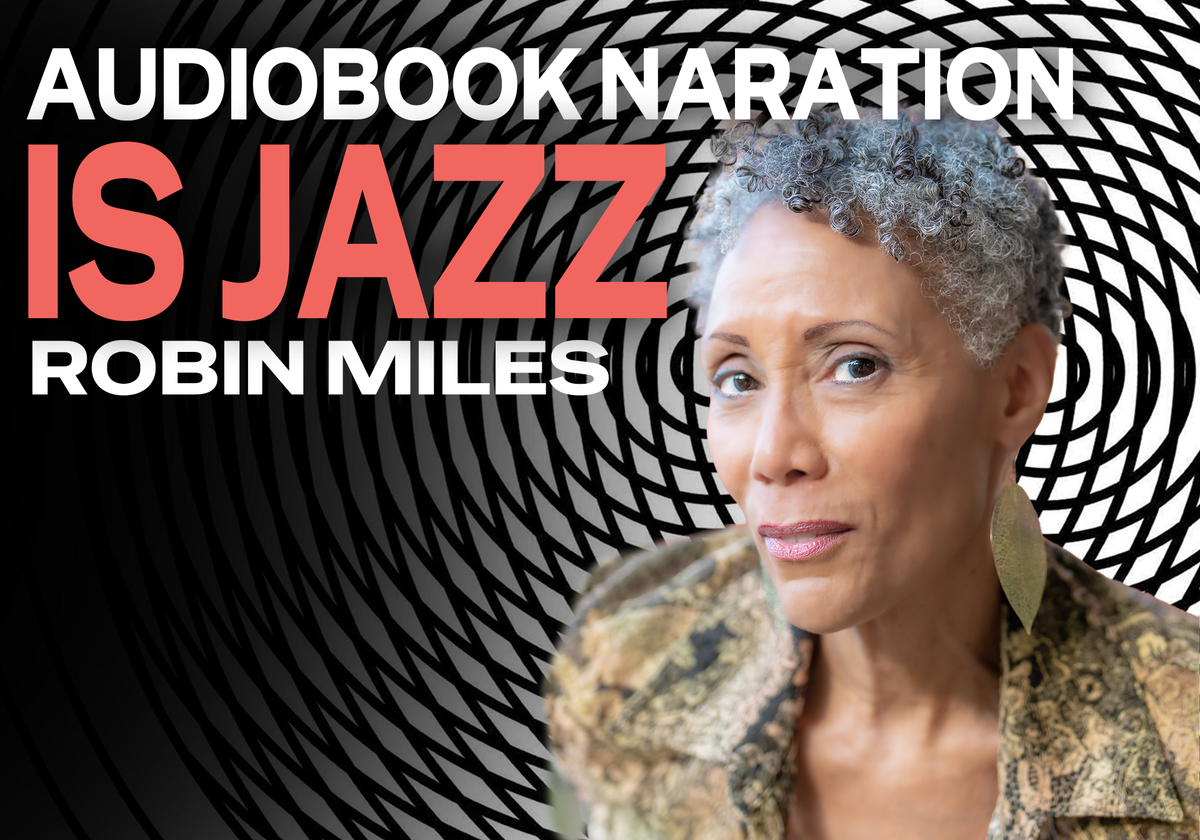
Audiobook Superstar Robin Miles: The Full Interview
While Mack takes a summer break, we bring you this treat from the archives: the full-members-only version of his 2024 interview with beloved audiobook narrator Robin Miles. This episode features almost an hour of additional content, including our What’s Good segment where Robin unsurprisingly makes some really great book recommendations! To get access to all our members’ content, past and future, become a member at mackhagood.com.
This episode is a masterclass in audiobook narration and acting with an acclaimed actor, casting director, audiobook narrator and audiobook director. Miles has narrated over 500 audiobooks, collecting numerous industry awards and, in 2017, was added to the Audible Narrator Hall of Fame. She’s the most recognizable voice in literary Afrofuturism, having interpreted books by Octavia E. Butler, Nalo Hopkinson, N.K. Jemisin, and Nnedi Okorafor.
Miles holds a BA and an MFA from Yale. She has taught young actors and narrators at conservatories across the country and she has an amazing talent for doing accents—something we really dig deep into on this podcast. In this conversation we talk about technique, the audiobook industry, and the politics of vocal representation. How do we avoid the misrepresentation of marginalized people on the one hand and vocal typecasting on the other?
Cited Media:
Books:
- Nalo Hopkinson - Midnight Robber (2000)
- N.K. Jemisin - The City We Became (2020)
- N.K. Jemisin - The World We Make (2022)
- N.K. Jemisin - Broken Earth trilogy (2015–2017)
- Octavia E. Butler - Patternmaster series (1976–1984)
- Octavia E. Butler - Kindred (1979)
- Octavia E. Butler - Parable of the Sower (1993)
- Octavia E. Butler - Parable of the Talents (1998)
- Octavia E. Butler - Xenogenesis series (1987–1989)
- Tananarive Due - The Good House (2003)
- Isabel Wilkerson - Caste (2020)
- Isabel Wilkerson - The Warmth of Other Suns (2010)
- Bell Hooks - Teaching to Transgress (1994)
- Bell Hooks - Teaching Community (2003)
- Bell Hooks - Teaching Critical Thinking (2010)
- Dennis Lehane - Small Mercies (2023)
- Ian Reid - We Spread (2022)
- Cicely Tyson - Just As I Am (2021)
- Karina Yan Glaser - The Vanderbeekers series (2017–present)
- Nnedi Okorafor - Binti series (2015–2018)
- Taylor Jenkins Reid - The Seven Husbands of Evelyn Hugo (2017)
Plays:
Transcript
Intro: SpectreVision Radio
This is phantom Power
Mack: Hey everyone, how's it going? Mack here. So this is a little bit of a preamble for a rewind episode, and I am taking a break for the month of July, and I have a couple of my favorite episodes from 2024 for you to listen to, and these will be the extended members versions of those episodes.
So hang tight for that. But before we get into it, and not to get all NPR on you, but. I would like to take a moment and ask for your support. I think some folks are under the impression that I am making money off of this show. You know, especially because of the relationship with SpectreVision. I feel super fortunate that SpectreVision have picked up this show as part of their network, but they're not paying me anything. And the way that I would get paid is to run ads and we would split the revenue from the ads. But aside from promos for SpectreVision shows, I'm not running any ads. And that's because I just don't like what it would do to the podcast itself.
Now, if I ever find a sponsor who is doing something audio related that I think my audience would like, I'm kind of open to that possibility. But, but in terms of like just blasting y'all with ads for socks or sports betting or whatever, fuck no. No, that is not gonna happen.
And there've been super patient with me about that, and like, it's just been amazing. They're not getting really anything, they just like the show and they're being supportive of it at this point. Maybe sometime down the line we'll make some money, but right now we're not.
And ironically, as the show has gotten more popular and grown its audience. I've actually been spending more money, you know, we've doubled the cadence, we're doing two episodes a month. I couldn't handle that on my own. I hired Cameron Naylor, who does an amazing job of editing and creating transcriptions and doing some of the other backstage work that needs to get done.
I'm still doing all the fielding of queries and scheduling interviews and reading and listening and watching and prepping to get ready for these interviews and, you know, there's software costs too, there's all kinds of software that goes into doing this show, that all tends to be subscription.
And I am super grateful to the Phantom Power members who are helping me pay those costs, but I'm nowhere close to breaking even right now, and I would love to get to that place where at least I'm close to breaking even on doing this podcast because. You know, I hope you're really getting something valuable out of it.
So if you're somebody who's just been listening to the show for a long time and really finds value in it, if you could find it in your heart to kick in five or 10 bucks a month. I would be thrilled, and so appreciative. Another way that you can help out the show is to subscribe to the newsletter and to tell your friends about it.
But the financial contribution would be amazing to if you've got the means. And by the way, if you don't have the means and you know, like you're a grad student who's studying sound or something like that, and you want to be a member, just drop me a line and I will comp you a membership. That's something I'm more than happy to do. So yeah, think about supporting at mackhagood.com.
And just to give you a little taste of what you will get as a member, we are providing the full member's versions of a couple of my favorite 2024 interviews. One with Robin Miles, audiobook, narrator extraordinaire. And in the second half of the interview, which was only, available to members, we got deep into the financial side of the audiobook industry and the gendered pay gaps there.
And we even talked microphones and recording software and her process, it was. Really, really fascinating. Likewise our episode with Marie Thompson, the Scholar of Sound and Affect theory. She and I got to talk about our mutual research interests in tinnitus, and we went really deep on that.
Okay. Enough for me. I hope y'all have a great summer, and I will be talking to you again in August. For now, just enjoy this episode from the Vaults.
Okay. Let's talk about today's guest. I am so excited. Robin Miles is an American actor, casting director, audiobook narrator, and audiobook director. She has narrated over 500 audiobooks.
She's won every award you can think of in this space. In 2017, she was added to the Audible Narrator Hall of Fame. She holds a BA and an MFA from Yale. She's taught young actors and narrators at conservatories across the country, and she has an amazing talent for doing accents, which is something we really dig deep into in this podcast.
It was a dream interview for me because Robin is my favorite audiobook narrator, and I really enjoyed getting into the weeds of her work. We talk about how she creates a parasocial relationship with her listener. We really dive into scene analysis and acting, and also in narration. Like, how does she mark up a script or mark up a book to make decisions about characterization and vocalization?
We talk about the International Phonetic Alphabet and how that's such a crucial tool for her accent work. We dig into some of her work narrating Afro-futurist fiction, so we talk about her work doing N.K. Jemisin's books or Nalo Hopkinson's books. And then we really get into a fascinating talk about the politics of representation in voice.
Who should be able to represent whom vocally? What are the ethics around that? And she has, as you might not be surprised to learn, as a woman of color who's been narrating audiobooks forever and acting forever, she has a lot of really profound ideas about this topic. So I just learned so much from her.
We talked for two hours. There was way more content than I could put in one episode. So, I have almost an hour of additional content. We talk about unionization, how she approaches nonfiction as a narrator, what kind of microphone she uses. we talk about Octavia E. Butler. W- like, just there's so much more.
So, including our What's Good segment, where unsurprisingly, Robin makes some really great book recommendations. I mean, she has read a few books.
All right. Without further ado, here she is, Robin Miles.
Robin Miles, thank you so much for being on the show.
Robin: It is my pleasure. Thanks for reaching out to me.
Mack: I have to say, it's a little bit uncanny for me to hear you speaking directly to me through my headphones because you've been a voice in my headphones for so many years, and there's, like, this term in media studies that I think has actually gotten wide exposure now, but, a parasocial relationship, right?
Like, I feel like I have this relationship to you because you're my favorite audiobook narrator. Do you think about that kind of relationship often? Does that affect how you do your job at all?
Robin: You know what? I would have to say that it's the cornerstone of my relationship to what I do and my audience and I actually taught this lesson yesterday when I was in the classroom to my audiobook class. The very first thing that you have to do as a narrator is establish a relationship with your listener.
And they're not physically corporeally there, so you have to project it. And I always tell my students, "You're not talking to a group of people. This is not an address, a public address." Your listener is one person. And so, you know, as they're practicing and getting used to talking to one person, I say, "You know, you can use the person sitting next to you. If you're in a booth, you can use the engineer, if you're lucky enough to have one on the other side. Or if you've got really good acting chops, you can project that person across from you." But the scenario in my head is I'm telling this story to you across the top of a table in an Irish pub, and it has to be an Irish pub.
Oh, really? Because it's the most collegial place in the world culturally. It's just like an after-work place to let down your hair, to reconnect with the community after you've done your job all day. And there are people all around you doing the same with another person.
And so you have to create a bubble of intimacy around you and that table the way you would in a bar when there are other conversations going on. You want to be heard by that person, so you can't be all whispery. But at the same time, you don't want everybody in the bar to know your business. And so that same, I don't know, quintessential feeling of sitting down with someone you know after work and sharing life.
In Hawaii they might call it talking story, just telling your story. So that's where it starts for me. And if you don't have that intimacy and that connection to that audience, which is an audience of one, you miss something.
Mack: It's a different form of address Yeah. It's a more intimate form of address when you're addressing one person rather than an imagined group. Yeah.
Robin: Yes. And even when I'm teaching just straight acting in the classroom, if I have an actor doing, one exercise I have them do is from, Saint Joan of the Stockyards, and she's standing there talking to a group of people trying to motivate them to, like, you know, march in protest.
And even though it's a group of people and one person addressing them, I have them always make eye contact with one person, then move to another, then move to another. So it's always a one-on-one, it's just there are many ones.
Mack: And for our listeners, so you are not only an audiobook narrator and an actor, but you also teach acting. Can you tell us just a little bit about that since you mentioned it?
Robin: Sure. right now I'm a professor at Pace University, which is in New York. I've also taught at UCSD, and SUNY Purchase, and, you know, they're sort of really good conservatories. I count myself extremely lucky to have been part of the faculty of all of them.
But right now I teach my freshman script analysis, which is helping them learn to see the invisible connections. I say this all the time, that theater and entertainment, what we do as actors and playmakers, people who make, you know, entertainment, is that we make the invisible visible. We make the invisible forces between human beings that you can't see or touch or smell, but you can absolutely emotionally feel them.
They're invisible, and we basically examine them and then inhabit them so that they can be seen. That's what we do. And so script analysis is seeing where those things exist in a way on the page, seeing what the structure is of, exposition, then conflict is rising, and then climax, and then falling action.
So being able to see them. If you can't see them, how do you enact them? I do that with my freshmen, and then I get them back as sophomores and teach them acting technique on scene study.
Mack: You were talking about script analysis and, you know, I know actors, one form of their preparation is to sort of read a script in advance, mark up the script thinking about the goals or the backstory of their character, maybe marking out the individual beats of a scene, these inflection points where the tone changes or the character's tactics shift, or you need to pause for a joke to land, something like that.
How does an audiobook narrator prepare? Is it the same process or is this a different job?
Robin: It is, it's a different job. although I don't ever forget about my actor sensibilities, and a lot of that script marking in the dialogue is going to be very similar. Scenes, because they're scenes.
However, for an audiobook narrator, wow, I mark the tone. I mark who's talking in the scene coming up, so as I change a chapter or a section changes, I mark who's in it so I can make that sort of mental adjustment to where I am and what's about to happen. Complicated text, British authors, or just more erudite writing with longer sentence structure might really require that I mark on long thoughts where I'm going to breathe.
I want to be like a jazz musician. I want to be in the pocket. My dad was a jazz musician.
Mack: Oh, really? Wow.
Robin I want to be in the pocket, which means I want to be in flow and living in the moment. So I want to bring the number of errors I make down, because every time I make an error, it's a slight interruption to being in it, 'cause I got to come out, and I got to drop the cursor, and then restart the session.
And I try and stay in it as much as possible. I just keep breathing, hanging in that moment I was in. Just keep breathing, stay there. But it is an interruption, so when I'm prepping my piece, like I said, I'll mark breaths, things that are just so long I need to figure out where I'm going to breathe.
If there's an antithesis, a comparison between two things in a sentence, and then they're far away from each other, I'll underline the first one, and I'll mark an A over the top of it, a little A, on an iPad. You know, I got my little stylus. And then I'll draw a line under element B, the other part of the antithesis, so that I know that that comparison is there and I'm about to compare two things.
Mack: So that you can put a certain kind of emphasis on the front end of that sentence and then a different kind on the back end of the...
Robin: Yeah, because we're, just like we are humans who speak English, and the ear is accustomed to the music of English. And so, if I know the music of English, then I've got to find a way to deliver on the music of English.
And if I miss something, you know, I go, "Ugh, that was a comparison. I need to go back," 'cause I didn't set up those two things to be compared.
Mack: You also have to switch between characters, so like it, it sounded like part of your marking up was making sure you see who's speaking when, so that you don't get halfway into a sentence and then realize it's a different character.
'Cause I hear that. I hear some audiobook narrators do that. I can hear like oh, they just realized they were supposed to-
Robin: And they should have stopped themselves and gone back and re-recorded, that's what you do. But I always have marked at the sentence head, at the margin, who's speaking.
And I have a system for marking that so that I use the least effort doing the marking, but that it's clear what I'm doing. And you know how you get to the end of a line, and you get to the tag phrase or the tagline that says, "She whispered while continuing to search for her mittens on the shelf," right? And, you know, you read it, and you go... "She whispered." Damn.
Mack: And then you got to go back. You got to go back and whisper it.
Robin: So, you know, I'll use like a little, there's a little IPA symbol, International Phonetic Alphabet symbol for wha, the fff, and it's really whispered, right?
We don't really invest in that whole puff of air much anymore, but I'll just use that little W with like a circle drawn around it, and that means, ah, character's whispering, so I know that that's what's going on.
Mack: Okay, I'm so glad you brought up IPA because. So, I know you studied at Yale.
I studied acting, as an undergrad at Tulane for a little while with a Yale MFA named Ron Gural, who, he had students like Willem Dafoe. There were a couple of other Yale faculty who were at Tulane at that time, And I remember these guys throwing down some real rigor. And like, and one part of the training that I remember was there was the International Phonetic Alphabet, IPA.
Could you maybe talk about what that is and how an actor or an audiobook narrator might deploy that in, in their work?
Robin: Sure. let me start with, what is it? The International Phonetic Alphabet is a system of symbols that essentially have a one-to-one correlation to the sounds of language. So you've got a symbol for every single phoneme, meaning like single unit of sound.
So every consonant, like cuh, puh, tuh, vv, all have a symbol. and all the vowel sounds, the open sounds without consonant breaks, like A, E, I, O, U, all have a symbol, and when you get to compound sounds like, pay, my, boy, diphthongs and triphthongs, higher power, you break them down into units.
So boy is boh-ee. Boh-ee. It's two things, actually. And so it's a very exact way of rendering the sounds in a language. So we have a whole bunch of symbols that we use in English, but there's a whole bunch of ones that we don't use because those aren't our sounds, like the rolled R in Spanish and the rolled R in French.
One's rolled in the front, one's rolled in the back. They're different symbols. There's a different symbol for the h, ich, like the, the word ich, I, in German, and there's another one for the ch in Hanukkah. So again, you can be very exact about Indicating how to say a word. And you can even transcribe a whole sentence in IPA, a whole speech in IPA. That's one of the exercises that we do. Why is it helpful?
Because, wow, when you're doing things, particularly in an accent, this is where it becomes really, really useful. If there's a sound in that language that doesn't exist in ours, we're not gonna get it right unless we familiarize ourselves with that.
And I'll tell you the specificity level I like to get to: Class, the way people speak. Class, region, dialect, the way people speak in different places. Like you'll hear people in New York say, "My mother, my father." Yeah. "My mother, uh." That's a uh, straight up schwa. But there are a lot of people who say, "My mother, uh."
Is it ah or uh? Those are different sounds. And they can be culturally specific, and they can also be class specific. And it's the same in German. The ends of words in Germany do the same thing as they do here, like father, mother, father, mother. Father, mother. Yeah. Same thing, and it's an expression, it can be of class or culture or, you know, somebody code switching within their own culture, might go from one to another depending on the situation they're in. You hear the shift, and you know what they're doing.
Mack: So having that ability to sort of score that kind of thing. First of all, just having an awareness that these differentials exist, and having a code for them allows you to really suss out the complexity in something.
It's like having a wider palette of colors, vocal colors and phonetic colors.
Robin: I love that analogy of colors. I want, like, max colors so that I can be true to what the author wrote and who the characters are that they created. And I'm really strongly opinioned about that.
I didn't write the book. I can't take credit for that, and it's not my job to then change that book and make it, quote-unquote, mine. That is not what I'm there for. I am in service to that author. I'm in service to the words, which means get your ego out of the way.
And it's funny because it is, it's physiological when you approach it that way. Like, at the end of the day, if I've been narrating for whatever, four to six hours, I have given over my body, my breathing pattern, my feelings to this story and to these characters in service to that author, and it's like when I get out, it's very funny. You'd think, right, that after talking for six hours, all you'd want to do is shut up and sit in a corner or watch TV and have somebody else do the acting. You'd think. That makes sense.
First thing I want to do is talk, and hear me and my opinions and my voice again so I can kind of reclaim them again. 'Cause I've let them occupy my space for the last six hours.
Mack: I mean, I love this idea of being physically embodying a text and kind of being possessed by a text and being the tool of this text, like physically. Like, that's a fascinating thing to think about.
Robin: You know what? I honestly think it's, in a way, easier to do that. If you're able to accomplish the moving of the ego aside, 'cause it's not easy. But if you're able to accomplish that, let the music play through you. And you know what's interesting is, too, the body doesn't lie.
And I'm an ex-dancer. I started out in this business as a dancer, Which is very far away from sitting in a tiny little booth with the door closed where you can't move. It's a far cry from where I started. But, the body doesn't lie. And so if I feel something in my gut like that's not right, that was just not right, and I'll do it again.
And I may not even be able to tell you why. I just know the feeling was that was wrong. Or, mm, that was too big. It's over the top. My body is, like, going, "Mm-mm. Nope, nope, nope." And I just have to listen to it. And you know, Uta Hagen, the famous Uta Hagen, who trained so many actors in her day. Just before she retired, I was in her class as a very young actor in New York, first coming here. And she used to say, when you're in a scene, and like the classic Chekhov scene, Masha (She Cries) is in parentheses. I always used to panic when I saw that 'cause I'm not a crier. I'm just, like, fake crying, not in my toolbox. But she used to say, " When that happens, the text tells you that, you don't go in and go, 'Mm,' and then try to cry and pop out the tears."
She said, what most people do in our culture, and this is just culturally who we are, we tend to try and manage or suppress the tears. And as soon as you do that, what's so wacky is your body feels you clamping down, trying to hold, you know, speak with, you know, without all over the place. And your body goes, "Wow, I'm doing all those things I do when I cry, I must be crying," and the tears come out.
Mack: Ah. So it's fighting, it's fighting the tears that brings them forth. Yeah.
Robin: Yeah, but it, your body knows that scenario, you've been in it many times, and then it just produces the tears. It's like the most organic thing I ever heard of it, and it, now I have incorporated it into my teaching as well.
Mack: That's incredible. I mean, it's so amazing to hear about your technique 'cause I think about, like, I don't know, like a Robin Miles tour de force, I think, would be your performance of Nalo Hopkinson's 'Midnight Robber', which-
Robin: Oh, I love that book. I'm so glad you liked it.
Mack: Oh my gosh. I love that. Your performance is so amazing.
Like, I, for those who don't know, it's this Afrofuturist novel. It's a little hard to describe, but it's basically about a young girl who gets exiled on another planet in another dimension. And, and she gradually takes on the identity of this figure from Caribbean folklore, the Midnight Robber who dresses in black, speaks in poetry, takes from the rich and gives to the poor.
But the dialogue and the narration are all written in this kind of Caribbean vernacular. And we had this audio scholar on the show recently, audiobook scholar Matthew Rubery, and he talked about how we often culturally privilege the printed book as the site of, like, real reading, right?
But he pointed out that often the reader's, you know, what he called the brain voice, it's not as good as a performance by a great narrator. And to me, Midnight Robber is the ultimate example because I read Hopkinson's book in print, and I'm not, like, totally ignorant of, like, the Black Atlantic or Caribbean culture, but my head voice just didn't have the cultural or linguistic experience to open up the text the way your performance did.
And it's not just, like, the pronunciation of words, it's the cadences, it's the subtextual stuff that's going on, that you need a certain knowledge to be able to put forward. And I mean, also, this is a book that's about Black oral traditions, right? It's like, it's about verbal storytelling.
There's, like, storytellers in the book and there's this kind of verbal jousting. Tantan, the Robber queen, the main character, I mean, she's basically like a battle rapper, right? So it just makes so much sense on multiple levels for this to be an audiobook.
I don't even know what my question is here. I'm just, like, raving about your performance, but, like how did you approach that?
Robin: Well, firstly, you start with your author, and Nalo is visionary and brilliant, so you have to start with that. You can't do something fantastic with writing unless the writing gives you the opportunity. It's like, actors agents, managers, when they get a script that's Oscar worthy, they usually know it because there's a journey embedded in the script that allows you to give an Oscar worthy performance.
See what I mean? So I'm always looking out for something that I can really do something with, and I love working with authors like Nalo. As I was reading it and prepping it, and it's funny 'cause I did this many years ago, but I remember this, reading it through the first time and realizing she spelled words in different ways, and I was like, "These are people from different Caribbean islands."
Ah. Like Haiti is French influenced, and some of the words and phrases, I was like, "This one's Haitian." And then another one I realized, "Oh, this one's from a Spanish-speaking Caribbean country, and this one's from an English deliniated Caribbean country." And so I noticed that running through and I finished the book, prepped it, and I went, "I gotta go back, and do it again and mark for that." Before I started.
Mack: And is this knowledge that you had from your studies of phonetics or?
Robin: I studied Spanish in high school through college. I wasn't a Spanish minor, but I was required to have literature fluency in a foreign language. I went to Yale undergrad before I went to the drama school and I wanted to be a theater studies major. But they had decided, "Oh, you're not coming to Yale and just parking yourself in acting classes and getting through. Uh, no, no, no." So they devised these units. You had to decide what you were interested in, and for me, I loved classics, so I had one unit in that, and I liked politics.
I had another one with political theater and then politics of an era. But you had to have foreign language fluency and be able to read dramatic texts in that foreign language. Spanish was mine, and then I also decided to take on a, a third language, which was French, so I studied that while I was there.
So that allows me to wrap my lips and my tongue around the sounds and the words and the phrases and, like, how they connect in other languages. Wow, I'm not even sure if I'm answering your question. I think I'm far away from it.
Mack: No, no. I mean, well, there's the linguistic piece. There's also the cultural piece.
Robin: Cultural piece. my nuclear family is Jamaican, but I also have cousins whose, like, their dad's from Antigua. And, you know, so we're, we're kind of a multiracial, multicultural, and on my mom's side, Caribbean-based family. So I grew up with my great aunties, and they all had accents.
I grew up with my grandparents and, you know, sometimes you grow up with a generation that comes from somewhere, and they have an accent, and you're a kid, and you don't actually realize it. I didn't realize it till way later that I'd been living in a house with two people who had strong accents.
But they had literate accents 'cause they were both English professors.
Mack: Oh, wow.
Robin: My grandfather was a professor of Shakespeare and, Victorian poetry. Those were his two subjects.
Mack: That's your grandfather? Is this the Jamaican side of the family?
Robin: Yeah. This is the Jamaican side.
Mack: I mean, this might be a stereotype, but I, I've had friends tell me that Jamaican parents are, like, very demanding about academic excellence and stuff. It's kind of slotting into that stereotype.
Robin: Oh, we have a couple of stereotypes that always make me chuckle. The other one is, like, Jamaican folks are always employed because we'll take two, three, four jobs. And friends of mine used to laugh 'cause when I was at Yale in school, I had no money.
I was on financial aid, and I I worked in a sweet shop. I worked in the office running, like, a little theater. I was a Yale bartender, so I was being shopped out to different places to bartend, and a couple of my friends would be like, "How many job you got? You got, what, you got three job? What a matter with you, you lazy?" Three job. You know, that's the stereotype and, of course, the joke.
But that's what I had to do to make it through school. I exhausted myself, but, somehow made it through.
Mack: Oh, well, this is, I mean, so this is incredible. I mean, you were bringing a lot to the table in terms of interpreting this particular text.
Robin: Yeah, it was a really good fit. And fit is, I do think is a lot of it as well. I'm really lucky. I fit this industry really well, and the only reason why I found myself here, because I got out of Yale Drama School. I was booking work. I was going out, doing a thing, you know, a regional theater, coming back. I was doing like short spots on, on soap operas before that whole thing folded.
I was doing the thing you do, and then I got a Broadway show. You know, like that's what actors do. But I always had a community service. My parents always had a community service thing that they did. And so it felt weird to me to be in New York City, and I wasn't-- Like, I, I'm really privileged, right?
I got to grow up in the suburbs in a house. I got to go to college, and not just any college. I got to go to Yale, and then back there again. Now, truth be told, I got debts up the wazoo still. 'Cause so sh- you know, I didn't have any money, so I had to take on full loans. But I really have lived in my opinion, just amazingly privileged life, and I'm incredibly grateful for it every single moment of my life.
I wanted a community service, and one day I was coming out of a hair salon, and across the street was the Lighthouse for the Blind building. And I saw that and I went, "Ting! I could maybe read for the blind. That could be my new community service." So I called, and they said, "Well, you know, mostly what we do is, you know, we, we read their mail to them and stuff like that, but probably what you should do is call American Foundation for the Blind."
And I did, They liked my voice on the phone. They said, "Come on in and audition." I came in and I auditioned. I'd never done this before. I'd never listened to an audiobook, and I was rejected by the client which was the National Library Service, NLS, down in Washington.
At the time, they really wanted you not to interpret anything. They just wanted you to read with incredibly crisp, clear diction. That part I had. But they didn't want... no, not too much acting. And truth be told, there are a lot of people who are visually impaired or blind or unable to maybe, like, due to Parkinson's, hold a book steady you know, who might be clients at the library.
And they have these readers that allow them to listen at increased speeds. Sped up. So speed-reading with the eyes, speed-reading with the ears. And so all that acting, they felt, kinda got in the way. It was when I made it into the commercial world that the acting chops really became valuable, and I got a Earphone, my first Earphone award came from, I think it was my second book, for recorded books. And my colleague and friend, Suzanne Toren, who is an amazing narrator, was the person who said, "I think these people need to hear you," and she made a call and made it possible.
Mack: So she was your entryway into, into the, the industry?
Robin: Yes. She was the phone call maker and the advocate for me. And as our lives have gone on, she's directed me on books. I've directed her on books. We have this wonderful, we should just own a publishing company together Because we do all that stuff.
She's also remarkable, and then she speaks French fluently, and she speaks Polish fluently. I mean, she's just, Yeah. Jaw-dropping.
Mack: So since you brought it up, maybe we can talk about the roles in audiobook production?
Like, you mentioned a director. So, some people might be surprised to hear that there's a director in audiobook production. So what are the different roles and what's the process of r- recording an audiobook from start to finish?
Robin: Okay, this is like lifting up the hood of a car and going, "Let me show you how the engine works."
Mack: Yes, I want to know.
Robin: So in terms of process, a book arrives from a publisher. Sometimes it's still in manuscript state, and there may be a final edit yet, and the narrator is chosen, either approached, you know, the production team will have an idea of who they want to voice it, or they might put it out there for different agents or, different producers to do the casting.
But they'll listen to the samples if that's the way they're going, and there are multiple people, they'll choose one, make the offer.
Mack: Just to clarify, when you say the production team, like are these people from the print publisher?
Robin: Well, that depends. See, the way audiobooks get made, you might have someplace like Hachette, or Harper or Simon & Schuster that are big, well-known print publishers, and within that big house, there is an audiobook division. And so what used to happen back in the day when I was young, when I was young, it used to be that a book would do a bit of business and get good reviews, and they'll say, "Okay, great, let's now make it into an audiobook."
Flash forward to the present, it's now book is coming up through the pipeline to be released. We want to release it in all formats simultaneously. So you'll be working on the audiobook while they're still, you know, finalizing the release of the hardcover or, you know, or whatever, the print version, the e-book version, all of that.
And so that team is typically the team at the audiobook division that I'll be dealing with. Depending on your level of experience and also the values of the publishing company, they'll either assign a director/engineer pair to work on the book, and I'll come in, and I'll have a director who I've probably talked to once or twice about pronunciations and, character voices and, you know, size of things.
Like with Nora Jemisin's book, I love that team.
Mack: Are you talking about The City We Became?
Robin: The City We Became. Yeah. And the second book that's actually up for an Audie this year is... Let me see. The City We Became. The second one. Oh my goodness. Is that the-
Mack: Oh, right. Yes. Yeah, the, the other one has a similar title.
Robin: Yeah. Now I'm forgetting which one is which. I have to go back and take a look because I forget which one's which. Elise Green and Michelle Figueroa and I are a team, so I go in and everybody's got their ear listening to it, and everybody has their knowledge pockets.
So Michelle will bring in something that she knows from her neighborhood or her culture or her background, and Elise will bring in something that she knows. And she's a really good director. Like, I get actual directions from Elise. And I love that and I welcome it.
There are a lot of now audiobook narrators who don't really want to be directed. But if I can give that 'you be my outside ears' job to somebody else, I feel I can kinda just, again, stay in the pocket. Come out of it less, redo things. That series also, those two books also have a lot of post-production on them. It's not only a performance, there's sound effects.
Mm-hmm. It's like, audiobooks at another level, and it's on steroids. 'Cause it's, it really is huge, huge, wonderful characters, performances, a wonderful villain who allows me to use every sound of my voice. You know, because she's literally otherworldly. And even though they're big and otherworldly, you still have to ground it and remember making the invisible visible.
What's driving her? What is she feeling? What is she experiencing? What does she want? Who's she talking to and how's she trying to get what she wants? You still have to ground it on all that stuff. Even if you make the colors, you dial up from pastel, which you might use in, you know, a more everyday novel, a mainstream novel, you have your colors are more in the pastel range. Or the majority of them will be. And then, like, with The City We Became, you're just gonna dial that into technicolor.
Mack: I haven't gotten to that one. I did listen to N.K. Jemisin's Broken Earth trilogy, which you did. And it's kind of interesting because, you know, if we compared to, say, Midnight Robber, you kinda had this world of accents, but all within the Caribbean. But with something like Broken Earth, it's like this whole planet, and you've got people of different races, different cultures, in a lot of books, cause you do a lot of science fiction, speculative fiction, you've got people of different planets, different species, people who aren't people, people who are other, you know, alien species. How do you approach voicing such a diverse cast of characters as a narrator?
Robin: I am so glad that you asked that, because to me that is so much fun. It really allows me to be as creative as I, as I can be. When I have a fantasy world or a sci-fi world, you know, planets that don't exist I have two ways of going about it, particularly with fantasy. If I have a group of people, oftentimes those books have a map, like a fantasy book will have a map of this fantasy landscape, and so you'll see the terrain, and you'll see, oh, these people live off the coast on this big island, or these people live up in the mountains.
I'll choose one or two accents that would be considered, you know- easily identifiable. And I'll either assign it to that, that group regionally, or if it's fantasy and I don't wanna pull too much from one accent, I'll do what I call a mashup. So I'll take, like for instance, I'll take the sounds of German, and then what I will do is I will add the rhythm pattern of Nigeria.
Because this is a race of people who are dominant in their area, culturally dominant, or militarily dominant. And so I'll take two cultures that might have those characteristics or have operated that way in our world and I'll just go k-k-k-k, mash them together.
Mack: You are playing jazz.
Robin: I love it. I totally love that. So I've done that with a couple of things, where I'll just take, like I, that was one of my ones that I remember is taking German sounds and then mashing it up with the rhythm of Nigerian speech.
But the other thing is I had friends at the drama school who were from Norway. There's a pipeline of Norwegian theater artists, and Scandinavian really, it's not just Norway, who had come to Yale Drama School, which we're supposed to call now the David Geffen School of Drama, It's now got a new name. And so I was around them a lot. And then when I was in New York City in the Uda Hagen class, I had two friends, one Swedish, one Norwegian, who were in class with me, one of which I'm still friends with.
I still keep in touch with Christian. And so I got to be around a lot of people who were from Norway, and Swedish. And so I started to be able to really hear their speech. And sometimes, like, I'll tinge it with a little bit more German, just so that it's not so strictly one thing in this fantasy novel.
Or sometimes it's like, oh, she's just so straight up, this thing or the other. I always feel like also I want to add sounds from different cultures that generally don't get represented. 'Cause people just don't think of them. I'll try and add, there's a Hawaiian character, and it's not deeply strongly, I just need flavors.
Just need flavors. I'm creating that ideal Star Trek world. when Star Trek hit, it was like they had this spaceship with people from all these different countries that are often at war or totally marginalized. Yeah. And they're all working together to do something greater than themselves, which that's what theater does.
The whole is greater than the sum of its parts. And the sum of its parts are varied. So, that's my way of sort of casting the world so that it reflects the world that we see now in the world that we hear.
Mack: I mean, you're, you're talking about the politics of representation in voice there, right?
Robin: Absolutely.
Mack: And I mean, I guess I can see like a certain tension there, right? Like, the history of American radio, especially early history, is really rife with minstrelsy and the sort of the misrepresentation of Black voices. Even as recently as 2020, there was this case where the hip hop scholar Regina Bradley, there was a white voice actor who read an essay of hers.
I don't know if you heard about this, but I honestly don't know what this guy thought he was doing, but it was like this really bizarre and really offensive dialect. It just sounded outrageous. Those things are like clearly way beyond the boundaries of like ethical representation, right?
But on the other hand, I could see another kind of danger, which is a sort of vocal segregation. Like people are only allowed to voice people who are exactly like them. Which could lead to typecasting, right? Like, so I'm, I, I guess I'm wondering how do you think about that? Have you ever felt like you're being typecast as a woman of color? Like, I'm, just curious about that.
Robin: Wow. That's the story of my life. I remember being a young actor, and I was a musical theater actor, so I was a singer, when Les Mis was coming here and casting. And they would not see a young actor of color to play a street urchin child of a prostitute, and there's no father in sight So frankly, either one of those roles could have been anybody, really. They absolutely would not allow me to audition.
Now, poetic justice, what is this? 30 years later, I saw the final production before it closed about, I don't know, maybe eight years ago. And there was a Black actress playing that role. But I couldn't get anywhere near it. And I'm a vocal person. I am.
I remember going into an audition once. Now, I had an agent, so I'm not talking about, like, nobody unrepresented actor that you don't have anybody to vouch for you. I literally was in Three of Us Studios, big studio where they audition, and I was auditioning for one thing, and I saw, ooh, Craig Lucas play.
And I like Craig Lucas' writing, so I went across to the people running that audition, and I said, "I'd really like to audition for this blah, blah, blah role," 'cause I know the play. I said, "I'm at J. Michael Bloom. Philip Carlson's my agent." And we're talking about a powerful agent. This is the agent who tapped Paul Giamatti and I at the same time at the end of our year.
He took the two of us. That's it.
Mack: Paul Giamatti being another Yale grad.
Robin: Yeah, we were in the same class, with Lance Reddick, actually. The three of us. God rest his soul. He passed recently. So sad. So I said, "I can call my agent and have them submit me." Like, I just told you that I have a very powerful agent, you know, a well-known agent.
She looked at me with terror in her eyes. Like I was from the NAACP Race Police and she was going to get, you know, written up. This is 30 years ago. They were not open. This is a person in this play, like, who has a husband, but there's no family. There's no children. It's not like it's now going to mean we have to cast all these people to be racially in line.
It was easy. It was easy. We do this all the time because now we're in Shonda land. We're in Shonda Rhimes land. And everybody wants a piece of that success that Shonda has. Including people of color and lots of cultures is part of what she does. Yeah. And other people are doing it now, but 30 years ago, no.
How does that relate to audiobooks? I tell my students all the time, "Be careful what you ask for. You might get it." If you want to segregate an industry and then only be able to play what your DNA test says you are, really? Is that really what you want? Think about that But there is something, and it's because we're a culture that is so horrible at balance.
American culture has to be all the way over here or all the way to the other extreme. And we keep literally throwing our weight all the way, missing the mark. What is that called? Hamartia in Greek, missing the mark. And then all the way over to the other side, completely missing the whole middle ground that's balance.
We are a culture, and I use this metaphor, it's like we have this basket of shoes, and the shoes are the stories of all the cultures that are in our culture. We're a multicultural place, right? We got all these different people from different places. But we also have a lot of groups that get marginalized, whose stories aren't wanted and weren't told for many years.
And I mean women, I mean the queer community, I mean the Native American community, the Hispanic community, the Black community, the disabled community. There's so many people that have been othered and pushed to the fringes, and it's like, "We don't want your voices." And they're also told they can't be American.
That's a big question. Like, who can be American? Who can play the role of just an American that's just been written? It's beginning to change now, but we're also looking like we're gonna slide back. So there's this bucket, right? This basket of shoes, and white actors and white culture are taking out the shoes that belong to all these other cultures and not even letting people who are of those cultures wear their own shoes, which is where you get yellowface and blackface and brown face.
Or erasure, taking, like, a role that is maybe based on somebody who was Black or Hispanic, and then just rewriting it and making them white. And the danger of that is that you have a lot of white supremacists in this country who will tell you how Black people and Hispanic people and da, da, da, people have never contributed anything to this country.
Because their contributions aren't included in the history books. Like, you know, when entertainment takes their story and makes it into something else, half the time they're completely erased off the planet, so you don't even know that, they came up with this invention or that invention or were prominent in this, that, or the other.
And so you got a whole bunch of people who really believe it because they don't even know. It's just not in the history books. So my position is we are in a healing beat. I'm trying to find this middle ground, right? I'm trying to enter this middle ground. But the first thing that has to happen is you have to give those people their shoes back.
You have to give all those groups their own shoes, their own stories back to write, to generate from a place of authenticity. And then you have to allow those actors that know that experience to portray them. And once that's been reclaimed, and we've been allowed to be who we are, and also be American, we will have the grace, I do strongly believe, to put the shoes in the basket and say, "Other people can pick from them when I'm allowed to pick from the basket, too."
Mack: Yeah.
Robin: Do you see what I mean? But we keep going back and forth between these two poles. And the truth is we have to figure out a way to achieve middle ground. We do. We have to, or else we're just gonna keep experiencing this over and over again. And I belong to a university, and it's like any other place that wants to have more inclusion and understanding between groups that are very different.
You know, I'd go to a DEI meeting, and then I would start to hear or experience the ire that white people as opposed to non-white people have about this process of bringing other people in. And we had some, some experiences where agents right now realize they don't have people of color in their roster.
Like, a whole lot of people of color, and, the queer community as well. And so they're trying to fill in those gaps. And so there's this fear that, "Oh my God, agents want people of color. They don't want white people anymore." And I li- I raised my hand, and I just went- I just stood up and I said, "Wait 10 minutes."
I've been on this planet long enough to know if you wait 10 minutes, the pendulum is gonna swing back at you. It always does, because we can't seem to get in balance. And then it'll go back, and then we're not wanted anymore. When I was out there, I had agents who were interested and say, "But we have one Black actor, so we have two that are, you know, we have a dark-skinned person and a light-skinned actress." They couldn't afford to have any more. Because there wasn't enough to employ all the people in their own house. So they'd literally have their own two actresses competing against each other for a job, and with no other job behind it.
Mack: Because there weren't enough jobs.
Robin: Right. So that's what I grew up with and came out of. And yeah, it's changed, so much so that I'm like, "Okay, I'm ready for my close-up, Mr. DeMille. I'm ready, you know? I'm gonna go b-" I'm, you know, decided I'm gonna go back and seek an agent and actually let them do my negotiations.
'Cause I've been doing it as a business person on my own for a long time. So the politics of it, I know that was the original question. We have to first let marginalized people have their shoes back. Let them write their stories, perform their stories, before we expect them to be generous enough to put their shoes back in the basket they've never been able to draw from, and that their stories have been taken to.
Let them have them, you know? And I don't feel the same way equally, because I don't think it's an equal situation. When it comes to marginalized people and people of color, ethnic minorities especially, but I really do include all marginalized people. And I didn't mention Jews as a group, but they have gone through this, too.
And now it's happening again with the politics in the world. So- If you're from a, a minority group, and like African Americans are about 12% of the population, Asians are less than that, Native Americans are less than that. If you're from a marginalized group, you are surrounded by the dominant culture.
It's everywhere, and you better know how it works if you wanna survive, if you wanna get and hold a job, if you wanna make it through school, you have to negotiate uncomfortable situations in which you are always the minority. You may not have an ally or an advocate.
You have to learn how do they work? What's important to them? How do they express it?
Mack: What do they sound like?
Robin: What do they sound like? How do I fold into it so that I don't stick out? You have to learn all of that, or you just grew up in it, and you don't know any other way. So typically, you're gonna find people who have that pressure to blend in, to disappear.
Of course, they're going to be able to play characters in the dominant culture. we've been adjacent to that, not to mention, we raise your children and we clean your houses. We are adjacent to your culture or part of it constantly.
So it's much easier for a Black actor or a Hispanic actor, an Asian actor to play a character outside of their race if it's dominant culture than it would be for a white actor who might not have access to any of those things to play a Black character or an Asian character. I mean, it's just the numbers and the reality of our survival.
Mack: And then the reality of available roles, it wouldn't really make a lot of sense to give a job to that white actor anyway.
Robin: Yeah. Yeah. That's more of, that's more of the politics.
Mack: Yeah. Just one little additional wrinkle to that is that there can be a difference between having an ear for a culture and having a pretty accurate knowledge of what that culture sounds like or what that group sounds like, but actually having the skill, the, the tools to reproduce that, right?
Like, like I can hear some pretty amazing jazz solos in my head. I can imagine them actually, but my execution as a musician is maybe not that great. And just to give you an example, nothing takes me out of a book faster than a male narrator who can't do women's voices or a female narrator who can't do men's voices.
And with the men, they quite often will do this kind of breathy, high-pitched thing to signify a woman, or women will do this sort of low, dorky, Barney Rubble sounding thing to signify men. And, like, what I love about your men is that, often you don't even alter pitch. And there's just a kind of, like, swag you embody.
Robin: That's it. You know it. You heard it.
Mack: Like, like you're in touch with the masculinity of the character instead of doing some kind of vocal drag show. I don't know, does that resonate for you? Like.
Robin: I don't think I've ever heard that put better, to be very honest.
It's not being male. It's using the different aspects of masculinity That's what it is. And like, I start with a couple of different soup bases on that. Like, my, my beef broth is like toxic masculinity. The kind of guy who can't show any emotion. Kind of guy who's like, you know, just cut off.
Yeah. Doesn't let anything in, doesn't let anything out. Very protective, but again, it's frontin'. And I think it helps, I have played a man on stage a couple times. I was playing Jenny in Threepenny Opera, but she doesn't come in till like the third act, and so the first two acts, you know, they, they wanna save money on hiring actors I was one of Macheath's gang.
So I went quickly got my dad's fedora that I, I keep stuff like that. I have my grandfather's sweater. I got my dad's fedora, and I actually wore it on stage. And I put all my hair up underneath it. And I drew on a little mustache the way my dad used to wear his mustache.
And my sister and my mom came to the show. They had no idea that that gang member was me. You know, and I put a sock in my pants, honestly. Because think about that. Like, male sexuality is externalized. Female sexuality is internalized, so it's hidden. It's got this little mysterious quality to it.
If I'm all aflutter and, and hot to trot for you, you're not gonna see it because I have a bulge in my pants. It's, I'm not gonna be giving away. Yeah. Whereas if I'm a guy, I might be. And secondly, if somebody wants to really hurt me and cripple me, all they gotta do is, is kick me in the balls and I'm going down.
And I'm literally one leg length away from everybody around me who could do that. The first time I thought about that, I went, "Shoot, I wanna keep my distance too." Like, you know? Certain distance between people. So thinking about the physical reality of maleness and on also thinking about masculinity, the qualities of masculinity, we all have them to a certain extent.
And they blend with femininity to whatever, whatever blend you need. That's what I think about. And then I might make a little, you know, vocal change. Couple of guys that I know when they talk, ah, their vowels are always really long. Like, all this air is going through their vowels. And so, like, one of my guys will have, like, a vowel thing that they do when they talk. Ah, it just, they hang in their vowels.
So that to me was also something. I was like, "Oh, mark that. I could use that." You know? I, I know a few people who are like that.
Mack: Yeah. That's so interesting. Is that a vocal expression or is it a physiological thing 'cause they have like a, bigger, I don't know, larynx or-
Robin: I don't know. Honestly, I heard it, and when I tried to embody it, it made certain... I got feelings that were different from my feminine feelings, and I was like, "Okay. Check. Mark that off."
Mack: And that's right. And, and, it's working for the listener because it's working for you. It's feeling right in your body and somehow that comes across to me as the listener.
Robin: Yeah. It's interesting too because I mentioned tears and crying before. I have this videotape of my Uncle Charlie being interviewed. And it's like a home tape. It was somebody who wanted to interview a Tuskegee Airman about, you know, about being in the Corps and then coming back stateside.
And in the course of this interview that I watched, my Uncle Charlie was talking about coming back and then being denied pilot's jobs. These guys were fighter pilots and they couldn't get a job with any airline because they were Black. I mean, solely. And also the experience he had very specifically, he was talking about hurts and slights that he endured.
That was one, and then he talked about during the war, coming back stateside, there were German officer POWs that were held in detention o- on American soil, as well as in other places. But you had these detained German officers that were permitted to use the officer's club for recreation, and the Black officers were not.
And in time of war, if you disobey a direct order, that's treason to disobey a direct order. And so what they would do is the officers, the lieutenants, the captains, et cetera, my uncle was a lieutenant colonel, would go to the door of the officer's club two by two.
They'd go two one night, and they would be told they could not enter, and they had to go away. And then those two guys couldn't come back again. They couldn't. So and then they'd send another two. But as he was recounting that, the pain of literally risking your life for your country and being a patriot and a military officer and being denied like that, he began to tear up and cry.
And this is a big, barrel-chested, masculine man. And so I was able to see how qualities, and experiences filter through that. I try and keep my eye open for dualities because that's what really makes humans interesting, is the thing that you are crossed with a thing that people don't expect or something that contradicts it in some wonderful or wacky or ironic or sad way.
Mack: You seem to be, like, radically in touch with the world around you and with what other people are doing. To me, what's coming across is, like, that's central to your craft.
Robin: It is, what does an empath do with all that empathy? I feel like I landed in just the right place.
And again, this was plan B. This wasn't even plan B, this was like plan C. It was my community service that then turned into something greater. And I do think, you know, I've played slaves on everywhere. I've played slaves i- in every, like, state of the Union. I've played slaves on different planets.
And it's, you know, after a while I was sort of like I had to tell my publishers, I had to turn down a couple things. I was like, because filtering that experience is very difficult, so I can only take on a number of them a year, honestly. But it's the same way that that experience I feel like I can enter into without a lot of effort, 'cause it's, now I know it so well, and I've read a lot of material and seen a lot.
But I also feel that sometimes the marginalization and that feeling of being on the edge and being not fully accepted has a lot of similarities from marginalized group to marginalized group. And so I do think, I tell my students, my actors, "If you're, going to climb into an experience that you're not fully familiar with, you have to find a window of some sort of familiarity that you can identify with, and then enlarge it and crawl into it, and allow more of the experiences to bleed out from the common one that you have."
If you don't have a common one, you might wanna rethink maybe doing it. But I do have my students play other cultures in the classroom because it's a really good exercise for doing what we do, for broadening your landscape.
Mack: Are your current generation of students comfortable with that?
Robin: Really good question. I would say by and large, not no. But I also try and confer a permission upon them by showing them how I do it myself. Yeah. And I like to think, and I think I've been proven right. In each class I have a couple of students who really are courageous.
And they'll take on something. I had a student last semester, she hated Sam Beckett, and I love Sam Beckett's work. And I said, "You know, when I bring Beckett into the classroom, you know, they tend to fall into lovers or haters." she was in the hater camp. but she chose for her final project to work on a Beckett piece because she wanted to see if there was something in it that she didn't see.
Cool. I was like, "You go, Cheyenne." "You go, girl." I had a couple of students several years back want to work on, two women wanted to work on Topdog/Underdog as sisters. And they were two white women. And I thought, "Okay. Let's see what you can do with this," because they're not trying to be Black men. They're not trying to do that.
They're trying to open the window of the experience and see if they can climb into it and learn something. And, you know, I wouldn't do that. I wouldn't cast them for the Broadway production. I wouldn't cast them for a regional production. I wouldn't cast them in that way, 'cause that would be, I think, very strange.
You'd have to do a complete adaptation of it and change it. It's so much an outflow of a specific African American experience.
Mack: But as an exercise.
Robin: But as an exercise, how do you get into playing another character? What happens when we do a production where we're in mask or half mask?
Because we do have those. They're not as common. Our kids at, at SUNY Purchase are trained in mask work. I was trained in mask work. I love it. connecting to the archetype, not the stereotype. And archetypes, are shared from culture to culture to culture. You know, the archetype of the martyr, the archetype of the, the hero's journey occurs in, like, every culture. Because there are archetypal qualities to it. The devil character, the tempter or temptress, is an archetypal character, and then it individuates and becomes specific as it goes into different people's hands, different writers' hands.
Mack: I was wondering about how the money works in audio, in audio narration. I mean, how does the pay compare to theater acting and film acting? Is there like a union scale? Are most narrators SAG-AFTRA?
Robin: Well, I'll say this. Okay. Most actors should be SAG-AFTRA because this is really hard work, firstly, and it should be compensated. So I feel like it would be a really smart choice for actors who wanna do this to join the union. But secondly, we're sort of the poor stepchild to, like, film and TV. We don't get paid as much per hour as commercials, but we do have a contract that establishes minimums, and that's really what those contracts are fantastic for, is that they cannot pay you below a respectable wage.
And if you become very popular, very known or sought after, you can always, and you should, negotiate upward from that. I don't work at minimum anymore. And it's really great because it allows me... I can put more time into each project because I'm not getting... you know, I don't have to scramble after every minimum.
You know, I have other voiceover things. I, I generally get my own work 'cause I haven't been using an agent for, good Lord, 15 years or more.
Mack: No kidding. Wow.
Robin: Mm-hmm. So, like I'm the PBS announcer for the tri-state area. "So tonight at 8:00" is, that's me. You know, and I'll give you the underwriting, all the people that put the money up for American Masters.
Those are some of the tributaries that flow together to make the, the mighty little river that is my income. It is not a mighty, it is not a mighty river. And I still teach, and I teach because I love teaching. Not because I have to teach. I also feel it's my responsibility as a senior person, someone, you know, older in a creative, a craft, to pass on what I know.
But money-wise, we are the poor stepchild. We get paid by the finished hour. This is a big fallacy. People think that audiobook narrators walk into a job and we get paid $10,000 to do a book. We get paid $1,000 an hour. That is so, so wrong, and I think it's the people who are pushing AI and how AI is a great way to save money. We don't get paid $1,000 an hour or anywhere near it. The minimums are, like, in the 200s.
And it draws on all this experience and voice and all this stuff that we do. I can't drink red wine on weeks that I work. And I work every week.
Mack: It dries your throat out?
Robin: It does. And the next day my voice will be lowered. If I know I'm doing a lot of male characters, the next day I might have a half a glass of red wine the night before. Or I'll do it on a weekend where I know I'm not working. So I give up a lot. I watch what I eat. I do yoga. I do warm-ups. I do cool downs.
I really take care of the instrument so it can do what it needs to be done. But in terms of money, I'm so grateful that we do have a union. I'm grateful that we have support groups and groups of people on, like PANA, the Professional Audiobook Narrators Association, places to go to get support, to get information about what's going on.
But there was a time back in the day when I first sort of got into the commercial side of this from, reading for the blind, where we might, on a commercial book, get paid by the studio hour, not the finished hour. And how does that compare? So for every hour that I'm booked 10:00 to 5:00, I'm paid a certain amount per hour.
And it's nice. So you have a certain amount of control, in a way, over your income. If you're a clean reader, if you've prepped and done a really good job at prepping, creating a roadmap through your script so you don't have to stop and look things up, et cetera- You can get more done more quickly, which means fewer hours in the long run, right?
But it also gives you more hours of leisure. That's where the value comes in, 'cause you can get it done faster, and you're cheaper on the back end for the people you're working for. We now get paid by the finished hour, which means every 10 to 11,000 words equals a finished hour. So they count the words, and they're like, "Okay, this is a nine-hour book," because we know that approximately, it'll go a little over, a little under, but approximately that works out.
So they always know I can budget for the book will be this length at this much per finished hour. You know, $300 an hour, it's gonna be $2,700 for your talent fee. Then you've got is there gonna be a director? Is there gonna be an, an engineer?
What's happened, especially since COVID, is that we're all working out of little booths in our house, in our closet. I'm in a closet. No more clothes in here, just me. Although when I started, before I kind of really treated the inside to make it a usable space, I was working with my gowns behind me, my suits in front of me.
I had a milk crate that the computer, you know, the iPad sat on. Yeah. and I had my microphone slung up over the clothing bar, knotted and hanging in front of my face. It's the funniest thing you've ever seen. But that was before I actually, you know, like really took everything out of a small closet and did this.
But that's what happened because of COVID. The studios all closed down. So a lot of us had to figure out a way to either get a booth in our home, or convert a closet. So now, if we have a director, that director is like, Zooming in or using like Source-Connect, something like that.
If there's a director. I'm a veteran. I don't always get afforded a director because I also direct and I produce, and so people know that I think about things from a director's point of view before I get into the seat as a narrator, and so they're like, "Eh, she doesn't really need it. She doesn't really need one." Or it might be that it's just, you know, all the directors are booked, and they know it's a good bet to, like, let Robin off on her own.
Yeah. I prefer to work with a director, but most of us narrators are self-directing, so that's where it really starts to separate the women from the girls. The men from the boys.
If you have a really good, solid acting technique, you're, I think, able to do that more easily. And the other thing is the engineer has been taken out of the picture. A lot of the engineers who would run our sessions and mark the script while we're working with a director.
What I would do is, with my engineer, that we'd stop and do something again, or I'd just ask them to do it again. We wouldn't even stop the tape, and then I'd mark, or the engineer, I'd have the engineer mark the take that we liked. It was the third time they did it, and they'd see what the timestamp is, so when it went to an editor, if it was passed into someone else's hands, they'd have this roadmap of what to cut out.
That still happens, especially with celebrities and author reads, that still happens. But most of the time it's your friendly neighborhood narrator in their space punching themselves in. They've got their hand on the mouse or they're using the keyboard that's, like, gently set to the side to stop tape and then reset the cursor before the mistake happened and then we punch in.
Mack: And what are you, are you using Pro Tools? What are you recording into?
Robin: I happen to use Pro Tools because I learned on it. I happen to have it. As a director, I felt it was important to know Pro Tools because I might have to go into this studio or that studio and run the session. And I needed to know what the studios were using.
It's so much more functionality than we need. So there are other people, they use Twisted Wave, they use Ocen it's O-C-E-N, I think it's spelled.
Mack: Huh, I've never heard of these.
Robin: There's a bunch of other digital audio workstation softwares that are out there, and people use different ones.
GarageBand is a little, kind of, under the professional level. You know, it used to come packed on Macs, so you could do it without having to spend any extra money. So there are several others that people have learned to use. We all talk about what microphones we like and-
Mack: Yeah, what mic do you use?
Robin: I use a Neumann.
Mack: Okay.
Robin: Which is an expensive baby. It's a, let's see, it's a Neumann, what is it, a 102? I forget the number. It's a German mic. I'm looking right at it. It's a TLM10 something, right? 102. So what happened was I was using a Rode, an R-O-D-E mic.
Mack: Yeah. I've got one of those.
Robin: And yeah, they're, they're good mics.
But there was I think, a higher sound floor than one of my clients, Apple News, I read the news for Apple. You know, sometimes you, on your phone you'll hear the Apple News. They pay well, and I didn't wanna lose that gig. And they said, "Look, we can't continue to hire you until you get a better mic."
So I did. And, you know, it pays for itself in a few jobs, and you're done. Now I upgraded my stuff.
Mack: Well, I did not know you read for Apple News. I have Apple News. I guess I haven't done much listening on it lately, but that's, well, I'll look out for that. That's cool.
Robin: I actually read for three services. I don't read a lot for Apple News, because I think their style is kind of like young, fresh, fast. And I tend to be given a lot of, like, New Yorker articles that are, they're a bit erudite. They're challenging in terms of just the structure of the presentation of the article or the argument that it makes if it's, if it's got a thesis to it.
I do a lot of Jill Lepore's work.
Mack: Oh, yeah. She's awesome.
Robin: She's awesome. And so-
Mack: Did you read the New Yorker article about you?
Robin: Oh, that's great. I love... No, I did not, ironically. That's funny.
Mack: Oh, there, you could have done your own voice in the quotes. That would've been-
Robin: That's so funny. But I work for a British company called Curio. I'm one of their American voices, and it's interesting 'cause sometimes they have me read British authored stories. But I don't know, whatever fits, I guess. But I read for Curio, and I read for Autumn, and Autumn is, like, an aggregator of news.
So I might get a New York Times article. I might get a ProPublica article. I might get an Axios article. And I just, I'm just, it's like I'm learning. People pay me to learn more stuff. I just think that's incredible. I love it.
Mack: It is, and, I mean, a couple things just pop into mind. You mentioned AI at some point.
I think everything we've talked about, about your technique, about the experience that you're able to provide to the listener, it just makes it absurd to think that AI could in any way replicate any of that, and I actually think-
Robin: It can't.
Mack: I feel, I feel, pretty strongly that listeners are not gonna want this impoverished version of audiobook narration or news reading or, or what have you.
I mean, yes, for a quick utilitarian thing, an AI voice, it has its place, and I'm not against it in that regard. But when we're talking about human beings resonating with one another, having these experiences of empathy and identification across our differences robots can't do that. I'm sorry. Like, I-
Like, that's just not part of the organic process of-
Robin: You're right. You're absolutely right.
Mack: Another thing that comes to mind is, so just having heard all about your experience, and I think I looked in Audible. I don't know if this is accurate, but when I did a search for your name in Audible, there were like 500 books.
Robin: Hundred. Yeah. I am past the 500 mark.
Mack: That is wild. And, my wife, who's a huge fan and wanted me to thank you, by the way.
Robin: Oh, tell her I really appreciate it that she listens to my work, and I'm glad she likes it.
Mack: Yes, yes. She wanted me to thank you that She's discovered and we've discovered so many books that we might not have because we looked for you as a narrator, and you have such good taste in the books you choose that we feel like if it's got your imprimatur, then, hey, we'll pay one credit for this book or whatever.
But, has that been something like, all of your work in sort of speculative fiction, like that seems to be a lane you've got. You also do nonfiction work. Of course, you've done some like really prominent nonfiction things by, Oh, I'm trying to think. Isabel Wilkerson.
Robin: Isabel Wilkerson.
Mack: Bell Hooks.
Robin: And The Warmth. Mm-hmm. I've got three more Bell Hooks coming out in the spring.
Mack: Oh, wow.
Robin: I- she's- she was just... She died, I think recently also. Just brilliant.
Mack: Yeah. Absolutely. Teaching to Transgress, I mean, as a- for me, that was a very impactful book in grad school. And then I remember one time I, years ago, I was telling my wife, "It would be so cool if Robin Miles narrated the works of Octavia E. Butler."
Robin: That's, for me, that's like my, bucket list. I would love to do all of them, and I did one of her trilogies.
Mack: Last year you did some, right?
Robin: Yeah, I did the Patternmaster series, which she wrote sort of out of sequence and not in a traditional way. In a way, I kinda like that about Octavia Butler. She was forging a path through something that didn't exist at the time.
Mack: Oh my gosh. That's so brilliant.
Robin: You know? So I was able to do that.
And then I would love to do, Kindred. I would love to do, the Lauren Olamina stories, which is The Parable of the Talents, The Parable of the Sower.
Mack: Parable of the Sower.
Robin: But, you know, other people already have their imprint on that, so.
Mack: The Xenogenesis books, I would-
Robin: That I wanna do, too. Yeah.
Mack: Oh, I wanna hear you do that so bad.
Robin: Me too. Me too.
And the same thing with Tananarive Due, the horror writer. Horror and fantasy. Oh my God, she's just so talented, and I did her book, The Good House, years ago. And now I just, I wanna do everything.
Mack: Okay, I'm writing that down.
Robin: I just, everything. I just wanna do everything she does. There's several writers like that that just hit me home so hard.
Yeah. You would be surprised, though, and I will speak to this. How do I get paired with books is the question. I'm contacted to either audition or with a booking. "We're proud to offer you this book," is what I'll... You know, the email say. So there are a lot of reasons to choose, and I'm, I'm gonna stick my producer hat on for a second.
If I'm looking for an actor to do a book, I might have a book that's a first, you know, a debut novel, that's getting some nice, scuttlebutt and feedback from the people internally. "Wow, we expect this to do really well." And I might say, "Let's pair the book with someone who could give it a boost."
So, you know, you wanna maybe pay a little bit more. I have a following now, so if I do your book, I'm part of your marketing budget, actually. You know, and I'm not so afraid to ask for my hourly rate, which is not minimum.
And it's not 1,000. It's not even half that, okay, guys? Just me say, it's not even half that. The men can ask for $500 an hour and up. Women, generally, not so much.
Mack: Are you kidding?
Robin: No. There's a lot of that still alive.
Mack: Oh, Jesus.
Robin: But, but, you can be strategic with who you choose, or you wanna choose a powerhouse that's equal to the power of your author, you know. And honestly, celebrity is not necessarily the way to go, and I would have to say, I use the word necessarily, I'm qualifying. A lot of times this is not what they do. It's not what they do frequently, for sure, if they're celebrities. And I've hired many a celebrity. I hired Kathleen Turner to be in a book.
She was wonderful. What an enriching experience to work with her. And she came in, and she was sort of like our celebrity anchor. And then there were other celebrities that also came in that I've directed on books.
I was working with a company doing audio drama, so what I would do is I'd adapt the book. I'd just change scenes, sometimes taking out the he said, she said attributive lines, so that it doesn't interrupt the flow as much. I did Midnight in the Garden of Good and Evil audio drama. What's his name? Wally Lam. Not Sean Lam. Funny, my, my friend Beth wrote the biography of Wally Lam.
I directed Wally Shawn. I did Wally Lam.
Mack: Oh, Wally Shawn.
Robin: I always get them mixed up. Yeah. That's just coming out. But, casting that, I like to anchor with a really solid narrator who has audiobook experience if they're gonna carry the weight of the storytelling as a narrator.
And then I might have other people come in and do a chapter, like, "This chapter's all first person. It's from this person's perspective." Or if it's an audio drama, I'll have them play a character, which is much more akin to what they're expert at which is scripts. Back and forth dialogue.
Mack: I've noticed that, I'm just thinking about the gender aspect of this, and you were talking about men getting paid more. What, what I've noticed when it comes to fiction, the protagonist, the gender of the protagonist generally determines the gender of the narrator.
Robin: Generally, yes.
Mack: When it comes to nonfiction I seem to, correct me if I'm wrong, but I don't listen to as much nonfiction. I tend to read nonfiction on paper. But I see male authors getting male narrators and female authors getting female narrators. Is that true?
Robin: It is true, and I think the reason for it is because the way I conceive of it is I am the stand-in for the author. I'm their stand-in. And as their stand-in, I mean, then we're getting to the technique of it, which is, yeah, I wanna see if they have a thesis, right? Does this book have a premise that it wants you to agree with or believe is right by the end?
'Cause you gotta be able to figure out what that is and hook into it because all those roads, all those different avenues inside of it flow towards that one purpose. And it's not, " I'm gonna convince you," but it's just that the whole thing is, "I discovered this great thing. Wait till you see the truth of it."
Or whether it's just kind of informational. Is it process-oriented? Is it chronologically organized? How is it organized so that you can follow how the information needs to be delivered? But the person delivering it is the stand-in for the author. And if that author has a lot of their personality in it, I wanna make sure that that's reflected.
was a book I did that was wonderful. It's about, like, cave drawings and initial human attempts at writing. Signs something. I, I can't remember the title of it. Fantastic author. Her grandmother was one of the Hidden Figures female mathematicians at Bletchley Park in England.
'Cause they had, they had a staff of women too. Not quite the same way we did here in the United States, but Bletchley Park also used women at the time, and did any of us get the memo back then that women were better at math than guys? Yeah. She writes these chapters as if she's Indiana Jones, except instead of like robbing cultural artifacts, what she's doing is going in to take a look at them and draw them and think, and decode the messages.
She's not there to desecrate or to steal. She's there to reveal. But it's like going in, the caves are like this. It's like spelunking to get in, and crawling on your belly and coming out into a chamber where here are these early cave writings, which reveal that early humans were more humanoid earlier than we actually think.
Which is the premise of the theory, the thesis of the book. But you have to be able to realize that that's how she wrote the book. You're like a little Indiana Jones. And it's really exciting what you discover. It's the dry stuff, the really, really dry works, that you have to now double down on your connection to your listener.
It has to be a relationship, you talking to somebody who you really hope will understand and follow the argument or whatever it is you're trying to let them know. You have to kind of make it less dry. But the thing that makes it less dry is the connection.
Mack: It's interesting, though, because. So I recently got an agent, a literary agent. I'm working on my first non-academic book, trade press book.
Robin: Well, congratulations. That's great.
Mack: Thank you. And like, when I think about just all the things that we've discussed today and the way you think about voice and sound and stuff, I'm writing about sound, right? Like, that's my area of specialization.
Just think, I couldn't think of a better narrator than you for something like that, that's so sonically oriented and it's about listening, and it's about technologies that we use not to listen to one another. So it's a cultural history of white noise machines, noise-canceling headphones, apps and records that do nature sounds.
And it's these things as kind of a, a harbinger of the filter bubbles and polarization and, these different ways that we've kind of gotten used to having everything precisely our way, and that that erodes the possibilities of a shared space because we're in our own sonic bubbles, just like we're in our own information bubbles.
And just everything you've, you've said today tells me that you're thinking about very similar things in the way you do your work, right? But our genders don't match. Like, is that really I'm just kind of surprised that that's the way we do this, in terms of who narrates what and-
Robin: Well, you know, it kind of hearkens back to another part of our conversation, which is we try to also match gender, culture. For culture, I think there are reasons to do that, but again, particularly for marginalized cultures.
There's an example. Like AI can't detect irony, right? If my character's really mad, really angry, and somewhere in the conversation he or she says, "Yeah, I really love it. I really love it when you do that." Right? And you can tell from the timbre of the conversation that they're being sarcastic or something.
Like AI sees "I love it" and won't read it with the right inflection 'cause it doesn't know when you're being ironic. That comes off of other clues. Talking to one person using the line of dialogue while directing the action to the person standing next to them happens all the time, like in my acting class.
You know, you got three people on the stage, or two people even, and they're talking to one person and they're looking at them, but they're also intending for the meaning to land on the other person.
Mack: The message is for that third person.
Robin: That third person. So your action's going one way doing one thing, and the words and your body language and stuff are doing the other.
That is aided by the visual, obviously, but you can also do it or hint at that vocally. You can. So I don't know, it's... your book, first of all, can I just say I can't wait to read it.
Mack: Oh, wow.
Robin: Because I do think, again, I'm fascinated. I, personally, am fascinated by that which is not seen but felt.
And felt in the ears, heard, right? Like, I can't see this thing. We're so empiric that way, you know? We believe that if we can't see it, it doesn't exist. And of course, my first comment to that is oxygen. Not in the room. You're gonna die. But you can't see it. It's pretty real. Same thing, like emotions and actions between people are felt, you know?
And they're delivered through sound waves. I tell that to my students all the time, too. You think that we're not touching each other when we have a conversation. We absolutely are, because I send a sound wave out from my mouth, and it hits your body. If we're in the same room, it is a different experience than Zoom.
I am literally making sound waves that hit your body. And I did this wonderful workshop through, a group I belong to called VASTA, which is the Voice and Speech Trainers Association. And it was in 2008. The conference was in Denver. I went. I have family in Denver, so I stayed with them.
I took the train into the Denver center every day. And it was a medically science-based voice conference. So it wasn't about voice performance. What we were doing was, as voice teachers, people who train actors and people who train speakers and singers, it was about the science of voice. And we went into the lab, and we saw vocal cords, like, you know, it was like there's pig's vocal cords stimulated by electrical activity, and we saw how they vibrated and how they moved.
There was so much that was medical and purely scientific biological in that. One of the things I thought was fantastic was in the audiology part. I think it was a spectrograph is what it's called. Am I right? You know sound, I'm not even sure.
Mack: Yeah. That's a, that's a thing.
Robin: And we could see the frequencies of every vowel.
As you spoke it, it would, you know, like, we could see what it looked like visually and also see where it numerically came out. And so I remember the conversation being, like, the size of the human ear, the opening of the ear, you know, is whatever millimeters apart. And when you have a sound whose sine wave fits through that opening, you get every aspect of the sound in your head because it's not a little piece of it that bounces off the flesh of the ear.
It's like all going in that little hole. I don't remember what it was. I don't know if I necessarily need to. But then I went and heard my friend Michelle singing the national anthem. It was at her husband's funeral. And she is a backup singer and a producer in Vegas. She's amazing. She sang the national anthem, and all the hairs on my arm were standing up.
Like, hair on my body was literally fff. Like, right? And I thought, "I wonder if it's because when she sings, she's at a frequency that my ear gets every bit of it." I wonder, because there's a science to this. And I hear other people singing, and my hair doesn't stand up.
But she moves you. And she produced the Prince retrospective in Vegas. backup singer for, Barbra Streisand when she did her show in Vegas.
Mack: That's incredible.
Robin: She's pretty phenomenal. But I've been so fascinated because, again, it's another one of those things where normally you cannot see it, but a spectrograph renders a visual on an invisible thing.
I'm a little bit of a science-y nerd. I was, like, a math kid in high school. My senior class, we were working out of the MIT first-year calculus book, and I, you know, I didn't, I didn't get the memo. I didn't know girls could do that. Right? So I went on, I said, "You know, I'll be an actor. I'll play a mathematician somewhere or other," but love science and love all that stuff.
Mack: Yeah, I mean, that, I did some field work in audiology settings, in audiologists' offices and labs and stuff like that. And one of the things that I studied was tinnitus, because people use these noise machines to kinda mitigate their tinnitus.
And one of the really fascinating things that I learned was they'll try to create an audiogram that pitch matches the tinnitus, so that they can have a visual representation on paper. And, and I was like, "Well, does this actually help in the, you know, creation of, you know, like, certain technology to, the wearable technologies to help?"
And they're like, "No, we actually just use sorta, like, a brown noise thing for that." The real purpose of it is so that these people who are really having problems with tinnitus can show it to their friends and family who are like, "Why don't you get over it?" And, like, have this visual evidence, like, "Look, this is the sound that's happening in my head that you don't believe in." you know, that kind of validation. It goes back to what you were talking about, the making the invisible, visible. Right?
Robin: Right. That's my job. That is my job.
And all of those other actors out there that, do their job well. We make human relationships that are so complicated and so painful to us, right? Or fulfilling and joy-inducing. But we make it evident how forces work upon each other. That's what we do. and I, I think it's magic. Have you ever gone into a show, you know, like, like a play, three hours long, and you come out and you can't believe it's dark out?
We did Angels in America. I brought my kid with me when they were 15, I think, or 16. And so I took Rain to see this, and it was both halves, part one and part two, in one day. And we went in at whatever it was, 1:00, something like that, to, Went into a matinee, saw the first show.
It was three, three and a half hours long. Then they gave you two hours off to eat dinner. We went up... Literally, went to Like, went on the cheap. We went up to Whole Foods we got things at the salad bar. Then we went back to the theater, and we watched another three and a half hours of it. I had a 15-year-old with me.
That 15-year-old didn't move in their seat. They were rapt the entire time. We couldn't believe it when we came out and it was dark, and then we came out again, and it was like, "It's time to go to bed." In other words, it stopped time. we invest our focus in have that ability to, like, arrest time.
That's amazing, to have the ability to do that, to give somebody a moment where they're so invested in something else that all the other cares can go away for a moment, even if it's only three hours. That's magical to me.
Mack: I mean, that is the discussion I just had with my wife this morning when she was talking about, like, what your work has done for her. She's just like, "I just want you to thank her for creating these worlds that I can lose myself in and forget about all the stresses of, of my life and, and experience something interesting." You know? Yeah.
Robin: It was funny. I was at the head of my classroom. It was last spring. I was teaching my script analysis class, and class is emptying out, and I see by the door there's a couple of stragglers just leaving, but there's a gaggle of, like, six students by the door, and they're looking at each other, and they seem to, like, tacitly agree to move to come address me.
One of them has a phone in their hand, and they put their phone up and they go, "Is this you? This is you, right?" And there's this TikTok video of this woman in a gown, and she's talking, but my voice is coming out of her mouth. So she's done a duet.
Now, this is so embarrassing. Until last spring, I didn't really know what the hell TikTok did, was, I had no idea. So my students come up to me and they show me this, and they go, "You have over a million views, you know?" And I'm like, "Okay, that's nice. What does that mean?" I really don't know. I don't know anything. But apparently, this book that I have done Is so popular, The Seven Husbands of Evelyn Hugo.
It is wonderful. Kind of a mystery and romance at the same time. I, I can't say anything more about it because there is a reveal, you know I hate spoilers. I hate when people do spoilers. So I go on, I leave my freshman and I go to my junior and senior class, and you know, I told them about it, and they of course go to their TikTok and they bring it up and they're like, "Oh my God, this is a- do you know what you could do with this?"
And I literally had to say, "No, I don't. What do I do with it?" And they were like, "You have a million views. You can monetize this. You can use this for it." So I'm, I dragged myself into the 22nd is it only in the 22nd century now? Whatever it is, 21st century.
But the idea that there's a whole generation of people who are listening and doing different things with audiobooks and sharing little memes and parts of books. I wanna do something with that. So I've been sort of trying... I haven't figured it out. I haven't figured out how I'm gonna do it, but there's a whole new way to communicate with people. I've always been very happy to be in the background.
I am the stand-in for the author, but the author's the author. But now there is, I see there's the potential too, to communicate with people and share things with people on this vocal level that's now, like, one step to the left or the right of the audiobooks. So if you figure it out you come tell me. I'm not sure the answer.
Mack: Yeah. Believe me, I'm on a much smaller scale in a similar boat because I try to figure out how to turn this podcast into other kinds of social media content and it's just not my lane. Right. I just don't get the joy from it that I get from doing the podcast and- but I'm trying to find younger people who might be able to do that for me.
Robin: Well, stick around younger people. I think that's always the key. My mom is 94. And she does not like being around people her own age. She likes being around younger people because they're exciting and they're talking about new things, and she's learning about new things.
And she's the perfect person. You know, she's like, These children, they're figuring out their sexuality. They're figuring out who they are. That's what they're supposed to do at that age. That's right."
Mack: That's great.
Robin: She's so... She's just great. I'm really great about that.
Mack: Oh my gosh. Well, it's been such a pleasure to talk to you. I've enjoyed this so much. Thanks for doing this.
Robin: Likewise. It was my pleasure to be here. I always figure, I don't try and push anybody who hates audiobooks to listen to audiobooks, although I will tell them, "You hate them for the wrong reason. You need a really good narrator. You had the wrong first experience."
But I have always just sort of stayed in the background on it. but the fact that I can meet people who love audiobooks and who really appreciate my work, that tells me that I haven't used my time and all that effort that I put in, in vain. It is. It's helpful, it's useful, it's enjoyable.
So thank you. You validate all that I do. And it's really important to know you're not, like, talking into the void.
Mack: Yeah. Well, my pleasure. You know? there is one little thing that we do on the podcast which is it's called our What's Good segment, where we ask a guest to suggest something good to read, something good to listen to, and something good to do. I don't know if you have any suggestions, but...
Robin: Well, I do have a couple of audiobooks I think are really good stories for people who like different things. I don't have one, so it would be more like three or four.
Mack: Whatever. Yeah. Let's do it.
Robin: And then in terms of good things to do, that's such a big-
Mack: Yeah, it's a big category. A big category.
Robin: Let me say this. I do think that it's really good, something good to do, really good to take care of yourself first thing beginning of the day, even if it's something as simple as getting up in the morning, brewing some jasmine green tea and sitting down and doing some yoga.
Or if the first thing you do during the day is to do some reading on something interesting that enriches you that you want to catch up on. I used to go into the kitchen. I'd literally leave the bathroom, get up, go to the bathroom, go to the kitchen, put away the dishes in the drain from the night before.
Like, my first thing was always a task a chore. Now I've changed that. The first thing I do in the morning is self-care. I just do self-care, and it's only 45 minutes, but it proves to me that, yes, taking care of myself is important. in terms of something good to read, wow. That's like, that's another podcast in and of itself.
But-
Mack: You've got 500 in your rearview mirror to choose from.
Robin: Yeah. in terms of new stuff, I'm gonna be recording three more bell hooks titles to add to the two that we spoke of. Teaching Community and Teaching Critical Thinking. There's a third one too. But there are, there are some books that have come out lately that I think had a truth, a core truth to them, like Dennis Lehane's Small Mercies.
Ian Reid, Canadian writer, whose work is gold right now. Everything he writes is being turned into a movie. I already heard the one, this one. It's called We Spread, just like, you know, butter, spread butter. We Spread is, I believe, being made into a movie as we speak. That's the story of an older woman at the end of her life, and I feel like, wow, I'm so glad he did that.
I did Cicely Tyson's memoir, Just As I Am, and then she passed away months later. And I got to talk to her on the phone. It's the highlight of my life, 'cause she's one of the reasons why I became an actor.
Mack: Oh, really?
Robin: Yeah.
Mack: Oh, wow. Just amazing. That's incredible. D- is there a lot of Miles Davis content in that?
Robin: She does talk about him but it's like, he has his own memoir, so she sticks to her interactions and her experience with him.
Mack: Yeah, I'd love to hear her perspective on it.
Robin: I did a book for kids, so if you have, younger kids that... A series for kids that we just wrapped up, and it's called The Vanderbeekers.
And what's interesting is the book is set in Harlem, 20 blocks from my house.
Mack: No kidding.
Robin: Yeah, so that was really great to do. If you haven't read Caste, it's coming out as a movie or just came out as a movie. Read the book first and then watch the movie. I always like to read the book first before I watch the movie.
Yeah. That is, It's jaw-dropping. A lot of truths in that.
Mack: Yeah, that's a great recommendation
Robin: Yeah, it's just so good. I do have a lot of books that I've done about sort of the Irish American experience. Dreaming in Irish. Sarah Jane McKenna, which is contemporary, and then The Moon and the Mars, which is that one I mentioned earlier, the little girl.
That is historical fiction, so it's set around the time of the draft riots. Oh, there's so many, I don't know even where to start. And there, there's one that I'd like to mention, but I can't because I'm not supposed to talk about it yet, so. I can't. I can't. And so, I mean, so many.
I mean, you've, you've already actually mentioned The Robber Bride. Listen to me, The Robber Bride. Midnight Robber- Yeah ... is what she's called.
Mack: Yeah, yeah, yeah.
Robin: So, and I've already mentioned Tananarive's book too, which was just tremendous. And we can't... I mean, N.K. Jemisin. You know her as N.K. But Nora's books are fantastic. The last two are The City We Became and the... I just did it again.
Mack: You just have to look that up. I can't remember either.
Robin: Ugh. I've said so many things, but the second half of the book.
definite fantasy sci-fi. It's a tour de force performance, it really is, but what makes that book is it is the team effort of Elise Green and Michelle Figueroa, and I think, um, who was our sound designer on that? Stork, I think maybe. There are so many layers to that audiobook. It's unlike what you normally get.
It's like having an audio drama except with one person playing all the roles.
Mack: Yeah, I wanna check that, I can't wait to check that out. That's been on my, to-read list for a while, and I really need to dive in. Can I... I just wanna toss in another one since we're back in this lane.
All of your work with, Nnedi Okorafor's Binti series. Oh.
Robin: Yes, loved that. Mm-hmm.
Mack: What a delight. Just a, such a charming, delightful, listen. I mean, I just love these stories, the characters, and what you did with them.
Robin: Thank you. That scenario it feels like it should be considered a piece of science fiction canon, you know?
This idea of, people coming from these different cultures and going to a university that is literally a universe university. What would that look like? She's teaching us how to do it Yeah You know, a lot of sci-fi writers are teaching us how to be a global community if we'll just listen. If we'll just listen, they're teaching us how.
So yeah, I'm so glad that you brought up all of those. I honestly, because- I've passed the 500 mark and I get a little overwhelmed. I'm like, oh, yeah, and then I short circuit.
Mack: Oh yeah, can imagine. Can only imagine.
All right. Well, thank you. This is, this has been so much fun.
Robin: Thank you. Let me know when I can, tell friends and family and followers to tune in.
Mack: Absolutely.
Robin: That sounds great. Thank you so much. This was delightful.
Mack: Thank you.
