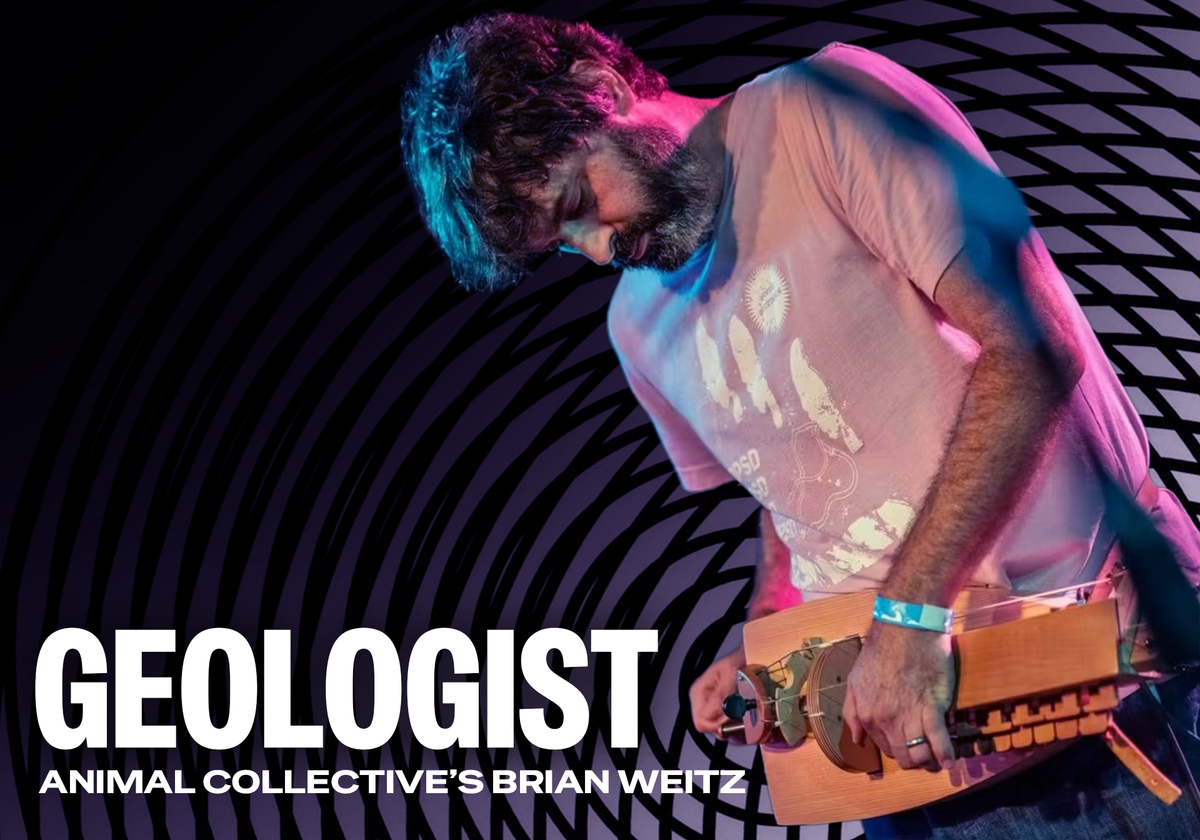
Animal Collective’s Geologist: Still Digging Up Sonic Gems
Best known as Geologist, Animal Collective’s Brian Weitz injects synthesizers, samples, animal sounds, and field recordings into that band's enchantingly strange sound world. Recently, Weitz has been on a creative tear, releasing a solo album and several other projects, including Croz Boyce with Avey Tare. In our interview, he talks about sonic texture, the internet’s influence on music culture, and his obsession with the hand-cranked medieval instrument, the hurdy-gurdy.
In this conversation, we talk about sound, technology, and the music business: the first sounds that caught Brian's young ear; his love of that classic turn of the millennium technology the MiniDisc player; Animal Collective’s determination never to sound too “trad”; the strange opportunities and pressures of early internet fame; And the hurdy-gurdy--that infernal machine that fuels so much of Brian's recent creativity.
Phantom Power members will get the full interview, including Brian’s background in ocean conservation—we talk about scuba diving the recordings of seals and walruses that found their way into Animal Collective tracks. Plus Brian's reading and listening recommendations.
And Croz Boyce will perform at Cincinnati’s Talk Low Music Festival on Saturday, September 26, at the Contemporary Arts Center. Phantom Power is proud to sponsor Talk Low, and I hope to see some of you there.
Cited Media:
Albums:
Michael Jackson - Thriller (1982)
Panda Bear - Panda Bear (1999)
Animal Collective - Spirit They're Gone, Spirit They've Vanished (2000)
The Strokes - Is This It (2001)
Animal Collective - Campfire Songs (2003)
Animal Collective - Sung Tongs (2004)
Animal Collective - Feels (2005)
Animal Collective - Merriweather Post Pavilion (2009)
Animal Collective - Meeting of the Waters (2017)
Floating Points, Pharoah Sanders & The London Symphony Orchestra - Promises (2021)
Motherfuckers, JMB & Co (2025)
Geologist - Can I Get a Pack of Camel Lights (2026)
Avey Tare & Geologist present Croz Boyce - Croz Boyce (2026)
Climax Golden Twins - Imperial Household Orchestra
David Crosby - If I Could Only Remember My Name (1971)
Valentin Clastrier - solo hurdy-gurdy record
New Psychoactives - Animal Collective side project (SoundCloud)
Series & Platforms:
Daryl Hall - Live at Daryl's House (web series)
Artists:
Transcript
Intro: SpectreVision Radio
Brian: You can either be, like, timeless, which means, like, maybe a little too trad and, like, you just don't have a unique sound. Or you can just try and find something that feels very new and fresh, at the risk of it being dated. That's sort of not for us to judge, you know what I mean? I guess it's up for, like, future people to judge.
Intro: This is phantom power
Mack Hagood: Welcome to another episode of Phantom Power. A podcast about sound. I'm Mack Hagood, best known by his stage name Geologist. Today's guest, Brian Weitz is a founding member of Animal Collective for nearly 30 years. His synthesizers, samples, animal sounds, and field recordings have helped shape that band's enchantingly strange sound world.
With their 2009 album, Merryweather Post Pavilion, Animal Collective achieved something rare for a band so experimental. The album debuted at number 13 on the billboard chart, sold some 200,000 copies in the us, won the Village Voices Poll of Critics, and in a Pitchfork Readers Poll, they won Album of the Year, song of the Year and Best Live Act.
Notably, this commercial and critical high watermark was also a record on which Geologists, electronics and samples played a larger role. Over the past couple of years, Brian Weitz has been on a creative tear. He released his first proper solo album. Can I get a pack of Camel Lights? And a record with his trio motherfuckers JMB & Co, which features former members from GWAR and Eugene Chadbourne's backing band.
On both records. Brian plays hurdy-gurdy, the medieval hand cranked instrument you might see and hear at a Renaissance festival. Brian, however, pushes the hurdy-gurdy into droney overdriven territories that reference Sonic Youth, Can, and Tony Conrad.
Brian also recently teamed up with longtime band mate, Dave Portner, better known as Avey Tare Form Croz Boyce, a folk tinged instrumental duo whose debut leaves a lot of space around its instruments for listeners to focus on the textures of the music. In this conversation we talk about sound technology and the music business.
The first sounds that caught Brian's young ear, his love of that classic turn of the millennium technology called the minidisk player, Animal Collective's determination never to sound too trad, the strange opportunities and pressures of early internet fame. And of course the hurdy-gurdy, that infernal machine that fuels so much of Brian's recent creativity.
Phantom power members will get the full interview, including Brian's background in ocean conservation. We talk about scuba diving and the recordings of seals and walruses that found their way into animal collective tracks. Plus we get Brian's reading and listening and doing recommendations. You can become a member at mackhagood.com.
Okay. Also Croz Boyce will be soon performing at Cincinnati's Talk Low Music Festival on Saturday, September 26th at the Contemporary Art Center. Phantom Power is a proud sponsor of Talk Low and I hope to see some of you there. I'll have a booth and I'll do a drawing to win free Phantom Power Merch. So please come by and say hi.
Finally with Talk Low Fest coming. We've been on a bit of a musical artist run, but in the coming months we have some amazing authors and technologists on tap. Ted Gordon is coming on to discuss his new book, the Composer's Black Box, making Music in Cybernetic America.
Amy Skjerseth will be on to talk about her new book Pre-Programmed, how Electronic Presets Changed Music and Media, and we're gonna celebrate the new book, Power in Listening, curated from articles in the beloved sound studies blog Sounding Out. I think we're also gonna talk to Josh Scott of Pedal Maker JHS, who recently co-authored a new book about legendary pedal makers Electro-Harmonix.
And finally, we've got a wild Halloween episode on tap where we're going to try to contact the spirit realm through a technological process called. Instrumental transcommunication and, no, I'm not joking. We're gonna try to cross over to the other side. We're finally gonna put the Phantom in Phantom power.
So, be sure not to miss an episode or to miss my monthly newsletter where I just dropped a piece on whether music really evolved as a male courtship ritual, as some evolutionary psychologists seem to think so. You can find out the answer to at mackhagood.com. You can join the newsletter. Subscribe to the podcast on the platform of your choice. It's all at mackhagood.com Alright, here we go. Here's my conversation with Brian Weitz, AKA Geologist.
Mack: All right, Brian, welcome.
Brian: Thanks for having me.
Mack: So, maybe we could go a little bit down memory lane. I'd love to hear a little bit about how you got into music as a kid.
Brian: I mean, some of it is hard to remember, you know? I,
Mack: Sure
Brian: I li- I I liked the radio quite a bit. My parents were always, like, popular radio, Top 40 radio kinda people. I was born in the late '70s, '79, and I have early memories of songs I really liked on the radio in the early '80s. A lot of Hall & Oates, Eurythmics stuff I was really into. I mean, and I was young.
Michael Jackson Thriller was probably, like, the first, like, big memory I have, even though I was only, like, four something years old. I remember my parents watching, like, the making of the Thriller video, and taping it on a VCR.
So as a kid, was really into, like, the makeup scenes in that documentary. I would watch that tape a lot, you know, again, like, in nursery school, would just ask to watch it. It's probably why I like horror movies, too, I think. So Thriller was, like, an early one, And I, I started playing piano around that time, too, like Suzuki.
But I think because I was into music, my parents got me, like, Suzuki piano lessons around that time.
Mack: I actually just went and saw Hall & Oates a couple years ago. They came here to Cincinnati, and that was an amazing show.
Brian: That was cool. Nice.
Mack: And possibly the last chance to see them 'cause I believe that they're on the outs.
Brian: Yeah. Well, I've heard they've, they've been on the outs for a long time.
Like I've heard from people in the live music industry that they have, like, separate dressing rooms, and that they essentially don't see each other, you know, until they have to be on stage.
I don't know if that's a rumor, but Daryl Hall has that, he had, like, a YouTube thing or some kind of web series called Live at Daryl's House or, there was talk of Animal Collective being on it, like 15, 20 years ago or something.
And it never happened. I don't know what happened, but I was a little too nervous to do it, 'cause I'm not really, like, a traditional musician, you know, piano lessons, notwithstanding. I'm better at it now, but, like, at the time that we were being asked, I was just triggering samples and loops and stuff, and I was like, I don't really know if I can hang with Daryl Hall, like, playing on one of his songs.
So I was probably not gonna, go but Dave, who's Avey Tare in Animal Collective and Croz Boyce, he was really excited and was like, "We can't say no to this. Like, we have to do it," you know? But I really don't know what happened, like why it broke down, but. Yeah. I was gonna show up with some mini disc loops and, yeah, with some crickets. There was no way I was gonna go. Or if I went, I would, like, just pretend to be Dave's roadie or something, you know? But yeah, I wish it had happened, 'cause I would've loved to have seen Dave, play with him.
Mack: So guys all started playing together in what? High school.
Brian: Mm-hmm. Yeah, well, Josh and Noah, they're a year older than us, and they went to a different school together starting around second grade. So they probably started making music together in middle school or high school on their own. Dave and I started making music together in 10th grade, 94 it would've been.
And then within a year, year, year and a half, like we had all met and started playing music together. Well the band that's currently Animal Collective wasn't a thing, but like in different combinations, the four of us had a few bands together
Mack: And you guys were in, what, Maryland?
Brian: Mm-hmm. Yeah, Baltimore. I was born outside of Philly, I moved to Baltimore in '93. Was the start of ninth grade. And Dave was, like, literally one of the first people I met at high school on the first day, and I knew somebody from a summer camp I had gone to, and they, like, you know, I said hi to them, and then they brought me.
They were like, " "You should meet my friend Dave. I think you guys are very similar in terms of being obsessed with music." And, you know, at the time, early '90s, like, being a 14-year-old, like, if you were alternative or into grunge or something, it was an identifying thing. Or if you had started to listen to the Grateful Dead, like, in middle school, it kinda denoted you as a certain kind of person.
So, so we were introduced by somebody we knew in common. and yeah, became fast friends. Yeah.
Mack: You guys all knew each other in high school, but Animal Collective itself didn't start until you all went away to college, right?
Brian: Yeah, we continued to play with each other during summer breaks and winter breaks, and Dave and I went to school, both in New York City, and we continued to play together up there. And Josh and Noah went to school All of us went to different schools, but they were both in the Boston area, so they continued to play up there.
And we all did our own music. And so I think it was around, like, 99-ish where Josh had decided, like, we should start our own record label, and he really wanted to spearhead it and be the one that ran it. And he first called it Soccer Star, and he put out the first Panda Bear record in '98 or '99.
And then I had this little EP that I had done on a four-track, just like a noise EP, and Dave was working on what ultimately became They're Gone Spirit, They've Vanished, which is considered the first Animal Collective record.
That was when we changed the name of the label to Animal, and we had this conversation, like, this record label or this friendship, like, the four of us have where we, like, jump between each other's projects and bands and, this is, like, a collective. You know, we had seen that from The Elephant Six guys a little bit down in Athens, and also just starting to get more into, like, experimental music and free jazz, like, you know, living in New York City, learning about, like, artist collectives.
We were like, well, it's sort of what our friendship is, and if we change the label from Soccer Star to Animal. And we just saw, like, well, we'll just be The Animal Collective. The record label, at least initially, will focus on what the four of us are doing, and we'll put the name of every single person that plays on a record on the record.
Like, The Animal Collective was not the band name. It was, like, the label group. And it wasn't until the fifth record that came out that all four of us are even on a record together. And we started working with this record label Fat Cat around that time, and, this other record label, Carpark Records, which started an offshoot called Paw Tracks for our projects, 'cause at this point we had given up on the, the record label ourselves.
And just talking to them, it was like, "You guys need like a band name so that people can find you more easily and, promoters get more familiar with you, and your lineup can still be fluid, but there at least needs to be an umbrella term now that you're more widely known just outside of the New York City area, you know, amongst your friends."
So it was 2003 we started using that band name.
Mack: Actually all that backstory explains a lot because seemed like, you know, when I heard you guys, you, you just really had your own sound, and it sounds like maybe that was because you had that long early stage where you were kinda knocking the kinks out.
Brian: I mean, if you listen to the first record Dave made, Spirit They're Gone, which, you know, Noah plays drums on it, but, like, essentially it's, like, really Dave's brainchild. and, like, that sounds pretty fully realized to me and, But then, like, that to me is still almost, like, a Maryland record.
Brian: Like, even though we had lived in New York for a couple years, like, we weren't in the New York music scene the way we became, like, just after that. And so then, like, hanging around, like, people that had moved to New York from the Fort Thunder scene in Providence. Like, we had a, practice space with the band Black Dice, and then this other band Gang Gang Dance moved into our practice space and, you know, then they weren't a Providence band, but, like, there was so much, like, cross-pollination of, like, noise and freeform stuff, but also some songcraft, and things got, like, messier again for a few records.
But that was a little bit more, like, trying to survive as a band in New York City. And, I think by Song Tongs what you just hear, you know, even though it is just those two guys, I think you just hear maybe, like, the start of, like, figuring out how to synthesize things that, like, we had done.
Like, on certain records you're like, well, we're really leaning into the noise, or we're really leaning into songcraft, or we're trying to, you know, leaning into, like, extreme frequencies or we're just leaning into acoustic guitars, like campfire songs and field recordings. And Sung Tongs to me was like, you know, even though I don't play on it, and maybe it's why, because I don't play on it, like, it's my, maybe my favorite Animal Collective record, you know? It's the one I, if I was a fan of the band I'd probably be like, " That's the one," you know?
Again, it's because, There's nothing, like, for me to criticize about my own playing, and I went on that tour with them, like. Again, before they recorded it I had been living in Arizona for a year and then I came back in the summer, and they were gonna go on this seven-week tour, and I hadn't seen them in a year.
I mean, I guess I had seen them, like, here and there, but, like, when I came back east for, like, a weekend. But, they were like, "Well, you're not doing anything over the summer," 'cause my job wasn't supposed to start for a couple months, and I went on the tour. So I watched those songs go from these, like, messy embryonic things, like, into what they made on that record.
So it's... I, I really love that record. I think it's really special and, but I also hear like the... It's like the synthesis of like the noise, the guitars, the songwriting, the vocals, the harmony, like everything is really starting to be like there's a natural balance that's being struck that like really sounds unique and sounds like our own thing.
And, again, I think the early records feel like that too to me. You're like, "Well, we're really leaning into this, and really leaning into that." And maybe on Sung Tongs people say like it's a lean into like acoustic guitars and harmonies, 'cause that was like the freak, freak folk time period where a lot of people were doing that stuff.
But to me, it just felt like those are two elements. But there's these other elements too, and there's in the way the guitars are strummed, like relates very much to me, like our interest in minimalism and trance and even like ambient techno stuff like that feel like the frequencies, the way the guitars blend, like almost sound like a pop ambient compact record to me.
And, so yeah, that's
Mack: Those mid-200s records, they have conventional instruments, but they're not being played and arranged so conventionally. And it kind of makes me wonder, like, did you guys have a strong, I don't know, sort of editorial sense or like policing the boundaries of like, "That sounds too conventional," or, because I could see that that could be, on the one hand, like it could sort of shut down creativity, or it could, you know, the constraints of something like that could maybe help you be
Brian: more creative.
I Mean, we've definitely said that. We, we use the word trad sometimes, like something sounds too trad or, you know. I guess yes is the short answer. I think we maybe like thought about it or voiced it with internally a little differently. Like, I really wanna stress, like I sort of regret some of these feelings.
But like at the same time we were starting in New York, like in 2000, in terms of like playing shows at the Mercury Lounge, was the same time bands like The Strokes and The Yeah Yeah Yeahs and we were friendly with people on DFA, but that's sorta like, we're either going back to like a '70s punk sorta thing, like The Heartbreakers or Television, up until like the sort of early '80s post-punk Liquid Liquid thing.
Like, we all loved that music, and we would hear about these other bands doing it. Again, not maybe like listening to them as much, but, I mean, 'cause we... Once we heard the first Strokes record, we loved it, and I, I'll go see The Yeah Yeah Yeahs anytime they play. Like, they put on a great show.
It's just... We were like, "Those bands are good." Especially The Strokes really like stood out to us, but we were like the fashion, the look, everything. Like, the thing that made punk so special, or made any, like, era so special, we even felt this way about some '60s retro stuff, was like those people were very, like, of their time.
When you look back at those bands, like that was new and that was fresh, and That's why that music and that, you know, those scenes had vitality, was because it was very, like, current. And so when we would talk internally in the band, We didn't like always say something sounded too conventional, but if it was too, like, referential or something, we would just say, like, "Our goal should be to sound like ourselves and not like anybody else, and we should sound like a band of the moment, that's reflective of, like, the time we're living in, the technology we're living in." you know, which, you do run the risk of then dating yourself. Like, a lot of psychedelic stuff sounds dated or, you know, '70s punk can sound dated, and then anything that sounds like it sounds retro. Maybe people look back on, like, 2000's Animal Collective as like, "Well, that's a very 2000-sounding band."
But It's like you can either be, like, timeless, which means, like, maybe a little too trad and, like, you just don't have a unique sound. Or you can just try and find something that feels very new and fresh, at the risk of it being dated. That's sort of not for us to judge, you know what I mean? I guess it's up for, like, future people to judge.
Or now that these records we're talking about are 20 years old, it's up for people to judge now. I don't know.
Mack: Yeah. You mentioned, like, reflecting the technology you're in, and, like, that makes me think, a sort of different context of technology was, you guys came out, like, right at this moment where the music internet was super interesting and very rich. There were all these, like, MP3 blogs. I think Napster was what? Like '99??
Brian: I remember people... Oh yeah, I remember people talking about Napster in college. I literally remember the first time, I mean, it was even pre-Napster, but just like because of the school I went to, there was an engineering school and, like, these computer science whizzes. And I mean, it was, like, as early as '97 that I asked a kid, I was like, "Hey, I'm, I'm going down to Other Music today. Do you wanna come with me or do you want me to..." He was super into, well, I don't know, some, some, some band. It was, like, an Autecher-ish kind of band, if not Autecher, who, like, put out a record in '97 or '98, like early '98. And I said like, "Do you want me to grab it for you or do you want to just come with me to the store?"
And he was just like, "I don't buy music." You know what I mean? And, like, he was the first one to try and explain to me what, like, FTP sites were and MP3s and he showed me how his, like, CD booklet was all CDRs and how, like, he had music on his hard drive and, like, I didn't understand any of it, you know? So yeah, that was '97, and Napster was a few years after that.
Mack: You guys didn't get huge exposure on television or anything like that, but you were famous on the internet.
Brian: Mm-hmm.
Mack: And I feel like, in that moment, there was just an interesting thing that was happening. You, there was the collected animals message board, or is that, I don't know what we call it.
Brian: Think it's still going. Yeah.
Mack: Yeah. So, so I guess I'm just curious of like, what that was like to be an up-and-coming band in that particular environment, and how do you think it maybe it affected your career?
Brian: I mean, I can't, like, deny it probably helped in some ways. We're a fortunate band in that, like, we got the benefits of both, like, the previous era and, like, what was going on at that time because, like, when we signed our record contract with Domino, who we're still on, like, it was really life-changing.
You know, didn't, like, instantly make anybody millionaires or anything, but, like, at that point, like, we didn't have to have day jobs anymore. You know, and if we kept, like, making records and our tours did really well, and, I don't think, like, bands are... Again, it wasn't, like, in the millions or anything, but, like, If, like, you know, you have modest needs and means, like, we could become musicians. I don't think, like, shortly after that, and I know because, like, sometimes, like, we're like, "Oh, well, it's time to make another record," and the record labels are like, "Yeah, records aren't worth that anymore," you know?
We signed pre-streaming, and I don't think record labels, like, saw where streaming was gonna go. There was still, like, the tension of, like, illegal downloading, and maybe, like, Apple Music was starting to do some MP3 sales. So we were getting the exposure of, like, file sharing and the blogs and MP3 blogs, which brought people out to our shows, and we did really well on tour.
We sold a lot of merch on tour. Again, like, helped us become, like, working musicians, and making a living. And, you know, I've been super fortunate. Like, we've worked consistency, and, like, I made enough money in those days to save that, like, since my wife works and she has healthcare, you know, I don't make anywhere near what I used to make, but, like, I c- I still, like, don't have to have a day job. I can, like... You know, it's getting longer and longer between Animal Collective tours, but, like, I can make it.
Like, so we, we really had this, like, big moment, that was... the record label probably shouldn't have signed us for what they signed us for. And, part of me complained about downloading and file sharing at the time, but I think I just didn't like the sense of entitlement some people had.
You know, people acted like it was this great democratic moment. And I suppose it was. Nothing is ever, like, one thing. You know what I mean? It's-- there's so many sides, and so many things are true at the same time. I felt like the people that were, like, talking about the democratization of access were also still, like, kinda privileged kids on college campuses with high-speed internet, and I was like, "Are you, like, using all this energy to, like, try and bring high-speed internet to impoverished neighborhoods and school districts and public schools? Or drinking water?"
You know? I didn't really enjoy the entitled aspect that, like, sorta techy people talked about it, you know? I think as we've seen over the last decades, the way they talk about how they think they're changing the world with their tech and access usually doesn't always end up great for us, you know?
So I think I was, like, a little hesitant to admit at the same time that, like, it was a huge benefit to us. So, like, we really got the best of both worlds at that time period, and, I mean, I often say this to younger bands, like, "I don't know how we would start today."
Like, I mean, I, I don't doubt that I would still make music, but, you know, the idea of figuring out how to do it full-time without... Like, I don't understand the landscape of, like, a viral thing on TikTok or, I don't understand the landscape these days, and I'm not supposed to. I'm 47.
It's time to get out of the way, people that understand it better can have their moment, you know?
Mack: I think one of the things that was maybe a little different, in the era where you got so much notoriety was, I think online encouraged people to have a little bit more of expectation of access to the musicians they were fans of.
late '80s, '90s, like I wouldn't have imagined, like, being able to send a message to Sonic Youth.
I mean, I could write them fan mail or whatever, but I wouldn't really expect to hear back from them or anything. But having, like, these, you know, spaces where your fans are congregating, like did you engage with that? Did you feel like as a band that you needed to engage with it?
Brian: So like we had an email address. It was the early days of email, so fans could email us, and at the time, if anybody, like, that wasn't in our group of friends outside of New York emailed us, it made you feel like, like, "Whoa," like our music's reaching people.
It felt good, you know? So we would write back, and before Feels came out, this one guy wanted to start some kind of a message board website for us, but he emailed us in advance about it
I don't remember what his idea was, but we also, you know, we came from the world of like, some of us liked the Grateful Dead and saw the Grateful Dead, but we were also really into Pavement, and like in the early days of the internet, there was like a big like online Pavement tape trading community. And so we were always really into live recordings of bands. And we always recorded our own shows, and we would almost fantasize like, "Oh, like, if we ever become like a band that people care about, we'll allow taping, and like we'll try and encourage..."
Like, so When we were gonna make our own website, it took us like 15 years to getting around to making a website, but like in the early 2000s we're like, "We're gonna have a section where we host live recordings." Kinda like what Fugazi has now with their live archive. We're like, " Every show that we record ourselves we'll put up on there, and we can sell them if somebody sends in like a CDR or something, we'll burn a CDR and sell it." Again, this idea didn't ever get off the ground. And so when this guy emailed us about setting up a fan site, we said like, "Well, why don't you make it a live recording exchange?
Like a FTP thing or like a, a hub for people that tape our shows and like, you know." and then he was like, "Yeah, sure, I'll do that. I'll also make a side forum for just general discussion about you guys. But why don't you guys make usernames and come on there and like validate it so it, like people know that it's legit?"
And so we did that. And then that started years of like feeling this pressure of answering every single question and sometimes arguing with people. And then like, you know, some privacy things happened, you know, like when we became a bigger band, and you know, some of us were starting to have kids.
We were just like, "We need to get out of this. Maybe some mystery is for the best. People don't need to always need to like have everything explained to them." It was really during like when we were in the studio recording Merriweather that we were like, We need to, like, get off of this feeling like we need to check in and answer people's questions on a daily basis while we're in the studio is gonna be in our heads, and we also don't want them to ask, like, "Where are you guys and what are you doing right now?" And.
That was kinda the end of it, for me anyway, which was 2008, so like, yeah, I mean, almost 20 years now. And people bring up our, like, Discord servers and our Reddit threads and, you know, we do AMAs and stuff, and, like, I always say, like, God bless those communities. I'm so glad they're out there.
And, that, like, level of dedicated fandom still makes it so we can do what we do. Like, I'm flattered that those spaces exist, you know? I think our, like, disappearance from engaging with them, to me, just feels very natural. Like, you can't sort of have everybody's opinions about you in your head all the time.
And, and they should also have a space where, like, they feel like they can discuss their favorite band freely without being like, "Well, the band's gonna see this." So I really try and, like, not, like, lurk on those spaces ever, you know? Almost really never do. I try not even to look at Instagram comments, but that's a harder battle sometimes
Mack: Yeah. Well, let's talk about what you've been doing musically, you know, recently. 2026 seems like it's been a really big year for you.
Brian: Yeah, I mean, part of it is just that Animal Collective's been, like, kinda dormant in terms of, like, a lot of, like, sustained work. Like, we've done some scoring stuff. The four of us have worked on a seven-inch together, but I don't know, I just needed to fill time, and, started playing with more people around DC.
Like, people started asking to play with me, and, so yeah, I've done a lot the last two years, and it's really rewarding and fun. But I don't know if there's, like, a specific one you wanna talk about or-
Mack: Well, I mean, we could talk about Cross Boys.
You, and Avey have this recent record. Really like a enigmatic… I was actually just interviewing recently Tashi Dorji, and he was talking about, playing the guitar, and hearing his guitar for the first time through a condenser microphone with headphones, and how that, like, affected his playing, 'cause he was hearing the wood and that came to mind when I'm listening to your record because there really seems to be an attention to timbre and, like, the sounds, and there's, like, enough space to kinda listen to the sort of, I don't know, like, materiality of the instruments or some- if that makes any sense.
Brian: Yeah, totally, yeah. I mean, like, even starting in high school when we were teenagers, we started getting into, like, collage music and, tape music and, like, found sound sort of stuff. So texture was always a really interesting thing and, and that was big in Animal Collective too. Like, I mean, it was kinda my role in the band for a long time, was, like, to add, textures that didn't necessarily feel like you should be hearing them in songs like this to create more of a, an environment.
Mack: Is that where the MiniDisc player came in? You mentioned a MiniDisc player.
Brian: Yeah, yeah, totally. Yeah, yeah.
Mack: to hear that.
Brian: Yeah, like a lot of field recordings or...
field recordings and just, like, found sound stuff, like, you know. There was a band called Climax Golden Twins. I mean, they're still around. based out of Seattle. We stumbled on them in high school. We started to read magazines like Banana Fish, you know, 'cause we were essentially, like, looking for modern versions of, like, '60s tape music, things like that. So, they made a record called Imperial Household Orchestra, and just the way it was done, you were like, "Well, that just sounds like somebody banging pots and pans," but it's done in this really, like, artful way, and it seems like they're actually really, like, thoughtful about the textures of whatever they're banging, you know.
So we were really into, like, abstract textural collage music, I mean, I remember talking to Sam, who's Floating Points, about the Pharoah Sanders record he did, and I was like, "Man, that's almost like a microsound record." If you listen to that record in headphones, it's like you hear the chairs creaking. You hear, like, people, like, resting on their instruments.
Brian: And I was like, "That's, like, a whole record in itself." Like, it's masterful. And, and we talked about how, like, when you're dealing with classical engineers, like, their job is to, like, edit all that stuff out and to try and mic things in ways that, like, you actually won't pick up those kinds of sounds, and how he would...
He heard them as they were working on that record, like when he had the orchestra, you know, in to play the parts, and he heard it in real time, and, like, as he noticed that they were trying to get those things out of the record, he was like, "You don't have to get rid of those, things on there."
Like, "I want those things in the record. I want people to hear that as well." It was, you know, a very intentional decision. And now that we've been doing it for so long, when it comes to croz boyce, like when you hear that... 'Cause people have mentioned that to me as well, like especially with Dave's guitar, like hearing his fingers on the frets, and it's almost just like second nature to us at this point that, that stuff will be in there, and we only take it out if it's, like, annoying, like, if it's distracting or something. But the fact that it's, like, this nice ancillary aspect of it, you know, like bonus, that it's there.
Mack: And I feel like I saw somewhere that the name was inspired by Crosby, Stills, and Nash.
Brian: Sort of. I wouldn't... No, no, you're, you're right. It's part of the story. It's not, like, really, like, an inspiration thing. we do love David Crosby. I do like a lot of Crosby, Stills, and Nash. I've seen Crosby and, and Nash together, like, as a duo. that first David Crosby record, If I Could Only Remember My Name, is one of my favorites of all time.
And Dave and I have been talking about this project for a couple years. We have another side project that just because we, we only post things onto SoundCloud, it's called New Psychoactives, and, like, that's, like, a Animal Collective side project that's just the two of us, and we often just put it for free on SoundCloud, or we do, like, limited cassettes kind of a thing.
Like, it's not really, like, on Bandcamp or streaming services. So it's pretty under the radar, and we like doing things like that. Sometime during COVID, there was a compilation that that music supervisor Randall Poster was putting together, 'cause I guess he had gotten into birding at some point.
I don't know if it was during the pandemic or before. He's really into birding and bird songs, so there was a compilation to benefit the Audubon Society and the Macaulay Library in Cornell, which catalogs a lot of bioacoustic recordings, and Animal Collective has used them a lot over the years.
So, we got asked to be a part of that. We wanted to be a part of it. And, it just turned... You know, it was still when everybody was remote, like pre-vaccine, like right around the vaccine starting to roll out. So Dave and I recorded parts for a song, and Josh and Noah, by the time it was due, just, like, didn't have time.
Or, like, they listened to it when there was, like, a couple days left before, like, the compilation needed it so it could meet their production schedule, and they were like, " this actually sounds like a complete idea. We're not sure, like, what we would add to it that wouldn't, like, cloud the space. Why don't you, the two of you just... I mean, it'll still be an Animal Collective track, but, like, this will just be, like, the two of you."
We had done a previous EP, like, where it was a similar thing called Meeting of the Waters, where Dave and I went down to the Amazon for Vice TV to record a record in the Amazon, and again, like, we were just the only two that could go.
Like, Josh was not playing at the moment. He was working on some solo stuff, and Noah couldn't make the trip. So we had already set this precedent of, like, acoustic guitars and my synths and electronics is a template that has a unique sound. And so we made that EP. We made this track for this comp.
And at some point we were like, "Hey, we should just make a really dedicated full-length record that's just this, this combination." You know, and I think we maybe even thought it'd be an Animal Collective record. We were just like, "It'll be just this lineup." And it came time where, it was three years ago at this point, or three and a half years ago, Animal Collective had just put out a record, toured for a year.
We were gonna take a break, and we were like, "All right. It's time to start working on that record." And literally Dave was like, " I have a recording of me playing acoustic guitar. I'll send it to you for you to play over. I'll start a Dropbox folder." And that was the day that David Crosby died. So, like, in the same, like, text conversation of being like, "We should start this record, and let's, like, create a Dropbox folder. Oh, and RIP David Crosby, like, he ruled," you know, kinda thing. You know, like, Dave just named the Dropbox folder Croz Boyce, because we were talking about David Crosby dying as he was creating this Dropbox folder.
And so it was like, yeah, we're like, "His boys," like, We were just joking around. And, like, it just became the name of the project because that was the name of the Dropbox folder, and You know, we were like, "You know, maybe, like, we don't call this Animal Collective.
It just feels like when you put out, like, a full-length Animal Collective record, sometimes it's either, like, a big record with singles, or it gets dismissed as, like, one of our weird soundtrack or experimental things." Which this might fall into that camp, but we were like,
"This felt, like, a little different, but, like, we'll call it whatever you want us to call it. We'll call it Avey Tare and Geologist present Croz Boyce or whatever. Like, that could just be the album title." and Domino was like, " We actually kind of like the idea of, like... we won't hide that it's you guys. Like, we'll still promote it as, like, it's you guys from Animal Collective, but we kind of like the idea of you having..."
like, like, they liked the name too, and they were like, " Yeah, it's kind of like a fun thing that we should try. Like, putting out something that, like, we say is the guys from Animal Collective, but, like, it's got its own unique personality, so we're gonna call it something different." Like, kind of back to what we always thought Animal Collective would be 25 years ago.
Like, it's not really about the band name, it's about the people that take part in it, and, like, their specific connection and work on that specific record. So, you know, Domino, they actually pushed it more for us to not call it Animal Collective.
Mack: So I really wanted to ask you about the hurdy-gurdy, because that seems to be a really important instrument in your life right now.
Brian: Yeah, it is, yeah.
Mack: I'm not sure everyone is familiar with what a hurdy-gurdy is, so can we maybe first sort of talk about what that is?
Brian: Yeah. Do you, you want me to s- do you wanna see it? It's right, I have it over here.
Mack: Oh yeah I'd love to see it. Sure.
Brian: I'm tangled up here. Hold on.
This is not, like, a great one. I mean, it's great, I love it, but it's like, a student model.
Yeah. So, I only have one string on it right now, but the different strings are tuned. These are like the melody strings. They're in G. These are drone strings in C. They're not on the wheel. The wheel, you put rosin on the wheel, and you spin it, and it bows the strings.
Put some cotton, like, to make it so it's not screechy. And then these are, you know... It's, like, laid out like a keyboard. So,
Mack: Oh, yeah.
Brian: like, that's middle C. Right there's middle C. And then you play, like, these, you know. So, like, you, you kind of just, like, start to learn by feel, like, where you are. But you can also look down and kind of see the keys coming up.
So if you know how to play a piano, you can, you can do the melody on it pretty easily. And then this piece of wood here, that's, like, if you listen to, like, Renaissance or, you know, medieval hurdy-gurdy music, you hear, like, a buzz noise. Like that's made by this piece of wood, which, like, there's, like, some strings.
It doesn't make sense in my music, so I don't always do it. See if I can make it work
That's- it's just made by, like... I mean, I'm doing it very sloppy right now 'cause... But, like, you just sort of, like... Like, if you, like, kind of hit this in a certain way, as you're, like, going around, if you, like, give it... You're turning a crank, and then, but, like, if you give it, like, these impulses, it just seems to do something to this little string which pulls on that, and that makes that piece of wood vibrate.
So that's how you play it in a traditional sense. But it's really just, like, a... You know, so it's a bowed instrument, but you fret it like you're playing piano, which I know how to play, so you know. It's kind of, kind of almost like a monophonic synth in a way, with, like, infinite sustain. So, And, and you can put the drone strings on.
Oh, these aren't in tune right now, so I detune it when I'm traveling, you know, sort of like you're supposed to do with a guitar. and for Croz Boyce I only use this string, so that's the only one that's in tune right now. But, yeah.
Mack: And, did I hear that on Abundant River Zap? That was one of the tunes on Croz Boyce.
Brian: Yeah. the drone on a Abundant River Zap is actually a harmonium, but the distorted, it almost sounds like a distorted electric guitar. I play drone on hurdy-gurdy, and like it's even more so on my solo record that I just put out like six months ago, So at the beginning of this year, I put out a record called Can I Get a Pack of Camel Lights? Which is like my hurdy-gurdy record. Thank you.
Mack: That record That record, kills.
Brian: Thank you. I'm trying to play it like the way I wished I could always play guitar. you know, and this allows me to like live out those teenage fantasies a little bit.
Mack: Oh my gosh, yeah. Some of it sounds like, a Sonic Youth record.
Brian: That's kind of what I was trying to...
Mack: yeah. Yeah. I mean, it's... but it took me a minute 'cause I was just, like, listening to it and I was like Wait, that a guitar? No, what is that?
Brian: Yeah.
On Abundant River, what people think is a distorted electric guitar at the end, like the little lead that comes in at the end of that song, that's the hurdy-gurdy.
Mack: Man, that is so cool. So what attracted you to this instrument?
Brian: I did radio, college radio, and at the school I went to, Columbia, in New York, we had, like, two college radio stations. There was one at Columbia and there was one at Barnard, which is the women's college, and you could work at either of them. The one at Barnard was, like, a, more like traditional college radio, like very freeform programming.
You could play whatever you wanted, and that's where, like, a lot of the indie rock and college rock was played. But the Columbia station was, like, pretty weird and interesting, and they had a new music department they did a lot of free jazz in the '60s, and were super into the, like, loft jazz scene in New York in the '70s.
They had this classical department and a jazz department. And the classical department and the jazz department eventually, like, as free jazz and, like, 20th century classical, and, like, atonal stuff became more of a thing, that split off into the new music department, which was again, yeah, like, more, like, challenging 20th century classical or, like, really extreme free jazz stuff.
And then in the '90s, they started getting into noise music and underground noise and collage. So that band I mentioned earlier, Climax Golden Twins, that I was a fan of, they had performed on the Columbia radio station before I got there. There was this, like, 72-hour, like, noise festival that the radio station did.
So I was like, " I'm gonna go work for that radio station, instead of the indie rock radio, you know, that I could've done on the Barnard one." And, that was right around the same time that this club Tonic opened in New York City, which was like a John Zorn-led club, and, and it was, like, really important.
I saw so much great music there, and I could get in for free because I did, radio promo for all their shows, and I did ticket giveaways for their shows, so I could go to any show I wanted. And I went to see Keiji Haino do a three-night residency. He was this Japanese guitar player. He did a three-night residency in 1998.
And he's still around, by the way, still doing tons of music. the Blank Forum Gallery in New York's gonna honor him with a big event this fall. So I was getting into his music at the time, and, I went to go see him do this residency, and one of his sets was a hurdy-gurdy set, and it was, like, this very dark...
I wouldn't, like, say, like, totally atonal, but, like, there was some dissonance, and it was just, like, a very haunting drone set with a hurdy-gurdy. I got really into that and his records with hurdy-gurdy, But that was a very, like, siloed thing for me. It was like if people asked me about, like, Keiji Haino, I'd be like, " my favorite stuff he does is the hurdy-gurdy stuff, like, more so than guitar." But it, again, it was very siloed as that. And then, Dave, like, yeah, 20-something years later, got into a French player that played more traditional but also some avant-garde stuff called... His name is Valentin Clastrier.
Dave played me that record, just solo hurdy-gurdy. Really blew my mind. And it was at the same time that we were working on some Animal Collective stuff where I was using these synthesizer patches that I had made to play with John Cale, Cause he likes Animal Collective and asks us to join him sometimes, like, on a song or, you know, we've done a few of those, like, Velvet Underground things.
And sometimes to, like, mimic his viola drone or, like, the stuff he did with La Monte Young and Tony Conrad, who I'm also a big fan of. Like, I had this synthesizer patch that was an open fifth drone, that I tried to make sound like a bowed kind of a thing.
It was the same time period, and I was like, "Well, I'm really into this sound and this drone that I've been playing with John, so I'm gonna try and bring it to these Animal Collective songs." And as I started to listen at the same time to, like, get back into just listening to hurdy-gurdy records, I was like, "Oh, that's the same drone."
Like, it's an open fifth. And actually a lot of these synth patches that I'm playing kinda sound like a hurdy-gurdy if you just play it as a drone instrument. So I went on Facebook and, you know, I started emailing a few players that I found online that played more, like, experimental hurdy-gurdy stuff, and, I found a...
It was a climate change professor at University of Maryland that plays locally and, like, Renaissance fair kinda stuff. I emailed him, just, like, cold emailed. I was like, "Can I come over to your house and look at it?" And It was super cool. Cause the hardest thing about when you get it is getting it to work.
You know, like, Figuring out how to get that cotton on the string, and the right tension of all the strings, and the tuning, and everything. so these two guys, like, helped me a lot. And, like, once I got over that intimidation of like, "Oh, I could make this thing work," and then, like, it's just a matter of, like, you're playing piano and You know, if you wanna learn that buzzy thing, you can, but it didn't fit with what I was doing. But yeah, I got this student model, and that was that.
Mack: I cranked up Can I Get a Pack of Camel Lights real loud, and it's like you can hear these kind of very weird mechanical noises coming... It sounds like some kind of infernal machine.
Brian: That's the other thing I really like about it. I mean, going back to what we talked about with Croz Boyce, like, I like the, the textural aspect. Like, the keys, like, have this clackiness to them, you know, one of the things I like a lot about, like Colin Stetson, you know, I love his music, and, like I saw him play in a studio one time, he told the engineer like, "Well, this is where you put the mics," but then he had all these lines out of his saxophone. He had contact mics, like, on his saxophone that he sends to the engineer as well, and he's like, "Well, that's 'cause Like, I wanna hear the mechanics of the instrument."
Like, you know, 'cause you, yeah, like as you play it, it's such a part of the experience and same with hurdy-gurdy. And so, yeah, I like to mic it in this way where you can hear that too. you know, and also like because it can be a droney instrument even when you're playing notes, it helps, to like, kinda put some transience in there, like when the notes change.
so like it has like a traditional musical role that like those textures too, but I just like all those textures. You know, almost sounds like a separate track to me.
Mack: Yeah. Well, I really like that record a lot. I've really been enjoying,
Brian: Thank you. Appreciate it.
Mack: Had it on repeat for a while. Well, man, I really appreciate you taking the time to talk to me, and thanks again for doing this. It's
Brian: Yeah, thanks for having me. Yeah, you too, and I'll see you in Cincinnati. Are you gonna be at the festival?
Mack: Oh yeah,
Brian: oh, okay, sweet. All right, cool.
Mack: Yeah. All right,
Brian: All right, I'll see you there. Take care.
Mack Hagood: And that's it for this episode of Phantom Power. Huge thanks to Brian Weitz for being on the show. You can check out all the recent music we discussed at geologist.bandcamp.com, it's really great stuff. You can also see Croz Boyce at Cincinnati's Talk Low Music Festival on Saturday, September 26th. If you show up for that, please come by and say hi.
And today's show was edited with love and care in the United Kingdom by Cameron Naylor, and web content produced by Abraham Hagood in the Grand Dutchie of Luxembourg. Dutchie Grand is, it couldn't be douchey. How do what? I don't know how to pronounce Dutchy. I'm assuming it's Dutchy past the Dutchy on the left hand side Anyway.
Thanks for listening, and I'll see you in a couple of weeks.
