Media beyond McLuhan
There are fresher ways to understand life's digital shit show. Welcome to the past sixty years of media theory.
In last month's newsletter and on my podcast Phantom Power, I criticized how journalists and commentators keep rediscovering the work of Marshall McLuhan and Walter J. Ong and promoting it as a "theory of everything." McLuhan and Ong popularized the idea that a society's primary technology of communication determines the nature of that society. Their work is thought-provoking to be sure, but as I wrote, it also has severe deficits:
[It] makes claims about media without actually examining the technologies and the industries that make media, as scholars do in the field of media studies. It makes claims about the senses without studying the physiology and cultural practices that shape sensory experience, as scholars do in fields like sound studies. It makes claims about literacy without being literate in literacy studies. It makes claims about “tribal” cultures without anthropology and about oral cultures without knowledge of folklore. Even in McLuhan and Ong’s home field of literature, their claims about a transformation from an oral to a literate mind have been disputed from the get go.
People are attracted to the McLuhanism because they feel it helps them make sense of the digital shit show we call life today. However, aphorisms like "media are the extensions of man," "the medium is the message" obscure as much as they reveal. People need theories that address the real complexities and conflicts that turned have turned our dreams of perfect communication into the semi-nightmare we're living through now.
So, let's run through just two of the criticisms I leveled against McLuhan's (and Ong's) work on the podcast, to peek at the deeper complexities these disagreements reveal. The goal here is not to dismiss the Canadian's ideas, but rather to truly engage with them, as so many theorists have done in the ensuing decades. For each critique, I'm going to suggest three readings that go beyond McLuhan for a deeper understanding of media.
1. McLuhan presents a technologically determinist view of media and society.
The most frequent criticism of McLuhan is that he treats history as a knock-on effect of changes in media technology. This "technological determinism" ignores the social, political, and economic forces that drive the evolution of technology, as well as the idiosyncratic cultural forces that can cause different societies to use the same medium in different ways.
Take for example, radio. It first manifested as a "wireless telegraph." Later, different nations harnessed it as a broadcast medium in divergent ways: Nazi Germany for propaganda, the UK as a taxpayer-funded edutainment source, and the US as a commercial enterprise funded by ads. Soon enough, pictures were broadcast over radio (we call it TV) and then data (your cellular signal). And let's not even get into all the military and scientific applications found for the medium.
Looking at this dizzying variety of applications and transformations around radio, does it really make sense to say "the medium is the message"? Or that the "hot" nature of radio and the "cool" nature of television really determine much of anything at all? How much do McLuhan's vague aphorisms really help us understand a complex media history like this one? McLuhan stans argue that the determinist critique oversimplifies his work, but looking at the ways his ideas are recirculated in the media, the claim is almost always that media technology determines social outcomes.
Reading beyond McLuhan:
Raymond Williams, Television: Technology and Cultural Form (1974).
Williams' Television is probably the most influential response to McLuhan ever written. It is also a foundational book in the world of cultural and media studies. Williams' critique of technological determinism stabilized the concept as we use it today, while his counter-concept of "cultural materialism" made space for the ways cultures and their technologies co-evolve. This should be required reading for the McL pilled.
Jonathan Crary, 24/7 (2013).
24/7 is a quick and bracing polemic by one of the most sophisticated critics to ever study sensory perception, attention, and distraction in modernity. Crary's brilliant rant offers a quick and dirty demo on flipping McLuhan's determinist script: his topical concerns are similar to McLuhan's, but for him it is capitalism that rewires our digital media for the extraction of attention and the acceleration of time, not something inherent to the technology itself. Crary claims that a capitalist logic of extraction and control has trapped us in a digital "semblance of a social world" (9).
Lindsey Ems, Virtually Amish: Preserving Community at the Internet's Margins (2022).
Working at a smaller and more empirically grounded scale than either McLuhan or Crary, Ems presents an inspiring ethnography of technological resistance. Far from Luddites, the Amish people she studies think critically and deeply about digital technology and how they can appropriate it to serve—rather than destroy— their spirituality and community. Where McLuhan presents the effects of technologies as foregone conclusions, Ems shows how cultural values can reshape the human-technology relationship.
2. Western bias, colonialism, and bigotry suffuse McLuhan's entire argument about "tribal" and "primitive" oral communication vs. "rational" literate communication.
Sure, McLuhan and Ong were writing in an earlier era. I'm not particularly interested in whether they were good people, though I doubt they had overtly racist intent. The issue at hand is that their biases undermine their central claim about how technology shapes culture.
Ong and McLuhan theorized a great divide in human history between a tribal oral culture, a more rational (if alienated) print culture, and a re-tribalized culture of "secondary orality" stemming from electronic media. In this schema, Black and nonwestern people are the stand-ins for all things "primitive." If you don't believe me, take a look at this picture from McLuhan's The Medium is the Massage [sic, 1960].
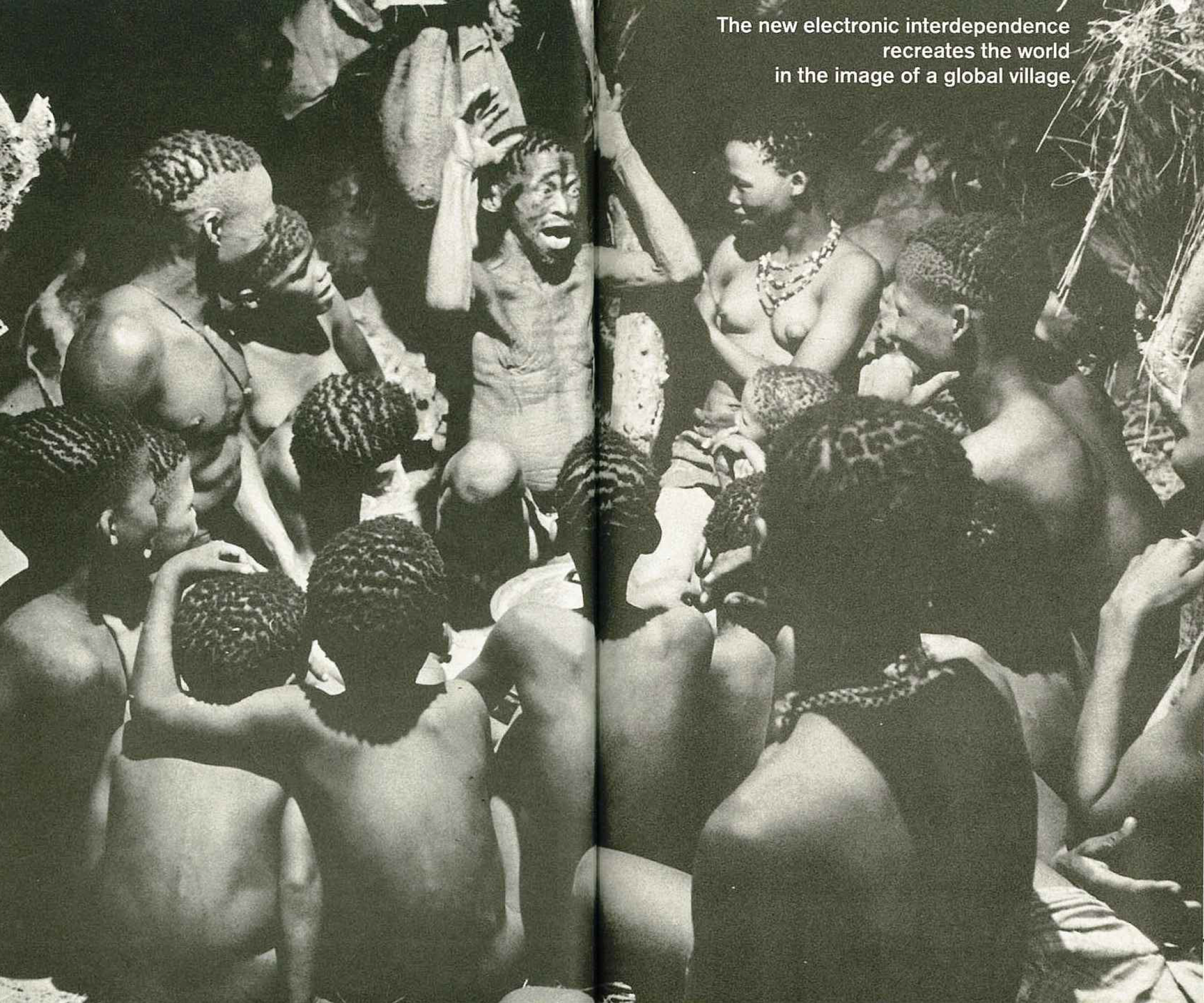
This isn't simply a matter of some examples or images that haven't aged well: claims about nonwestern people are essential to McLuhan's claims about media. Word-searching the Internet Archive copy of Understanding Media (1964) turns up 23 instances of "primitive" and 75 instances of "tribal." A search for the word "Africa" results in so many head-shakers it should come with a warning for neck injury. For instance, this gem:
Radio is the medium for frenzy, and it has been the major means of hotting up the tribal blood of Africa, India, and China, alike (1994 edition, page 310).
Seriously, what is dude even talking about?
The fact that we get weird takes like this instead of actual studies of oral cultures should be devastating to McLuhan's argument that print and electronic media radically reshaped the human sensorium and society. In fact, anthropologists and psychologists who have actually studied oral cultures have resoundingly refuted McLuhan and Ong's claims.
Great divide theory is kind of like an old Hollywood Western or African adventure film: the story is really about the travails and triumphs of the great, modern whites. The nonwestern others are just there as a contrasting backdrop. Honestly, I find it wild that marquee journalists and commentators constantly name-drop Understanding Media without addressing this glaring issue.
Reading beyond McLuhan:
Alexander G. Weheliye, Phonographies: Grooves in Sonic Afro-Modernity (2005).
I could have started with a lot of books here, but for my money, Weheliye is the perfect intervention. Like McLuhan, he takes seriously the material effects of audio technology. Unlike McLuhan, he examines how racialized people experience and utilize these effects differently. “Modernity cannot be conceived without blackness, and blackness cannot be understood outside of modernity,” he writes (3). Black people have dramatically shaped the modern use of audio technology, yet they have also been positioned as pre-modern the entire time.
Mark Dery, "Wired Man's Burden: The Incredible Whiteness of Being Digital" (2007).
If you think I'm hard on McLuhan, you've got to read this. Dery does a teardown of whiteness in McLuhan and his geek-culture acolytes at Wired magazine.
Reginold Royston, "Podcasts and new orality in the African mediascape" (2021).
This article by recent Phantom Power guest Royston acknowledges the importance of orality in African cultures and traces its manifestations in African podcast culture. Royston rejects the term "secondary orality" for the term "new orality" to better focus on "orality as a quality and mode of interaction" and not a "reversion to primitivity ('primary orality')." In fact, the African tech podcasters Royston studies are using the medium in part to challenge the kinds of western stereotypes McLuhan and Ong subscribed to.
When it comes to contemporary scholarship on media, the six readings I've offered above barely scratch the surface. For every sweeping claim of McLuhan, there are hundreds of studies that engage with the real cultural, political, economic, and affective dimensions of living in today's media environments. We owe respect to McLuhan as a media studies ancestor. He's worth reading and he's influenced my own work for the better. But he was a product of a specific moment, not a sage of eternal truths.
