Feed Logic and the Failure to Thrive

Two disquieting works of fiction I encountered this spring feature the same menacing figure: a young girl that refuses to eat. In Ben Lerner’s novel Transcription (2026), doctors inform a couple that their waifish, picky-eating daughter is, in fact, “failing to thrive,” suffering from ARFID (avoidant/restrictive food intake disorder). In Mary Bronstein’s film If I Had Legs I'd Kick You (2025), the child in question is so malnourished as to require a feeding tube, ported directly into her stomach.
Both works capture something few people warn you about parenthood: that your offspring will arrive as an unknowable, untamed, alien other. Both narratives center on parents who are desperately in love with an enigma. Desperate because the thinking and motives of this strange being are inscrutable, its actions beyond their control.
If I Had Legs is a claustrophobic meditation on a world never stops sucking the life out of its women, while also refusing the nourishment they offer and then blaming them for the rejection. The mother, played wrenchingly by Rose Byrne, careens between guilt, rage, and chemically assisted avoidance. In Transcription, ARFID is just one thought stream in a torrent of words evoking the multiplicity and estrangement of our digitalized lives. Instead of a feeding tube, a YouTube feed comes into play.
In both film and novel, the parents coddle, cajole, reason, and demand that the child eat—but you really can’t force a stranger to thrive, can you?

Students' failure to thrive
Bronstein and Lerner’s narratives were both ringing in my head as I staggered across the finish line of the dismal academic year 2025/26. You’re no doubt familiar with the political and financial pressures faced by universities today, as well as the way AI has turned humanities teaching into one long and disheartening Turing test. But what truly dismayed me this past year was the state of my newest students, the likes of whom I’ve never encountered in over a decade and a half of college teaching. They refuse to eat. They are failing to thrive.
Any midlife professor can tell you that students have gradually done less reading, attended fewer classes, and had more difficulty with critical thinking, but this year was just something else entirely. By my estimate, the majority of my students avoided reading. AI use appeared rampant on homework. Attendance cratered, even with clearly stated penalties in effect. Even eye contact was down. And grades (at least in my class, where I counteracted AI use with standardized tests) were way down.
Student apathy was a recurring topic in conversations with fellow faculty. They seemed to require more care from us (accommodations, help choosing classes, extended deadlines, repeated instructions, and replies to endless emails) and yet to care less about their own academic success. These were not the old Millennial try-hards, constantly asking for extra credit opportunities. Substantial numbers of them didn’t even complete their work.

I’ve generally been a “tough love” type of professor, but over the last year I found myself “meeting the students where they are,” as the saying goes. I removed assignments from my syllabi, as the expectations of the past no longer seemed realistic. I added more class time on basic methods in reading, note-taking, research, and writing. I cut back on lectures and created in-class writing periods so they could gain a little momentum and confidence on major assignments. And yet, I sensed none of this was addressing the real lack at hand. And as one colleague said to me, "No matter how much you lower the bar, they'll find a way to crawl under it."
Like the parents in Transcription and If I had Legs, we find that many of our students are indifferent to, or even repulsed by, what we've worked hard to put on the table. Like those fictional parents, many faculty have cycled through a range of responses: bafflement, worry, self-doubt, guilt, anger, sorrow, resignation. Most of us care deeply about our students. It feels awful to see them so lost. It's also easy to resent them for the rejection. We have coddled, cajoled, reasoned, and demanded—but you really can’t force a stranger to thrive, can you?
Fortunately, our students aren't as enigmatic and inscrutable as Lerner and Bronstein's tight-lipped girls. We can talk to them, ask them what's going on, get their theory of the case. In a future newsletter, I'll share some lessons I've learned from over a decade of having students study their own digital lives in a structured and intentional way. Today, I want to focus exclusively on the question of why many students are refusing to eat.
Starved by the endless feed
I agree with those who suggest that this bad year was, at least in part, a COVID-19 aftershock. College classrooms are now thick with kids who spent their formative adolescence in captivity, pawing a screen for pellets of digital distraction and affirmation. The crisis starved these young people of authentic opportunities for embodied social interaction, meaningful discourse, hard work, and spontaneous joy.
Instead, they got to live fully within the friction-free digital dream that Silicon Valley had been promoting for their entire their lives. But it turns out that all that extraneous friction is kind of important for human development.
Transcription has been called the first great American COVID novel. The global trauma of the virus and shutdowns plays a major role Lerner’s narrative about the thinness of reality in a time of digital enclosure and screens as life. When feeds everywhere but there’s not a byte of real sustenance, ARFID starts to make a certain kind of sense. After enduring a succession of experts and interventions, Lerner's afflicted family stumbles upon a solution: instead of eating with her parents, the girl cozies up with an iPad. As she watches one unboxing video after another, her food aversion begins to wane. Distracted by someone else’s performance of consumption, she finds her own appetite again.
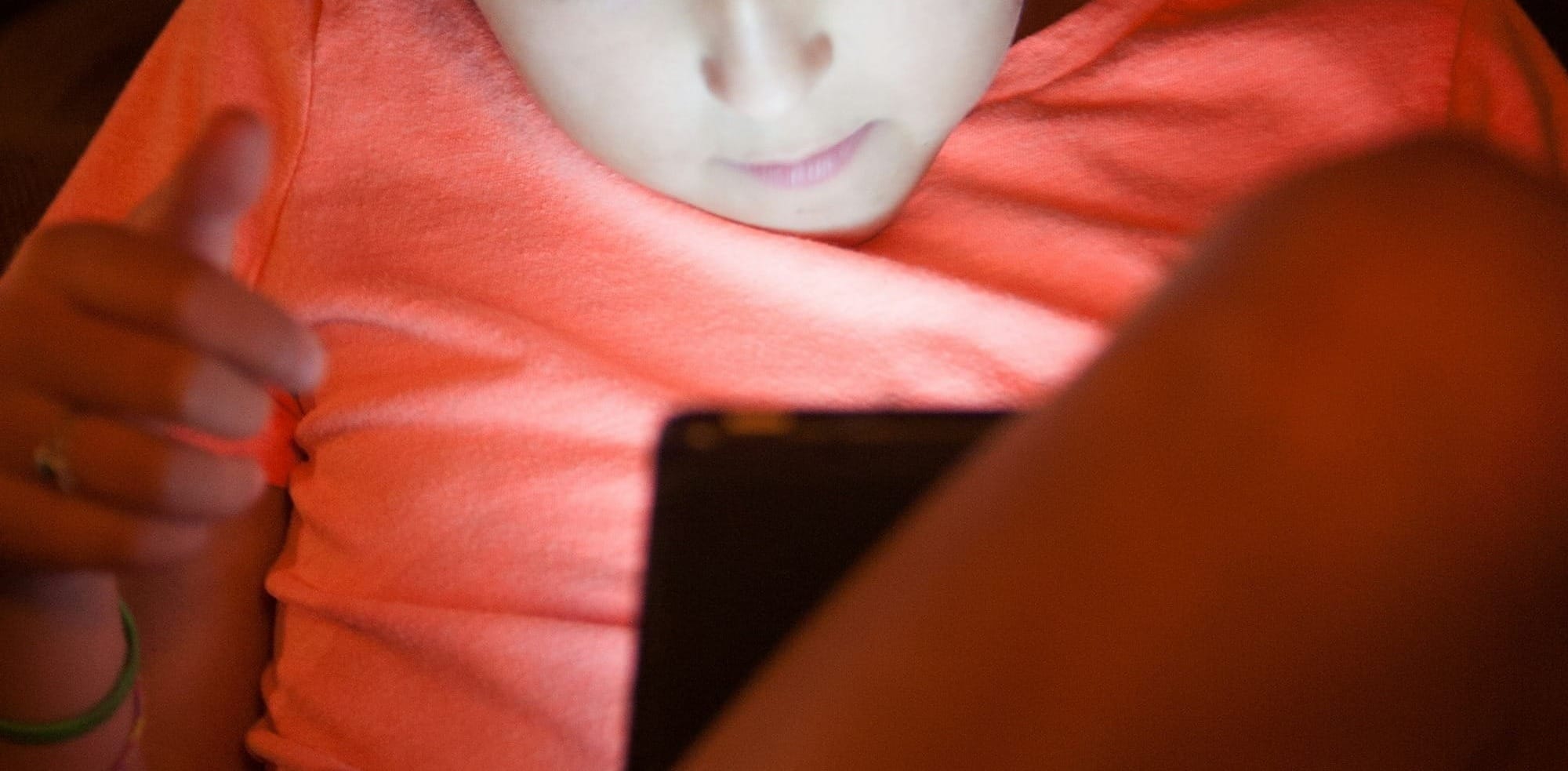
I've had the privilege of listening to two generations of young people as they came of age. I'm also a media scholar who has studied how our relationship to technology has changed over that time. This is what I've observed: Our society has systematically replaced nourishing experiences, processes, and relationships with digital facsimiles. The meaningful physical, temporal, and social differences that used to mark distinct times of day, types of experience, genres of art and craft, friend vs. stranger, work vs. play, and so on have all been distilled into a single, endless feed.
The feed encourages us to interface with the world instead of resonating with it.
No matter how wonderful any individual idea, sound, vision, or activity is, the fact that it has been turned into decontextualized "content" within an endless flow saps it of its rightful resonance in the world. Instead of sustenance, we get ultra processed communication, designed to keep us hungry and desperately pawing at the screen for something to satiate the hunger within. This is the contextless context of young people's days, in which we faculty are supposed to somehow construct some solid ground for education.
Feed logic's harms to education
Feed logic has trained today’s students to think of education as just one more type of content to consume. This creates five problems:
First, students are already overfull with empty calories, which spoils their appetite.
Second, because professors are experts in their fields and not dancing clowns, we immediately come off as inept content creators offering an inferior product.
Third, since learning is actually inversely proportional to the speed and ease with which one “consumes information,” the entire friction-free digital apparatus (including the "learning management systems" that form the backbone of education today) actively discourages learning.
Fourth, because white collar jobs have all been jacked into the digital blob, students sense that their best-case scenario is to spend the rest of their lives continuing to stare at a screen alone. Not much of a motivator.
Fifth, since work and thinking have been reduced to pixel pushing, students believe that native-born AI agents will soon be better than them at everything, threatening not only their ability to earn, but also their sense of meaning and purpose as human beings.
In other words, students’ refusal to eat is completely rational. Their anger and frustration—with faculty and with the system at large—may be somewhat incoherent, but it is justified. Given the system described above, is cheating a moral failing or a rational choice?
We can coddle, cajole, reason, and demand all we want, but what exactly are we trying to feed to our students today? The value of college is no longer self-evident. If we want students to put in the work, we first have to give them a clear explanation of what the work is for, then we need to create a space and a pedagogy that facilitates that sense of purpose.
Over the past year, I've been struggling hard to articulate precisely what nourishment I have to offer to students in today's world. It's a vulnerable feeling. The risk of losing face is high, because I haven't totally figured out the answer.
It would be safer to enact the pantomime that the system encourages, where I pretend to teach, students pretend to learn, everyone gets As, and my evals stay fine. But that's not what I became a professor for. So, in a upcoming newsletter, I'll pitch some of the ideas I'm playing with.
In the meantime, I'd love to hear your thoughts.
